State-News
States Vote Through Floodwater, a Cratered Highway, and a Tax on Billionaires
World & Security
A Learjet 60 flying from Austin to the Bahamas spent about 90 seconds going from a routine icing report to a crater in a Palm Beach County highway. Co-pilot Nathalia Gadelha Filgueiras, 20, told Miami controllers the ice was “manageable,” then declared a mayday, then an overspeed dive of 20,000 feet a minute, then that they were going to hit the ground. The jet plunged more than 27,000 feet in a minute and struck Military Trail nose-first, killing all nine aboard. On Tuesday, NTSB member Tom Chapman said the left elevator had been found in three pieces between 1.3 and 3.8 miles from the wreck — “important pieces of the aircraft separated before the impact,” in the dry language of people who spend their lives reconstructing bad days. Investigators still have to decide whether the breakup caused the dive or followed it, and whether a cockpit voice recorder is even still on the airplane. Rain has filled the crater; hundreds of mobile-home residents remain locked out while the puzzle is bagged for analysis, according to CNN’s account.
Florida’s east coast spent Election Day under water anyway. Palm Bay’s mayor said two people died — Joshua Bennett, 34, and Archie Richards, 78 — and crews pulled hundreds of residents from flooded streets after as much as two feet of rain in southern Brevard County. Governor Ron DeSantis declared a state of emergency in seven counties and signed an order relocating 23 polling places from Brevard through Palm Beach. Officials warned that water can take days to drain, which is the sort of civic slogan nobody puts on a bumper sticker. Southwest Colorado got a second round of flooding on the same weekend: piers on the Piedra River Bridge on US 160 collapsed, Wolf Creek Pass stayed closed, and the Colorado National Guard has rescued more than 50 people plus dogs and cats. Governor Jared Polis has already asked President Trump for a major disaster declaration, citing nearly $27 million in preliminary public infrastructure damage in Archuleta and Rio Grande counties — a figure that does not include Sunday’s rain or private property. Denver7 and NOTUS have the maps; voters in both states were told to check their polling place before they got in the car.
The rest of the security ledger was no quieter. New York recorded its first measles-associated child death in more than 30 years, in Lewis County, with 178 cases statewide as of October 24. A Yakima County dairy worker died of H5N1 after contact with infected cattle, Washington’s first bird-flu death of 2026; the CDC still rates public risk as low and pasteurized milk as safe. Florida health officials have confirmed 485 locally acquired dengue cases, the largest outbreak in years, with Tampa Bay dominating the latest weekly count. In Trenton, Governor Mikie Sherrill told port operators not to accept Russian diesel that President Trump licensed amid tight inventories, arguing the 2022 import ban still applies — on a day GasBuddy put election-day diesel at a record $6.28 a gallon. And one manhunt ended: Jacob Morley, a Tennessee lifer who cut through a prison fence nine days ago, was grabbed in Missouri after Flock cameras flagged his car, according to CNN. The cameras, as Minnesota is discovering, are a separate argument.
Markets & Economy
California voters spent Tuesday deciding whether the state should become the first in the country to tax billionaires’ wealth. Proposition 40 would levy a one-time 5 percent tax on residents whose net worth exceeds $1 billion, with most of the money earmarked to replace federal health-care cuts that SEIU United Healthcare Workers West puts at $100 billion over five years. Bernie Sanders has barnstormed for it; Governor Gavin Newsom has warned the rich will simply leave, taking their income-tax payments with them. The “no” campaign has raised roughly ten times as much as the “yes” side. A companion committee, Building a Better California, has hauled in more than $333 million — about 30 percent from Google co-founder Sergey Brin — for measures designed to nullify the tax even if it passes. Public Policy Institute of California polling flipped from 52–46 in favor in early September to 52–46 against in mid-October, which is either a crash course in television advertising or a reminder that Californians like the idea of billionaires until the billionaires start packing.
Texas, never shy about a customs loophole, handed Tesla a 14-month, limited-basis foreign-trade zone authorization for Megapack production at its Brookshire Megafactory in Houston-area Subzone 84AM, the Foreign-Trade Zones Board notice shows. The program lets manufacturers defer duties on imported parts and skip them entirely on goods exported from the zone; Washington, characteristically, did not estimate the savings. Down the coast, the Maritime Administration licensed ST LNG’s proposed $8.2 billion offshore port near Matagorda, designed for 8.4 million metric tons of annual capacity, 20 platforms, four floating storage units and 7.7 miles of pipeline, with construction eyed for 2027 and operations in 2029, ConstructConnect reported. Waaree Solar Americas, meanwhile, started commercial production on two new 800-megawatt module lines at the same Brookshire campus, doubling the plant to 3.2 gigawatts. U.S. operations now account for 43.8 percent of Waaree’s $7.05 billion order book, and Q2 FY27 U.S. manufacturing revenue hit $154.8 million, according to pv magazine USA. If you squint, Brookshire is becoming a battery-and-panel company town with a customs overlay.
New Jersey’s securities bureau quietly ended a three-year staking freeze, rescinding a 2023 cease-and-desist order and a $5 million penalty against Coinbase without ruling on whether staking is a security. Coinbase has put forgone New Jersey rewards at about $15 million; California, Maryland and Wisconsin still bar new staking, and the company says residents in the four restricted states have missed more than $130 million as of October 2025. The withdrawal is “without prejudice,” which is lawyer for “we can always come back,” as Bitcoin Magazine noted. Combine that with Sherrill’s diesel warning and you get a portrait of statehouses trying to run energy, crypto and ports on rules written for a different decade — while the price at the pump does the campaigning for them.
Technology & Industry
South Korea’s Maeil Business Newspaper reported that Samsung Electronics will use its second Taylor, Texas, foundry to make high-bandwidth-memory base dies for AMD and Nvidia on 2-nanometre technology, in a plant about 2.7 million square feet — roughly 1.5 times the first Tesla-contracted facility. Construction is due to start this month, equipment in February 2029, mass production in 2030; the paper said the plant has already booked its entire output, mostly for AMD. Samsung declined to comment, which is how chip stories often begin, as Reuters relayed. If the report holds, Central Texas is stacking a second HBM factory next to the first, which is either industrial policy working or a very expensive game of musical chairs among the same three customers.
Local governments are discovering that “yes” to a data center is not the same as “plug it in.” Hermantown, Minnesota, voted unanimously on October 30 to approve zoning, a development agreement and a decommissioning clause for Google’s more-than-200-acre campus outside Duluth — three buildings totaling about 1.66 to 1.7 million square feet — after Google cut a fourth building, capped heights at 33 feet, and dropped an $80 million tax-break ask. Projected property-tax revenue is about $3 million a year; projected power draw is up to 500 megawatts, which the Citizens Utility Board of Minnesota has compared to the combined residential demand of Minneapolis, St. Paul, Duluth and Rochester. Three lawsuits and a Minnesota Public Utilities Commission review of the Minnesota Power contract still sit in the way, Gadget Review notes. OpenAI, facing the same grid politics in Georgia, is testing a “Grid Protectors” demand-response program at a planned Effingham County campus, with a 3.2-gigawatt Georgia Power agreement that includes 1,000 megawatts of flexible load the company says it can shed on the hottest days, according to Tom’s Hardware. It is the 1970s steel-mill trick, now with GPUs.
Minnesota police, meanwhile, are hiding the map. A KSTP review of state data found 61 Flock automated license-plate cameras now listed as “location withheld,” including all 34 of Edina’s units, after agencies invoked a security exception meant for real threats. Crow Wing County’s sheriff said vandals cut wires on $3,000 cameras that taxpayers replace. Privacy groups call it a loophole; lawmakers left the statute untouched last session. The same camera network helped Missouri troopers find Jacob Morley. That is the argument in miniature: a tool that catches an escaped murderer and, depending on who is holding the login, also looks up a state representative’s plate. 5 Investigates has the withheld entries; the next Legislature is expected to get the bill.
Politics & Policy
It is Election Day, and Texas is behaving as if it had not received the memo that it is a red state. More than 7.7 million Texans voted early, a modern midterm record. Democrats have forced Republicans to compete not only for the U.S. Senate — James Talarico against Attorney General Ken Paxton, a seat no Democrat has won since 1988 — but for lieutenant governor, railroad commissioner and a governor’s race in which Gina Hinojosa has pulled even enough with Greg Abbott to make the incumbent spend. Talarico raised more than $146 million; a Republican rescue operation financed primarily by Elon Musk put more than $280 million of ads in the air. Abbott has outspent Hinojosa eight-to-one. GOP data still showed Democrats with a 26,000-vote early-vote edge after a period that used to belong to Republicans by hundreds of thousands. Rural anger over data centers, power lines and those Flock cameras is the subplot nobody in Austin ordered, the Texas Tribune reports. Whether it survives contact with Election Day is the only poll that counts.
Michigan’s Senate race is the other national hinge. Progressive Abdul El-Sayed, who would be the first Muslim senator, is testing whether universal health care and campus turnout can win a state Donald Trump carried in 2024; Republican Mike Rogers, who lost here by fewer than 20,000 votes two years ago, is trying again without Trump at the top of the ticket. No Republican has won a Michigan Senate race since 1994. Advertising since the August 4 primary has topped $100 million. The scar tissue from El-Sayed’s primary against Rep. Haley Stevens — including AIPAC’s nearly $30 million, its largest single-race outlay — burst into the open when Stevens endorsed Rogers in the final days, an Associated Press dispatch that Democratic consultants will be citing into the next decade, whichever way tonight goes. Democrats need four Senate pickups for a majority. Losing Michigan would make the math unkind.
The Supreme Court, which does not adjourn for polling, spent Monday refusing the Trump administration’s bid to stop California from counting ballots the Justice Department says were cast by noncitizens — denied in hours, no noted dissents, SCOTUSblog recorded. On Tuesday the justices heard St. Mary Catholic Parish v. Roy, Colorado’s requirement that state-funded preschools admit children of LGBTQ parents. The conservative majority sounded ready to let Catholic programs opt out; Justice Elena Kagan warned the court would then be refereeing “substantial burden” claims forever. Colorado has now lost three recent religion cases at this Court. In Alaska, the Justice Department sent target letters — including to Democratic election lawyer Marc Elias — in a criminal probe of a second “Dan Sullivan” on the Senate ballot. More than 100 subpoenas are out; a federal judge in Anchorage already dismissed the administration’s attempt to halt certification of a Mary Peltola win. Elias called it a sham timed to Election Day. Attorney General Todd Blanche said a man is running only to confuse voters. WTOP’s AP copy is the most complete account, and it still cannot say what crime, if any, a grand jury will be asked to name.
Human Stories / Social Trends
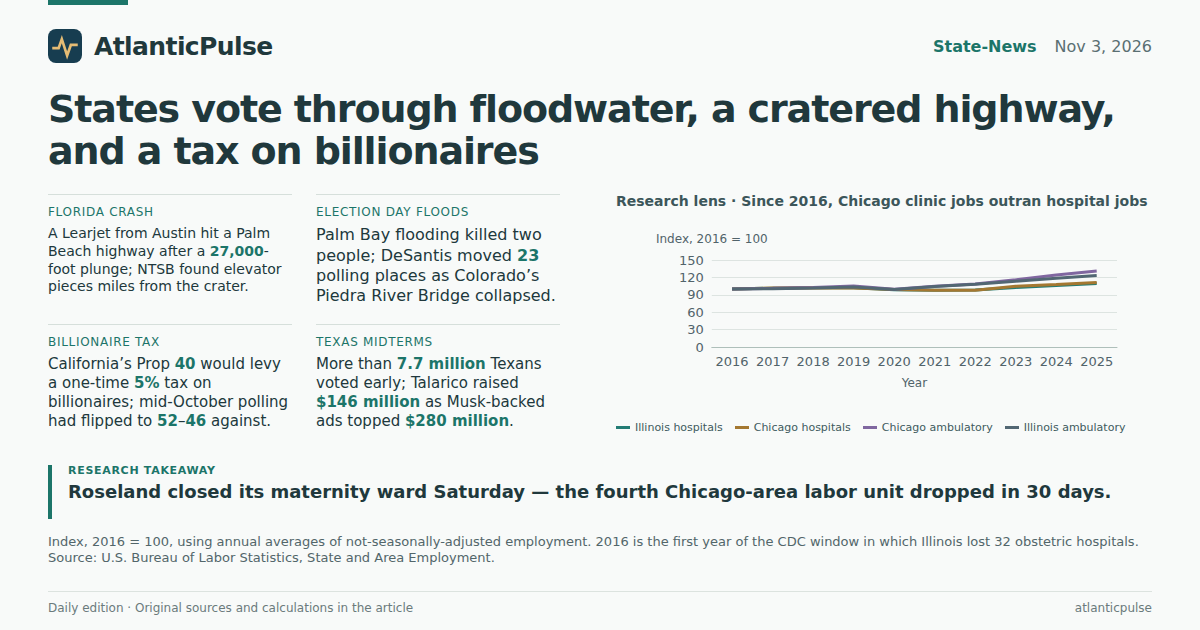
The measles death in Lewis County is a statistic until you remember it is a child. New York health officials, four weeks after Governor Kathy Hochul’s disaster emergency, said vaccination is still the best protection and that one MMR dose is 93 percent effective, two doses 97 percent. They will not name the family. The outbreak’s 178 cases as of October 24 are concentrated upstate; New York City has eight. Infants as young as six months are being offered an early dose if they live in a transmission community. The joint state-and-county statement is mostly a vaccination pamphlet written in the past tense. In Chicago, the pamphlet is about obstetrics. Roseland Community Hospital closed its maternity ward on Saturday, the fourth Chicago-area hospital to suspend labor and delivery in 30 days. Illinois lost 32 obstetric hospitals between 2016 and 2023, CDC figures cited by WTTW show. Black women in the state are more than twice as likely as White women to die of any pregnancy-related condition; a 2025 Illinois Department of Public Health report found 91 percent of those deaths potentially preventable. The nearest full maternal-care hospital to Roseland is more than four miles away, and it is scheduled to close obstetrics in 2027. Dr. Joy West compared it to removing a fire station from a neighborhood that already has fires.
A 17-year-old Utah girl missing since May 2025 was found Sunday in Huntington, Oregon. FBI agents and Oregon State Police took her from a house on East Fulton Street; Adam Hunter Harmel, 39, was arrested later that day in Ontario and charged federally with transporting her across state lines with intent to engage in criminal sexual activity. The FBI said the investigation had run more than a year across the United States and other countries. Huntington’s mayor said the town had no warning of the operation and was “very pleased that this child is returning to her parents.” The Baker City Herald has the charging details; the girl is not being named. It is the rare missing-child story that ends with a living teenager and a jail booking, which is not the same as a happy ending, only a better one than the alternative.
Elsewhere, the ordinary risks of American weekends turned lethal or merely astonishing. Rachel Apa, 24, of Lewisburg, Pennsylvania, collapsed near the 24-mile mark of her first New York City Marathon, running for a Parkinson’s team in honor of her grandfather. Spectators started CPR; she was pronounced dead at Mount Sinai that night. The medical examiner’s first autopsy was inconclusive; her father told the Times he believed she died of rhabdomyolysis. “Perfect health, perfect shape, 24 years old,” he said, in the Daily News account. Off California, an 86-year-old man and his dog were lifted from the disabled sailboat Willow Wind about 460 miles from San Diego after two months of radio silence on a voyage from Astoria, Oregon, toward American Samoa. A merchant ship reached them in rough seas; a Coast Guard helicopter finished the trip to Scripps Mercy in San Diego. The boat, sails damaged, was left to drift. The Coast Guard, with the timing of people who have given this speech before, recommended a float plan. On a day when states were counting ballots, it was a reminder that some rescues still depend on a beacon, a cutter, and someone on shore who noticed the silence.
This daily edition uses stored reporting scoped by publication date, or arrival when publication was absent. Source collection can lag publication.