State-News
Craters, rivers and rifts: the states on the eve of a midterm
World & Security
Atlanta hosted the world’s diplomats this weekend and still could not produce a group photo, which is one way of measuring the temperature. G20 foreign ministers wrapped two days of talks without a joint communiqué, settling instead for a chairman’s statement from Secretary of State Marco Rubio that listed priorities — energy, food, navigation — and named no agreements. European diplomats had objected to sharing a snapshot with Russia’s Sergey Lavrov; Poland’s Radosław Sikorski, a first-time G20 guest, said wars at the table make a common line hard. Rubio was frank that a negotiated peace in Ukraine is not obviously within reach, even as the State Department approved a proposed $2.1 billion Patriot interceptor sale. The December leaders’ summit is still scheduled for Florida. Whether Vladimir Putin accepts an invitation to a Miami golf club is, for now, another unsolved security question.
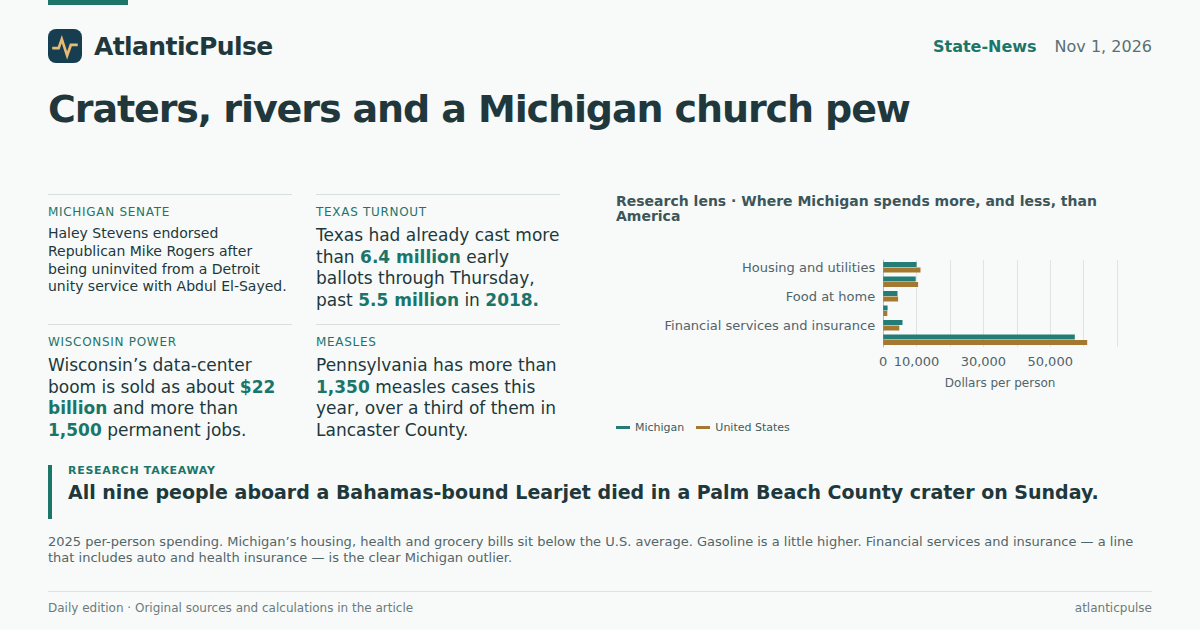
A more immediate crater opened in Palm Beach County. A Learjet 60 that left Austin for the Bahamas nosedived into Greenacres around 12:50 p.m. Sunday, killing all nine people aboard. Transportation Secretary Sean Duffy called it a horrific tragedy; Governor Ron DeSantis, at the scene, said it looked like a missile going down. Pilots had reported icing and turbulence, then an overspeed descent of 20,000 feet per minute, then a last radio call that they were going to crash into the ground. The fireball appeared to miss homes and passing cars by feet and inches. About 600 people were evacuated from a nearby mobile-home park while the NTSB and FAA began their work. Rain was still falling. A flood watch ran through Monday.
The same weather system was not a curiosity in the Southwest. Officials in Pagosa Springs, Colorado, warned of potentially catastrophic flooding as the San Juan River was forecast to crest above 19 feet — higher than the 17.8-foot mark of the 1911 flood that wiped out most of the town. Sedona ordered people near Oak Creek to leave at once; some were already trapped. A Tucson meteorologist put it without poetry: two or three months of rain in a couple of days. Overnight, a different kind of American insecurity played out after Halloween. Dallas police counted four dead and 15 injured in three Deep Ellum shootings between midnight and 1:30 a.m., with no public finding yet that the scenes were connected. Outside Birmingham’s Legion Field, after the Magic City Classic drew nearly 70,000 fans, one person was killed and eight wounded. In Fairfield, California, families shopping for costumes heard what one shopper’s wife thought were five shots inside a Spirit Halloween; one person died and six were wounded.
Markets & Economy
Seattle’s hometown carrier is discovering that passenger demand is a wonderful thing until the fuel bill arrives. Alaska Air Group, still digesting Hawaiian Airlines, warned employees it could lose as much as $700 million pre-tax this year if current conditions persist — the first such adjusted loss outside the pandemic since 2003, CEO Ben Minicucci said. Fuel is now expected to run $1.8 billion above the original 2026 plan; fourth-quarter economic fuel is penciled at $4.65 to $4.85 a gallon. The company is cutting about 200 non-contract jobs, including 125 in Washington and 48 in Hawaii, while shielding pilots and airport crews. Third-quarter revenue still rose 14 percent to $4.3 billion. The GAAP net loss was $147 million. Liquidity at the end of September was $3.3 billion, which is comfort of a sort, and the Paris and Athens routes are still on the spring 2027 board. Growing the top line while the wing tanks empty is an old airline trick. It is getting harder.
Wisconsin, meanwhile, is discovering what it costs to host other people’s computers. Milwaukee 7 puts about $22 billion of investment across Microsoft’s Mount Pleasant campus and the Vantage-Oracle-OpenAI project in Port Washington, with more than 1,500 permanent jobs expected once the cranes leave. A draft Public Service Commission report, as reported by Wisconsin Public Radio, projects electricity demand up 40 percent by 2032, with 72 percent of peak-load growth tied to three data-center developments. At least 24 communities had moratoriums by July. An August Marquette Law School Poll found 67 percent of residents want to ban new data-center development for at least a year. Construction added 10,500 jobs statewide in the year to August 2026 — half of all non-farm gains — which is a boom with a known expiration date. The PSC’s preliminary idea is that campuses should pay for the generation built to serve them. Preliminary, as every ratepayer advocate will tell you, is not a bill.
Elsewhere the ledger is mixed in the usual American way. Hyundai is putting another $500 million into Montgomery, Alabama, bringing its investment there since 2005 to $2.2 billion, to support a new Tucson, a refreshed Santa Fe and extended-range electric propulsion. Gavin Newsom, before leaving office in January 2027, signed a law setting a $19.75 hourly minimum for H-2A farmworkers and local employees doing the same jobs, with Social Security cost-of-living adjustments thereafter. Growers say fuel and fertilizer are already high; one Central Valley employer warned that higher wages would mean fewer hours. A SmartAsset study, using MIT living-wage data, found a single adult now needs at least $80,000 to live “comfortably” in every state and more than $100,000 in nearly half of them. Florida’s Suncoast listeners were invited to compare notes on insurance, rent and groceries. Six figures, it turns out, no longer buys the old bragging rights.
Technology & Industry
Tesla is about to test whether Austin was a hometown courtesy or a product. The company said unsupervised, steering-wheel-free Cybercab rides would open to the public in Dallas in November, after Austin service began on Sept. 3 and the local fleet, by one tracker, passed 300 vehicles. Nevada has already approved up to 5,000 robotaxis in Clark County over 12 months — a ceiling, a Tesla engineer said, not a forecast; 2,500 in a year would make the team “extremely happy.” The bull case still hangs on a $0.30-per-mile operating-cost target that has not been shown in service. Austin riders pay a $3.25 base fare plus $1.00 a mile. NHTSA opened an audit query the day Austin rides began, asking about self-certification for a vehicle with no manual controls. Dallas will not settle that argument. It will only make it louder.
California, which has been promising a fast train since some of this year’s voters were in middle school, at least now has a contract for actual rolling stock. On Oct. 28 the High-Speed Rail Authority board approved three Siemens trainsets rated at 220 mph for $281.7 million, plus hundreds of millions more for parts, maintenance and provisional sums, with options for up to 19 further sets. Each seven-car train is to seat at least 450 people, with power and USB-C at every seat — the small dignities of a long ride. Testing on the authority’s own track is slated from spring 2030; the trainset timeline shows revenue service in the third quarter of 2032, while trade coverage still says 2033. The same meeting cleared the Los Angeles-to-Anaheim environmental document, completing Phase 1’s paper route. More than 90 miles of Central Valley guideway are finished. The seats, as ever, are the easy part.
Two other state experiments sit at opposite ends of the technology mood. San Bernardino County, the largest in the country by land area, is buying five autonomous Seneca firefighting drones and a mobile operations base, able to put more than 500 gallons of foam on a start and, officials hope, to reach new fires in under 10 minutes, including at night. Fire Chief Dan Munsey wants to stop 90 percent of fires before they grow larger than 10 square feet; the aircraft are expected in service ahead of the 2027 season. In Utah, the argument is not about foam but about who may take a bet. Attorney General Derek Brown filed felony charges against prediction market Kalshi and co-founders Tarek Mansour and Luana Lopes Lara, after an investigator placed real sports bets from a Utah IP address. Kalshi calls it a crazy overreach and says the Commodity Futures Trading Commission already regulates the contracts. Utah is the first state to put named executives in criminal rather than merely civil crosshairs. That is a different kind of weather.
Politics & Policy
Michigan’s Democratic family argument spilled into the nave. Rep. Haley Stevens, who lost a bitter August Senate primary to Abdul El-Sayed, endorsed Republican Mike Rogers on Sunday after sitting with him at Perfecting Church in Detroit — hours after she had been asked to skip a unity service with El-Sayed, Jim Clyburn and other Democrats. “Our Democratic nominee for Senate said I was no longer welcome in his campaign,” she said in a video. “And he’s right.” El-Sayed told reporters he does not think about Haley Stevens. State party chair Curtis Hertel said she had abandoned everything she claims to care about and, later, that she is not a member of the Michigan Democratic Party and will not be. Chuck Schumer called it a despicable betrayal. Donald Trump called it bravery. More than 1.8 million Michiganders had already voted as of Friday. The remaining argument is whether a church pew two days out can move any of them.
In Juneau, a federal judge declined to let the Justice Department put Alaska’s Senate count on ice. U.S. District Judge Sharon Gleason dismissed a suit that sought to block certification if incumbent Republican Dan Sullivan loses to Democrat Mary Peltola, finding the requested “investigation” of ballots cast for a little-known candidate also named Dan Sullivan infeasible and incompatible with voter secrecy. The other Dan Sullivan took about 2.5 percent in the ranked-choice primary — enough to reach the general election ballot. The department said it would appeal. Peltola’s campaign called the case a sham; the senator told CNN he expected to “lose a lot of votes to that trickery.” Gleason, an Obama appointee, also cited the states’ constitutional role in running elections and the Supreme Court’s reluctance to change rules close to a vote. The ballots, many of them already in, will be counted as Alaska counts them.
California’s governor is writing letters in a similar key. Gavin Newsom warned federal judges he fears Justice Department agents will seek warrants to seize ballots before certification, after an appeals court on Friday rejected an administration demand for state records in a noncitizen-voting inquiry. The administration has alleged more than 20,000 noncitizens are registered in California; the state calls the data suspect, and the department has not said how many of those people have actually voted. Texas, less interested in theory, is already breaking records: more than 6.4 million ballots through Thursday, past the 5.5 million early in-person votes of 2018, with a Senate race between Ken Paxton and James Talarico that AdImpact puts above $560 million. Fox News moved Kansas to a toss-up and still calls Senate control a toss-up. In Washington, Sen. Chris Murphy of Connecticut, 53 and not on Tuesday’s ballot, was hospitalized after a stroke at his son’s hockey game. His office said he is awake, alert and, doctors hope, on the way to a full recovery. Even the calendar, this weekend, refused to wait.
Human Stories / Social Trends
Sunday in New York was the other American spectacle: more than 60,000 people running 26.2 miles through all five boroughs, from Fort Wadsworth over the Verrazzano and, eventually, into Central Park. Tracy Morgan was among the faces along the course. A few hours’ flying time west, four volunteers walked out of a windowless, 3D-printed habitat on a NASA site in Texas after 378 days of pretending the planet next door was home. Ross Elder, Matthew Montgomery, James Spicer and Ellen Ellis grew plants, repaired things, exercised, and waited 22 minutes to send a text. Spicer said he was excited to see the sun — or, depending on the forecast, a hard rain. The next analog mission is planned for 2027. After a year without weather, even a flood watch has a certain glamour.
In Lancaster County, Pennsylvania, the weather that matters is measles. The state has more than 1,350 cases this year, over a third of them in the county that holds the nation’s largest Amish population, and five measles-associated deaths, three of them in Lancaster. Community leaders say the official count is low because many of the sick never see a doctor. National kindergarten MMR coverage has slipped to 92.4 percent from 95.2 percent in 2019-20; Lancaster County’s rate is 88 percent. Some Plain families are newly willing to take the shot — Union Community Care has given about 450 measles vaccinations through small clinics — while others, like farmer Ephraim Zook, still call the illness natural after nursing twins through it. An Old Order Mennonite who has spent a career in a parochial medical center put the trust problem in a single number: about twenty years.
Far from the ads that make every local race sound like Washington, Drummond Island is trying to vote as if township millages still count. The island, off Michigan’s Upper Peninsula, has 1,116 registered voters, one precinct, and no early-voting site; that is a 50-mile one-way trip plus a ferry. Turnout usually beats the state: 74 percent in 2024, 63 percent in the last midterm. Supervisor Krystal Truax and a newcomer named Bob Chunn are knocking on doors and arranging rides, telling neighbors who hate national politics to skip the top of the ballot if they must and still vote for the schools. Resident Tom Salwoski, who had stayed home because everything felt national, said local races finally made sense. History says two in five Michiganders will sit this one out. An island with a limestone shore is betting that a school millage, explained patiently, is still a reason to get on the boat.
This daily edition uses stored reporting scoped by publication date, or arrival when publication was absent. Source collection can lag publication.