State-News
Fire, flies and a $560 million Senate race close out October
World & Security
A fire at South Carolina’s Savannah River National Laboratory produced the sort of Wednesday night that makes emergency managers reach for two phones. Officials declared an emergency at 5:39 p.m. at the Energy Department site near Aiken that still produces tritium for U.S. nuclear weapons, briefly shutting gates and restricting rail, river and air traffic. The blaze was extinguished and the emergency lifted by 9:45 p.m.; officials reported no contamination outside the lab, and the department said Thursday that no radiological material was released. More than 13,000 people work on the Cold War-era reservation, now cleared for a plutonium-pit plant expected to cost roughly $23.5 billion. Watchdogs at the Union of Concerned Scientists asked why airspace closed if the risk was so tidy, and Savannah River Site Watch wants fire protection reviewed before pit production ramps up.
Minnesota offered a quieter mystery. A farmer combining corn in Scott Township found an 11-foot bowl-shaped object on October 14 that may have sat among the stalks for about six weeks; the State Department said it was secured and posed no danger. Experts linked it to the upper stage of a Zhuque-2E rocket that China’s LandSpace launched September 15 with ten Qianfan broadband satellites, a Starlink rival, though the company has not claimed the hardware. Along the border, Arizona confirmed its first New World screwworm case in a Cochise County ranch dog as New Mexico and Texas each counted six active infestations. Officials say no human cases have been acquired in the United States. In Virginia, defense-contractor employee John Allen Kurrle Jr., 62, who held a top-secret clearance, pleaded guilty to conspiracy to commit wire fraud after letting foreign workers use U.S. identities for remote jobs that produced nine offers. He faces up to 20 years. Prosecutors described North Korea’s IT-worker sanctions-evasion model but did not identify the foreigners in his case as North Korean.
Markets & Economy
The Maritime Administration approved an $8.2 billion deepwater LNG port for ST LNG, 10.4 miles off Matagorda, Texas—the Trump administration’s third such license—pitching 2,000 construction jobs, up to 855 permanent posts and a 7 to 9 percent lift in U.S. export capacity from four 2.1-million-tonne trains, with construction eyed for 2027 and operations in 2029. First Solar opened the first phase of a $330 million module plant in Gaffney, South Carolina, aiming to grow from 1.7 to 3.4 gigawatts by mid-2027, with 500 jobs filled and nearly 200 more planned. Hyundai pledged about $450 million more at its Montgomery, Alabama, plant—part of a $26 billion U.S. plan through 2028—to build Tucson hybrids locally and add Santa Fe extended-range electrics. Honeywell Aerospace plans a $500 million Tempe, Arizona, factory due late 2028, with about 600 jobs over time. The industrial map, in other words, is still being drawn in steel and gas, not just software.
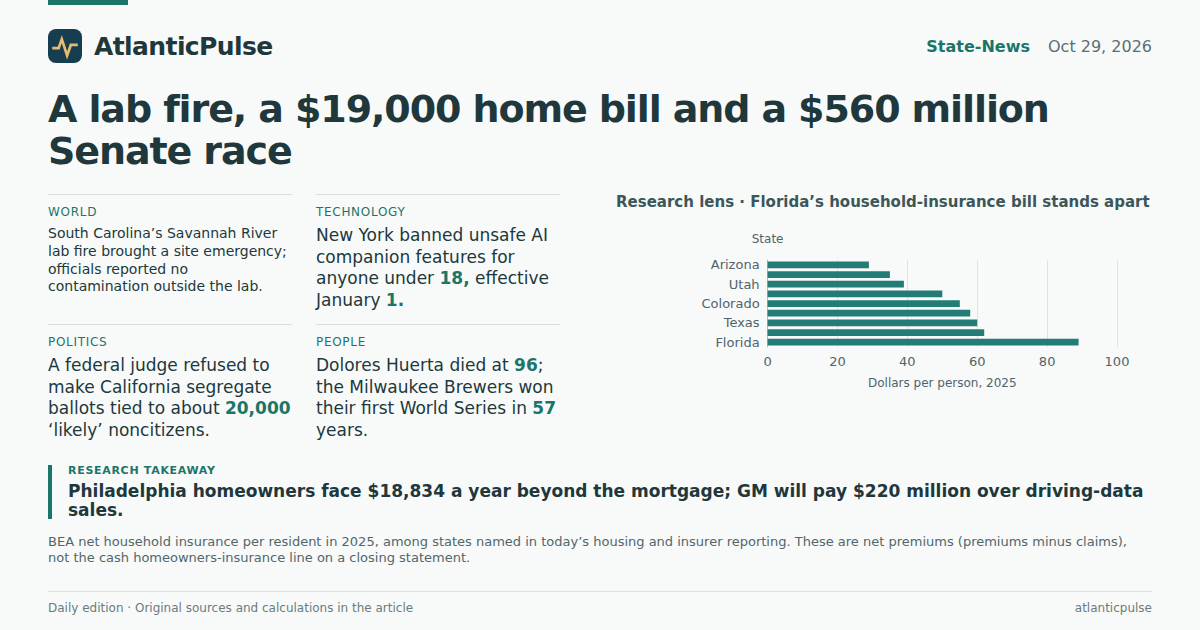
Households got the other ledger. A 36-state coalition said General Motors will pay $220 million over allegations it sold Smart Driver data—trips, braking, speeding—to brokers who resold it to insurers, affecting more than 10.28 million Americans. Connecticut, where 123,143 residents were swept in, is due more than $6 million. GM says it ended the program in 2024; the OnStar app had mistakenly told more than 370,000 drivers they were not enrolled. In metro Philadelphia, Zillow and Thumbtack put annual maintenance, tax and insurance costs at $18,834, up 31.7 percent in five years, or about $1,570 a month beyond the mortgage and $2,268 above the national estimate. Insurance is the national villain, up 54 percent over five years. The keys, it turns out, were the cheap part.
Technology & Industry
New York’s Kathy Hochul, mid-reelection, signed a law effective January 1 that bans a dozen “unsafe AI companion features” when chatbots talk to anyone under 18—no pretending to be a real person with feelings, no flattery, no sexually explicit material, no nudging secrecy. The attorney general can sue for damages, shutdowns and data destruction. Common Sense Media called it the country’s strongest kids’ AI safety bill; California required child-risk audits in September, and eight states sued OpenAI this month. Washington remains a reluctant chaperone. Florida, meanwhile, said a breach of its student-aid portal, noticed October 19, may have exposed Social Security numbers and other personal data for about 4.9 million people. Bright Futures grants were not interrupted, officials said, though the site still appeared down—the least charming way to learn that “portal” is not a metaphor.
California’s high-speed rail chief, Ian Choudri, resigned immediately after two turbulent years, citing family priorities. The board named Finance director Joe Stephenshaw as successor. Under Choudri the authority lost $4 billion in federal money after missing train-purchase deadlines, and investigators found consultants billed nearly $600,000 in questionable travel—first class, a nightclub, a cigar lounge. Voters approved $10 billion in 2008 for a $45 billion San Francisco–Los Angeles line by 2020; the latest plan puts a full buildout between $126 billion and $231 billion, with the 171-mile Merced–Bakersfield segment still under construction. The inspector general has warned cash could run out by December 2027. The board still approved a $772.1 million Siemens contract for three seven-car trainsets by 2030. Accountability, meet a German invoice. Centrus Energy, less glamorously, began shipping a new uranium-enrichment centrifuge from Tennessee to Ohio toward 2029 capacity.
Politics & Policy
U.S. District Judge David Carter denied the Justice Department’s emergency bid to make California segregate ballots tied to about 20,000 people federal officials call “likely” noncitizens. In a 26-page order he wrote that never before had the federal government, on the eve of an election, sought to coerce a state to abandon its procedures. Los Angeles County’s preliminary look found many on the list lacked active registrations. “Once a vote is segregated, lasting harm has occurred,” Carter wrote. The department, which sued October 15, is expected to appeal. Audits have found noncitizen voting extremely rare; the list’s accuracy remains contested.
In Alaska, Republican Governor Mike Dunleavy ordered an investigation of Democrat Mary Peltola’s Senate campaign after a New York Times report that her team helped recruit candidates to siphon votes from Republican Sen. Dan S. Sullivan—including Daniel J. Sullivan Jr., a retired Petersburg teacher whose ballot spot the state Supreme Court already upheld. Peltola’s campaign said it has no involvement with either Sullivan effort; she called the story a distraction. President Trump demanded prosecution. The Justice Department has already sued to block certification if the incumbent loses because of the similar name. Both parties have played ballot-stacking games in Alaska before, which is rather like complaining about the weather after seeding the clouds.
Utah filed felony charges against prediction-market firm Kalshi and co-founders Tarek Mansour and Luana Lopes Lara—13 counts of violating the state’s gambling ban plus profiting from illegal activity—after Kalshi kept operating despite a federal judge’s ruling that Utah law applies. Attorney General Derek Brown said calling it a prediction market does not change what it is. Kalshi called the case a “crazy overreach.” The Commodity Futures Trading Commission has sued at least ten states, including Utah this week. In Texas, AdImpact puts Senate spending past $560 million, the most expensive U.S. race on record, with Elon Musk’s network pouring in at least $168 million against Democrat James Talarico as Attorney General Ken Paxton, who crushed John Cornyn in a runoff, tries to hold a seat that has become a national ATM.
Human Stories / Social Trends
Dolores Huerta, co-founder of the United Farm Workers, died at 96, her family said Wednesday. Born in 1930 in Dawson, New Mexico, and raised in Stockton, California, she helped lead the Delano grape strike, negotiated early health and benefit plans for farmworkers, and coined the slogan Barack Obama later borrowed in English as “Yes, we can.” She received the Presidential Medal of Freedom and kept marching into her nineties. California Sen. Maria Elena Durazo recalled her dancing at a foundation fundraiser a few months ago. In the Collegiate Peaks, searchers found Colorado Mountain College students Kaden Matsuda, 19, and Jackson Donlon, 20, on Wednesday in a basin of West Apostle Mountain. They had left Leadville on October 23 for Ice Mountain; a collapsed tent turned up near Lake Ann under one to two feet of snow. No foul play is suspected. Sheriff Andy Rohrich said the team was proud to have found them before another weekend storm.
And in St. Petersburg, the Milwaukee Brewers finished a 4-1 World Series over the Tampa Bay Rays, winning Game 5 by the same 4-1 score for the franchise’s first title in 57 years—44 years after Harvey’s Wallbangers came up short. Jacob Misiorowski threw 5 2/3 scoreless innings; 22-year-old Cooper Pratt, in the majors since June, ran a Series-rookie record of six straight hits. The Brewers led the majors with 103 regular-season wins and went 11-2 in October, a bottom-half payroll club in a sport whose owners are already talking lockout. For one night, nobody in Wisconsin was arguing about that.
This daily edition uses stored reporting scoped by publication date, or arrival when publication was absent. Source collection can lag publication.