State-News
A week from the midterms, states juggle floods, fences and fine print
World & Security
Secretary of State Marco Rubio is due in Atlanta on October 30 and 31 to host a G20 foreign ministers’ meeting, which is about as close as Georgia gets to a summit without putting the Peach Bowl in the communiqué. The more consequential hardware news came from farther west: the United States will send USS Colorado, a Virginia-class attack submarine commissioned in 2018, to join Submarine Rotational Force-West at HMAS Stirling in Western Australia from late 2027. War Secretary Pete Hegseth, Australian Deputy Prime Minister Richard Marles and UK Defence Secretary Wes Streeting billed it as the first U.S. nuclear-powered boat in that rotation — up to four American Virginia-class submarines and one British Astute-class, under existing force-posture arrangements rather than a permanent foreign base. AUKUS still carries a Trump-era review and Australia’s A$368 billion (US$240 billion) three-decade commitment.
Closer to the Rio Grande, the federal government is considering rerouting 2.8 miles of border wall through Santa Ana National Wildlife Refuge after contractors were accused of trespassing on Hidalgo County Irrigation District land. A Justice Department lawyer told a federal judge the government might “move it through the wildlife refuge,” which he conceded “will probably just create additional litigation.” Congress blocked wall money there in 2019; CBP has used Trump’s One Big Beautiful Bill to work around those limits. Florida officials, meanwhile, added racketeering charges after a three-year probe they say dismantled a Sinaloa cartel pipeline into Tampa Bay — 60 kilograms seized from Daniel Pinales, more than 500 kilograms alleged on Pinellas streets, and dummy truck tractors rolling from El Paso.
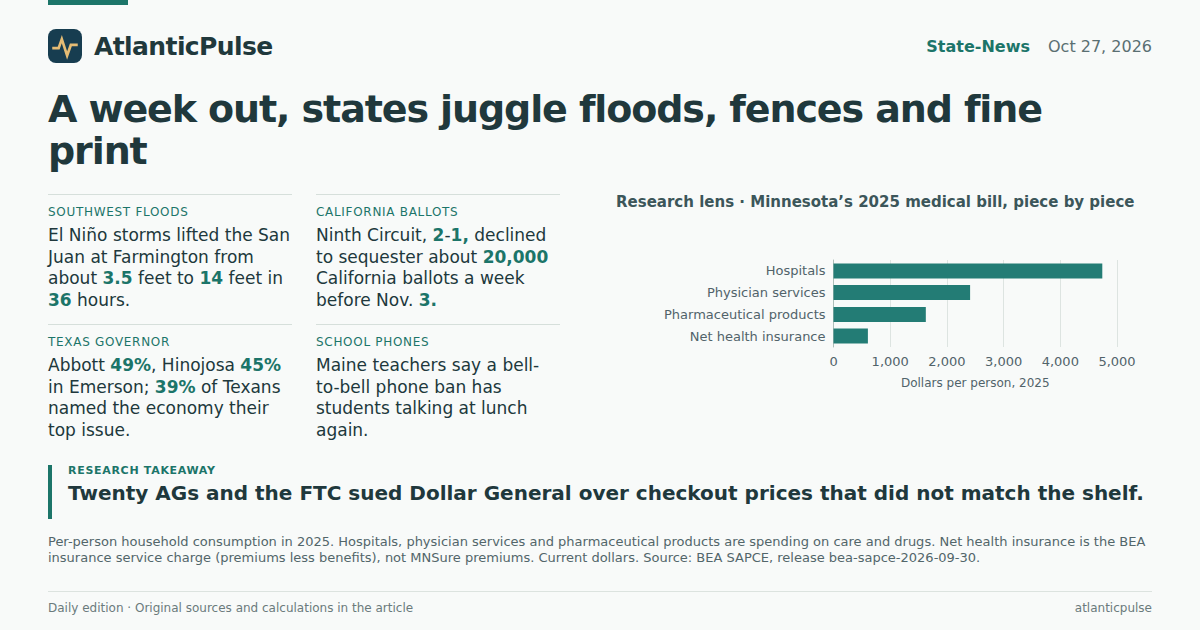
The Southwest’s other emergency is water. El Niño-fueled storms sent the San Juan River through Farmington, New Mexico, from about 3.5 feet to 14 feet in 36 hours. San Juan County crews, the National Guard and out-of-state teams pulled 200 to 300 people from washes and rooftops. Governor Michelle Lujan Grisham put infrastructure damage at $200 million to $300 million; Washington partially granted an emergency declaration and Santa Fe added $8.25 million. In Tennessee, Jacob Morley, 28, slipped a Northwest Correctional Complex fence on October 25, stole a 2008 Ford F-350 and became the second inmate to leave state custody in a week. The TBI put him on its Most Wanted list with a $2,500 reward — which, as manhunt incentives go, is not exactly AUKUS money.
Markets & Economy
Twenty attorneys general and the Federal Trade Commission spent Monday explaining that a $3.25 carton of eggs should not ring up as $4.50. Michigan joined 19 other states in an FTC lawsuit accusing Dollar General of systematically overcharging shoppers, especially in rural food deserts. The complaint cites nearly 30,000 overcharging complaints between January 2023 and March 2026, notes that about 60% of the chain’s revenue comes from households making $35,000 or less, and points to more than $6 million already paid in overpricing settlements since 2019. Dollar General, with more than 21,000 stores in 48 states, said discrepancies are “occasional” and that the money sought exceeds any profit overcharging could have produced — a defence that, if nothing else, is on-brand.
Alabama shoppers are being promised a tax cut that may not show up on the receipt. Leaders say wiping out the remaining 2% state grocery tax will be a “day-one priority” of the 2027 session, after earlier cuts from 4% to 2%. Fiscal staff put the hit at more than $240 million a year; food sales tax still put $393.5 million into the Education Trust Fund in 2025. Cities keep their own grocery levies, and Foley’s mayor warns that replacing the money would mean tripling property taxes. Alabama is one of eight states that still tax food. Open enrollment is arriving with less cheer in Minnesota, where individual-market rates could rise 9% to 21% for more than 200,000 people. Economist Jen Schultz notes the uninsured share has already climbed from 3.5% to 5.8%.
Chicago aldermen opened hearings on Mayor Brandon Johnson’s $17.6 billion “Fair Share” budget, which would borrow about $481 million to settle police-misconduct cases. Finance staff pencilled 6.923% interest on the first $350 million of 2027 bonds — more than $139 million extra — while claiming settlements could save $300 million to $400 million versus litigating. In California, Proposition 40 would levy a one-time 5% tax on about 200 billionaires, with SEIU projecting $100 billion over five years, 90% for health care. Governor Gavin Newsom opposes it; so do the California Teachers Association and the California Medical Association. Even if it passes, Propositions 41 and 42 could override it. The politics of making 200 people pay for 39 million is simpler than the arithmetic.
Technology & Industry
Albuquerque spent Monday discovering that a Level I trauma centre is only as sturdy as its login screen. A cybersecurity incident at the University of New Mexico Health Sciences Center forced temporary limits on new patients, halted outpatient surgeries and cancelled Health Sciences classes through Tuesday. Officials would not say who was responsible or whether patient data was taken. UNMH later said it was “back online to take all levels of trauma,” which sounds reassuring until you remember the sentence had to be issued. Neighbouring hospitals absorbed the overflow.
Utah, which uses about four gigawatts of energy a year, is watching planned data centres that developers say could more than quadruple that load. Because the grid cannot feed them, many projects are going “behind the meter”: Kevin O’Leary’s Stratos site would tap the Ruby Pipeline; Creekstone Energy’s Delta campus would tap Kern River gas and add solar. A 2025 law, SB132, lets large-load customers bring their own power after utilities say no. Consumer advocate Michele Beck argues that keeps ordinary ratepayers off the tab; Johns Hopkins scholar Abe Silverman puts the consensus more bluntly: “Grandma should not be subsidizing Google’s electric bill.” Natural gas, which also heats homes, is the part of the bill nobody has quite priced.
Washington is suing a state for trying to police a market Washington says it already polices. The Commodity Futures Trading Commission sued Utah and Attorney General Derek Brown to block gambling-law enforcement against CFTC-registered prediction exchanges, after Brown sued Kalshi to halt sports and election contracts. CFTC Chair Michael Selig said Congress gave the commission exclusive jurisdiction; Brown said Kalshi had 55,819 Utah-address accounts as of February 2026 and perhaps $30.59 million to $61.18 million in fees from what he calls illegal bets. The commission has filed similar suits in nine other states. Schools, at least, are taking a simpler line: Governor Josh Shapiro signed a bell-to-bell student cellphone law covering public, charter and private campuses by 2027-28, making Pennsylvania the 25th state with a statewide phone-free school policy. The lockboxes will be easier than the federalism.
Politics & Policy
With a week to go before November 3, the Justice Department is still trying to get California to set aside about 20,000 ballots it says likely belong to noncitizens. A Ninth Circuit panel declined on Monday to intervene, 2-1, sending the fight back to a Southern California district judge for a Tuesday hearing. Two judges wrote that sequestering votes this late risked “electoral chaos”; a dissenter said federal law bars mixing “ballots likely cast by aliens” with legitimate ones. Los Angeles election officials said a random sample of the federal list looked, in the majority of cases, like people born in the United States. Attorney General Rob Bonta called the ruling a “welcome speed bump.” Noncitizen voting is illegal. Proving 20,000 names on a list, a week out, is a different sport.
Arizona is where that national mood meets a still-red registration roll. Democrats have returned nearly 28% of mail ballots versus a bit more than 23% of Republicans, though the parties hold roughly equal shares of more than 884,000 ballots already in because the GOP has more members. Nearly 90% of the state’s 4.37 million voters use mail. HighGround polling showed Democrats ahead in all five top statewide offices, with as many as 20% of Republicans crossing over. University of Arizona professor Samara Klar credits centrist Democratic campaigns and an economy that has “absolutely overshadowed” immigration. Democrats have not controlled the state Senate since 1990 or the House since 1966. Klar still warns that Arizona is “much more competitive than the national picture.”
In Texas, Governor Greg Abbott holds a 49% to 45% edge over Democrat Gina Hinojosa in an Emerson College survey of 1,000 likely voters, just outside the 3.1% margin of error. Forty-six percent approved of his job, 48% disapproved, and 39% named the economy as their top issue — up three points from September — ahead of immigration at 16%. Early voting runs through October 30. The closing argument is the grocery bill, which is awkward timing for anyone still litigating last year’s talking points.
Human Stories / Social Trends
Two rooms that taught people how to linger are turning out the lights. Vermont’s oldest craft brewery, the Vermont Pub & Brewery in Burlington, said Monday it will close after almost 38 years, with a last full day on November 14. Owners said they have not recovered to a sustainable level of business since 2020; downtown foot traffic was down 20% from last year. In Seattle’s Chinatown-International District, Mi La Cay is serving its last bowls of noodle soup this Thursday after more than 30 years. Siblings Trinh and Ha Ong pointed to competition outside the district, health issues, and a neighbourhood that never fully got its pre-pandemic wave back. “Vietnam is where I was born, but this is my home,” Trinh Ong said, which is a better closing statement than most campaigns will manage this week.

Maine, which banned phones from starting bell to dismissal this fall, is reporting something rarer than a campaign promise kept: teenagers who notice the difference. Teachers told The Maine Monitor that students are more attentive, finish more in-class work and actually talk at lunch. Brunswick senior Jonathan Bisson put his phone in a wheeled lockbox, felt a flicker of panic when the door would not open after class, and then forgot the device so thoroughly he nearly left it at school. Bangor High had two or three infractions by early October; its middle schools had none. Pennsylvania’s new law is the same idea with a later due date. The experiment is not that children cannot live without phones. It is that adults finally stopped asking them to try in the hallway.
In New York, the Archdiocese has reached an $800 million settlement covering some 1,300 abuse claims brought under the state’s lookback laws. Archbishop Ronald A. Hicks said the still-unfinalized deal, due to be signed the week of November 6, would close outstanding claims against the archdiocese, parishes and affiliated agencies. Attorney Jeff Anderson said all survivors who filed have agreed, with a $250,000 quick-pay option and a requirement that the archdiocese publish names and files of credibly accused priests. The archdiocese sold its Manhattan headquarters for $100 million in 2024 and is still fighting insurer Chubb. U.S. dioceses had already paid more than $5 billion from 2004 to 2024; this agreement pushes the running total toward, and possibly past, $6 billion. Healing, if it comes, will not be itemised on a receipt.
This daily edition uses stored reporting scoped by publication date, or arrival when publication was absent. Source collection can lag publication.