State-News
Factories, Floodwater and a Restless Ballot
World & Security
A homecoming Saturday in Tallahassee ended with gunfire a few blocks from Florida A&M’s Bragg Memorial Stadium. Police said 12 people were hurt, 11 of them by bullets, after an altercation involving two or three people near Perry and Manatee streets. Six of the victims were children, the youngest 11. By Sunday morning five people had been released from hospital; six remained, one of them in critical condition, WHDH reported. FAMU, a historically Black university with nearly 10,000 students, said the campus itself was safe and asked people to stay away from the scene. No arrests had been announced.
Along the Oregon coast, a fire at Pacific Seafood in Newport sent a different kind of alarm through a city of just over 10,000. Officials found low traces of ammonia in the smoke and recommended — not ordered — evacuations for hundreds of people in a one-mile radius. Employees were accounted for and no injuries were reported, though tanks inside the plant remained a worry, CNN affiliates said. Farther inland, the leftovers of Hurricane Trudy dumped about four inches of rain on the San Juan Mountains and shoved rivers over their banks. Colorado put 12 counties under a disaster emergency; New Mexico reported hundreds of water rescues between Farmington and Bloomfield. No deaths had been reported as of Saturday, which is the sort of mercy you notice only after you have pictured the alternative. Gov. Michelle Lujan Grisham asked Washington for a federal emergency declaration that her office said would unlock at least $13.8 million, and she planned to walk the San Juan County damage on Monday.
Security desks had quieter but uglier files. A federal grand jury in Salt Lake City indicted 22-year-old Skyler AJ Rose of Ogden on hate-crime and explosives charges after posts that included “I wanna blow up a synagogue”; a search turned up six working pipe bombs and two AK-style rifles, the Justice Department said. Ranch country got its own scare: New World screwworm cases jumped to 12 active livestock infections in a week, mostly in New Mexico, with two more in Hudspeth County, Texas. Since June, tallies cited in farm reporting have reached 65 livestock cases plus one wildlife case — an elk in Otero County, now listed as inactive — and one trapped fly. It is not the October surprise anyone asked for.
Markets & Economy
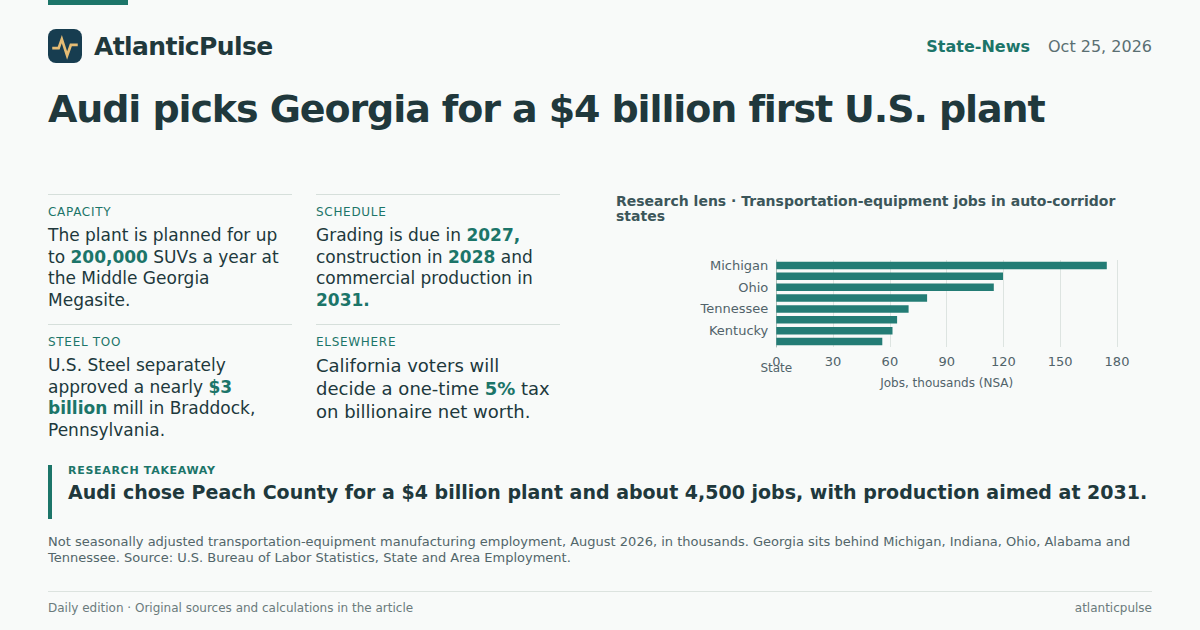
Audi finally picked a US address, and it is in Peach County, Georgia. The company and Gov. Brian Kemp announced a roughly $4 billion plant at the Middle Georgia Megasite, promising about 4,500 jobs and up to 200,000 SUVs a year for North American buyers. Grading is due in 2027, construction in 2028, production in 2031 — or, in Ingolstadt’s slightly vaguer phrasing, the early 2030s. President Trump, speaking in nearby Perry, claimed tariffs made the deal possible; state officials have not published the incentive package, and Audi has not named the models. For Middle Georgia, the concrete pour is the point.
U.S. Steel’s board approved a nearly $3 billion hot-strip mill at the Edgar Thomson Plant in Braddock, Pennsylvania, lifting capacity from about 2.2 million tons a year to 3.5 million, with first output expected in late 2029. Senators Dave McCormick and John Fetterman billed it as a down payment on the $11 billion Nippon Steel partnership and on more than 11,000 existing Pennsylvania jobs. Not every acre is so fashionable. Oregon State University Extension, working from USDA survey estimates, says Oregon farm real estate averaged $3,880 an acre in 2026 — up 2.6% on paper, down 0.3% after inflation, the second straight real decline and the only back-to-back drop since the current USDA series began in 1997. Washington was similar; Idaho’s pasture kept that state slightly ahead. Land still looks like a safe asset. It just is not beating the grocery bill.
California, meanwhile, is asking voters whether a little more than 200 billionaires should pay a one-time 5% tax on net worth — Proposition 40 — to raise a claimed $100 billion for health care after federal cuts. A September Berkeley IGS/Los Angeles Times poll had 45% of likely voters in favor, 42% opposed and 13% undecided. Governor Gavin Newsom is against it; Google co-founder Sergey Brin has given more than $100 million to a group backing measures that could block the tax. Meta disclosed that Mark Zuckerberg might leave if it passes, and that the company is dangling a stay-put incentive. If you wanted a clean test of whether “eat the rich” still polls once the rich threaten to take the kitchen, here it is.
Technology & Industry
Intel is bolting tools into Fab 62 on its Ocotillo campus in Arizona, the sixth high-volume plant on a site the company still calls home. Operations are aimed at late 2028 on the 1.4-nanometer-class Intel 14A process; sister Fab 52 has been making 18A chips since late 2025. Ohio’s $28 billion New Albany plant, once promised for 2025, is now expected in 2030. Chips take longer than speeches. New York is writing a different check: $360 million in state money, $300 million of it for a quantum hub at SUNY Stony Brook, riding $1.37 billion in federal foundry commitments. Two expensive ways of saying “please build it here.”
Pennsylvania Governor Josh Shapiro signed the Artificial Intelligence Deceptive Advertising Act on October 22, telling advertisers that synthetic content which creates a false impression of goods or services needs a clear label that AI was used. The net is wide — television spots made out of state still count if they run in Pennsylvania — but so are the holes: parody, satire, commentary and criticism, plus the eternal lawyer’s friend, “significantly modified.” Critics already smell a statute that will be interpreted in court for years. That may be the point.
TP-Link, which market estimates put at about half of US home routers, signed a letter of intent with Key Tronic to assemble Wi-Fi 8 gear in Corinth, Mississippi, part of a pledged nearly $1 billion in US research and manufacturing. The company has been stuck since April waiting on a Department of War review after the FCC put foreign-made consumer routers on its Covered List; rival Asus already has a waiver through March 2028. Domestic assembly might start in 2027, if anyone can say what “domestic enough” means. Until then, the world’s most common hallway gadget is a trade-policy hostage.
Politics & Policy
Barack Obama spent Saturday doing what former presidents do in the last fortnight: packing gyms. In Detroit, at Cass Technical High School, he stood with Senate candidate Abdul El-Sayed and gubernatorial nominee Jocelyn Benson and compared the attacks on El-Sayed’s name and faith to his own 2008 campaign. In Cleveland, several thousand people filled Public Auditorium for Amy Acton and Sherrod Brown; Obama called Vivek Ramaswamy “thirsty” over an ad featuring Acton’s estranged mother. The Cook Political Report moved the Ohio governor’s race to Lean Democratic on Friday. Detroit’s clerk said 2,305 people voted on the first day of early voting, beating the city’s 1,897 on opening day of the 2024 presidential cycle. Grocery prices, she suggested, make better canvassers than anyone on a payroll. The midterm is November 3.
Alaska’s Senate race managed both a car crash and a federal lawsuit. Mary Peltola and her family took minor injuries Saturday when another vehicle hit theirs on the way to the Alaska Federation of Natives banquet; she is pausing events until Tuesday in Homer. Attorney General Todd Blanche spent Sunday defending a Justice Department suit, filed at President Trump’s request, that would block certification if Republican Sen. Dan Sullivan loses — citing a second candidate named Dan J. Sullivan. Alaska’s Supreme Court already put both Sullivans on the primary ballot in June; Sen. Lisa Murkowski said Alaskans do not need the help. Blanche insisted Trump is “not trying to take over a state election,” then allowed that “there could be a crime.” It is the sort of sentence that does not get less interesting on a second hearing. Peltola’s campaign said she was in good spirits.
Down-ballot, the country is arguing with itself in several dialects. Eleven more Illinois counties will vote on non-binding questions about exploring a split from Cook County; 33 counties have already said yes, and a Pritzker spokesperson has called the whole thing a “stunt.” Alabama’s state superintendent approved the only Ten Commandments poster schools may hang from 1 January 2027. Massachusetts voters will decide whether to keep a 2024 gun-registration and assault-style-weapons law, after an emergency clause made them register first and vote six days later. Idaho, for its part, is asking which of six historic firearms should be the official state gun, a turnout gimmick dressed as heritage. One of these is a constitutional fight. The other is a conversation you can have in a pickup on the way to an elk hunt. Both will be on the November ballot.
Human Stories / Social Trends
The Archdiocese of New York told clergy it is on the verge of an $800 million settlement with more than 1,000 people who say they were sexually abused by clergy, a sum that would be the second-largest of its kind in the United States after Los Angeles’s $880 million deal in 2024. Archbishop Ronald Hicks said the agreement, still unsigned and due to be executed on 6 November, would resolve Child Victims Act claims against the archdiocese, parishes and affiliated agencies. Lawyer Jeff Anderson called it “a reckoning.” Money is not healing, but it is how American institutions keep score when healing arrives late. Signatures are scheduled for November 6.
In New Orleans, 15-year-old Phillip Mullin of Alexandria became the first child in Louisiana functionally cured of sickle cell disease after Lyfgenia gene therapy at Manning Family Children’s Hospital. He had been hospitalized more than 100 times. He wants to be a hematologist-oncologist; for now he wants his own bed and Lego with his baby sister. In Houston, Jennifer Clark launched Abby’s Brave Buddies after her daughter, diagnosed with leukemia at 2, asked to spend her third birthday with her nurses. Infection risk makes playgrounds a luxury. The nonprofit books cleaned venues so families can be in the same room without treating one another like biohazards. Mullin’s speech, his hospital said, left the room in tears.
And in Wapakoneta, Ohio, a retired Air Force and airline pilot who watched the Moon landing at age 9 wrote a $400,000 check so Neil Armstrong’s childhood house would not vanish into the private market. The Auglaize County Historical Society closed on 19 October and hopes to restore the 1940s dining room where a boy built model planes, then open it within three years. It is a small, stubborn kind of public memory: not a museum wing, just a house someone refused to let become someone else’s kitchen renovation. Ken Schreiber funded the purchase himself.
This daily edition uses stored reporting scoped by publication date, or arrival when publication was absent. Source collection can lag publication.