Research
Audi's 4,500 Georgia jobs, next to a factory payroll that already exists
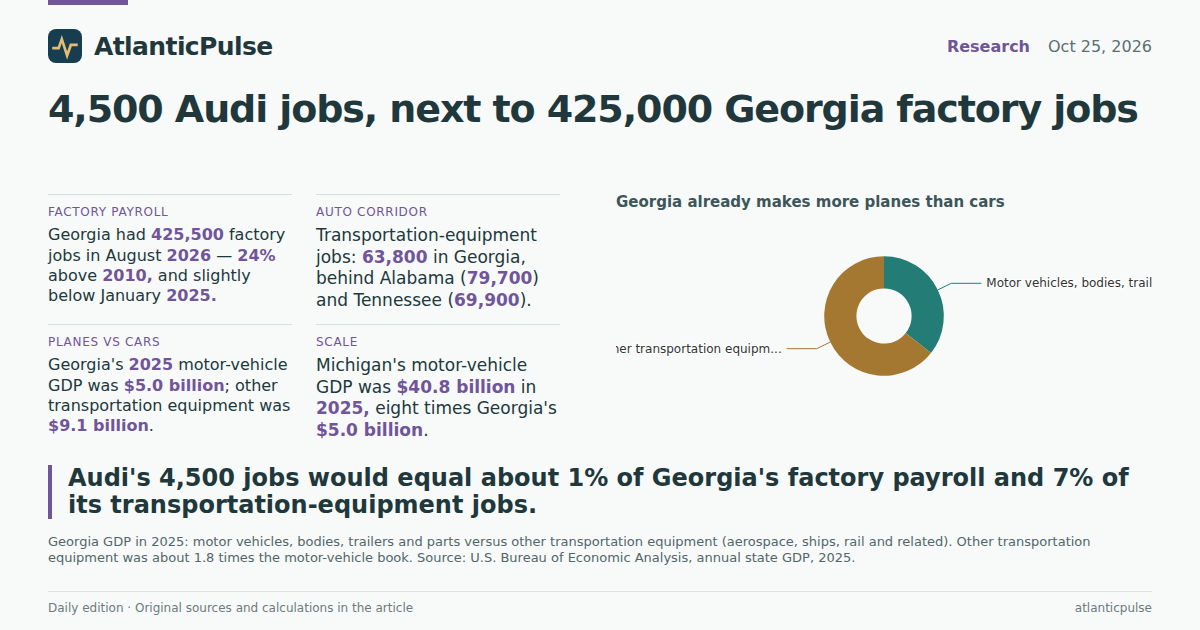
The 4,500-job promise, next to 425,000 factory jobs
Audi and Gov. Brian Kemp announced a roughly $4 billion plant at the Middle Georgia Megasite in Peach County, with about 4,500 jobs and up to 200,000 SUVs a year, grading in 2027 and commercial production in 2031 — or, in Ingolstadt's phrasing, the early 2030s (Fox 5 Atlanta; Audi). That is a real factory. It is also a delayed one. The question for readers is not whether the ribbon-cutting will look good. It is how large a dent 4,500 jobs would make in the factory state Georgia already has.
The Bureau of Labor Statistics seasonally adjusted manufacturing payroll in Georgia was 425,500 in August 2026. That is 8.5 percent of the state's 4.99 million nonfarm jobs. It is 82,900 jobs, or 24 percent, above January 2010. It is not a boom in the last year: the August 2026 reading was 2,400 below January 2025. Audi's promised 4,500 jobs would equal about 1.1 percent of the factory payroll already on the books. If every one of those jobs arrived tomorrow, Georgia would still be a services economy with a factory floor — not the other way around.
Georgia factory payroll, 2010–2026

View exact chart values
| year | jobs_thousands |
|---|---|
| 2010 | 344.1 |
| 2011 | 350.7 |
| 2012 | 352.9 |
| 2013 | 356.4 |
| 2014 | 369.2 |
| 2015 | 378.3 |
| 2016 | 388.9 |
| 2017 | 397.6 |
| 2018 | 405.3 |
| 2019 | 405.6 |
| 2020 | 380.5 |
| 2021 | 396.2 |
| 2022 | 418.6 |
| 2023 | 429.3 |
| 2024 | 429.3 |
| 2025 | 426.2 |
| 2026 | 425.5 |
Transportation equipment grew. Georgia still is not Detroit.
The closer comparison is transportation-equipment manufacturing, the BLS bucket that holds motor vehicles, aerospace, ships and rail. That series is not seasonally adjusted, so August-to-August is the honest cut. Georgia had 63,800 of those jobs in August 2026, up 25,500 from August 2010 and up 600, or 0.9 percent, from August 2025. Audi's 4,500 jobs would be about 7 percent of that existing transportation-equipment payroll — material for Peach County, modest for the statewide line.
Those 63,800 jobs do not put Georgia at the front of the auto corridor. In August 2026, Michigan still had 174,600 transportation-equipment jobs, Indiana 119,800 and Ohio 114,900. Among Southern neighbors, Alabama had 79,700 and Tennessee 69,900. Georgia sat sixth in this eight-state set, just ahead of Kentucky (61,400) and South Carolina (56,000). A first U.S. Audi plant is a catch-up story, not a leapfrog.
Georgia transportation-equipment jobs, August snapshots

View exact chart values
| year | jobs_thousands |
|---|---|
| 2010 | 38.3 |
| 2011 | 42.7 |
| 2012 | 44.2 |
| 2013 | 45.1 |
| 2014 | 47.9 |
| 2015 | 50.4 |
| 2016 | 52.9 |
| 2017 | 54.2 |
| 2018 | 55.5 |
| 2019 | 55.3 |
| 2020 | 49.7 |
| 2021 | 52 |
| 2022 | 55.1 |
| 2023 | 60.7 |
| 2024 | 63.3 |
| 2025 | 63.2 |
| 2026 | 63.8 |
Transportation-equipment jobs in auto-corridor states

View exact chart values
| state | jobs_thousands | jobs |
|---|---|---|
| Michigan | 174.6 | 174600 |
| Indiana | 119.8 | 119800 |
| Ohio | 114.9 | 114900 |
| Alabama | 79.7 | 79700 |
| Tennessee | 69.9 | 69900 |
| Georgia | 63.8 | 63800 |
| Kentucky | 61.4 | 61400 |
| South Carolina | 56 | 56000 |
Georgia already makes more planes than cars
Payrolls mix cars with jets. The Bureau of Economic Analysis splits the output. In 2025, Georgia's motor-vehicle, body, trailer and parts manufacturing produced $5.04 billion of current-dollar GDP. Other transportation equipment — aerospace, ships, rail and related — produced $9.11 billion, about 1.8 times as much. Gulfstream's Savannah complex lives in that second number. Kia's West Point plant lives in the first. Audi would join the smaller book.
That motor-vehicle GDP is 5.7 percent of Georgia manufacturing output ($87.9 billion) and 0.54 percent of the state's $936 billion economy. Among the same auto-corridor states, Georgia's 2025 motor-vehicle GDP was the smallest: Michigan $40.8 billion, Kentucky $10.1 billion, Alabama $8.3 billion, Tennessee $8.2 billion, South Carolina $6.2 billion. The South already has an auto belt. Georgia is on it. It is not the thickest link.
The real (chained 2017 dollar) motor-vehicle series shows the climb underneath those current-dollar totals. Georgia's inflation-adjusted motor-vehicle output rose from $1.38 billion in 2010 to $6.20 billion in 2025. Compensation of employees in the same industry was $3.08 billion in 2025. The industry grew. It did not grow into Michigan.
Motor-vehicle factory output, 2025

View exact chart values
| state | mv_gdp_billions | mv_gdp_millions |
|---|---|---|
| Michigan | 40.79 | 40787.9 |
| Kentucky | 10.09 | 10088.3 |
| Alabama | 8.34 | 8344.3 |
| Tennessee | 8.15 | 8153.8 |
| South Carolina | 6.16 | 6161.5 |
| Georgia | 5.04 | 5040.1 |
Georgia already makes more planes than cars

View exact chart values
| category | gdp_millions |
|---|---|
| Motor vehicles, bodies, trailers and parts | 5040.1 |
| Other transportation equipment (incl. aerospace) | 9110.7 |
Paychecks, construction crews and a 2031 start date
Average hourly earnings for all manufacturing employees in Georgia were $31.69 in August 2026, not seasonally adjusted, up from $20.76 in August 2010 and 3.6 percent above August 2025. State officials have not published starting wages for the Audi plant, only that pay will be "competitive." The existing factory wage is the baseline that claim will be measured against, not a forecast of what Audi will pay.
Construction is the nearer-term labor market. Georgia's seasonally adjusted construction payroll was 232,800 in August 2026, up 79,800 from January 2010. Site work is scheduled for 2027 and vertical construction for 2028. Those crews are a different occupation from the 4,500 assembly jobs advertised for the early 2030s. Counting construction and production as if they were the same announcement is how press releases get to a bigger number than the plant will ever staff on a Tuesday in 2032.
What the announcement actually moves
Put the pieces in one place. Georgia already has more than 425,000 factory jobs and nearly 64,000 transportation-equipment jobs. Motor-vehicle output is a $5 billion slice of a $936 billion state, and it is smaller than the state's other transportation-equipment book. Audi's 4,500 jobs would be a large plant in Peach County and a 1 percent add to the statewide factory payroll — arriving, if the schedule holds, after another presidential election.
None of that makes the investment fake. A 200,000-vehicle plant is a plant. It does mean the political language of "historic" should be read against a ledger that already includes Kia, a large aerospace industry, and a manufacturing payroll that has been flat for three years. The jobs worth celebrating in 2026 are the ones already on the clock. The 4,500 are a 2031 story.
Sources and methods
BLS State and Area Employment figures are from the pinned snapshot with release id bls-sm-snapshot-2026-08-24 (observations through August 2026). Manufacturing, construction and total nonfarm are statewide seasonally adjusted all-employee series in thousands. Transportation-equipment manufacturing is statewide, not seasonally adjusted, NAICS 336; month-to-month NSA comparisons are avoided. August-to-August changes are used for that series. Average hourly earnings are NSA for all manufacturing employees. Duplicate BLS series IDs for the same industry were distinguished by frequency; monthly series were used. Null observations were dropped and were not treated as zero.
BEA figures are annual state GDP and compensation from the pinned 2026-09-30 regional release, calendar years 1997–2025. Motor vehicles, bodies, trailers and parts are NAICS 3361–3363 in current dollars unless labeled chained 2017 dollars. Other transportation equipment is the BEA residual of transportation equipment excluding motor vehicles (aerospace, ships, rail and related). Manufacturing GDP is the sum of durable and nondurable goods manufacturing. Compensation is thousands of dollars. Chain-weighted industry GDP values are not additive across industries.
Audi's 4,500 jobs and $4 billion are company and state announcements, not BLS or BEA observations. Production is scheduled for 2031 / the early 2030s. No causal effect of the plant is inferred. Peer-state comparisons use the same series definitions; dictionary presence was not treated as proof of observations. Snapshot vintage lags the edition date; these are not current-day prints.
Research completed 2026-10-26, for the October 25, 2026 news edition. The available source data may cover earlier periods; see the observation periods and source vintages above.