State-News
States absorb floodwaters, farm ledgers and a midterm crunch
World & Security
Mississippi released body-camera video of the June shooting that killed 1-year-old Kohen Wiley outside a Senatobia Walmart, and the officer who fired, Hunter Foster, resigned days after Attorney General Lynn Fitch declined to send the case to a grand jury. Officers had followed Wiley’s mother and a friend over suspected shoplifting of diapers and baby clothes; neither woman has been charged with theft. Video shows Foster shooting into the car after it appeared to move toward officers. His lawyer said the driver nearly struck five of them. Civil-rights attorney Ben Crump and the family called the “justified” finding excessive force from the start. The town is already on a short fuse after its former police chief was fired over alleged racist texts.
In Bend, Oregon, carpenter Kaylub Giamanco told Oregon Public Broadcasting he crawled through a shattered window at Silver Rail Elementary after a 16-year-old killed a teacher and three children on Oct. 15. Giamanco, who had two daughters at the school and a pistol in his truck, had decided leftover tacos beat a packed snack—which put him on the street as a “man in black” opened fire. He told 911, “I’m sorry, I have to go in,” then shot the gunman after finding him fighting a teacher for the rifle. Police credit him with stopping the attack. He cannot sleep. “I didn’t save everybody,” he told his mother. A federal grand jury in Utah, meanwhile, indicted 22-year-old Skyler AJ Rose of Ogden on charges including an attempted hate crime after alleged posts threatening to “blow up” a synagogue; investigators say they recovered six improvised pipe bombs and two rifles.
Nature did not wait for Election Day. San Juan County, New Mexico, prepared a state of emergency as the San Juan and Animas rivers rose, with Farmington’s police chief calling the flooding “once-in-a-generation” and Bloomfield shutting wastewater treatment because untreated sewage was entering the river. Pagosa Springs, Colorado, recorded a 15.02-foot crest, the second-highest on record. Pennsylvania’s measles outbreak climbed to 1,338 confirmed cases this year, with 255 hospitalizations, as providers gave far more MMR doses than usual. In a western Minnesota cornfield, a metallic object among harvested stalks was tied to a Chinese LandSpace rocket that apparently missed the ocean. South Dakota Governor Larry Rhoden activated about 120 soldiers from the 155th Engineer Company for a roughly year-long southern-border mission.
Markets & Economy
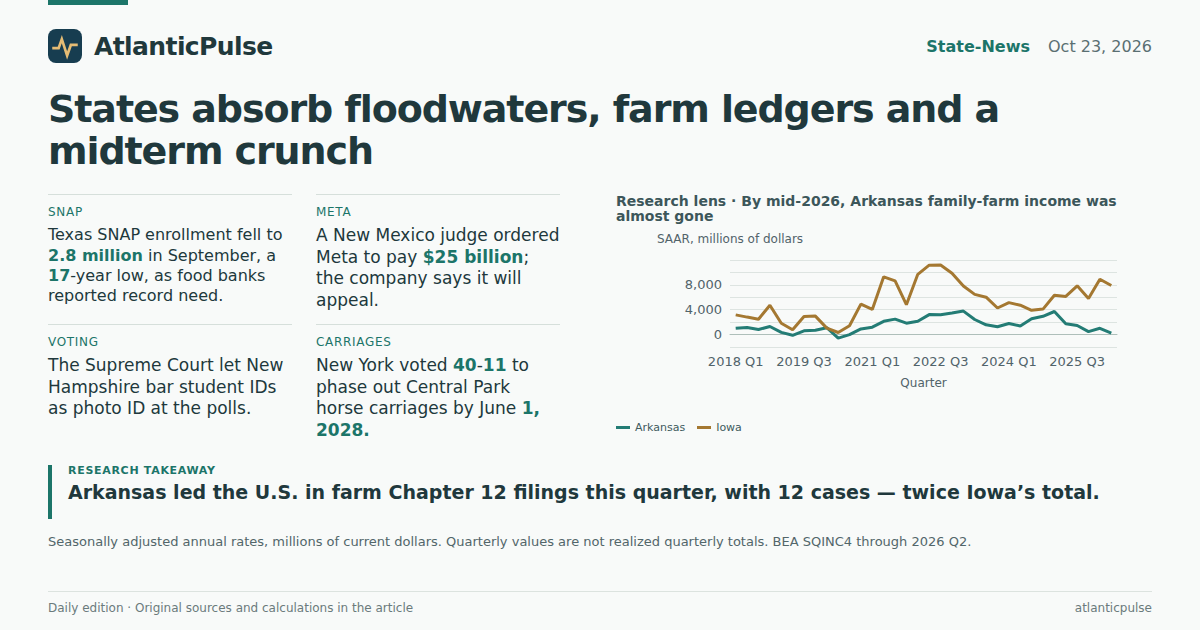
Arkansas led the country in farm Chapter 12 bankruptcies in the third quarter, with 12 filings—twice Iowa’s total—and 32 so far this year, according to the University of Arkansas Division of Agriculture. Nationwide, 292 Chapter 12 cases have been filed in 2026, nearly 19% above the first three quarters of 2025. Farmers describe diesel that jumped from about $2.50 a gallon last year toward $6, fertilizer that more than doubled, and rice acreage falling below a million for the first time since the early 1980s. Texas SNAP enrollment, meanwhile, fell to 2.8 million people in September, a 17-year low and a 20.8% drop from a year earlier, as federal work rules tightened and the state processed only 64% of applications within 30 days against a 95% federal requirement. Feeding Texas says food banks are seeing record need even as the caseload shrinks—an efficiency metric only a spreadsheet could love.
On the other end of the wealth distribution, California’s Proposition 40 would levy a one-time 5% tax on residents worth more than $1 billion as of Jan. 1, 2026, with 90% of the money earmarked for health care. The Legislative Analyst’s Office says the take could run to tens of billions over several years, though billionaires might leave. Campaigns have already spent more than $130 million. Meta’s board, not content to wait for November, arranged a new class of non-voting stock so Mark Zuckerberg could sell shares to cover a possible bill without surrendering the Class B votes that give him about 61% control of a company he economically owns at about 13%. The filing says he told directors he would need to start leaving California by mid-September if no deal emerged. Nothing says civic confidence like engineering a tax-payment share class before the votes are counted.
Vice President JD Vance used a North Platte rally to announce a $1.3 billion fertilizer investment, including two TalusAg plants in Nebraska that he said would serve 32,000 farmers on more than four million acres. Louisiana agreed with BP to convert remaining Deepwater Horizon economic-damages payments into a single early payout of about $350 million and settle leftover coastal-zone suits. And while farm country counts bankruptcies, grid operators counted a different harvest: the Solar Energy Industries Association says solar and storage saved Texas about $3.55 billion and California about $2.5 billion in wholesale energy costs from June through August compared with summer 2021, even as load rose. Retail bills still have transmission, distribution and wildfire line items that did not get the memo.
Technology & Industry
A New Mexico judge this week ordered Meta to pay $25 billion in a privacy case tied to Cambridge Analytica-era Facebook data, after a jury sided with the state in September. Meta denies wrongdoing and says it will appeal; legal experts told Reuters the company has a strong argument for shrinking the figure. If the verdict survives, private counsel DiCello Levitt could seek up to $1.27 billion under a 2025 contingency contract. The firm notes, with the calm of people who have read an appellate docket, that nobody sees a dime unless the win holds. States have been hiring plaintiffs’ shops to fight tech companies that can staff entire zip codes with lawyers. The fee math is the part that makes even sympathetic readers reach for a calculator.
Texas Attorney General Ken Paxton, who is also running for the U.S. Senate, sued OpenAI and Sam Altman in Collin County, claiming ChatGPT was marketed as safe without adequate age gates or testing, especially for teenagers. The office asks a court to bar new ChatGPT models in Texas without an independent evaluator’s sign-off. The filing arrives a week after campaign reports showed Elon Musk, a rival of Altman’s, spent nearly $200 million on ads for Paxton’s Senate bid. California, for its part, is being sued by NetChoice—whose members include Meta, Google and TikTok—over a law, effective Jan. 1, that would force platforms to display mental-health warning labels to users under 18. The trade group calls the notices compelled speech about “contested policy and scientific judgments.” The companies have spent years insisting they already moderate content. The state would like that message in a label, on a timer, after three hours.
A quieter failure sat in a file-transfer account. Hackers used a stolen login at Educational Testing Service, which runs California’s statewide exams, and copied records on about 7 million public-school students between May 22 and Sept. 18. The files include names, birth dates, home addresses, disability status and test results, but not Social Security numbers or bank accounts. ETS noticed on Sept. 25; families began hearing in mid-October. There is, so far, no public evidence the data has been dumped online. Free Experian monitoring runs through March 19, 2027, and parents can freeze credit for children under 16. It is a reminder that the most sensitive databases in American childhood are often one vendor password away from becoming a how-to guide for identity thieves who can wait until a teenager applies for a first loan.
Politics & Policy
The Supreme Court, in a brief unsigned order, let New Hampshire bar student IDs as photo identification at the polls, pausing a district judge’s narrower ruling under the Purcell principle that federal courts should not change election rules on the eve of a vote. Justice Ketanji Brown Jackson dissented alone, arguing the lower court had tried to stop alleged misinformation, not rewrite the statute. HB 323 took student IDs off the expressly valid list in June. Secretary of State David Scanlan told the justices he had already reprinted guides, posters and radio ads. For campus voters in a midterm, the practical effect is simpler: the card that gets you into the dining hall will not, by itself, get you a ballot.
Virginia state Sen. L. Louise Lucas, 82, the Senate’s president pro tempore and finance chair, surrendered on an indictment alleging she led a marijuana-distribution enterprise involving family members and associates, with FBI Director Kash Patel putting the alleged five-year operation at about $4.5 million. She faces racketeering, drug, money-laundering and honest-services counts, has been released on her own recognizance, and says she will not be intimidated; the defendants are presumed innocent. In Alaska, the Justice Department sued to block certification of the Nov. 3 Senate result if Republican Sen. Dan Sullivan loses to Democrat Mary Peltola while another candidate named Daniel J. Sullivan remains on the ballot. Trump told reporters he ordered the suit. Election-law specialists called it a state-law dispute dressed in federal clothing.
Pete Buttigieg endorsed independent Seth Bodnar, a Green Beret and former University of Montana president, over Democratic nominee Alani Bankhead in Montana’s open Senate race—an unusual party-family intervention with Republican Kurt Alme favored to succeed retiring Sen. Steve Daines. Bankhead has refused to step aside. Closer to classrooms than caucuses, Pennsylvania lawmakers sent Gov. Josh Shapiro a bell-to-bell cellphone ban for public and private schools starting in 2027-28. The Senate vote was 47-3. Shapiro, who says he will sign it, would make Pennsylvania the 25th state with such a law. A union-commissioned poll found 79% support. Teachers have been confiscating phones one hallway at a time for years. The capitol has now noticed.
Human Stories / Social Trends
New York’s City Council voted 40-11 for Romanch’s Law, a phase-out of Central Park’s horse-drawn carriages by June 1, 2028, named for 18-year-old Indian tourist Romanch Mahajan, who was killed in June when a runaway carriage threw him. A horse named Deniz later collapsed in a heat wave. Mayor Zohran Mamdani backed the bill; the city will halt new licenses and owes a workforce-transition plan by 2027 that, officials say, will emphasize training rather than cash. Carriage owner Francesco Riccobono said he invested $400,000 two years ago and that the city is “coming here to steal it.” The Transport Workers Union promises a federal lawsuit. The Central Park Conservancy, with 42 million annual visitors and a rising tide of e-bikes, called it a safety question. The horses, if the law holds, are supposed to go to sanctuaries rather than slaughter.
In Lauderhill, Florida, officer Brian Sguros is accused of a scheme that sounds like a rejected prestige-TV pitch: after finding Dennis West dead on a 2022 welfare check, he allegedly took over the $400,000 house, paid taxes and utilities in the dead man’s name, forged signatures for permits and spent more than $200,000 of his own money on repairs. Sguros has said he acted to “prevent squatters” and that the place was full of trash with a partly collapsed roof. Investigators say he told the medical examiner he was a friend and that West had no family, which was not true, and used law-enforcement databases to learn more about him. He was charged with five felonies, including official misconduct, and has been suspended. Relatives later sold the house. Sguros sued the buyers for reimbursement. Community-minded home improvement, this was not.
Two gentler crossings rounded out the day. Over the 101 Freeway in Agoura Hills, the Wallis Annenberg Wildlife Crossing—about 210 feet long and the world’s largest—is due to finish Dec. 2, giving mountain lions a vegetated bridge across 10 lanes. Organizers are bargaining with El Niño not to flood the last weeks of work. And a 5-month-old, 220-pound walrus calf named Annautaq, found orphaned on a remote Alaska beach between two dead adults, completed a 4,000-mile trip to SeaWorld Orlando after federal wildlife officials decided he could not survive a first year without his mother. He is on as many as six bottle feedings a day in quarantine before meeting the resident herd. It is a long way from the Arctic surf. The alternative was no way at all.
This daily edition uses stored reporting scoped by publication date, or arrival when publication was absent. Source collection can lag publication.