State-News
A $25 billion privacy bill, a midterm photo finish, and one very busy school bus
World & Security
The State Department ordered non-essential U.S. embassy staff and their families out of Saudi Arabia after Iran-backed Houthis stepped up attacks on the kingdom, including a strike on Riyadh’s international airport that reporting described as the country’s deadliest in years. Spokesman Tommy Pigott pointed to assaults on civilian airports and other infrastructure. On Wednesday, Saudi officials said debris from an intercepted drone aimed at the Shaybah oil field killed two workers — a Filipino and a Nepali — and injured two others; a separate attack on Dammam airport killed one person and wounded eight. Yemen’s four-year truce collapsed in June. Late Wednesday, Iranian state media reported explosions in Hormozgan province overlooking the Strait of Hormuz, a waterway that in peacetime carried around a fifth of the world’s oil.
A more local plume settled over Toledo. A 5,500-gallon tank of glycidyl methacrylate ruptured around 9:30 p.m. Tuesday at MC Tank Transport. Nearly 1,000 people within a mile were evacuated; more than 50,000 within three miles, including some in southeast Michigan, were told to shelter in place. About 30 people were evaluated for irritation symptoms. By 5 p.m. Wednesday the shelter order was lifted and the evacuation zone shrank to half a mile. In Bend, Oregon, teacher Becky Drury, 54, said she played dead after a 16-year-old with a twelve-gauge shotgun shot her at close range in her Silver Rail Elementary classroom last Thursday. Three boys, ages 5, 8 and 11, and a 25-year-old teacher died. Drury said her left hand was “almost completely severed.” The suspected shooter was fatally shot by a father of two students who followed him inside. District schools reopened Wednesday.
The USDA also confirmed the first New World screwworm case in U.S. wildlife of the current outbreak: an elk harvested at a Pecos County, Texas, game ranch. The flesh-eating parasite, whose maggots burrow into open wounds of warm-blooded animals, had already been found in livestock and pets across Texas and New Mexico. As of October 15, 56 animal cases had been confirmed since June, all previously in domestic animals. Officials still lean on sterile-fly releases, the method that drove the pest out of the United States in 1966. Movement restrictions remain in parts of 12 Texas counties. It is an unglamorous biosecurity story, which is another way of saying it can rearrange a cattle market if it keeps walking off the ranch.
Markets & Economy
New Mexico, which declined to join an $18 billion multistate settlement with Meta this summer, got the verdict it wanted and then some. State District Judge Francis J. Mathew ordered the company to pay $25 billion after a September jury found it liable for more than 43 million consumer-protection violations tied to misleading statements about Facebook user data and the Cambridge Analytica harvest of some 87 million profiles. “Facebook promised users that they (the users) controlled their data. This was false,” Mathew wrote. Attorney General Raúl Torrez called it “an unambiguous message to Silicon Valley.” Meta’s chief legal officer called the case “a tax on speech” and promised an appeal. The figure would dwarf the FTC’s 2019 $5 billion Facebook fine; a Villanova professor noted it works out to about $12,000 per New Mexican. Under the state constitution, consumer-protection fines go to education — eventually, if appeals do not eat the check. Meta’s market value is about $1.8 trillion, and shares still rose 2 percent.
The same week, Meta’s board cut Mark Zuckerberg a deal to stay in California. Proposition 40 would impose a one-time 5 percent tax on billionaires who were state residents on January 1, 2026. Zuckerberg will receive non-voting Class C shares he can sell to cover a potential bill, in exchange for remaining a resident of California or Meta’s headquarters state for eight years. Stanford economists Benjamin Jaros and Joshua Rauh put collections at $28 billion to $36 billion rather than the $100 billion supporters advertise, and their simulations produce an average net loss of $38.9 billion if departures persist. California’s Legislative Analyst’s Office still expects tens of billions in, and less than $1 billion a year in lost income-tax payments. Nvidia’s Jensen Huang, for his part, called paying an estimated $8 billion over five years a “privilege.”
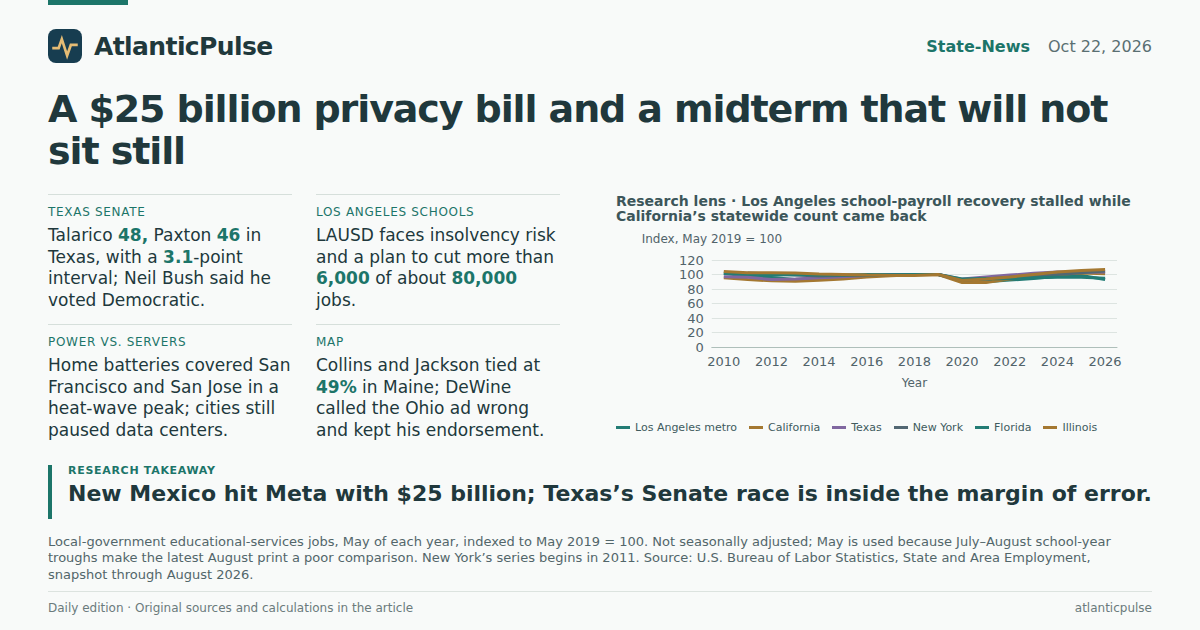
City halls ran their own experiments. Chicago Mayor Brandon Johnson’s $17.6 billion “Fair Share Budget” aims to close a nearly $900 million gap with a $25-per-employee monthly levy on firms with more than 125 workers, $131.5 million in new spending, and $480 million in borrowing for police-misconduct settlements he said in September he would not pursue. Los Angeles Unified, the country’s second-largest district, is running a $1.5 billion to $2 billion annual structural deficit; a state crisis team says insolvency is a real risk without cuts, and the district’s plan would eliminate more than 6,000 of roughly 80,000 jobs. In Sacramento, SEIU Local 1000 staged its first strike in 44 years, pressing Governor Gavin Newsom for raises and relief from a four-day in-office mandate. Kinder Morgan, unbothered by municipal theater, formally committed to Permian Link: $4.2 billion, about 434 miles, 2.8 billion cubic feet a day of Permian gas aimed at power providers for an unnamed hyperscale data-center operator, under a 20-year take-or-pay contract, in service in 2030.
Technology & Industry
On October 6, as a late-season heat wave pushed California demand, home batteries from Tesla and Sunrun sent enough power back to the grid to cover every home in San Francisco and San Jose — combined population about 1.8 million — during peak hours, according to the nonprofit Common Charge, as Grist reported. Sunrun says it has already run more than 800 of these dispatch events this year; owners often never notice, because the company keeps a reserve in the tank. Between Tesla and Sunrun, 1.2 million U.S. home batteries can theoretically dispatch 8 gigawatts, nearly 11 times the California heat-wave contribution. The old grid burned gas when the afternoon air-conditioning spike arrived. The new one knocks on garage walls and asks the neighbors, politely, to share.
The buildings that eat that power are meeting a different reception. California ranks third nationally with 366 data centers operating, under construction, or in planning. Since June, at least 26 local resolutions, moratoriums, or bans have been proposed or passed; Oakland and San Francisco approved pauses this month. In Indiana, the University Environmental Resilience Institute now counts restrictions in at least 50 counties — more than half the state — including 32 moratoriums and a permanent ban in Marshall County. Texas took the comedy option. After Governor Greg Abbott called for a pause in September, the Texas Commission on Environmental Quality’s automated STEERS portal kept issuing construction authorizations. Following reporting, the agency shut the portal down and suspended 17 data-center-related permits so that humans could look at them. Fighting the AI build-out with a 404 page has a certain elegance.
If the servers want carbon-free baseload, eastern Kentucky is volunteering. The Nuclear Company proposed Prosperity One along the Ohio River in Lewis County: up to six Westinghouse AP1000 reactors, about 6.6 gigawatts if fully built, with a 2028 construction target that still needs federal licenses. County leaders have applied for a nuclear-ready designation. Pennsylvania, meanwhile, decided the more urgent infrastructure is a pocket. The Senate sent Governor Josh Shapiro a bell-to-bell school cellphone ban, 47–3, for the 2027–28 year; he has said he will sign it. The parent group PA Unplugged says the state would become the 25th with such a law.
Politics & Policy
Texas, which has not made a habit of sending Democrats to the Senate, is suddenly a photo finish. An Emerson College/The Hill poll of 1,000 likely voters, taken October 17–19, put Democrat James Talarico at 48 percent and Republican Ken Paxton at 46, with a 3.1-point credibility interval, a dead heat. Governor Greg Abbott led Democrat Gina Hinojosa 49–45 in the same survey. Talarico raised $64 million in the third quarter to Paxton’s $18 million; Elon Musk put $158 million into a super PAC backing Paxton. Neil Bush said he voted for Talarico, a family defection that will not move El Paso by itself but does suggest the Paxton brand is not traveling well in every living room that still has a Bush photograph on the wall.
Elsewhere the map is equally uncooperative. In Michigan, Democrat Abdul El-Sayed and Republican Mike Rogers used their final debate to argue about policing and reproductive rights; a recent Marist poll had them two points apart. In Maine, a Fox News poll found Susan Collins and Democrat Troy Jackson tied at 49 percent each. Only 12 percent of Maine voters said their family is better off than two years ago; Donald Trump’s job rating there was 37 percent approve and 62 percent disapprove. Ohio Governor Mike DeWine, a Republican, called Vivek Ramaswamy’s ad featuring Democrat Amy Acton’s estranged mother “just wrong” and “deeply, deeply, deeply troubling,” then confirmed he was not dropping his endorsement. In Virginia, 82-year-old state Sen. Louise Lucas — president pro tempore and finance chair — was indicted on federal racketeering, marijuana-distribution, and money-laundering conspiracy charges. She denies wrongdoing and called the case intimidation. Recreational sale of marijuana is still illegal in Virginia even as a regulated market is slated for next summer.
The Supreme Court, on an emergency application, paused a lower-court order and let New Hampshire keep student IDs off the November ballot. The justices cited the usual warning against changing election rules on the eve of a vote; Justice Ketanji Brown Jackson dissented, arguing the district court was correcting official misinformation, not rewriting the law. In Florida, election supervisors in Leon and Monroe counties reported Customs and Border Protection vehicles or masked agents near early-voting sites. Leon’s Mark Earley filed a complaint with the FBI. Federal law bars federal agents from polling places. That used to be the boring part of election administration. It is not, this cycle, boring.
Human Stories / Social Trends
In St. Paul’s Dayton neighborhood, Ebro Ahmed, 27, was outside a convenience store when a school bus rolled past with its doors open and the stop arm out. The driver was having a medical emergency. Ahmed ran the bus down, jumped on, accidentally put it in reverse, then pulled the parking brake. Eighteen students were unhurt; the driver was later discharged from hospital. “Even if I were to die, it would still be worth it,” Ahmed told ABC News, in a rescue he later credited, in part, to Grey’s Anatomy. Two girls in the front held his phone and glasses. Sometimes the social trend is simply that a person ran toward the problem.
New York’s City Council voted 40–7, with two abstentions, to ban horse-drawn carriages by June 1, 2028, under Romanch’s Law, named for 18-year-old tourist Romanch Mahajan, killed this summer when a carriage toppled in Central Park. The Conservancy called it the ninth carriage-related incident in just over a year. Council Speaker Julie Menin said the horses “don’t belong in an area that attracts 42 million people a year, pulling a 1,000-pound carriage in record heat.” The Transport Workers Union, representing about 150 drivers, promised a restraining order “the minute the ink dries.” A workforce transition program is supposed to follow.
And in Colorado, a newly released report found that a wildlife overpass over a busy interstate — plus miles of 8-foot fencing and five underpasses — cut vehicle-animal collisions by 91 percent in the 10 months since it opened. Elk, bears, pronghorn, and northern leopard frogs have been using it. After a day of billionaire tax engineering, chemical plumes, and Senate attack ads, it is almost restful to picture a frog on a pedestrian bridge, minding its own business, and not checking a poll.
This daily edition uses stored reporting scoped by publication date, or arrival when publication was absent. Source collection can lag publication.