State-News
A toxic cloud, a $25 billion fine and an ugly Ohio ad
World & Security
North Toledo spent Wednesday staring at a chemical plume that, unhelpfully, coincided with actual fog. A tank at MC Tank Transport exploded around 9:30 p.m. Tuesday, releasing glycidyl methacrylate — an industrial chemical used to make plastics and paints “perform better,” which is not how anyone described the air. Mayor Wade Kapszukiewicz said the tank can hold 5,500 gallons, still might explode within 12 hours of the incident, and that hazmat crews were not approaching it. More than 900 people live inside the one-mile evacuation zone; a three-mile shelter-in-place ring sat beyond that. A sheriff’s deputy drove himself to hospital. Health officials advised showers for anyone whose eyes or lungs felt the burn.
If the plume was accidental, the envelopes were not. Suspicious letters with white powder reached Arizona Democrats Adelita Grijalva, Greg Stanton and Yassamin Ansari, plus Secretary of State Adrian Fontes’s office, which evacuated the Executive Tower on Oct. 15. Grijalva’s powder tested negative; the FBI and Postal Inspection Service are investigating a wave covering more than three dozen congressional and election offices in 32 states. Capitol Police logged 14,938 threat assessments in 2025. Public health, meanwhile, is running its own intimidation campaign: Pennsylvania’s measles count rose to 1,317 cases, with 251 hospitalizations and five deaths this year, and less than 1% of cases among vaccinated people.
Florida and Alabama offered a split-screen on capital punishment. Florida executed 77-year-old William Reaves, a Vietnam veteran, for the 1986 killing of Deputy Richard Raczkowski — the state’s 18th execution this year and the eighth of a prisoner over 70. Florida has already carried out more than half of the 32 U.S. executions so far in 2026. Hours away, Gov. Kay Ivey commuted Toforest Johnson’s death sentence to life without parole, citing insufficient direct evidence in the 1995 murder of Deputy William Hardy; Johnson’s lawyers still want a new trial. New Mexico Attorney General Raúl Torrez, busy on several fronts, sued Jeffrey Epstein’s longtime attorney Darren Indyke and accountant Richard Kahn, seeking to block estate payments and alleging they enabled trafficking at Zorro Ranch near Santa Fe.
Markets & Economy
California’s Proposition 40, a one-time 5% tax on billionaires who were residents on Jan. 1, 2026, has economists arguing over whether it is a $100 billion healthcare windfall or a slow-motion fiscal own-goal. Stanford’s Benjamin Jaros and Joshua Rauh put collections around $30 billion and, if income-tax losses from departures persist, a net present-value hole of about $38.9 billion. Sponsors say that math treats the tax as one-time but the migration as forever. A Citrin Center–Politico poll had likely voters 46% yes and 43% no; tech donors have poured more than $340 million into killing it. Meta disclosed that Mark Zuckerberg considered leaving California; the company is creating a new stock class that could give him $20 billion in “immediate liquidity” without losing control if the tax passes. Nvidia’s Jensen Huang, for his part, said he would be comfortable paying.
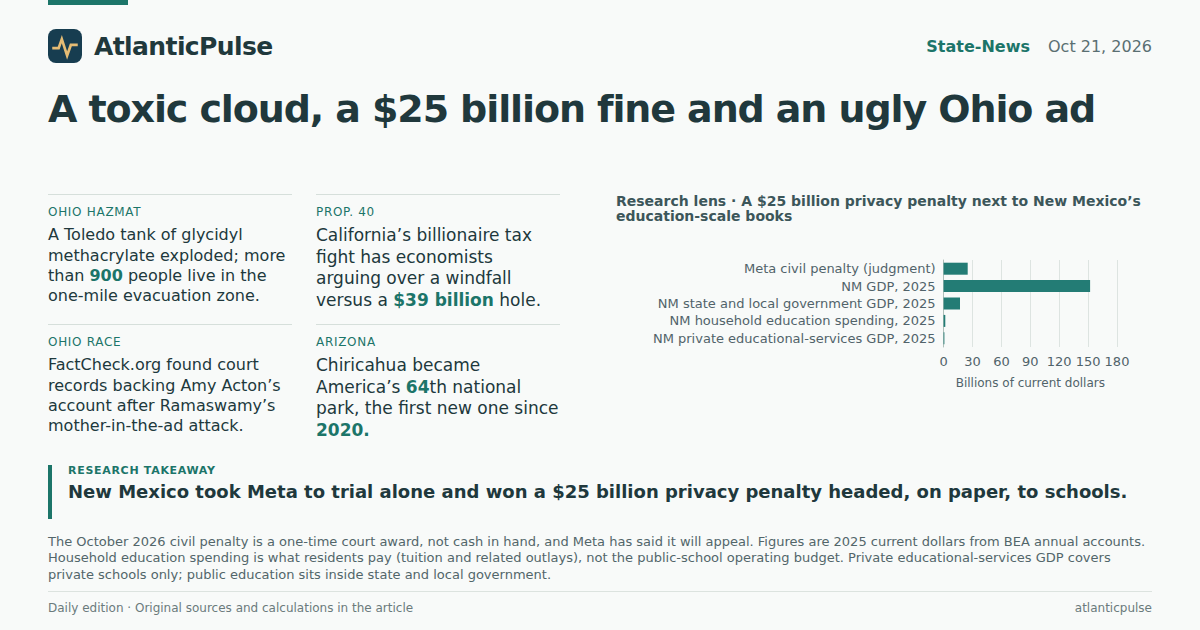
New Mexico, which sat out a 48-state Cambridge Analytica settlement, won a $25 billion civil penalty against Meta after a jury found more than 43 million consumer-protection violations. Judge Francis Mathew cut a $219 billion jury figure — the theoretical record-breaker — to $25 billion, still described by Torrez as perhaps the largest state verdict against a company in American history. Under the state constitution the money would go to education, if it survives appeal. Meta’s chief legal officer called the approach “all but impossible to do business” in New Mexico. Shares were trading higher anyway, which is either markets being markets or Silicon Valley’s version of a shrug.
Elsewhere the cost of moving things around is the story. West Virginia Gov. Patrick Morrisey declared a 60-day emergency so trucks can burn red-dyed off-road diesel on highways, a 20.5-cent-per-gallon dodge after AAA put statewide diesel at $6.34 versus $3.57 a year ago. Texas employment actually fell in September — 18,900 jobs gone — slowing year-to-date growth to 0.8%, well below the state’s 2% average, the Dallas Fed said. And up to 95,000 California state workers in SEIU Local 1000 staged the union’s first-ever one-day strike over pay, health costs and Gavin Newsom’s four-day office mandate, which is one way to make a DMV wait even more philosophical.
Technology & Industry
Intel is doing the unglamorous part of industrial policy: bolting tools into buildings. The company began installing production equipment at Fab 62 in Arizona, aiming for operations before the end of 2028, and workers set the first major structural truss at the Ohio One complex in New Albany. Intel also says it has put High-NA EUV lithography into high-volume manufacturing in Oregon. It did not say which node Fab 62 will run, or when Ohio actually starts making chips. The supply-chain brag is real enough: more than 4,500 U.S. suppliers across 49 states and over $29 billion in annual domestic spending.
Data centers, meanwhile, are the guest who arrived with a 10-gigawatt appetite and a closed-loop water story. In Millard County, Utah, Creekstone Energy’s planned campus on more than 10,000 acres could use more than double the state’s current power demand. Pew estimated about 67% of more than 1,500 new centers under development were planned for remote areas; a Utah State survey found 76% of respondents opposed or strongly opposed new centers in the state. Texas Gov. Greg Abbott ordered a pause on data-center permits in September; FracTracker and Public Citizen still counted 35 subsequent TCEQ actions, including stormwater coverage and public notices. The governor’s office says no permits have actually been approved. Rural Utahns and Texans are discovering that “pause” is a word with a lot of footnotes.
Two other industrial bets landed on the same day. Florida Polytechnic University’s police department is preparing to fly a Jetson ONE electric aircraft — eight motors, 63 mph, about 20 minutes of flight, ballistic parachute — once the FAA says yes. And Hudbay and Mitsubishi gave a final investment decision to Copper World southeast of Tucson, targeting 102,000 metric tons of copper a year over the first decade and production in the second half of 2029. America wants chips, copper, and now, apparently, a flying campus cop.
Politics & Policy
Ohio’s governor’s race, already a Cook Political Report toss-up, found a new low: Vivek Ramaswamy’s campaign produced a 60-second ad in which Democrat Amy Acton’s estranged mother calls her a “liar” about her childhood. FactCheck.org reviewed court records and contemporaneous reporting that back Acton’s account of being removed from her mother’s custody at 12 after her stepfather was charged with raping her; the couple later skipped town. Ramaswamy said he planned to spend $4 million airing the spot. Fellow Republican Sen. Jon Husted criticized it; Vice President JD Vance told Republicans to stop whining. Acton’s brother, Philip Stearns, called the tactic “despicable.” If this is persuasion, it is the kind that makes you wash your hands afterward.
In Texas, early voting opened with Harris County logging more than 104,600 ballots on day one, versus 63,188 on the first day in 2018, and Dallas reporting 76,079. A Fox News poll of likely voters put Democrat James Talarico and Republican Ken Paxton tied at 49% apiece for the open Senate seat, while Gov. Greg Abbott led Gina Hinojosa 52–47. Hispanic likely voters favored Talarico 64–34 in that survey. Paxton’s unfavorable rating sat at 58%; Talarico’s was a wash. Disaffected Republicans showing up — or not — is the whole ballgame.
Utah Attorney General Derek Brown sued prediction-market operator Kalshi, calling it the manager of a “back-alley gambling den” and seeking roughly $30 million to $60 million tied to more than 32,000 Utah users; Kalshi says it is a CFTC-regulated exchange. New Jersey became the first state to make data-driven responsible-gaming interventions mandatory for operators and is asking the Supreme Court to hear its own Kalshi case. Pennsylvania’s House and Senate passed a bell-to-bell school cellphone ban for 2027–28; Gov. Josh Shapiro said he will sign it, making Pennsylvania the 25th such state. In Michigan, Abdul El-Sayed and Mike Rogers previewed a healthcare split — Medicare for All versus price transparency — at the Detroit Economic Club, then headed to a televised debate. The midterms are 13 days out, which is plenty of time for one more terrible ad.
Human Stories / Social Trends
Becky Drury, a teacher wounded in last Thursday’s attack on a special-education classroom at Silver Rail Elementary in Bend, Oregon, asked the public to drop a heroic myth. She said she never had a chance to shelter children: she saw the shooter, tried to shut the door, and was shot at close range, her left hand nearly severed. She pretended to be dead. Three children, ages 5, 8 and 11, and a teacher were killed; a 16-year-old former student is accused. Another teacher tackled the gunman; a father who followed him in shot him. Schools reopened Wednesday with officers at the doors. Accurate reporting, Drury said, would help heal. That is a modest request after an immodest week.
Not every strange object in a field is a tragedy. A Minnesota farmer harvesting in Stevens County found an 11-foot, charred metallic disc that the sheriff called “presumably a space object.” Analysts have pointed to the upper stage of a Chinese Zhuque-2E rocket launched Sept. 15; officials have not confirmed that, and LandSpace has not claimed the corn. Meanwhile Arizona gained America’s 64th national park: Chiricahua, about 12,000 acres of rhyolite spires southeast of Willcox, redesignated from a 1924 Coolidge monument — the first new park since New River Gorge in 2020. The rocks have been standing for 27 million years; the name change took a century of paperwork.
And then the mail. Families across Texas received texts and brochures branded as the Transgender Education Network of Texas, offering “resources” and emancipation guidance. TENT says it did not send them. Return labels point to a Wyoming LLC formed in September, the Texas Transgender Student Union. Staff were doxxed; a tour was suspended. The packets landed as early voting began and as Republican ads hit James Talarico on gender-affirming care. Impersonating an advocacy group to gin up rage is a lot of work for a political dirty trick. It is also, unfortunately, a very 2026 way to campaign.
This daily edition uses stored reporting scoped by publication date, or arrival when publication was absent. Source collection can lag publication.