Research
Twenty-five billion dollars, and a school payroll that still has not recovered
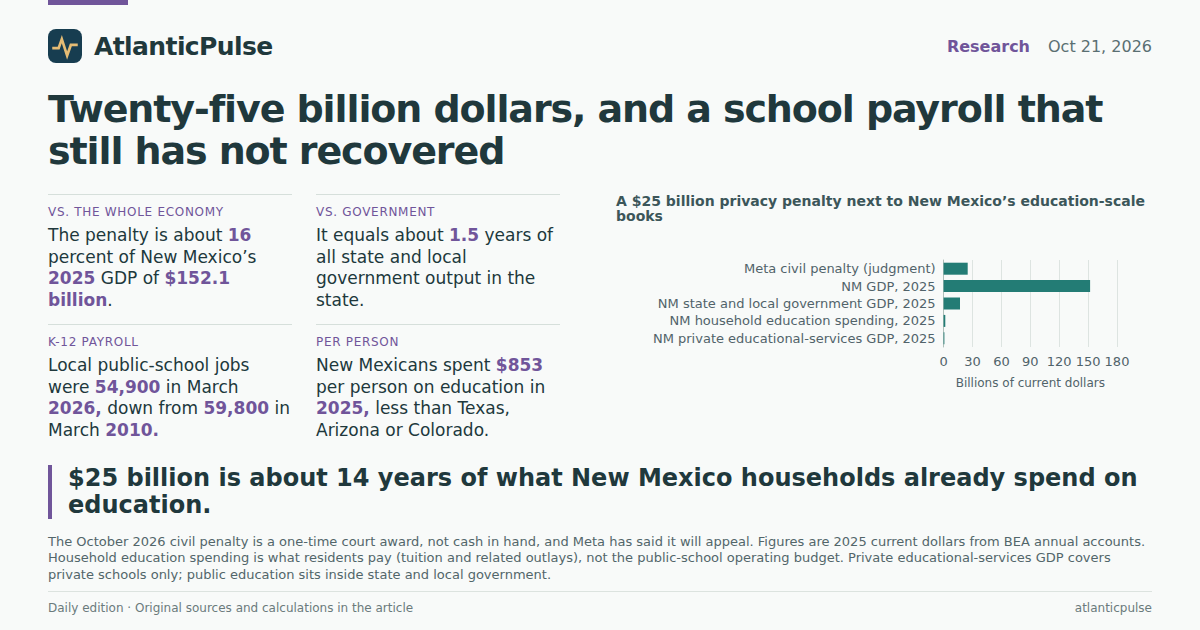
A school-fund number sitting on an appeal
A New Mexico judge on Wednesday ordered Meta to pay the state $25 billion after a jury found Facebook liable for deceiving users about privacy. Attorney General Raúl Torrez called it perhaps the largest state verdict against a company in American history. Under the New Mexico Constitution, consumer-protection fines go to education spending. Torrez joked that the state may have paid for school construction for the next 100 years — and then acknowledged the money would be tied up if Meta appeals, as the company has said it will.
That destination is the point of this piece. An earlier look at the case asked how a $35–40 billion ask compared with New Mexico’s whole economy. The question now is narrower and more useful to readers: if the $25 billion award is supposed to land in schools, how large is the education system already on the official books? The short answer is that $25 billion is enormous next to what New Mexico households spend on education and what private schools produce — and it is still not a substitute for the public-school workforce, which has not got back to its 2010 size.
The penalty is a slab. The school budget is a trickle.
Start with the accounting identity, not the press conference. New Mexico’s current-dollar GDP in 2025 was $152.1 billion, according to the Bureau of Economic Analysis’s annual state accounts. The $25 billion judgment is about 16 percent of that entire economy. It is also about one and a half years of everything state and local government in New Mexico produces — schools, highways, courts, hospitals run by counties, the lot — $17.0 billion in 2025. That is the right comparison class for a public-education windfall, because BEA parks public schools inside government, not inside “educational services.”
Households are a thinner book. New Mexicans spent $1.81 billion on education in 2025, 1.7 percent of all personal consumption in the state. At that pace, $25 billion is about 14 years of what residents already pay for tuition, fees and related education outlays. Private educational-services GDP — private schools and training, not public K-12 — was $820 million. The penalty is about 30 years of that industry. None of those ratios means a cheque is in the mail. They mean the verdict is large relative to the education flows the statistics can actually see.
Per person, the contrast is almost comic. Divide $25 billion by New Mexico’s 2025 resident population of about 2.13 million and you get roughly $11,800 a head. Household education spending in the same year was $853 a person. That is not a funding formula. It is a reminder that a civil penalty sized to a global platform is not the same species of number as a tuition bill.
A $25 billion privacy penalty next to New Mexico’s education-scale books

View exact chart values
| item | billion_usd |
|---|---|
| Meta civil penalty (judgment) | 25 |
| NM GDP, 2025 | 152.12 |
| NM state and local government GDP, 2025 | 16.99 |
| NM household education spending, 2025 | 1.81 |
| NM private educational-services GDP, 2025 | 0.82 |
What New Mexico already pays for, and what it does not
The consumption accounts also tell you which education New Mexico households buy. In 2025 they spent $1.10 billion on higher education and $373 million on nursery, elementary and secondary schools. College has been the larger household line for a quarter-century. That is not because public K-12 is small. It is because most public-school costs never show up as household consumption: they are paid by taxes and recorded as government output. Anyone who treats the $373 million K-12 figure as “what New Mexico spends on children” is reading the wrong ledger.
Even on the household side, New Mexico is not a high spender. In 2025, education outlays per person were $853 in New Mexico, $930 in Texas, $937 in Arizona, $1,091 in the United States and $1,092 in Colorado. The ranking is not a quality score. States with more private-school and university tuition in the mix will look “higher.” It does, however, undercut the idea that New Mexico households are already pouring unusual sums into classrooms that a privacy verdict would merely top up.
Private education compensation in New Mexico was $637 million in 2025. Local government compensation — teachers plus every other local public employee — was $8.32 billion. That second number is not a school wage bill. It is the closest official compensation total that includes public educators, and it still sits well below $25 billion. If the penalty survived appeal intact, it would not be a rounding error on payroll. It would be several years of local public pay, schools included.
New Mexico households already spend most of their education dollars on college

View exact chart values
| year | education_total_mil | k12_mil | higher_ed_mil |
|---|---|---|---|
| 2000 | 743.7 | 135.2 | 471.7 |
| 2001 | 759.8 | 146.8 | 473.1 |
| 2002 | 769.1 | 159.5 | 462.2 |
| 2003 | 826.1 | 162.8 | 506.2 |
| 2004 | 885.9 | 174.2 | 547.7 |
| 2005 | 966.3 | 179.2 | 611.1 |
| 2006 | 1052.3 | 182 | 679.1 |
| 2007 | 1075.7 | 190.4 | 685.8 |
| 2008 | 1092.2 | 208.3 | 682.8 |
| 2009 | 1155.5 | 218.9 | 738.2 |
| 2010 | 1228.9 | 218.9 | 803.5 |
| 2011 | 1249.7 | 215.7 | 830.9 |
| 2012 | 1230.3 | 216 | 815.5 |
| 2013 | 1207.6 | 222.8 | 797.7 |
| 2014 | 1218.7 | 229 | 801.9 |
| 2015 | 1290.7 | 244.8 | 850.8 |
| 2016 | 1382.3 | 253.4 | 923 |
| 2017 | 1404.8 | 257 | 940.2 |
| 2018 | 1432.9 | 262.9 | 955.2 |
| 2019 | 1477.7 | 269.3 | 973.9 |
| 2020 | 1479.5 | 271.6 | 986.3 |
| 2021 | 1549.8 | 299.2 | 1002.3 |
| 2022 | 1625.1 | 315.8 | 1035.2 |
| 2023 | 1695.4 | 327.6 | 1067.5 |
| 2024 | 1758.5 | 350.2 | 1086.9 |
| 2025 | 1812.9 | 373.1 | 1096.1 |
New Mexicans spend less per person on education than neighboring states

View exact chart values
| state | per_person_usd | year |
|---|---|---|
| New Mexico | 853 | 2025 |
| Texas | 930 | 2025 |
| Arizona | 937 | 2025 |
| United States | 1091 | 2025 |
| Colorado | 1092 | 2025 |
The workforce the money would actually meet
Jobs are the part of the education system you can count without waiting for an appellate brief. In March 2026, New Mexico local government educational services — the Bureau of Labor Statistics category that covers most public K-12 employment — employed 54,900 people. That was 6.2 percent of the state’s not-seasonally-adjusted nonfarm payroll that month. The annual average for state government educational services, mostly public colleges, was 24,000 in 2025. Private educational services employed 23,600 in August 2026, seasonally adjusted. Mix those vintages at your peril; they are not one snapshot. They are enough to say that the people who would have to absorb a historic school windfall number in the tens of thousands, not the hundreds of thousands.
Those local school jobs have not been growing. In March 2010 the same public-school payroll was 59,800. By March 2026 it was 54,900, about 8 percent smaller, even after a partial rebound from the 2021 pandemic trough of 49,000. Over the same March-to-March span, New Mexico’s seasonally adjusted total nonfarm payroll rose from an index of 100 to 111. The school line is at 92. The rest of the job market added work. The K-12 payroll did not get back to where it started.
Seasonality is real and unhelpful if you ignore it. August 2026 local educational services stood at 53,100, a summer number. March is the cleaner in-session reading, which is why the charts use it. Either way, the direction is the same: New Mexico is not adding a new school system that needs $25 billion to staff. It is running a smaller public-school workforce than it had 16 years ago, inside a government payroll that was 195,300 in August 2026 and a total nonfarm payroll of 907,400.
The statistical caution writes itself. BEA’s 2025 annual figures are not October 2026 cash. BLS state jobs run through August 2026 in this snapshot, not through Wednesday’s hearing. Public education is inside government GDP; “educational services” is private. Household education spending is not a school district’s appropriation. The $25 billion is a civil penalty subject to appeal, not a deposit. None of that makes the comparison ornamental. If New Mexico ever collects a sum in that neighborhood, the official record says it would be large next to the education flows already on the books — and it would arrive in a school system whose local payroll is still short of 2010.
New Mexico’s local public-school payroll is still smaller than in 2010

View exact chart values
| year | local_ed_jobs_thousands |
|---|---|
| 2010 | 59.8 |
| 2011 | 58.8 |
| 2012 | 57.1 |
| 2013 | 57.7 |
| 2014 | 57.1 |
| 2015 | 57 |
| 2016 | 56.6 |
| 2017 | 55.5 |
| 2018 | 54.6 |
| 2019 | 54.5 |
| 2020 | 54.4 |
| 2021 | 49 |
| 2022 | 51.5 |
| 2023 | 53.2 |
| 2024 | 55.6 |
| 2025 | 56 |
| 2026 | 54.9 |
The rest of New Mexico’s job market grew. The school payroll did not.

View exact chart values
| year | local_ed_index | total_nonfarm_index |
|---|---|---|
| 2010 | 100 | 100 |
| 2011 | 98.3 | 99.9 |
| 2012 | 95.5 | 100.1 |
| 2013 | 96.5 | 100.9 |
| 2014 | 95.5 | 101.3 |
| 2015 | 95.3 | 103 |
| 2016 | 94.6 | 103 |
| 2017 | 92.8 | 103.3 |
| 2018 | 91.3 | 104.5 |
| 2019 | 91.1 | 106.2 |
| 2020 | 91 | 107.2 |
| 2021 | 81.9 | 99.8 |
| 2022 | 86.1 | 105 |
| 2023 | 89 | 108.5 |
| 2024 | 93 | 110.8 |
| 2025 | 93.6 | 111.5 |
| 2026 | 91.8 | 111.2 |
Sources and methods
BEA annual state GDP (SAGDP) and personal income (SAINC) through calendar 2025, current dollars, from the September 30, 2026 regional release. GDP and state-and-local government GDP are millions of current dollars; population is Census midyear residents as published by BEA. Private educational-services GDP and compensation follow NAICS 61 and exclude public schools, which BEA classifies in government.
BEA state personal consumption expenditures (SAPCE) through 2025, current dollars. “Education” is household consumption (tuition and related outlays), not public K-12 appropriations. Nursery/elementary/secondary and higher education are published components of that household total. Per-person figures divide 2025 education PCE by 2025 population. Shares of total PCE use the matching SAPCE total.
BLS Current Employment Statistics, State and Area Employment, snapshot through August 2026. Local government educational services for New Mexico are monthly and not seasonally adjusted; March observations are used as in-session readings. Total nonfarm in the index chart is seasonally adjusted, March of each year, indexed to March 2010 = 100. State government educational services are annual NSA averages through 2025. Private educational services are monthly seasonally adjusted through August 2026. These series are not combined into a single-month total.
The $25 billion figure is the civil penalty described in October 21, 2026 reporting on the New Mexico judgment. It is a court award, not a receipt. No interest, collection lag, or appellate haircut is estimated. No causal claim is made about how a collected penalty would change enrollment, construction, or pay.
Observation dates are reference periods, not release dates or current-day counts. Provider lag is normal. Duplicate handling: null values excluded; one observation per period in each extract.
Research completed 2026-10-22, for the October 21, 2026 news edition. The available source data may cover earlier periods; see the observation periods and source vintages above.