State-News
Storms, server farms and a photo-finish Texas ballot
World & Security
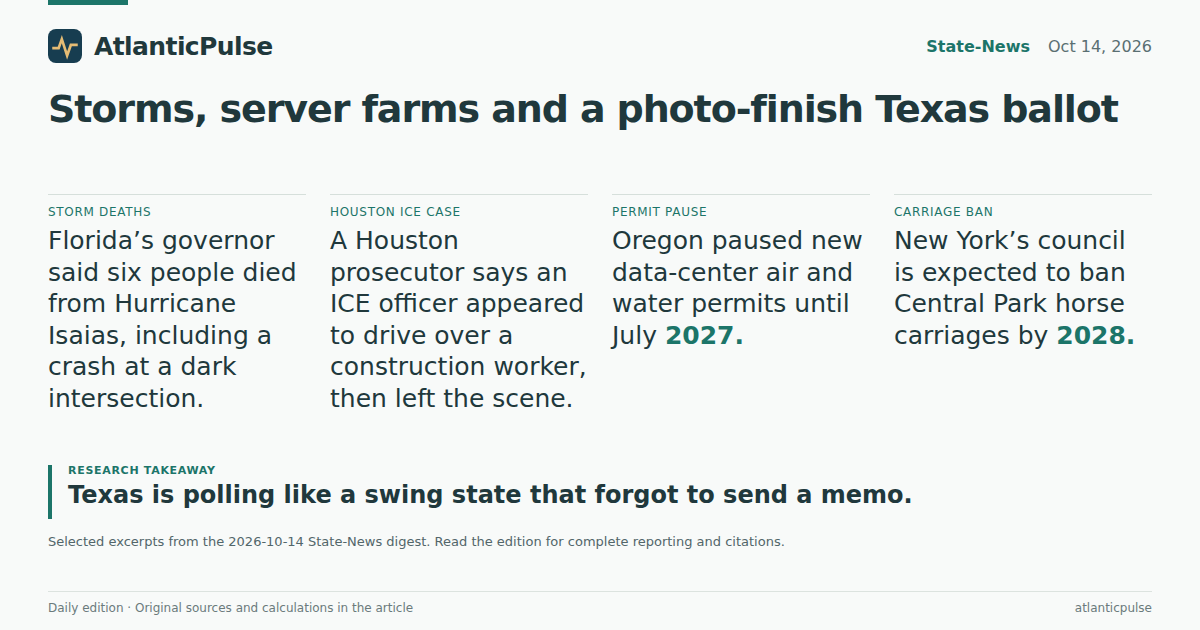
Hurricane Isaias has left the radar and stayed in the obituaries. Florida Governor Ron DeSantis said six people had died in the state, including two previously confirmed fatalities in Escambia County — one when a tree fell on a home, another from carbon monoxide after a generator ran in a garage — plus a crash at a dark intersection and two deaths tied to interrupted medical care. Alabama had already reported two storm deaths. The hurricane made landfall last Saturday and knocked out power for hundreds of thousands across Florida, Alabama, Georgia and Mississippi. HHS has declared public health emergencies for Florida and Alabama, following presidential declarations on 9 October, so certain Medicare, Medicaid and CHIP rules can be loosened while hospitals mop up.
A different collision is occupying Houston. Harris County District Attorney Sean Teare says an ICE officer appeared to drive an unmarked Jeep over a median and into Miguel Parra Hernandez, 48, a Mexican construction worker in the United States for 34 years. Teare, citing surveillance video, says the man was running away, not into the vehicle; ICE calls that claim “reckless” and “false.” Parra Hernandez had surgery for a broken leg, needs ankle surgery, and remains in ICE custody in hospital. Teare is weighing charges including assault with a deadly weapon and accuses the officer of leaving the scene, which he says can overwrite crash data. The same office is still investigating a July ICE shooting that killed Lorenzo Salgado Araujo. In California, a Ninth Circuit panel struck down the “No Vigilantes Act”, which required federal agents to wear visible identification, as a supremacy-clause problem. Transparency, the court essentially held, is a nice idea; states may not dress the feds.
Elsewhere, six people, including a child, died when a Piper PA-46 Malibu flying from Kenosha to Menomonie iced up at 24,000 feet and fell near Mirror Lake State Park. The pilot reported icing and asked to descend; tracking data showed a plunge of up to 4,000 feet per minute. Wisconsin’s DNR, in a quieter but uglier register, notified Enbridge of seven alleged violations on the $1 billion Line 5 reroute, including an 25 August leak of more than 1.3 million gallons of natural gas liquids — described as the state’s largest oil and gas pipeline spill. And in San Francisco, prosecutors charged OpenAI engineer Abdulrahman Alfozan, 35, a Saudi national, with planting a toilet-paper-wrapped recorder in an executive conference room. OpenAI says it used its own models plus CCTV to identify him and reports no evidence that model weights or customer data left the building. If convicted he faces up to five years. Even the companies that sell omniscience still have to check behind the television.
Markets & Economy
Diesel has become October’s unwelcome mascot. Governor Greg Abbott’s disaster proclamation lets qualifying commercial operators use dyed, tax-advantaged diesel on public roads and some haulers carry heavier loads, after AAA data cited in that coverage put Texas diesel around $6.43 a gallon — roughly 75 percent above $3.68 a year earlier. Ordinary pickup drivers should not expect a discount. Colorado’s average hit a GasBuddy record of $6.31, with some Colorado Springs stations above $6.50. The state has one refinery; Patrick De Haan of GasBuddy blames seasonal maintenance, tight global supply, Ukrainian strikes on Russian plants and thinner Chinese exports. Governor Jared Polis signed his own dyed-diesel order. None of this, De Haan notes, actually adds barrels.
While fuel burns wallets, chips and docks are collecting blank checks. GlobalFoundries said it will open two factories in Malta, New York, with up to $21 billion in Japanese financing tied to a Trump-era trade deal — about $10 billion to accelerate a plant slated for 2029 and $10 billion for a second factory. The firm had already drawn Biden-era CHIPS money, which it now says can be redirected. Trump posted that the U.S. government will take shares, Intel-style. Pennsylvania Governor Josh Shapiro pledged more than $371 million toward an $837 million Port of Philadelphia expansion meant to lift container capacity 122 percent and auto capacity 18 percent, create more than 6,000 jobs and unlock $466 million in private and federal money, including a 2,000-foot Southport berth.
California voters, meanwhile, are being asked to invoice the ultra-rich. Proposition 40 would levy a one-time 5 percent wealth tax on roughly 200 residents worth at least $1 billion, earmarking 90 percent for healthcare. The legislative analyst talks of “tens of billions”; backers float up to $100 billion over five years to offset some $30 billion a year in projected federal cuts. Doctors worry it is a blank check that arrives late and runs out. Sergey Brin has put more than $100 million behind rival measures. Independent September polls had support between 45 and 52 percent. In Texas, Abbott and Paxton are talking tough about data centers that skipped water-use surveys — last year only about 30 percent of 329 surveyed facilities replied — but the statute’s bite is a Class C misdemeanor with a $500 maximum fine. Facilities that did report last year used 1.4 billion gallons. Rhetoric remains cheaper than water.
Technology & Industry
Oregon Governor Tina Kotek has done what she long insisted she could not quite do: pause the data-center conveyor. She ordered environmental regulators to halt new air and water pollution permits for data-center projects until 1 July 2027, so her advisory committee and the 2027 legislature can catch up. Amazon’s Shannon Kellogg said the pause was abrupt and would “eliminate thousands of construction jobs” and billions in planned investment; Oregon Rural Action hopes it affects a proposed Amazon hyperscale site in Boardman. Oregon spent two decades luring servers with no sales tax, cheap power and industrial tax breaks. The cloud, it turns out, still needs a building permit.
Utah is building something that actually looks like a power plant. Fervo Energy’s Cape Station geothermal project, turbocharged by a 396-megawatt Google power-purchase agreement announced 1 September, is aiming at 4.3 gigawatts at peak, with early blocks already spoken for by California utilities and Google. Utahns, for now, get the construction dust and not the electrons. PacifiCorp told an 14 October planning meeting that at Fervo’s stated prices — even without tax credits — proxy geothermal looks competitive with gas. Enhanced geothermal means fracturing hot rock rather than waiting for a geyser. Whether Rocky Mountain Power eventually buys some of the leftover 3.4 gigawatts is the local subplot.
The same industry that wants the power is in the dock. Attorneys general in Arizona, Arkansas, Idaho, Iowa, Kansas, Montana, Nebraska and West Virginia sued OpenAI, alleging ChatGPT harmed children and broke consumer-fraud laws; Iowa wants up to $40,000 per violation and a halt to advanced-model testing. OpenAI has recently launched ChatGPT for Teens and parental controls and did not immediately comment. On the surveillance side, Texas Comptroller Don Huffines barred state grant money for Flock and other license-plate readers after cities including Midland dropped contracts. In suburban Cincinnati, Sharonville Lt. Walter Cordes was indicted for allegedly searching Flock 29 times to track someone he knew — a fifth-degree felony. Indianapolis and Joliet have similar cases. The cameras were sold as a way to find stolen cars. They also find acquaintances.
Politics & Policy
Texas, which has spent a generation as a Republican lock, is polling like a swing state that forgot to send a memo. A University of Texas/Texas Politics Project survey of 861 likely voters (25 September–5 October, ±3.34 points) has Democrat James Talarico at 50 percent and Attorney General Ken Paxton at 47 percent for Senate — inside the margin — with Talarico leading among Latino, urban, suburban and women voters in that poll. The same survey has Gina Hinojosa 49 percent to Greg Abbott’s 48 percent for governor. Other October numbers bounce: Marist has Abbott 49–45; YouGov has Hinojosa 48–47; Fox News had Abbott 52–47 in late September, according to a roundup of the field. Early in-person voting runs 19–30 October; Election Day is 3 November. Independent voters, not the usual Texas weather, are the variable.
Washington is treating California’s voter rolls as a crime scene. Acting Deputy Attorney General Trent McCotter gave Secretary of State Shirley Weber 48 hours to vet a password-protected thumb drive of alleged noncitizens who, the Justice Department says, were mailed ballots, and to sequester any it cannot verify. Los Angeles County Registrar Dean Logan has not plugged the drive in, calling it insecure. Attorney General Rob Bonta dismissed “false conspiracy theories.” The department has charged about 90 people this year for election misconduct, including 50 alleged noncitizen voters, against more than 227 million registered voters in 2024. A similar Nevada list collapsed to zero. In Texas, counties say they have cleared a 500,000-record registration backlog caused by a Department of Public Safety software error dating to October 2025; voting-rights groups have sued anyway over a 2021 settlement.
Iowa has decided that nitrates are now on-message. The state has the country’s second-highest rate of new cancers; Des Moines banned lawn watering last year to spare nitrate-removal plants that later ran 193 days straight. Democrat Josh Turek, running for Senate, tells cancer patients “the real issue is the water.” Republican Ashley Hinson says treated tap water meets federal rules and wants infrastructure money, not a farm blame game. Governor candidates Zach Lahn and Rob Sand both talk water without mandating conservation practices. Agriculture Secretary Mike Naig says progress takes a long view; Democrat Chris Jones wants mandates. The EPA still does not classify nitrates as a cancer risk. Iowans testing their wells have stopped waiting for the footnote.
Human Stories / Social Trends
New York is preparing to retire one of its most photographed anachronisms. The City Council is expected next week to pass a ban on Central Park horse-drawn carriages by 2028, after 18-year-old Romanch Mahajan, visiting from India, died in June leaping from a runaway carriage to help his mother. Three mayors had already tried. Mayor Zohran Mamdani declared the industry “coming to an end”; Council Speaker Julie Menin called the status quo a public-safety liability. Drivers and the Transport Workers Union say the bill offers “no meaningful economic relief” and accuse the city of using a tragedy. The proposal would require a workforce transition plan and bar selling horses for slaughter. Fred Astaire will have to dance into a Citi Bike.
Measles, which officials spent a generation treating as a museum piece, is filling hospital beds. Pennsylvania reported 1,222 cases, up 86 in a week, with 225 hospitalizations and five measles-related deaths this year; the CDC is sending extra help. The United States had 4,080 cases as of 8 October. Wisconsin is at 267 confirmed cases in 2026, clustered in Grant, Iowa, Lafayette and Vernon counties, plus smaller counts in Rock, Marathon and Chippewa. Two MMR doses are about 97 percent effective. That statistic is doing more work than it should have to.
In a quieter register, Minnesota Governor Tim Walz said the state is now the fifth to “effectively end” veteran homelessness, with more than 5,000 veterans helped since 2019 and new veterans homes in Montevideo, Preston and Bemidji serving nearly 200 people. “Effectively” is doing some work too — it is a functional definition, not a promise that no one will sleep in a car again — but it is a rarer kind of announcement than an iced-over wing or a tourist’s death at the park’s edge. Between Sauk County, Des Moines taps and a carriage stand on Fifth Avenue, the states are reminding anyone watching that policy is what happens after the postcard.
This daily edition uses stored reporting scoped by publication date, or arrival when publication was absent. Source collection can lag publication.