State-News
Gulf watches, a surviving execution, and states arguing over power
World & Security
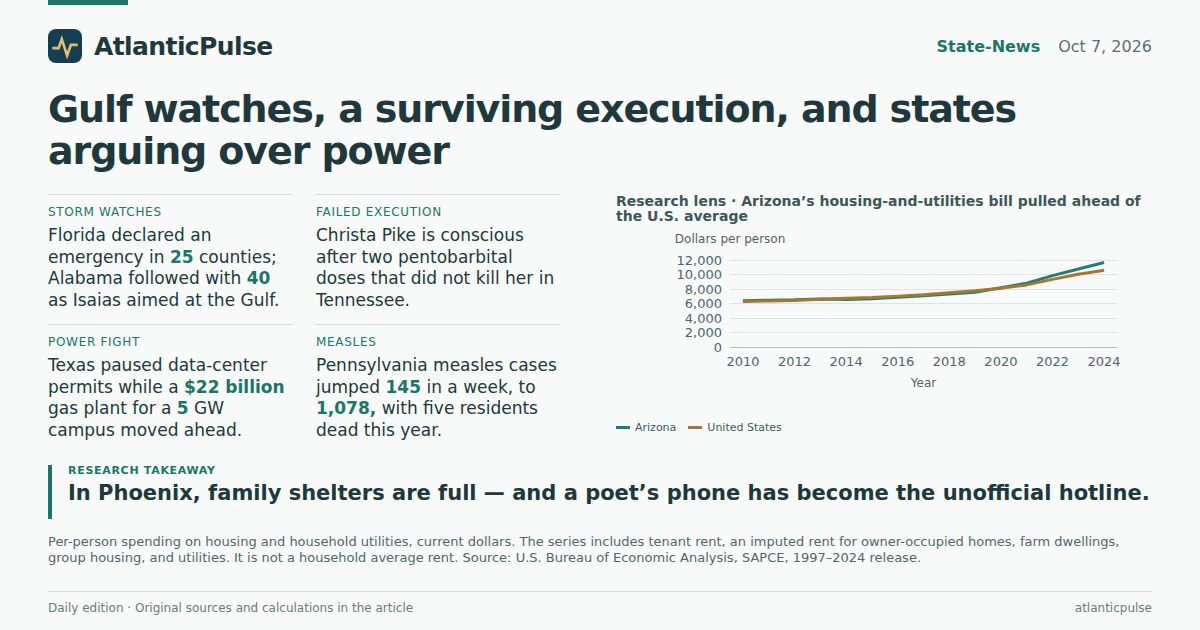
Tropical Storm Isaias spent Wednesday thickening into something the National Hurricane Center is no longer treating as a late-season curiosity. A Hurricane Watch now runs from Bay St. Louis, Mississippi, to Indian Pass, Florida, with surge of 5 to 7 feet possible from Ocean Springs to Indian Pass and in Mobile Bay, and 3 to 6 inches of rain, locally up to 10, from southeastern Louisiana through the Panhandle. An Air Force Reserve Hurricane Hunter found maximum sustained winds near 45 mph Wednesday morning; the official forecast peaks at 110 mph while the storm is still over the Gulf. Florida Gov. Ron DeSantis had already declared an emergency for 25 Panhandle and North Florida counties as Tropical Depression 9 approached, staging fuel, generators, water, and sandbags in Leon and Santa Rosa counties. Alabama Gov. Kay Ivey followed with a 40-county proclamation effective 4 p.m. CDT, directing the National Guard to prepare for possible activation and switching on price-gouging rules through October 14. The paperwork is the easy part. The Gulf, as usual, will write the rest.
In Nashville, attorneys for Christa Pike asked a court to lock down every needle, log, and drug lot from Tennessee’s failed September 30 lethal injection. Pike, 50, is conscious and speaking after two pentobarbital doses that did not kill her; the Death Penalty Information Center says she is the only person known to have survived after receiving lethal-injection drugs during an execution. Her arms were burned and blistered, and she remains handcuffed to a hospital bed. Gov. Bill Lee called the episode “deeply disturbing,” ordered a third-party review, postponed Tennessee’s only other execution this year, and watched the prison chief resign. Texas, unmoved by the optics, still planned to inject Jamaal Howard with pentobarbital on Wednesday for a 2000 convenience-store murder in Silsbee—the first U.S. execution scheduled since Pike’s ordeal.
Security stories elsewhere were less meteorological and more grimly digital. Federal prosecutors charged an 18-year-old Richfield, Minnesota, man with planning an ISIS-inspired shooting at the Mall of America after he bought a disabled AK-47, magazines, and about 200 rounds from an undercover FBI employee; he had picked October 24 and talked of killing 30 to 60 people. In Bellingham, a 30-year-old man was charged with conspiracy to murder persons in a foreign country for allegedly helping a February school shooting in Tumbler Ridge, British Columbia, including livestream tests and last-minute advice on starting a car. Arizona’s Supreme Court disclosed that a phishing click let attackers copy records on 1.3 million people with unpaid fines, nearly 30,000 protection orders, and 150,000 foster-care board reports. The court’s operations kept running. The people in those files may not be so lucky.
Markets & Economy
While the Gulf stacked sandbags, Texas tried to pause the other storm of the decade: data centers. Gov. Greg Abbott directed the TCEQ to stop issuing permits statewide, including for projects off the ERCOT grid, until a broader ERCOT audit wraps in mid-December. San Francisco and Oakland, first among Bay Area cities, voted 45-day moratoriums of their own, citing water, power, and air-quality questions and, in San Francisco’s case, freezing a Bayview expansion that would have jumped from 9 megawatts to 36. The contradiction arrived the same news cycle: a $22 billion, 6.47-gigawatt gas plant in Encinal, La Salle County, billed as Project Star, intended to feed a 5-gigawatt data campus next door and leftover megawatts to the Texas grid, with first power in 2029. States want the tax base. Neighbors want the lights to stay on. Nobody wants to be the official who rubber-stamped the cooling towers.
New York’s books, meanwhile, are having a better year than its consumers. Comptroller Thomas DiNapoli said Wall Street booked $45.9 billion in first-half profits, up 51.3% from the same period in 2025, and could top $90 billion for the year if the pace holds. The securities industry already supplied about $26.3 billion in state tax revenue in fiscal 2025-26. The New York Fed’s Survey of Consumer Expectations was less festive: one-year inflation expectations jumped to 3.9% from 3.6%, the highest since 2023, even as the five-year reading stayed at 3%. In Raleigh, the House answered pump-price politics the old-fashioned way, passing a temporary suspension of the state’s 41-cent motor-fuels tax through November 30—a roughly $360 million hit to highway funds that lawmakers propose to backfill from the Inflation Reserve, plus a harvest-season pass for farmers to run dyed diesel on the road. It still has to finish the legislative process before anyone’s tank gets cheaper.
Technology & Industry
Utah is trying to make artificial intelligence sound like a bedside manner. The state’s Office of Artificial Intelligence Policy signed master agreements with Intermountain Health and University of Utah Health to test refill systems, dermatology, and postpartum physical therapy, expanding a first-in-the-nation program that already lets an AI approve some prescription renewals—a setup the Utah Medical Licensing Board had criticized for skipping their input. Intermountain’s Dan Liljenquist warned that up to 40% of today’s providers may be gone by 2035. Gov. Spencer Cox separately signed an executive order requiring AI literacy training, human-in-the-loop review for decisions affecting individual rights, and annual progress reports starting July 1, 2027. California took the opposite rhetorical tack: Gov. Gavin Newsom’s SB 947, the No Robo Bosses Act, bars employers from firing or disciplining workers on AI alone. One state wants the algorithm to refill your acne cream. The other wants a human to sign the pink slip.
On the ground, the robots are already clocking in. Waymo began fully driverless testing in downtown Detroit and nearby neighborhoods this week, using Chinese-made Zeekr Ojai vans and Jaguar I-Paces, with rides still limited to employees and no public-service date. Einride and EASE Logistics put SAE Level 4 cabless electric trucks into daily freight runs between Marysville, Ohio, warehouses. In New Haven, QuantumCT opened a 4,500-square-foot hub with $15 million already awarded from a National Science Foundation engine that could reach $160 million over ten years if progress holds. The Arizona court breach is the reminder that “innovation” still includes someone clicking a malicious email on a backup server.
Politics & Policy
Four weeks from Election Day, governors and senators spent Wednesday rediscovering that debates are where you restate what you already mailed. In Owings Mills, Maryland Gov. Wes Moore and Republican Dan Cox replayed their 2022 grudge match: Cox as the tax-and-spend prosecutor, Moore as the Trump-tagger quoting a former governor who once called Cox a “Q-Anon whack job.” A UMBC poll had Cox down 27 points before they even sat down; both men left saying they felt good about it, which is the one bipartisan result of the hour. In Maine, five-term Sen. Susan Collins and Democrat Troy Jackson spent an hour on Brett Kavanaugh, ICE, and whether Collins’s 96% Trump-vote statistic is “greatly misleading.” Jackson leads by about a point in Decision Desk HQ averages; three more debates remain, which is either civic virtue or a hostage situation. Michigan’s Jocelyn Benson and John James argued data-center moratoriums, a gas-tax holiday, Canadian tariffs Benson put at $5,600 per household, and a Medicaid shortfall James said has not even taken effect.
Pennsylvania, at least, looks like a nap. Quinnipiac found Gov. Josh Shapiro leading Republican Stacy Garrity 59% to 34% among likely voters, with 63% job approval and 17% of Republicans in his column. Independents want Democrats to hold the U.S. House 56% to 27%. Sen. John Fetterman, on the third anniversary of October 7, remains underwater overall—50% disapprove, 41% approve—even as Republicans give him 74% approval and 72% of Democrats disapprove. The map is not one race. It is several different countries sharing a November calendar.
Human Stories / Social Trends
The ugliest local story was not a poll. Prosecutors in Los Angeles charged Guojun Xuan, 66, and Silvia Zhang, 39, with conspiracy to commit child abuse after security video from a $10 million Arcadia mansion allegedly showed systematic beatings of 14 surrogate-born children, most between one and three years old. Six more children were found at other homes, bringing the total to 21. The couple ran Future Spring Surrogacy from the house; a nanny charged in the original infant injury has fled to China. Both defendants pleaded not guilty. In Phoenix, ProPublica found people in homeless families at 2,103 this year, the highest since 2015, with nearly 200 families on the shelter waitlist in late September. A 26-year-old poet, Austin Davis, has become the unofficial hotline because calling 211 can mean months. In a county of nearly five million, the backup plan is a man in a park with an energy drink.
Chicago buried a different kind of failure. Seven-year-old Eddimar Hernandez Chacon was fatally stabbed on October 3 while walking hand-in-hand with her sister; Shavon Gayden, 48, is charged with first-degree murder in what police called an unprovoked attack. Gayden’s mother said she had been trying for years to get her daughter help. Pennsylvania’s measles count jumped 145 in a week to 1,078, with five residents dead this year, 207 hospitalizations, and less than 1% of patients fully vaccinated. New York declared its own measles disaster emergency at 110 cases—more than twice last year—mostly among adults, with the order running through November 4. Against that, a 37-year-old Lewisville, Texas, barber found $128,514 in cash and 19 checks sitting on a Bank of America ATM, walked it to a Chick-fil-A he thought might own it, then called 911. He asked to stay anonymous and took no reward. Humanity, it turns out, still has a few walk-up ATMs.
This daily edition uses stored reporting scoped by publication date, or arrival when publication was absent. Source collection can lag publication.