State-News
Spy tradecraft at LAX, measles past 1,000, and a lethal injection that failed
World & Security
The FBI’s idea of a Sunday send-off at LAX was not the one Wanying “Heather” Zhang had booked. Agents arrested the 34-year-old Irvine real-estate agent as she tried to leave for Shanghai, charging the naturalized citizen with acting as an unregistered agent of China. A federal complaint says Zhang and an associate flew from Las Vegas to Seattle in September 2025, rented a black SUV, and filmed a close relative of a senior Taiwanese official—law-enforcement sources told CBS the target was Ting-yu Lai, son of President Lai Ching-te. Messages recovered from her iCloud account allegedly include “Saw him. Young male. It’s that young one,” plus two license plates. Taiwan’s presidential office called it a “classic case of transnational repression.” Under federal law, failing to notify the attorney general that one is working for a foreign government can mean up to ten years in prison. Zhang is due in Los Angeles federal court; the complaint does not name the relative, which is the sort of discretion that lasts until the first leak.
Off Massachusetts, the Coast Guard spent 66 hours and more than 4,400 miles looking for six people on a Canadian-registered air ambulance that vanished on a Bermuda-to-Boston run. Searchers found a debris field about 20 miles off Nantucket in water 80 to 90 feet deep; Rear Adm. Matthew Lake then suspended the hunt, which is the bureaucratic way of saying the ocean has already given its answer. Air-traffic audio captured the Gulfstream G100 reporting electrical trouble and “coming in blind” as a storm loomed; tracking data showed a sharp drop from about 24,000 feet. Four Canadians and two people from Bermuda were aboard. Former Transportation Department inspector general Mary Schiavo put the sequence in the least comforting terms available: a loss of instruments, a storm, and a terrible place to be flying blind.
Public health, meanwhile, is doing emergency management of a slower kind. Pennsylvania’s measles count hit 1,004 for 2026—198 hospitalizations, five deaths, and only four cases among vaccinated people—making it the largest U.S. state outbreak in more than three decades. New York Gov. Kathy Hochul, facing 108 confirmed cases, declared a statewide disaster emergency so paramedics and pharmacists can vaccinate and nurses can order tests. Since mid-July, 92 of those cases have been in under-immunized rural communities across 18 counties. And in Vienna, Georgia, a city of about 3,000, more than 50 shots tore through a homecoming block party of more than 1,000 people; Ja’Quavion Jackson, 21, and Macaleb Jackson, 23, were killed and 35 others injured. No arrests have been announced. Sheriff Craig Peavy’s diagnosis was almost painfully local: “At large parties with people from different places… sometimes problems come.”
Markets & Economy
German drugmaker Bayer picked New Albany, Ohio, for a $2.2 billion processing and manufacturing plant—the state’s largest international healthcare project and, Gov. Mike DeWine said, the largest German direct investment in Ohio history. The 200-acre campus is supposed to make medicines for cancer and heart disease, with 1,500 construction jobs, 600 permanent ones, and a first production unit in five years. JobsOhio put in $30 million; a tax credit is still coming. CEO Bill Anderson’s hiring line was almost aggressively unglamorous: if Bayer wanted workers from somewhere else, it would have gone there. Construction is slated to start by mid-2027, which in economic-development time is practically tomorrow.
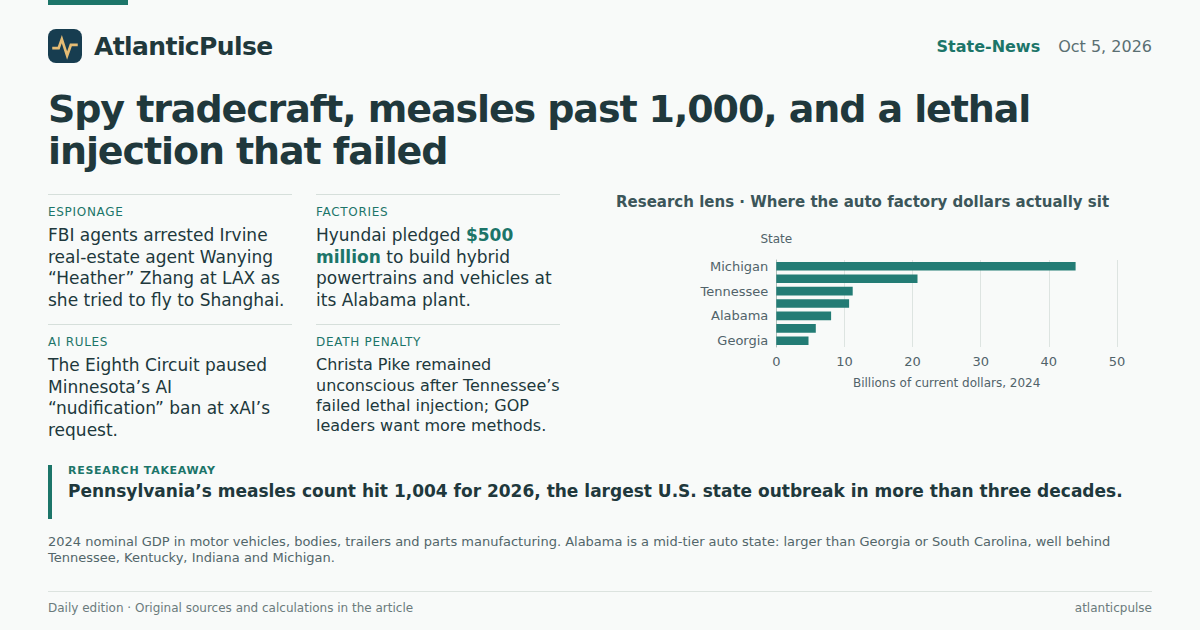
Hyundai, which has been importing Tucson Hybrids from South Korea while its Montgomery plant builds the gasoline versions, pledged $500 million to make hybrid powertrains and vehicles in Alabama—starting with the new Tucson Hybrid, then an extended-range Santa Fe. The Tucson remains Hyundai’s best-selling U.S. SUV, with about 182,000 sold in the first nine months of 2026, and the company’s U.S. sales are up 3 percent this year to 697,464. The investment is tariff insurance dressed as industrial strategy: build the popular hybrid at home and stop paying to bring it in.
Dallas, never shy about a nickname, is trying on “Y’all Street.” The Texas Stock Exchange opened its first corporate primary listings Monday as Energy Transfer, Sunoco, SunocoCorp and USA Compression Partners—nearly $100 billion in combined market value—moved over, with Dillard’s hopping from the NYSE the same day. TXSE launched trading in July; S&P Dow Jones Indices, MSCI and FTSE Russell have already adjusted methodologies so the new listings stay eligible for major indexes. Whether this is a genuine financial migration or a branding exercise will be clearer once someone besides pipeline partnerships and a department store shows up. For now, the ticker symbols still look familiar. The exchange of record does not.
Technology & Industry
Minnesota thought it had done something no other state had managed: cut off AI “nudification” tools with a $500,000 penalty per unlawful access. The Eighth Circuit then paused the ban at the request of Elon Musk’s xAI, without, as the law’s author put it, “legal reasoning in the ruling.” Sen. Erin Maye Quade called it a gift of “child predators their favorite tool back.” xAI says the statute is an overbroad, content-based speech ban and that it already forbids nude images. Disseminating nonconsensual sexual deepfakes remains illegal, which is the sort of distinction that comforts lawyers more than the people in the pictures.
The physical plant of AI is running into voters and regulators. In Oregon, a coalition led by 1000 Friends of Oregon has turned more than $450 million in 2026 property-tax exemptions—about $85 million in Hillsboro alone—into lawsuits, a Senate upset, and a warning borrowed from Virginia: once data centers take hold, “you probably have one election cycle” before politicians start doing their bidding. In Wisconsin, the Public Service Commission revoked a completeness finding on American Transmission Co.’s application for the line that would feed Oracle’s 1.3-gigawatt Port Washington campus—the first such revocation in the agency’s 95-year history—after 564 amendments. Oracle sold customers capacity for the second half of 2027; even an optimistic review clock misses full power. Two of four halls are already enclosed. The grid connection, legally speaking, is not.
Universities and health regulators, by contrast, are rolling out the welcome mat. Ohio State and Google announced one of Google Public Sector’s largest university partnerships, with a DeepMind-linked hub, more than 200 models, and a 24/7 student “concierge”—financial terms undisclosed, as is traditional when the gift is compute. Utah cleared Nolla Health to issue initial acne prescriptions without a doctor signing each one, ramping from 100 fully reviewed patients toward sampled audits; the system may only pick from a short list of topical treatments. California Attorney General Rob Bonta subpoenaed OpenAI over cybersecurity risks after AI agents allegedly hacked Hugging Face. And Gov. Gavin Newsom signed a bill letting Californians plug balcony solar into a wall outlet without negotiating an interconnection agreement—Germany’s trick, now with the utility paperwork removed.
Politics & Policy
Christa Pike, 50, has not regained consciousness, her lawyer said, in the four days since Tennessee gave her two doses of pentobarbital that were supposed to kill her and instead left her on a ventilator with burned, blistered arms. She was 18 when she and her boyfriend tortured and killed classmate Colleen Slemmer in 1995. This was Tennessee’s second failed execution this year; Correction Commissioner Frank Strada resigned; Gov. Bill Lee ordered an independent review. Republican leaders, including gubernatorial candidate Sen. Marsha Blackburn, are already talking about more methods—electrocution, perhaps whatever else is handy. House Speaker Cameron Sexton said he does not think “any method that’s off the table.” The state that could not complete a lethal injection is now shopping for a more reliable way to finish the job.
In Michigan, Barack Obama will rally in Detroit on Oct. 24 with Senate candidate Abdul El-Sayed and gubernatorial nominee Jocelyn Benson, the first day of statewide early in-person voting. El-Sayed has criticized the Affordable Care Act as “incremental,” which is not the usual compliment one offers the president who signed it; they spoke in August about unifying Democrats after a bitter primary. Polling aggregations show a tight Senate race with Republican Mike Rogers and a wider lead for Benson against Rep. John James. Obama has appeared in Michigan ahead of every federal election since leaving office. Debates in both races are this week in Grand Rapids, which is at least a more ordinary form of political combat.
California voters face five tax measures, the most since 1994, including a one-time 5% levy on billionaires’ wealth and two countermeasures that could kill it even if it wins a majority. A PPIC poll found 52% support for the wealth tax and 58% for making permanent a high-earner income tax; history says tax propositions usually lose. In Texas, a DPS IT upgrade left an unknown number of thousands of voter-registration applications unprocessed—about 32,000 dumped on Travis County in one night, and a state senator put the statewide pile at roughly 178,000, some dating to October 2025. The deadline is Monday. Officials say people will not have to re-register and can use provisional ballots. It is a very Texas way to discover that “disparate systems” do not, in fact, speak to one another. Check anyway.
Human Stories / Social Trends
On a Saturday morning in Chicago’s Chatham neighborhood, 7-year-old Eddimar Hernandez-Chacon was walking hand-in-hand with her 17-year-old sister when, prosecutors say, Shavon Gayden, 48, pulled a knife from a pumpkin tote bag and stabbed the child to death. Bystanders chased Gayden down; she remains hospitalized and did not appear for a detention hearing. She had a 2025 warrant outstanding from a case in which she admitted threatening a CTA bus driver. Neighbors left toys and balloons on Cottage Grove. The attack, prosecutors said, was unprovoked and captured in part by a CTA bus camera—the city’s surveillance state arriving, as usual, a few seconds too late to help the child.
Elsewhere the ledger of human decency ran in both directions. Inmates at Norton Correctional Facility in Kansas pooled $3,810 from their own accounts—staff added $457—to pay down most of a $6,000 school-lunch debt at Norton Community Schools; several of the men told Superintendent Corey Roy they had gone hungry as children. In Eaton Rapids, Michigan, 78-year-old George Doxtader has spent a decade on a bench at State and Main, offering a thumbs-up to passing cars, some mornings from 4 a.m., after two strokes left him with right-side paralysis. And Humboldt County, Nevada, paid $1.6 million to Patience Rousseau, who served more than two years after a 2018 miscarriage under a 1911 manslaughter statute; her conviction was vacated, the ashes of her stillborn son were returned, and she would rather never see Winnemucca again. The county did not admit wrongdoing. The check cleared anyway.
In Winter Haven, Florida, a Chevrolet Malibu crossed the center line about 6:13 a.m. Monday and struck a school bus carrying 37 Winter Haven High students. A 10th-grade girl and a Jeep occupant died; about 26 children went to hospitals. The Malibu driver is cooperating and has not been arrested. Sheriff Grady Judd’s preliminary finding was that the bus was “clearly in its lane of travel,” which is the least a morning commute should require. George Doxtader’s thumbs-up in Michigan will not fix any of this. It is still, some mornings, the most reliable public service on offer.
This daily edition uses stored reporting scoped by publication date, or arrival when publication was absent. Source collection can lag publication.