Research
Hyundai’s $500 million, next to the auto industry Alabama already has
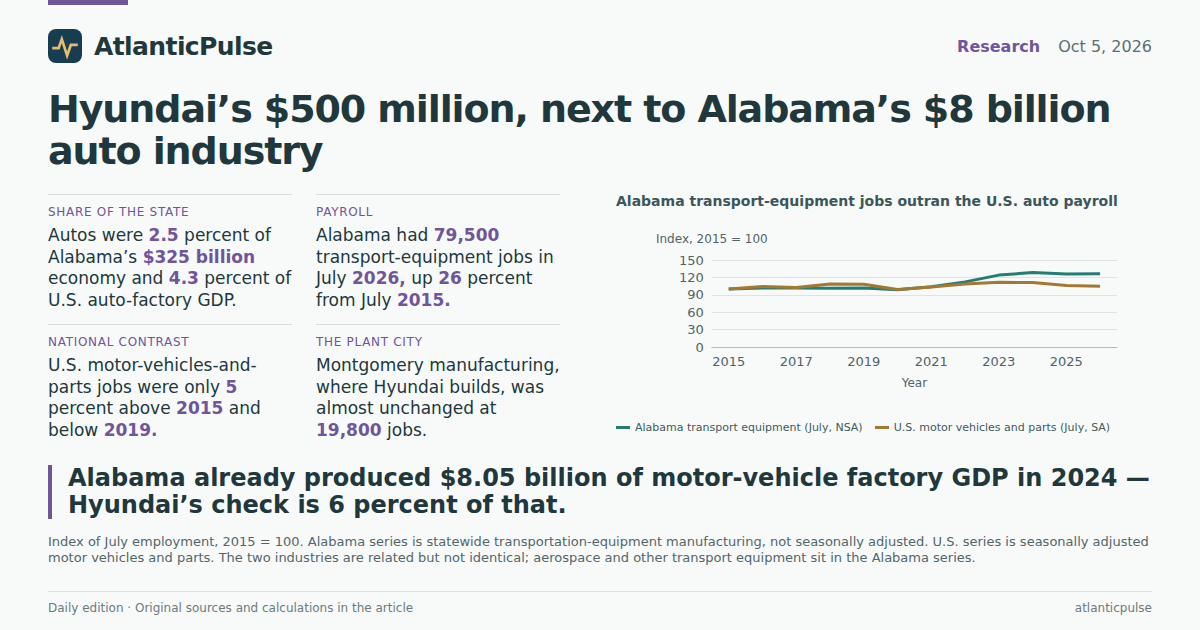
A half-billion dollars, in a state that already builds cars
Hyundai’s Montgomery plant has been making gasoline Tucsons for years while the hybrid versions arrived from South Korea. The company now says it will invest $500 million to build hybrid powertrains and vehicles there, starting with the new Tucson Hybrid and later an extended-range Santa Fe, as a way to thicken its U.S. manufacturing base and shrink its exposure to import tariffs (Just Auto). That is real money. It is also a number that needs a denominator.
Alabama is not waiting for its first auto plant. Mercedes, Honda, Hyundai and a Mazda-Toyota joint venture have been assembling vehicles in the state for decades. The official books are less cinematic than a groundbreaking, but they answer a simpler question: how large is the industry Hyundai is adding onto, and has it already been hiring? The short version is that Alabama already books about $8 billion a year in motor-vehicle factory output, that this is a mid-tier auto state rather than a new one, and that $500 million is a large check next to a single assembly hall and a modest one next to the industry already on the ground.
Alabama’s motor-vehicle factory output, 1997–2024

View exact chart values
| year | gdp_billions |
|---|---|
| 1997 | 0.88 |
| 1998 | 1.42 |
| 1999 | 1.63 |
| 2000 | 1.88 |
| 2001 | 1.98 |
| 2002 | 2.37 |
| 2003 | 2.83 |
| 2004 | 3.48 |
| 2005 | 3.82 |
| 2006 | 3.94 |
| 2007 | 3.58 |
| 2008 | 3.18 |
| 2009 | 1.43 |
| 2010 | 3.08 |
| 2011 | 4.11 |
| 2012 | 4.69 |
| 2013 | 5.46 |
| 2014 | 5.32 |
| 2015 | 5.88 |
| 2016 | 6.36 |
| 2017 | 6.52 |
| 2018 | 6.65 |
| 2019 | 7.11 |
| 2020 | 5.5 |
| 2021 | 5.14 |
| 2022 | 6.28 |
| 2023 | 7.52 |
| 2024 | 8.05 |
Eight billion dollars of factory output, two and a half percent of the state
In 2024, the latest year in the Bureau of Economic Analysis annual state GDP accounts, Alabama produced $8.05 billion of output in motor vehicles, bodies, trailers and parts manufacturing. That is NAICS 3361–3363: cars, light trucks, bodies, trailers and parts — not aerospace, not shipyards. The same tables put Alabama’s entire economy at $325.3 billion that year. Autos were 2.5 percent of it.
The industry is much larger than it was. The same current-dollar series was $878 million in 1997 and $5.88 billion in 2015. It fell hard in 2009, sagged again in 2020–21, then climbed to a new high in 2024. Those are nominal dollars, so inflation does some of the lifting; the direction is still up. Compensation paid in the same industry reached $5.26 billion in 2024, up 79 percent from $2.94 billion in 2015. Factory output and factory paychecks both grew. Hyundai’s $500 million pledge is about 6 percent of one year of that auto GDP. It would be a noticeable addition to a plant. It would not remake the state.
Among the auto states that actually book this industry, Alabama sits in the middle of the pack. Michigan still dwarfs everyone at $43.9 billion of motor-vehicle GDP in 2024. Indiana follows at $20.7 billion, then Tennessee at $11.2 billion and Kentucky at $10.7 billion. Alabama’s $8.05 billion is ahead of South Carolina ($5.8 billion) and Georgia ($4.7 billion). The U.S. total was $185.9 billion; Alabama was 4.3 percent of it. That is a serious Southern auto state. It is not Detroit with better weather.
An $8 billion auto industry in a $325 billion state

View exact chart values
| category | gdp_billions |
|---|---|
| Motor vehicles, bodies, trailers and parts | 8.05 |
| Rest of Alabama GDP | 317.29 |
Where the auto factory dollars actually sit

View exact chart values
| state | gdp_billions |
|---|---|
| Georgia | 4.73 |
| South Carolina | 5.8 |
| Alabama | 8.05 |
| Kentucky | 10.69 |
| Tennessee | 11.21 |
| Indiana | 20.73 |
| Michigan | 43.92 |
The jobs that grew — and the ones that barely moved
Payrolls tell a noisier story, because the finest statewide job series that covers Alabama’s vehicle plants is broader than cars. BLS State and Area Employment counts transportation-equipment manufacturing, which folds in aerospace and other transport equipment alongside motor vehicles. Huntsville’s missile and aircraft work lives in that number. Treat it as an upper bound on auto jobs, not a headcount of Hyundai and Mercedes.
Even with that caveat, the trend is not subtle. In July 2026, Alabama had 79,500 transportation-equipment jobs, not seasonally adjusted. That was up 26 percent from 62,900 in July 2015 and 70 percent from 46,900 in July 2005. The national motor-vehicles-and-parts payroll, a narrower and seasonally adjusted series from the Current Employment Statistics program, was 964,500 in July 2026 — only 5 percent above July 2015 and 3 percent below July 2019. Indexed to 2015, Alabama’s broader factory series pulled away after 2021; the U.S. auto payroll did not.
Montgomery, where Hyundai actually builds, looks different. All manufacturing in the metro — cars plus everything else — was 19,800 jobs in July 2026, only 6 percent above July 2015. Statewide factory employment as a whole, seasonally adjusted, was 281,100, up 9 percent over the same span; total nonfarm jobs were 2.21 million, up 12 percent. The hiring that shows up in transportation equipment is not, on these books, a Montgomery boom. It is a statewide one, and a chunk of it is probably not cars.
Compare Alabama with its neighbors on the same July 2026 transportation-equipment yardstick and the scatter plot does some of the explaining. Indiana had 119,400 of those jobs and $20.7 billion of auto GDP. Alabama had more transport-equipment jobs than Tennessee (70,200) or Kentucky (60,800) but less auto-specific output than either. That gap is what an aerospace cluster looks like when you leave it in the jobs series and take it out of the GDP series. The honest read is not that Alabama secretly passed Kentucky. It is that the state’s vehicle plants are real, its rocket plants are also real, and a single $500 million hybrid line will not be visible in either series for a while.
Alabama transport-equipment jobs outran the U.S. auto payroll

View exact chart values
| year | alabama_index | us_index |
|---|---|---|
| 2015 | 100 | 100 |
| 2016 | 101.7 | 104.5 |
| 2017 | 101.7 | 102.6 |
| 2018 | 101.4 | 108.5 |
| 2019 | 101.9 | 108.1 |
| 2020 | 98.6 | 99 |
| 2021 | 103.8 | 103.7 |
| 2022 | 112.2 | 108.6 |
| 2023 | 124 | 111.5 |
| 2024 | 128.3 | 111.1 |
| 2025 | 125.8 | 106.1 |
| 2026 | 126.4 | 104.9 |
Jobs versus factory output in the Southern auto belt

View exact chart values
| state | jobs_thousands | gdp_billions |
|---|---|---|
| Alabama | 79.5 | 8.05 |
| Tennessee | 70.2 | 11.21 |
| South Carolina | 55.9 | 5.8 |
| Kentucky | 60.8 | 10.69 |
| Indiana | 119.4 | 20.73 |
What this does, and does not, say about tariffs
Hyundai’s own explanation for the money is straightforward: build the popular hybrid at home rather than import it. The Tucson is already its best-selling U.S. SUV, with about 182,000 sold in the first nine months of 2026 (Just Auto). Alabama households, for their part, spent $6.32 billion on new motor vehicles in 2024, according to BEA’s state consumption accounts — not far from the $8.05 billion of auto factory output the state produced that year. The showroom bill and the factory bill are the same order of magnitude. That is a description, not a closed loop: Alabamians do not only buy Alabama-built cars, and Alabama plants do not only sell to Alabamians.
None of this proves that tariffs caused the last decade of hiring, or that $500 million will add a particular number of jobs. The GDP figures are annual, current-dollar, and end in 2024. The job figures run through July 2026 and mix industries. Missing observations were left missing. What the books do show is more useful than a groundbreaking photo: Alabama already has a mid-sized auto industry, it has been paying more into it, and Hyundai is writing a large check to change what one existing plant builds — not to invent the industry from scratch.
Sources and methods
This article uses official time series from a pinned, read-only catalogue. BEA annual state GDP and compensation are from the April 9, 2026 regional release; the motor-vehicle industry series (NAICS 3361–3363) for Alabama ends in calendar year 2024 even though the product envelope lists 2025. BEA state personal consumption expenditures for new motor vehicles end in 2024 (SAPCE release dated September 26, 2025). BLS State and Area Employment and Current Employment Statistics snapshots are dated August 24, 2026, with observations through July 2026.
Alabama transportation-equipment employment is not seasonally adjusted; job-level comparisons use July of each year. Alabama manufacturing and total nonfarm employment are seasonally adjusted. National motor-vehicles-and-parts employment is seasonally adjusted. Those series are not the same industry: transportation equipment includes aerospace and other transport equipment, which matters in Alabama because of Huntsville. Motor-vehicle GDP is the narrower auto measure. Units were preserved (thousands of jobs; millions of current dollars for GDP and PCE; thousands of dollars for compensation). Missing values were not treated as zero. Hyundai’s $500 million is the announced plant investment from contemporaneous reporting, not an official GDP increment, and is compared with 2024 auto GDP only as a scale check. No causal effect of tariffs or of the investment is inferred from these descriptive comparisons. Provider lag is normal; these are not current-day observations.
Research completed 2026-10-06, for the October 5, 2026 news edition. The available source data may cover earlier periods; see the observation periods and source vintages above.
- U.S. Bureau of Labor Statistics, State and Area Employment: Source 1, Source 2
- U.S. Bureau of Labor Statistics, Current Employment Statistics: Source 1, Source 2
- U.S. Bureau of Economic Analysis, annual state GDP and income: Source 1, Source 2
- U.S. Bureau of Economic Analysis, personal consumption expenditures by state: Source 1, Source 2