State-News
Capitals, Courts and Chatbots: How the States Spent a Long Thursday
World & Security
Tennessee spent Wednesday evening trying to carry out a death sentence and ended the night with an ambulance. Officials administered two doses of pentobarbital to Christa Gail Pike, 50, after the U.S. Supreme Court lifted a last-minute stay; she remained alive, snoring, and was taken from Riverbend Maximum Security Institution to a hospital. Pike, convicted of a 1995 Knoxville murder she committed at 18, would have been the first woman executed in the state in more than 200 years. Governor Bill Lee ordered a third-party review and halted remaining executions for the year, calling the episode a failure of a “most serious” state duty. Death Penalty Information Center director Robin Maher called it “singular and unparalleled”: other lethal-injection failures have involved veins that could not be found, not inmates who received the drugs and lived. It was Tennessee’s second aborted execution this year after Tony Carruthers in May. The protocol, the Associated Press noted, tells teams to give a second set of syringes “if the inmate is not deceased.” It does not say what to do when that, too, fails.
In Austin, the threat arrived as a Tuesday-night tip rather than a botched protocol. Texas Department of Public Safety said it had “credible information” of a violent attack planned for Thursday at the Capitol; SWAT officers arrested Benny Caldera Jr., 40, about 3 a.m. Wednesday at a home in Converse, near San Antonio. He was charged with making a terroristic threat against a public servant, later taken into federal custody, and the building stayed open anyway — the Texas version of keeping calm and carrying on, with extra troopers. Governor Greg Abbott, never one to undersell a press statement, said the state will not tolerate threats of violence against the Capitol. A thousand miles north, the Justice Department opened a different kind of fight: Attorney General Todd Blanche filed a judicial-misconduct complaint against Minnesota federal judges, including former Chief Judge Patrick Schiltz and Judge John Tunheim, over a New York Times interview about Operation Metro Surge. The department wants them recused from Homeland Security cases. The judges say they followed Judicial Conference guidance that lets them talk about the rule of law. The caseload numbers, at least, are not in dispute: Minnesota’s district went from two habeas petitions in the first quarter of 2025 to more than 1,100 in the first quarter of this year, according to that same reporting.
Maryland, meanwhile, became the eighth state sued by the Justice Department over rules that tell officers — including federal agents — not to hide their faces on the job. Senate Bill 1 took effect Thursday; the suit names the state, Attorney General Anthony Brown, and Montgomery and Prince George’s counties, and seeks a temporary injunction. Governor Wes Moore’s office declined to litigate in a press release but repeated that “an untrained, unqualified, and unaccountable ICE is unacceptable.” The constitutional argument is the old one about who gets to write the dress code for federal agents; the political argument is about masked raids in suburban Maryland. Public health offered a quieter, grimmer security story. Pennsylvania recorded a fifth measles-associated death, an unvaccinated Lancaster County resident, as the state logged 943 cases across 39 counties — its first measles deaths in 35 years, in what officials call the nation’s worst measles year since 1991. Two of the earlier deaths were infants too young to be vaccinated. International health officials will meet in November to decide whether the United States and Mexico have lost measles-free status.
Markets & Economy
If you needed a map of American anxiety, you could do worse than a diesel pump in the Midwest. Ohio lawmakers, called back to Columbus on a nine-day sprint after both gubernatorial candidates demanded relief, passed a 90-day holiday on the state’s 38.5-cent gasoline tax and 47-cent diesel tax, pulling $725 million from reserve accounts so road money would not take the hit. Midwest diesel had just hit an all-time high of $6.68 a gallon, according to the federal data cited in the Statehouse fight; regular gasoline was at its highest since May. Republicans rammed the bill through with an emergency clause so it could take effect before early voting. Democrats split between frustrated yeses and people calling it a stunt that oil companies would pocket. Vivek Ramaswamy, watching his own poll numbers, called the pace a preview of how he would govern: “focused,” “substantive,” and, above all, fast.
Minnesota tried a different kind of harvest math. Governor Tim Walz signed an executive order letting trucks hauling corn, soybeans, wheat, potatoes, carrots, sugar beets and forest products exceed regular weight limits by up to 10 percent on state and local roads — not interstates — so fewer trips burn less fuel. AAA put national diesel above $6.50 a gallon; Minnesota farmers say about 90 percent of on-farm fuel goes to planting, tending and harvest, at roughly eight gallons an acre for corn and soybeans. Similar weight or hours-of-service relief has gone out in Alabama, Arkansas, California, Georgia, Louisiana, Nebraska, North Dakota, Oklahoma, South Dakota and Texas. Walz blamed a war “with no clear mission” for the wreckage at the pump. The order lasts until October 30 or until he rescinds it.
California, never shy about a nine-figure number, closed a different ledger. Lyft agreed to pay $272.5 million to settle claims it misclassified drivers as contractors before Proposition 22 took effect in December 2020 — Attorney General Rob Bonta called it the state’s largest wage-theft settlement, covering rides from April 2016 through mid-December 2020. The company will pay $120 million in the first year and $152.5 million over the next three, with interest, and still insists drivers were always properly classified. Uber is not in the deal. Illinois, for its part, agreed with industry groups to ask a Sangamon County court to push a 0.2 percent digital-asset tax from January 1, 2027, to July 1, 2027, while a lawsuit continues. And TSMC, according to Taiwanese reporting picked up by TrendForce, is weighing a second U.S. hub of as many as six advanced wafer fabs around Dallas that could top $265 billion — more than its Arizona commitment. The board has not approved it, suppliers have not been told, and no SEC filing exists. In chip-land, that is how you float a quarter-trillion-dollar maybe.
Technology & Industry
Gavin Newsom’s last full day to sign bills was a reminder that California still treats itself as the country’s unofficial AI legislature. He signed measures banning employers from using the technology alone to fire someone, from predicting a worker’s emotional state with biometric data, and from skipping written notice when AI is responsible for mass layoffs. He also ordered state agencies to keep saying “artificial intelligence,” not the “super intelligence” label the White House has been pushing on diplomats — a linguistic turf war that would be funnier if the underlying fight were not about who gets to write the rules. “AI should expand opportunity — not come at the expense of workers and families,” Newsom said, criticizing Washington for leaving the field to a voluntary industry accord. He left the door open to a special session. He also confirmed, with characteristic timing, that he would not be watching the governor’s debate that night.
Renters got a smaller, more literal plug-in. Senate Bill 868, the Plug Into the Sun Act, lets Californians use portable solar devices — up to 1,200 watts of AC output, UL-certified — through an ordinary receptacle, without utility permission or interconnection fees, starting January 1, 2027. California is late to the balcony-solar wave that began in Utah, but it is the biggest market by far. Utilities did extract a 2030 sunset on the permission-free rules, which advocates now plan to beat the old-fashioned way: put so many panels on so many balconies that no legislator will vote to unplug them. The same desk that signed the solar bill vetoed SB 1130, which would have required a prominent recording indicator on wearable cameras by 2028. Newsom said the definition was broad enough to snag smartwatches. The manufacturer mandate died with it. Samsung’s glasses, due soon, will arrive in a state where the LED is still a product choice, not a statute.
Elsewhere, juries and subpoenas did the regulating. A New Mexico jury found Facebook violated the state Unfair Practices Act more than 43 million times — misleading users about data practices, third-party access, and post-Cambridge Analytica audits it did not complete. Penalties can run to $5,000 per violation; a judge, not the jury, will set the bill, and Meta is already talking about the First Amendment. In Sacramento, Bonta issued an investigative subpoena to OpenAI over cybersecurity incidents tied to its models, including a Hugging Face hack by AI agents earlier this year. Iowa is leading a 15-state coalition asking similar questions. The Federal Trade Commission, a senior official told Reuters, is running its own industry-wide probe into Anthropic, OpenAI and other labs — billed as the first U.S. enforcement effort aimed at rogue AI agents. The machines, it turns out, are not waiting for the special session.
Politics & Policy
California’s only scheduled gubernatorial debate was less a policy seminar than a drinking game with one word. Xavier Becerra, the Democratic favorite to succeed Newsom, spent the hour tying Republican Steve Hilton to Donald Trump on taxes, immigration and AI. Hilton, the former Fox News host, complained that “all you ever say is ‘Trump, Trump, Trump,’” and tried to run against Sacramento instead: housing costs, homelessness, the “corrupt machine.” He proposed eliminating state income tax on the first $150,000 and capping construction fees at $50,000; Becerra said the math does not add up and that Hilton would enforce “Trump’s laws” rather than California’s. On data centers, even Becerra sounded like a county supervisor: if a project only “robs” a community of electricity and water, that is not a good deal. Mail ballots are already going out. Newsom, as promised, had other plans.
Texas is running a different experiment: whether nine figures of television can move a Senate race that was not supposed to be a race. Republicans spent $122 million in September supporting Attorney General Ken Paxton after buying less than $6 million in the three months after he locked up the nomination, according to AdImpact figures reported by the Texas Tribune. Texas PAC, tied to Senate Majority Leader John Thune, has spent $131 million; Trump’s super PAC nearly $24 million. Combined outside spending on the general election topped $205 million, more than 98 percent of it for Paxton. James Talarico, the Democrat, has spent $61 million of his own and still leads most public polling; a Tribune tracker had him at 47.3 percent and up two points after the blitz. Paxton launched his first major statewide buy, $20 million, on Friday. The GOP has not lost a statewide race in Texas since 1994. Thune’s 53-47 majority cannot afford many more expensive surprises.
Newsom signed a quieter cultural shift: Assembly Bill 1267, banning marriage under 18 with no judicial workaround, effective January 1, 2027. California becomes the 18th state with a hard floor; until now it was one of three, with Mississippi and New Mexico, that had no minimum age. Survivor Courtney Stodden stood with him. Unchained At Last counts nearly 315,000 U.S. children married between 2000 and 2021. Thursday also brought a colder kind of policy. About 9,300 lawfully present immigrants in Illinois — including refugees and asylees without permanent status — lose Medicaid under federal eligibility changes. A Syrian family in Chicago, whose 19-year-old son is on a ventilator with Duchenne muscular dystrophy, told advocates they cannot afford private insurance. Work requirements due December 31 could knock another 165,000 to 330,000 Illinoisans off the rolls, the state estimates. Policy, on a day like this, is just the word we use for who still has a doctor.
Human Stories / Social Trends
Massachusetts Attorney General Andrea Campbell released what her office called the first comprehensive account of clergy sexual abuse in the dioceses of Fall River, Springfield and Worcester: more than 270 clerics, nearly 1,000 children, decades of transfers that kept accused priests in ministry. Most of the known abuse predates 2000, which is another way of saying the criminal statute of limitations has closed almost every door. Boston had its Spotlight reckoning in 2002; the neighboring dioceses had not faced a unified state inquiry of this scale. Campbell’s report is a public archive more than a charging document — names, files, a record of an institution that treated settlements as overhead. Survivors and advocates are again pushing to reopen civil windows. Documentation is not justice, but it is the thing the church spent half a century trying not to produce.
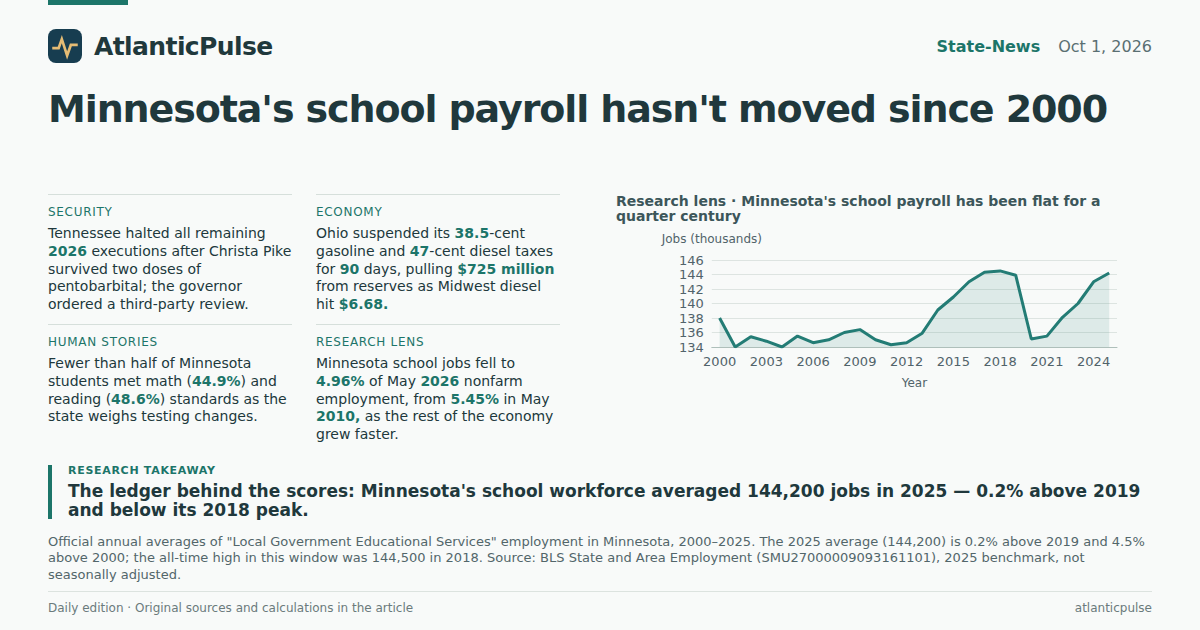
In Minnesota, fewer than half of students met grade-level standards on the spring Minnesota Comprehensive Assessments: 48.6 percent in reading, 44.9 percent in math, the latter a dip from 45.21 percent in 2025. The reading exam is new and not comparable to last year’s. Education Commissioner Willie Jett talked about “rigorous standards” and “potential for growth,” which is the official language of a chart that will not budge. The tests ran from March 2 to May 8, while Operation Metro Surge was still rattling classrooms; more than 80 percent of school leaders said immigration enforcement hurt students’ ability to learn, and a University of Minnesota survey found more than 1,000 students dropped out or unenrolled. In Bloomington, 16 percent of grades 6-12 respondents said the surge affected them or their families. High-schoolers, who can opt out, often do. A task force will spend the winter asking whether the tests even tell teachers anything useful in real time.
Two courtrooms and a mountain range rounded out the human inventory. An Arizona appeals court vacated Gabriel Paul Horcasitas’s 10.5-year manslaughter sentence because the judge had watched an AI-generated video of the victim, Christopher Pelkey, delivering words the victim’s sister believed he would have said. The conviction stands; the sentence does not. The court said the video erased the distance between a family’s imagining and the dead man’s voice — a first-impression ruling in a state that had never faced AI as victim impact. In Colorado, Parks and Wildlife estimated 45 gray wolves, including 20 spring pups, and temporarily suspended its “chronic depredation” rule that allowed killing wolves tied to three livestock attacks in 30 days. Adult survival last year ran at 61 percent, below the typical 75 percent; five wolves have already been euthanized this year. Ranchers asked what happens at 200 wolves. Advocates called it a necessary pause. Reintroduction, it turns out, is just another state program trying to keep a fragile population alive while everyone else argues about the tools.
This daily edition uses stored reporting scoped by publication date, or arrival when publication was absent. Source collection can lag publication.