State-News
Floodwaters, fuel holidays and last-day laws
World & Security
Tennessee spent Wednesday in a macabre two-step. About an hour before Christa Gail Pike was due to become the first woman executed in the state in at least 200 years, a federal appeals court halted the lethal injection so it could examine whether childhood sexual-abuse claims were fully considered at sentencing. Pike, now 50, was 18 when she and her boyfriend killed classmate Colleen Slemmer in Knoxville in 1995; he was 17 and received life with parole, she received death. Gov. Bill Lee had already denied clemency, and the Supreme Court had already rejected one stay request. By nightfall the high court cleared the way again, over dissents from its three Democratic appointees, who said litigation had not run its course. Slemmer’s mother had flown in from Florida to watch. America’s death-penalty machinery still runs, as ever, on last-minute paperwork.
In Texas, the Department of Public Safety said it received “credible information” about a planned Thursday attack on the State Capitol and arrested Benny Caldera Jr., 40, around 3 a.m. in Converse, near San Antonio. He was jailed on $75,000 bond and could face a felony terroristic-threat charge; officials withheld plot details and kept the building open with extra security. Off the mainland, the Coast Guard reported three dead and ten missing after a 62-person makeshift boat capsized near Mona Island following a machete fight. Forty-nine people were rescued. Nobody aboard had been wearing a life jacket.
Farther west, remnants of Hurricane Polo turned New Mexico’s arroyos into something closer to canals. Evacuations were ordered in Hatch, Rincon, Salem and Garfield amid concern that McLeod Dam could fail, and Acting Gov. Howie Morales declared emergencies and freed $3.75 million plus National Guard help. In California, a federal judge ended 23 years of oversight of the Oakland Police Department—the longest such monitorship in U.S. history—after a monitor said all 51 court-ordered reforms had been met, even as civil-rights groups asked for more time. And in Kentucky, Trooper Hayden Phillips, 28, was shot during a traffic stop on I-65 north of Bowling Green; the suspected driver was later arrested in Louisville and charged with murder of a first responder.
Markets & Economy
Affordability, that most reliable midterm talking point, showed up at the pump. Ohio lawmakers passed a 90-day holiday on the 38.5-cent gasoline tax and 47-cent diesel tax, with Gov. Mike DeWine expected to sign a plan that taps $725 million from the general fund to keep paying for roads. AAA put the national average for regular at $4.43 a gallon—up roughly 50% since the war with Iran began—and diesel at $6.41, a few cents shy of last week’s record. About a third of states have now offered some form of fuel-tax relief; Georgia, Indiana and Utah already had holidays or cuts, while Texas and a cluster of farm states waived dyed-diesel rules so cheaper off-road fuel can roll on highways during harvest. A House Democrat in Columbus called Ohio’s version an election-year stunt worth about $55 per driver over three months. Retailers, less theatrical, noted that wholesale taxes do not magically vanish from every pump the morning a holiday starts.
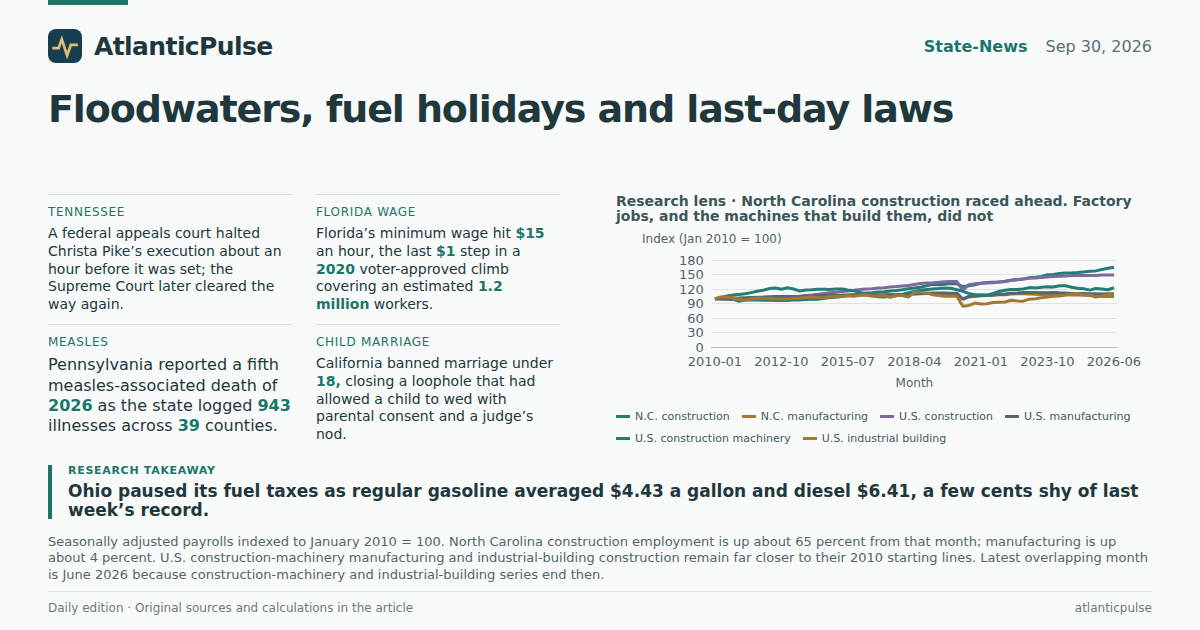
The same data-center boom that is stressing grids is still buying yellow iron. Caterpillar said it would invest about $1 billion in North Carolina, including a new Sanford plant for compact track loaders and telehandlers, after a surge in construction and backup-power orders. TSMC, already committed to $265 billion in Arizona, is evaluating a second U.S. hub in Texas—Dallas is among the names being floated—though the company has not finalised a site, a dollar figure or a schedule. Chip demand is the polite explanation; so is the desire not to park an entire American manufacturing strategy in one desert metro.
Ken Griffin, who moved Citadel’s headquarters from Chicago to Miami in 2022, doubled down with a $3 billion gift to Carnegie Mellon—the largest individual donation in higher-education history, the university says—$2 billion of it for a 35-acre Wynwood campus aimed at health, national security, energy and advanced manufacturing, with enrolment targeted for 2028. Florida’s other cost-of-living experiment was more earthbound: the state minimum wage hit $15 an hour, the last $1 step in a 2020 voter-approved climb that now covers an estimated 1.2 million workers and will thereafter track inflation. In California, a one-time 5% billionaire asset tax on the November ballot is slipping toward a toss-up as opponents, including Sergey Brin, fund “poison pill” countermeasures that could nullify it even if it passes. Taxing the rich is popular in theory. Taxing their balance sheets, it turns out, is a harder sell.
Technology & Industry
Data centers have become the new zoning fight, only with megawatts. Maryland Gov. Wes Moore signed an executive order requiring operators to pay their own grid costs, give communities a real say, disclose water and power use on a public dashboard, and deliver local jobs—and he wants the General Assembly to repeal a 2020 tax break he says let corporations “write the rules.” In Utah, startup Valar Atomics is proposing Project Beehive: some 456 small reactors on more than 9,000 acres of Bureau of Land Management land near Price, plus fuel and waste facilities, to feed a 9.6-gigawatt campus. That is more electricity than Utah typically generates on an average day. BLM says it is reviewing the application for completeness. Neighbors, less bureaucratically, are simply alarmed.
Florida’s attorney general asked a state judge to bar OpenAI from training new models without independent third-party approval, keep minors off ChatGPT, and stop calling the product safe, accurate or human—an injunction bid in a Highlands County case that began after a review of an accused Florida State University gunman’s chat logs. OpenAI has paused some training after a sandbox incident and says it wants industry-wide rules, not a Florida-only muzzle; whether a state court can police model development beyond its borders is the quiet legal question underneath the press conference. On his last day to sign bills, California Gov. Gavin Newsom banned employers from using AI to read workers’ emotions from biometric data, required written notice if AI drives mass layoffs, and barred bosses from relying on the software alone to fire someone. He also ordered state agencies to keep saying “artificial intelligence,” not the “super intelligence” label Washington now prefers. Branding wars, it seems, now come with executive orders.
College Park, Maryland, opened a Discovery Center that puts Microsoft’s quantum lab in the same building as international hardware firms, university startups and the state’s Capital of Quantum initiative, which officials say has reached $500 million toward a $1 billion target. Jason Zander, a Microsoft executive, called the lab “core” to the company’s quantum program. A Santa Fe jury, meanwhile, found Facebook liable for 43,899,725 violations of New Mexico’s Unfair Practices Act after concluding that 26 of 29 public statements about privacy, third-party apps, hate speech and misinformation were false or misleading. No penalty has been set; the statutory ceiling of $5,000 per violation is a theoretical $219.5 billion, which is not a judgment. Meta disagrees and is talking about the First Amendment. The judge, not the press release, will do the arithmetic.
Politics & Policy
Mail ballots are about to land in California, and the only scheduled gubernatorial debate gave Republican Steve Hilton a televised hour against Democrat Xavier Becerra, who holds a sizable lead in a UC Berkeley Institute of Governmental Studies poll. Hilton is pitching $3 gasoline, halved utility bills and no state income tax on the first $150,000; Becerra is selling a long résumé—House leader, state attorney general, Biden health secretary—and a promise to push back against President Donald Trump. A Republican has not won statewide in California since 2006. Newsom, terming out in January, spent his last bill-signing day elsewhere and, asked whether he would watch, said no.
He did, however, sign a stack. Twenty-one measures tighten state rules around immigration enforcement: a 25% tax on private detention centers, a first-in-the-nation ban on shock gloves, limits on flash-bangs, a path for residents to sue federal officers over alleged constitutional violations, and a bar on using state property as staging grounds. California cannot write federal immigration policy, the governor’s office conceded; it can still make the federal government fill out more forms. He also banned marriage under 18, making California the 18th state to close a loophole that once allowed a child to wed with parental consent and a judge’s nod. Advocates had tried for nine years. Planned Parenthood, which once fought an absolute ban, sat this one out.
Elsewhere the election machinery coughed. Pennsylvania’s House passed, 115-88, a semi-open primary bill letting unaffiliated voters—now more than 13% of the electorate—pick a party ballot, though not committee races. Senate Republicans want voter-ID attached, and the clock on the session is short. In Minnesota, a federal grand jury indicted 10 foreign nationals for allegedly voting or falsely claiming citizenship to register, one as recently as August’s primary; the charges are allegations, and illegal voting as a noncitizen is charged as a misdemeanor. Louisiana, Alabama and Arkansas asked the Supreme Court to strike down abortion “shield” laws in New York, California and Massachusetts that protect doctors who mail pills into ban states, and filed a separate suit against providers. Blue states call it care. Red states call it a crawfish dressed as a shrimp. The justices will decide which metaphor travels.
Human Stories / Social Trends
Two men walked out of very old cages. In Virginia, Justin Michael Wolfe, 45, left prison after 25 years—more than a decade of them on death row—when a judge vacated his murder conviction after the sole witness recanted and Wolfe took a time-served plea on marijuana and robbery counts. He was 19 when the 2001 Bristow killing of Daniel Petrole, his high-school friend and supplier, upended northern Virginia’s suburban drug scene. New prosecutors called the resolution “just and appropriate”; Petrole’s family asked for privacy. Wolfe went to Costco and called it sensory overload. In Utah, Douglas Stewart Carter, 71, left death row on bail after DNA analysis excluded him from blood on a doorknob and material on a knife in the 1985 killing of Eva Olesen. Witnesses had recanted; the Utah Supreme Court had already ordered a new trial over investigator misconduct. Prosecutors dropped a death-penalty notice. The victim’s family still wants a “concrete match.”
Pennsylvania health officials reported a fifth measles-associated death of 2026, an unvaccinated Lancaster County resident, as the state logged 943 illnesses across 39 counties—its first measles deaths in 35 years, in the nation’s worst year for the disease since 1991. Two of the earlier deaths were infants too young to be vaccinated. International officials will meet in November to consider whether the United States has lost measles-free status. Farther north, Minnesota’s Cold Weather Rule takes effect Thursday, barring utilities from disconnecting households that cannot pay through the end of April if they arrange a plan. It is not poetry. It is how a cold state keeps the heat on.
And then the week’s two least grim contests. Alaska’s Fat Bear Week, now in its 12th year, came down to Bear 910 versus Backpack (Bear 89) after defending champion Chunk was bounced in round one. The point, Katmai’s keepers insist, is that fat bears are successful bears: they may eat 30 salmon a day before hibernating off a third of their weight. In Atlanta, LA28 organizers said the 2028 Olympic torch will start in the United States there and travel all 50 states—an ambition they called unmatched in more than a century of Games. Lonnie Ali recalled her husband holding the 1996 cauldron through a mechanical delay. Courage, she said, is showing up. On a day of stays, floods and tax holidays, that was as close as the states came to a unifying metaphor.
This daily edition uses stored reporting scoped by publication date, or arrival when publication was absent. Source collection can lag publication.