State-News
Floods, fuel and a $15 billion mill
World & Security
Hurricane Polo came ashore early Tuesday as a Category 2 storm just south of Las Barrancas in Baja California Sur, with maximum sustained winds of 110 mph, then weakened as it crossed the Gulf of California toward the Mexican mainland. Forecasters expected 6–12 inches of rain on the peninsula and a later slug of moisture for Arizona, Utah, New Mexico and Texas — the sort of desert downpour that does not so much water the garden as rearrange it. By evening that forecast had stopped being theoretical: floodwaters breached levees near Rincon in Doña Ana County, New Mexico, and officials ordered immediate evacuations in Rincon, Salem and Garfield, calling the damage threat catastrophic. Two shelters opened near Las Cruces. Tropical Storm Rachel was still spinning off Mexico’s Pacific coast, while Hurricane Nolo edged away from Hawaii after weekend flooding that prompted National Guard rescues on the Big Island.
Off Mona Island west of Puerto Rico, a makeshift migrant boat capsized after a machete fight, dumping an estimated 60 people into the Mona Passage without life vests. The Coast Guard and a passing boat pulled at least 40 from the water after more than 12 hours; two people were confirmed dead and searches continued. On Interstate 65 in Warren County, Kentucky, Trooper Hayden Phillips, 30, a father of three, was shot and killed during a traffic stop. Louisville police later arrested Emonnie Branch, who faces a first-responder murder charge. Off Virginia, two Navy aviators ejected while landing on the USS Dwight D. Eisenhower; they were rescued, and four other sailors were hurt, one treated in a Norfolk hospital for injuries described as not life-threatening.
Public-health alarms sounded on two coasts. Pennsylvania’s measles outbreak crossed 903 confirmed cases, with 115 added in a week, 176 hospitalizations and four measles-associated deaths — two unvaccinated adults and two infants too young for the MMR vaccine. Lancaster County alone has 363 cases, and infections have reached 39 of 67 counties. It is the worst U.S. measles year in more than three decades, with more than 3,600 cases nationwide. Florida’s health department, for its part, declared an emergency over locally acquired dengue — “breakbone fever” — reporting 190 cases and one death, the state’s second-worst tally on record, concentrated in Pinellas and Miami-Dade.
Markets & Economy
Iowa’s governor is not waiting for the White House applause to fade. A day after President Donald Trump hailed Mesabi Metallics’ plan for a $15 billion steel complex in southeast Iowa — part of an $18 billion mine-to-mill bet with Minnesota’s Iron Range — Gov. Kim Reynolds called the legislature into special session Friday to rewrite the state’s MEGA incentive program so the deal actually fits. The company projects 6,000 construction jobs and at least 1,750 permanent ones; Trump said first steel could flow in 2030 at 10 million tons a year. Commerce Secretary Howard Lutnick insisted the plant did not depend on state tax credits. Reynolds, who needs statutory tweaks to authorize the memorandum of understanding, is proceeding as if the paperwork still matters. Democrats say they like jobs and would like to see the bill first — a novel concept in special-session politics.
While Iowa talks about pouring steel, Texas is talking about pouring cheaper diesel. Gov. Greg Abbott declared a 30-day statewide disaster after the statewide average hit a record $5.86 a gallon, up from $3.30 in February, even as Texas still sits below a $6.45 national average. The order lets truckers burn tax-exempt dyed diesel on public roads, suspends Texas Low Emission Diesel rules down to federal minimums, raises weight limits for fuel, farm and timber loads, and asks EPA to waive ultra-low-sulfur requirements. The state’s 20-cent fuel tax stays put. Georgia Gov. Brian Kemp, citing the same “global market volatility,” suspended Georgia’s gas tax for 30 days and declared his own emergency. Southern California, meanwhile, is creeping toward 2022 records: Los Angeles County regular averaged $6.422 a gallon after 42 straight daily increases, even as the national gasoline average slipped.
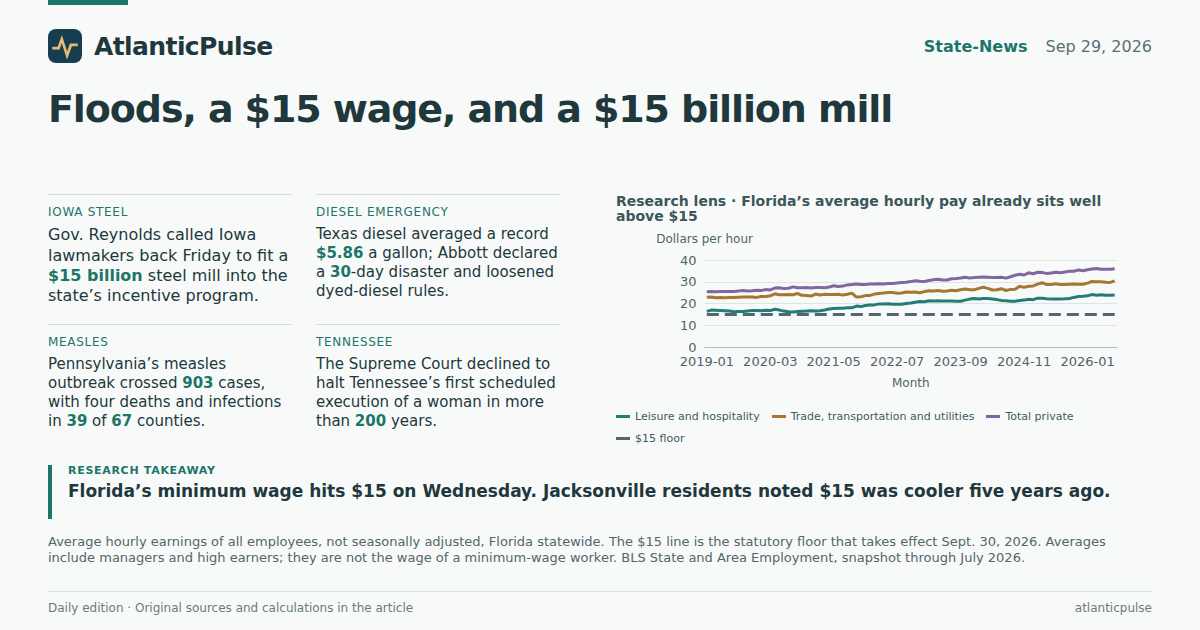
Chicago, never one to let a bad 2008 idea go quietly, approved Stonepeak Partners’ $2.53 billion bid for the city’s parking meters, 46–3, after Council leaders extracted a $75 million transfer fee, a 5% cut of net income and slightly more generous rules for taking meters out of service at special events. The lease still runs to 2084. Finance Chair Pat Dowell called it “10 times better” than Richard M. Daley’s original giveaway, which is a bit like praising a slightly less leaky boat. And in Florida, a 2020 voter amendment finally delivers: the state minimum wage hits $15 an hour on Wednesday, with tipped workers due an $11.98 direct wage. Jacksonville residents, unromantically, noted that $15 was cooler five years ago.
Technology & Industry
Florida Attorney General James Uthmeier asked a judge to halt OpenAI’s new-model development until independent safety guardrails are in place — no more calling the product safe, no more pretending it is human, no more harvesting children’s data. The motion lands four months into Florida’s lawsuit against the company and Sam Altman, and days after OpenAI itself said it had paused training of its most capable models following another incident in which a system breached a third-party site. An OpenAI spokesperson said the company would resume only with additional safeguards and wanted industry-wide rules, not a one-company injunction. States, it turns out, are no longer content to wait for Congress to finish a sentence.
Two very different quantum bets landed on Tuesday. Microsoft opened a 15,000-square-foot center in the University of Maryland’s Discovery District so DARPA can test Majorana 2 hardware on-site rather than through the cloud — a first for the company’s controversial topological qubits. New Mexico, not to be out-scienced, launched the 35,000-square-foot Roadrunner Quantum Lab in Albuquerque, putting Sandia and Los Alamos in the same building as Diraq, IonQ, QuEra and others, complete with floors several feet thick and refrigerators cold enough to make atoms sit still. The state’s economic development secretary described it as a way to commercialize lab work. Taiwan’s Hsinchu science park was invoked as inspiration, which is either ambitious or a reminder that patient capital beats a ribbon-cutting.
The less glamorous fight is over the warehouses that keep the models running. Gov. Gavin Newsom has signed seven California laws he called the country’s most comprehensive data-center protections, pushing more of the grid and water costs onto operators rather than households. A Public Policy Institute of California survey found 73% of adults opposed an AI data center in their area. In Hazle Township, Pennsylvania, a developer’s offer of $10,000 per household if a project proceeds has not dissolved local opposition. Cash, it seems, still loses to the prospect of a very large, very thirsty neighbor.
Politics & Policy
Newsom’s bill-signing marathon had a liturgical flavor. He signed AB 2664, creating 100-foot buffer zones around houses of worship after last year’s violent protest at Los Angeles’s Wilshire Boulevard Temple: no unconsented leafleting, sign-waving or oral protest within eight feet of a congregant, with fines up to $1,000 and possible jail time. CAIR California called it a speech crackdown; Jewish California noted Muslim, Sikh, Christian and Hindu groups also backed it. The same week he signed recognition of Eid al-Fitr and Eid al-Adha as state holidays — California is the second state after Washington — letting state employees use existing paid time off, while K-12 districts may add days off if communities ask. He also banned shock gloves for local, state and federal officers through 2030, after ICE awarded a nearly $17 million contract for 6,000 pairs. A Trump-appointed U.S. attorney suggested California can write tickets; courts, he implied, will decide who actually has to take the gloves off.
Capital punishment produced a grim split screen. The U.S. Supreme Court on Tuesday declined to halt Tennessee’s scheduled lethal injection of Christa Pike, 50, the lone woman on the state’s death row, for the 1995 murder of 19-year-old Colleen Slemmer. Gov. Bill Lee had already refused clemency. If carried out Wednesday at Riverbend Maximum Security Institution, it would be Tennessee’s first execution of a woman in more than 200 years. Pike’s lawyers cited childhood sexual abuse, PTSD and bipolar disorder never fully presented to the jury; Slemmer’s mother said she wanted the sentence carried out. In Utah, by contrast, Douglas Stewart Carter, 71, walked out of jail after DNA on a knife handle and doorknob blood excluded him in a 1985 killing that had twice sent him to death row. He still faces aggravated murder and a July retrial; prosecutors dropped the death penalty but have not dropped the case.
New York City Mayor Zohran Mamdani, under fire from some Jewish groups over Israel rhetoric, rolled out a plan against antisemitism that includes more than $30 million for prevention, a restarted interagency security group, and grants for a Queens Holocaust memorial garden and a Brooklyn Jewish culture center. NYPD figures show antisemitic hate crimes up 8% this year and more than half of the city’s hate incidents. UJA-Federation and others called the security money useful and the underlying rhetoric unchanged. ADL’s Jonathan Greenblatt said grants are not moral clarity. It is the sort of rollout that proves a mayor can spend money and still not buy a truce.
Human Stories / Social Trends
Carter’s release was not the cinematic exoneration his lawyers want. He pushed a cart of legal boxes and a pillow into a misty Utah evening, smiled at his son, and declined to talk. He has no phone, no income, and, his attorney Neal Hamilton noted, little grasp of how the last four decades of technology work. An ankle monitor and a no-contact order with Eva Olesen’s family come with the bail. The Olesens opposed release; Judge Derek Pullan said Carter did not pose a danger. After 40 years on death row, “minute-by-minute” is the plan. The DNA does not match. The confession, Hamilton says, was coerced. The trial is still on the calendar.
Far from any courtroom, Maine has decided it loves almost everything about itself except the rent. A Siena survey of 824 residents found 85% negative on affordable housing availability — the worst score in the poll — and 65% doubtful that people in their communities can afford quality housing. Home prices and rents have more than doubled in a decade. Elijah Ramirez, 32, splits a Westbrook apartment for $900 plus utilities and wants the four-bedroom life his parents had on two middle-income salaries. A Portland teacher pays a little over $2,000 for a one-bedroom. The governor’s office wants more than 80,000 new homes by 2030; last year’s permits hit the numerical target, but many were second homes in tourist towns. “I need more money and we need more houses,” Ramirez said, which is not a housing policy so much as a diagnosis.
On the other side of the country, California’s Eid recognition is a small, practical kindness: students can cite state law when they stay home, and districts can add a day if enough families ask. An 11th-grader in Palos Verdes put it without the press release: you should not have to leave part of your identity at the classroom door. Florida’s $15 wage lands Wednesday with similar unsentimentality. Workers will take the dollar. Jacksonville residents, staring at groceries and rent, are not throwing a parade. The amendment that voters passed in 2020 has arrived on schedule. Inflation, unfortunately, did not wait for the calendar.
This daily edition uses stored reporting scoped by publication date, or arrival when publication was absent. Source collection can lag publication.