State-News
Storms, ballots and a ghost town with a patron
World & Security
A nor’easter spent the weekend reminding the Northeast that autumn can still throw a tantrum. New York and New Jersey declared emergencies as the National Weather Service warned of coastal flooding, beach hazards, strong winds and heavy rain from Virginia to Maine. In Brooklyn a falling tree killed a man. More than 100,000 households, nearly all in the Northeast, lost power. Saturday’s full moon made the tides worse, inundating streets in Surf City and Manasquan. Governor Mikie Sherrill told New Jerseyans to take the storm seriously; New York City Mayor Zohran Mamdani advised residents not to travel if they could help it, and not to walk or drive through floodwater. More than 2,400 flights were delayed and 1,199 grounded. Concerts including Ed Sheeran in Foxborough and the Global Citizen Festival in Central Park were cancelled. By Sunday, New Jersey’s “beach eaters” had chewed through dunes in Ocean City, Harvey Cedars and Brigantine, with floodwater in Mantoloking garages and a damaged outdoor stage at the Stone Pony.
The Pacific, in an El Niño mood, kept the other ocean busy. Hurricane Nolo skirted Hawaii on Saturday with 90 mph winds, then strengthened to about 105 mph while remaining south of the Big Island. A hurricane watch was cancelled and a landfall of the storm’s centre was not expected, which is the sort of reassurance that still leaves 20 inches of rain in the forecast. Outer bands flooded a highway near Naalehu; National Guard members walked a driver through the water. About 400 Guard members were activated after the governor’s emergency proclamation, and President Donald Trump approved a FEMA declaration. Residents are still recovering from Hurricane Lala, which swept about 100 homes off their foundations. Hawaiian Electric recalled crews from Kauai after Hurricane Lowell. On Maui, a Saturday brush fire forced evacuations. Major Hurricane Polo, a Category 3 with 125 mph winds, was aimed at Baja California for a Monday landfall.
Inland, the hazards are slower and more bureaucratic. Colorado River drought guidelines written in 2007 expire October 1 after years of stalled talks among the seven basin states; the federal government has released its own management plan. Water journalist Luke Runyon’s diagnosis is grimly simple: too many paper rights, not enough river. In northern Wisconsin, Enbridge put an August Line 5 leak at least $15.1 million after a subcontractor’s unoccupied truck rolled into an excavation and punctured the pipe, releasing about 33,000 barrels of natural gas liquids. The line is back in service; federal investigators are still looking at how a truck left in neutral on a slope became a pipeline incident. And in southwest Kansas, ICE activity in Liberal, Dodge City and nearby towns has cattle groups warning of delayed shipments and a “chilling effect” on documented workers, while Senators Roger Marshall and Jerry Moran say the agency should coordinate with local law enforcement.
Markets & Economy
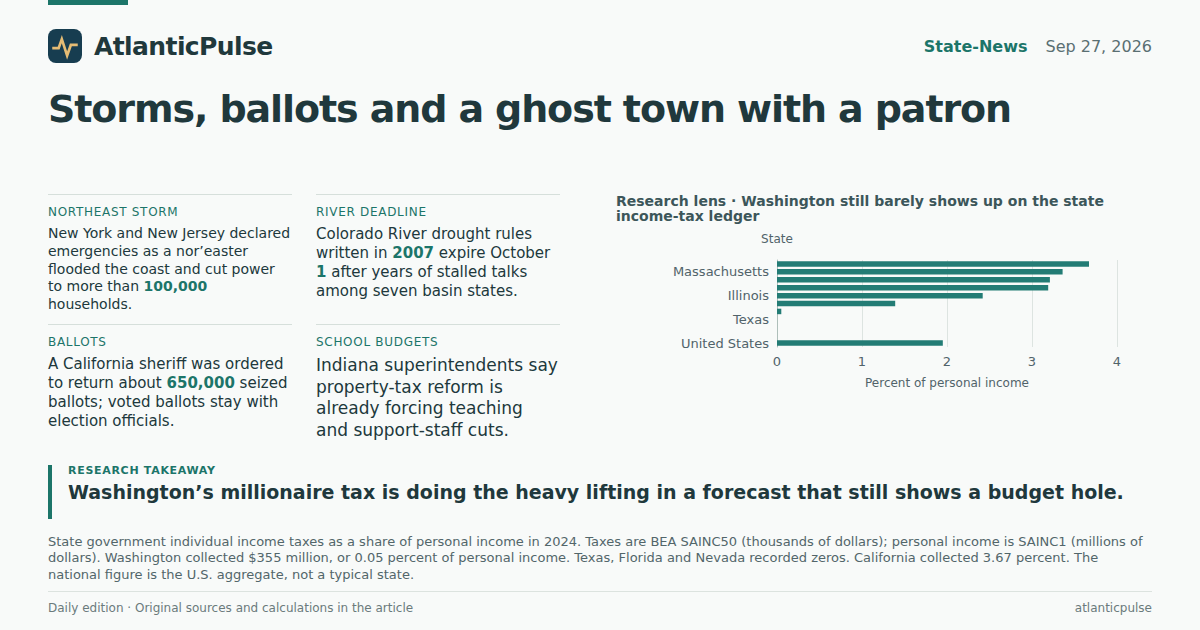
Washington’s new 9.9 percent tax on wage income above $1 million is doing a lot of work in a forecast that otherwise refuses to cheer anyone up. Friday’s revenue outlook added just $22 million to the current budget through June 2027 and $430 million to the next biennium—not enough to close a several-hundred-million-dollar deficit in fiscal 2028, let alone a multibillion-dollar hole after that. Chief economist Dave Reich now credits the high-earner tax with $3.5 billion in the next budget and $9.4 billion in 2029–31, up from June’s $2.7 billion and $6.9 billion. Opponents have sued; Initiative 645 would repeal the tax in November. Republican budget writer Chris Gildon noted the asterisk: those dollars would not be collected until 2029, if they are still on the books. The state’s economy is projected to generate $76.3 billion this cycle and $82.6 billion in 2027–29. “Creating a sustainable budget is the work we have ahead of us,” said OFM director K.D. Chapman-See, which is Olympia for please do not spend the hypothetical money.
Indiana school districts are already spending less. A survey of 144 superintendents by the Indiana Coalition for Public Education found nearly all expect damage from Senate Enrolled Act 1’s property-tax reforms. Half have already cut support staff; 46 percent are eliminating teaching roles, rising to 93 percent if you count those considering it. One superintendent planted prairie grass instead of mowing to save fuel. Rural leaders smell consolidation. Universal private-school vouchers, available regardless of income for the first time this year, are described by some as a manufactured crisis. New York City, for its part, announced a $131.5 million enforcement action against DoorDash for Delivery Worker Law violations, with more than $115 million headed to workers and $16 million in penalties and costs. California homeowners staring at Public Safety Power Shutoffs have a different calendar problem: the state’s 46-year solar property-tax exclusion expires January 1, 2027. Assembly Bill 2389, which would have extended it through 2031, stalled in Appropriations. Existing systems stay protected until the property changes hands; new installs must pass inspection by December 31. The federal residential tax credit already expired at the end of 2025. Resilience, in other words, now has a permitting deadline.
Technology & Industry
Maryland would like to be known for something besides crabs and traffic. Microsoft opened a 15,000-square-foot Quantum Research Center at the University of Maryland on September 22, part of a “Capital of Quantum” campaign that has already attracted more than $500 million toward a $1 billion five-year goal. Governor Wes Moore and UMD president Darryll J. Pines cut the ribbon; Pines compared quantum to what silicon was for Silicon Valley. The lab includes space for DARPA’s topological system. Five days from now, Maryland’s Protection From Predatory Pricing Act hits hard enforcement: grocery stores over 15,000 square feet and food-delivery services may not use personal data to charge different shoppers different prices. Penalties run to $10,000 per violation, $25,000 for repeats. Connecticut and New Jersey have their own versions, because nothing says interstate commerce like three incompatible algorithms.
California, never shy about a rulebook, appointed four experts after Governor Gavin Newsom’s September 18 executive order to consider independent onsite AI audits and a possible emergency “kill switch” for frontier models. The state has not enacted a kill-switch requirement; the panel is asked to examine one. Senate Bill 813 and Assembly Bill 1405 already set up third-party verification and an auditor registry. Jason Goldman, the first White House chief digital officer, put the question neatly: who checks a lab’s safety claims, and can a model actually be shut down?
The hardware is not waiting. Fervo Energy’s first 33-megawatt geothermal block at Cape Station in Utah exported power by September 24, with commercial operation due October 1 and two more blocks by January 1, 2027. The site has about 900 megawatts of contracted offtake, including 320 megawatts for Southern California Edison. In Oak Ridge, X-energy finished the main structure of TX-1, a 214,000-square-foot TRISO fuel plant billed as America’s first new commercial-scale advanced fuel facility in more than 50 years, licensed to process high-assay low-enriched uranium. Alabama settled with TikTok for at least $100 million days before the first state trial over teen safety, adding two-hour daily limits, overnight curfews and a possible $300 million if other states settle. Nashville teens as young as 13 can now ride Waymo, with parents watching in real time—the robotaxi equivalent of handing over the keys and then hovering.
Politics & Policy
The California Supreme Court ordered Riverside County Sheriff Chad Bianco to return about 650,000 ballots seized after a November 2025 special election on congressional redistricting. The court said voted ballots stay with election officials even during a criminal investigation; a search warrant does not override the Elections Code. Bianco said he would comply while rejecting “the message behind” the ruling—that local law enforcement works for Sacramento. Attorney General Rob Bonta had ordered the ballots returned months earlier. The registrar said a citizens group’s alleged 45,000-vote gap was actually 103. Newsom signed a bill Saturday to prevent anyone from seizing ballots, and separately signed 10 gun-safety measures, including voluntary storage programs and a requirement that consumer 3D printers block attempts to print firearms.
Ballots elsewhere are doing quieter constitutional work. Maryland Question 1 would require governors to include funding for state-employee labor agreements in proposed budgets, including terms imposed after an impasse, and would activate binding arbitration. The General Assembly would still control appropriations. Virginia’s Ballot Question 2 would strip a 2006 one-man-one-woman clause that federal courts already made unenforceable and affirm that two adults may marry regardless of sex, gender or race. In Maine, Susan Collins faces Democrat Troy Jackson in her first race since the Supreme Court overturned Roe v. Wade. She says she does not regret confirming Brett Kavanaugh. A New York Times/Siena poll found almost no likely Maine voters named abortion as their top issue, which is either good news for Collins or a reminder that voters are excellent at changing the subject.
In Texas, U.S. District Judge Robert Pitman ordered prison officials to create a plan to air-condition the entire incarcerated population by the end of 2029. The system holds nearly 140,000 people and currently has 53,676 air-conditioned beds, with about 7,000 more planned this year. Researchers have attributed at least 271 heat-related deaths in Texas prisons from 2001 to 2019. Jailhouse lawyer Alvaro Hernandez, after 30 years inside, suggested waiting to see whether the Fifth Circuit or the state actually follows the order. Air conditioning, he noted, is already required for animals.
Human Stories / Social Trends
John Poindexter, an 81-year-old Houston manufacturing magnate with no spouse and no children, is pouring foundation money into Shafter, Texas, a former silver-mining town of about 25 people. His Tidewater and Big Bend Foundation has taken in nearly $67 million since late 2020. The plan is a resort and living-history museum: rebuilt saloon, general store, post office, a dozen adobe rentals. The closest groceries are 19 miles away in Presidio. He invited about 200 guests over Labor Day. “I think that we’ve forgotten our origins,” he told the Times. It is Colonial Williamsburg with better barbecue and fewer tourists, at least for now. Philadelphia, less nostalgic, parked its first mobile methadone van in Kensington, a walk-up clinic that can get someone a health exam, a consultation and a first dose in less than an hour. The program has connected more than 500 people since launch. Maine, meanwhile, is losing maternity wards faster than most states; a Damariscotta hospital will be the 12th to close its birthing center in roughly a decade.
Not every rescue requires a foundation. In Torrington, Connecticut, Bella, an 11-year-old husky mix, launched herself at a black bear that had come out of the woods toward 6-year-old Colton Tazzara and his Nerf gun, biting the animal’s haunch until it fled. Treats were promised. In Marion County, Kentucky, first responders pulled a young girl named Baleigh Jo from a well; she received CPR at Spring View Hospital and was airlifted to UK Children’s Hospital. A GoFundMe had raised more than $1,200 of an $1,800 goal by Sunday. Between ghost towns, methadone vans, closed maternity wards and dogs who understand the assignment, the American weekend remains stubbornly local—which is both the charm and the problem.
This daily edition uses stored reporting scoped by publication date, or arrival when publication was absent. Source collection can lag publication.