State-News
States Brace for Storms, Verdicts and a Map That Missed Its Moment
World & Security
A September nor’easter is the sort of storm that shows up in summer clothes and then floods the boardwalk anyway. New York Gov. Kathy Hochul and New Jersey Gov. Mikie Sherrill declared states of emergency as the system parked off the Mid-Atlantic, pushing water into Surf City and Manasquan and knocking out power for tens of thousands. USA Herald put early Saturday outages near 30,000 in New Jersey—especially Cumberland, Monmouth and Ocean counties—and about 22,000 in New York, including Suffolk, Nassau and Queens; a later Nexstar tally counted more than 70,000 customers dark across the Northeast. Hochul’s order covers Nassau, Suffolk, New York City and Westchester. The National Weather Service warned of major coastal flooding over multiple high-tide cycles, and AccuWeather meteorologists told South Florida Reporter that prolonged northeasterly winds could lift water in some places to levels among the highest since Hurricane Sandy, with a harvest moon compounding the tides. Nearly 180 flights were canceled at Boston Logan, Nantucket and Martha’s Vineyard. Central Park’s Global Citizen Festival and Ed Sheeran’s Gillette Stadium dates were among the cultural casualties. Connecticut activated its Emergency Operations Center. The standing instruction remains the same: do not drive through seawater just because the GPS still thinks it is a street.
Hawaii is living a different weekend. Hurricane Nolo was expected to become a major hurricane, with maximum sustained winds of 105 mph on Friday and a center about 145 miles south of the Big Island, the same Associated Press report said. Forecasters warned of up to 15 inches of rain on parts of the island, with a possibility of 25—down from an earlier 35-inch scare that still would not make anyone feel lucky. President Donald Trump approved an emergency declaration; Hawaii’s governor issued a proclamation activating more than 230 National Guard members. Crews built berms and flew supplies from Oahu to a relief hub that has been running since August’s Hurricane Lala. Farther east, Hurricane Polo roared back to Category 5 intensity with estimated sustained winds of 175 mph and aimed at Baja California, while biologists moved olive ridley sea turtle eggs from Southern California beaches to Long Beach’s Aquarium of the Pacific. El Niño, the report notes, is damping the Atlantic season and juicing the Pacific—an arrangement that feels less like a trade than a bait-and-switch.
Security of another kind was on the docket in Utah. An external review released by Utah Valley University found that the school failed to conduct a formal security assessment, skipped a written event action plan and deferred critical decisions to Turning Point USA before Charlie Kirk was killed by a rooftop sniper on Sept. 10, 2025, the Associated Press reported. Campus officials had suggested indoor venues; Turning Point insisted on an outdoor courtyard Kirk knew. The review, which Turning Point declined to join, listed missed walk-throughs, no documented line-of-sight assessment and a police force of 13 sworn officers for a campus of about 50,000. Kirk’s family last week filed a wrongful-death notice. Tyler Robinson has pleaded not guilty to aggravated murder. And in Pennsylvania, measles is doing what measles does when vaccination coverage slips: the state health department told ABC that 55 new cases since Wednesday brought the year’s total to 890 across 39 counties, with at least 173 hospitalizations and four measles-associated deaths. Fewer than 1 percent of cases—four people—were fully vaccinated with MMR.
Markets & Economy
Texas still likes to remind the rest of the country that it is hiring. The state added 159,400 jobs over the year, a 1.1 percent clip that outpaced the national rate by 0.7 percentage points, The Center Square reported. The cattle country that helps feed that growth is less cheerful. The Texas Cattle Feeders Association, Kansas Livestock Association and Oklahoma Cattlemen’s Association warned Friday that ICE operations are delaying cattle shipments and disrupting dairies, feedyards, trucking and grain companies, with a “massive chilling effect” on legal, documented workers that they say will push beef prices higher, the Texas Tribune reported. DHS Secretary Markwayne Mullin said ICE is not conducting worksite operations in Kansas and is targeting people with criminal records or final removal orders; he did not mention Texas or Oklahoma. Ranchers are already cross about a plan to suspend tariffs and import 300,000 metric tons of ground beef. When an industry’s complaint list includes both raids and Argentine chuck, the supply chain is having a year.
Households are absorbing the bill. Maryland insurance regulators approved a 14.6 percent average premium increase for 2027 individual plans on Maryland Health Connection, compounding last year’s 13.4 percent hike after enhanced federal tax credits expired, Maryland Matters reported. About 274,000 people buy those plans, down from 294,000 a year earlier. Small-group plans will rise 10.2 percent on average. In Ohio, gubernatorial politics produced a more theatrical form of price relief: the GOP-controlled legislature will meet Sept. 30 on a 90-day gas-tax holiday after Republican Vivek Ramaswamy answered Democrat Amy Acton’s call, the Morning Journal reported. Regular gas was averaging about $4.46 a gallon and diesel $6.82; the state tax is 38.5 cents on regular and 47 cents on diesel. Ramaswamy’s campaign put the revenue hole at about $678 million and claimed typical-family savings of about $165. House Speaker Matt Huffman said Democrats who vote no “are doing it at their peril.” Gov. Mike DeWine has not committed to sign. Temporary holidays have a way of being both popular and, once the pumps go back to normal, instantly forgotten.
A new ALICE report found 35 percent of Minnesota households lack income for basic needs, KAAL reported, with residents swapping name brands, combining cars and wincing at $100 fill-ups. Economist Mike Walden said wages are not keeping up, and that tariffs and the war with Iran are adding pressure. Beef, the station noted, is almost twice as expensive as in 2016. The ranchers and the Rochester shoppers are describing the same grocery aisle from opposite ends.
Technology & Industry
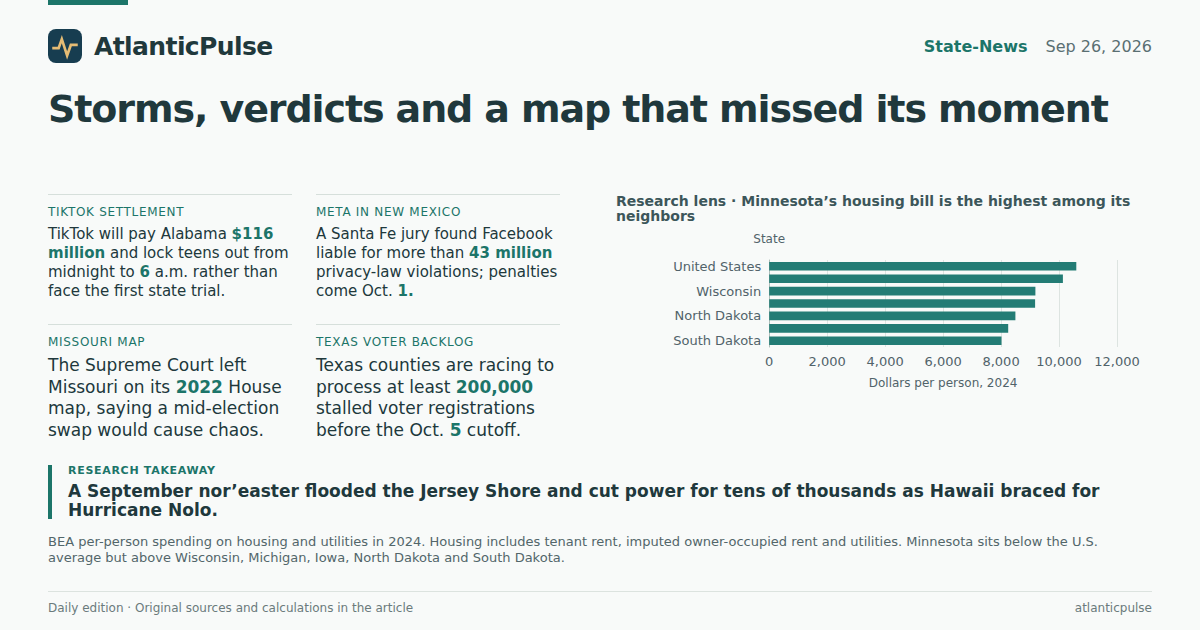
A Santa Fe jury found Facebook liable for more than 43 million violations of New Mexico consumer-protection law over deceptive privacy claims tied to the Cambridge Analytica era, Fortune reported. Jurors concluded the company’s statements affected the state’s entire population of more than two million; they did not buy the state’s claim that Facebook lied about removing harmful COVID-era content. The judge sets penalties on Oct. 1. State lawyers want the $5,000 statutory maximum per violation, a theoretical tab north of $200 billion that legal observers doubt will land in full. Attorney General Raúl Torrez said any award would go to education. New Mexico already won $942 million this year over youth safety and sat out an $18 billion multistate child-safety settlement that released other states from Cambridge Analytica claims. Meta said it will keep defending itself against “efforts to distort our record.” The company is profitable enough that even a nine-figure slap can sound like a rounding error, which is precisely the problem prosecutors keep trying to solve.
Alabama got there with a check instead of a verdict. Hours before it would have been the first state to take TikTok to trial over youth-addiction claims, the company agreed to pay $116 million and create a $183 million contingency fund, the Alabama Reflector reported. A Montgomery consent decree requires a default two-hour daily cap, a midnight-to-6 a.m. lockout, “productive pauses” after 15, 60 and 90 minutes of scrolling, a ban on cosmetic filters for teens and a default non-personalized feed, WAKA added. TikTok admitted no wrongdoing. Attorney General Steve Marshall called it a great day for parents. Of the $116 million, $100 million goes to his office; the rest covers fees. The extra $183 million pays out if other states pile on. If a teenager’s For You page suddenly looks like a public-service announcement, that is the point.
Industry is expanding even as neighbors complain. Tesla opened a 1.8-million-square-foot Semi plant next to Gigafactory Nevada, designed for 50,000 trucks a year, and said high-volume production and deliveries “start now,” Stocktwits reported. In Richardson, Texas, Amazon Prime Air drones—about 38 kilograms, cameras included—fly 7 a.m. to 8 p.m.; one homeowner counted 52 flights in a day, and residents call them “flying lawn mowers,” Trending Topics reported. The FAA, not City Hall, owns the airspace. The 6th Circuit said Ohio and Tennessee may treat Kalshi’s sports contracts as gambling, not CFTC-only swaps, Mashable reported, widening a split that may tempt the Supreme Court. Arizona’s court system disclosed a cyberattack that may have copied names and addresses; Chief Justice Ann Scott Timmer said she called the FBI, FOX 10 Phoenix reported. And Cal/OSHA floated an emergency ban on fabricating high-silica artificial-stone countertops after 644 silicosis cases and 35 deaths among mostly immigrant workers, Public Health Watch reported. Google will fund uprates at Plant Hatch and Plant Vogtle to add about 96 megawatts, with Georgia Power estimating $900 million in net customer savings over the plants’ lives, Interesting Engineering reported. The through-line is familiar: the future arrives first as a lawsuit, a drone or a lung disease.
Politics & Policy
The Supreme Court told Missouri, for a third time, that it is too late to swap maps in the middle of an election. An unsigned Friday order, with no noted dissents, left the state on its 2022 congressional lines rather than a GOP-drawn 2025 map that would have carved Kansas City’s 5th District and flipped the delegation from 6–2 to 7–1, CNN reported. Ballots using the 2022 map were already printed and mailed; military and overseas voting had begun. “At this point, ordering a return to the 2025 map in the middle of an ongoing election would cause electoral chaos,” the court wrote, invoking the Purcell principle against last-minute federal changes. President Trump had pressed the mid-decade remap to protect the House. Lower courts had yo-yoed between the state supreme court’s 2022 map and an 8th Circuit ruling that the general election must match the August primary map. County clerks had begged federal judges not to induce “more vertigo.” They may now take a Dramamine and get back to counting.
In Trenton, Lt. Gov. Dale Caldwell resigned Friday after Gov. Sherrill set a deadline following a law-firm report on ethics lapses and behavior toward women, the Associated Press reported. Caldwell, a Methodist pastor who also served as secretary of state, denied key findings, including a reported remark about “young sperm,” and said resignation was not an admission. Sherrill cannot fire a lieutenant governor; impeachment was the alternative. Senate President Nicholas Scutari will act as governor if she is away; acting comptroller Shirley Emehelu takes the secretary of state role. Republicans spent weeks hammering Sherrill for letting Caldwell serve as acting governor during the probe. The midterms are weeks away. New Jersey, never a stranger to political opera, has now lost its first lieutenant governor to resignation since the office was created in 2009.
Texas election officials are racing a different deadline. A software update by a third-party vendor left the Department of Public Safety sitting on at least 200,000 voter-registration applications and updates dating to October 2025, Votebeat and the Texas Tribune reported. Texas is one of eight states without universal online registration; the DPS portal is the only web option, and it exists because of a six-year court fight. Counties must process the backlog plus new filings before the Oct. 5 registration cutoff. The secretary of state offered grants for overtime. Gov. Greg Abbott said DPS told him the issue was “fully resolved.” Officials say affected voters can cast provisional ballots. Advocates want every person notified. State Rep. Matt Shaheen, the Republican who chairs the House Elections Committee, promised accountability—and then said the glitch is dissuading him from supporting online voter registration, a conclusion that treats a vendor bug as an argument against the internet.
Human Stories / Social Trends
In Rochester, Renee Remsberg has stopped buying name-brand groceries. Jenna Whiting’s household combined cars and bought an EV after staring at a pump that crossed $100, KAAL reported, in a state where an ALICE study says 35 percent of households cannot cover basics. Colorado’s Latino families are telling a similar story in a different accent. The Colorado Health Foundation’s Pulse 2026 survey found 89 percent of Latinos worried about housing costs and 44 percent fearing they could lose their home—58 percent among 18-to-29-year-olds—El Comercio de Colorado reported. About 45 percent of Latino renters skip repair requests for fear of a rent hike or eviction. Food worry hits 44 percent of Latino households, 13 points above the statewide population, and 53 percent worry about health coverage. Thousands, researcher Enrique Castillo said, are sacrificing to avoid eviction or debt. The independent streak in the same poll—45 percent of college-educated Latinos identifying as independents—reads less like ideology than exhaustion.
New York City, never accused of over-providing public toilets, is installing 17 modular bathrooms that unlock by text, QR code, app or tap card, PYMNTS reported. The city has roughly 1,000 public bathrooms for more than eight million residents; the $4 million one-year pilot, run by a company named Throne Labs, offers flushing toilets, climate control and changing tables from 7 a.m. to 10 p.m. At five minutes the stall announces you are halfway through; at ten the door opens. There is, currently, no extra time for someone who needs it. The tap card is the humane detail: partners will hand them out so a dead phone is not a civic emergency, with pickup supposedly within a 10-minute walk. In Burlington, Vermont, the opposite of disposable culture is meeting over bagels. The Old North End Repair Café fixes textiles and toaster guts for free, while a state-funded ReuseVT directory points people to repair shops and libraries that loan snowshoes, VTDigger reported. Vermont still generates about 912,180 tons of waste a year. Susan Alexander, who runs ReuseVT, put the consumer bind cleanly: a $27 toaster versus a $35 repair is a hard sell, even when 99 percent of the parts still work.
California, never shy about a commemorative day, now observes Sept. 25 as Dolly Parton Day, a calendar wink at “9 to 5,” after Bakersfield Republican Sen. Shannon Grove and Santa Cruz Democrat John Laird got the bill to Gov. Gavin Newsom, KERO reported. It is not a paid holiday, so the 9-to-5 still applies. Grove helped bring Parton’s Imagination Library to 54 counties with $68 million for bilingual books; she tells the story of a Spanish-speaking mother learning English from her toddler’s mail. Grove’s advice for the day: wear pink, donate, be kind. After a week of flood maps, privacy verdicts and voter-file glitches, that is not the worst civic program on offer.
This daily edition uses stored reporting scoped by publication date, or arrival when publication was absent. Source collection can lag publication.