State-News
Storms, ballots and a $6 diesel harvest
World & Security
Hawaii is staring at a Category 2 hurricane whose center, somewhat inconveniently, is supposed to stay “well south” of the islands while still dumping the kind of rain that makes that distinction academic. Hurricane Nolo had 105 mph winds by Friday morning, about 185 miles south of South Point on the Big Island, crawling north-northeast at 5 mph. The National Hurricane Center warned that eastern and southern Hawaii County could see 10 to 15 inches of rain, with isolated totals of 25 inches — “catastrophic life-threatening flooding and mudslides, especially in areas of steep terrain.” Tropical-storm conditions were expected Friday night, with hurricane conditions possible by early Saturday; Maui County sat under a tropical storm watch. Forecasters still expected Nolo to become a major hurricane as it turns west over the weekend.
That storm is not traveling alone. Polo has been battering Mexico’s Pacific coast at Category 4 and 5 strength, sending seawater through homes in Lázaro Cárdenas and forcing evacuations along Guerrero and Michoacán while 15,000 security personnel deployed. El Niño is the uninvited conductor: it tends to rev up Pacific cyclones even as it dampens the Atlantic. Hawaii has already had two other hurricanes since mid-August, plus spring flooding and an earthquake. “In my 20 years of experience here, I’ve never seen three hurricane watches for the islands in the same year,” said John Bravender of the National Weather Service in Honolulu. The same southeastern Big Island communities isolated by August’s Hurricane Lala are again in the wettest forecast cone — meteorological déjà vu with worse drainage.
Closer to the mainland, United pilots reported GPS interference near Los Angeles in the small hours of Friday. Flight 1962, an Airbus A321neo leaving LAX, and Flight 1866 both alerted controllers; a third report involved an Alaska Airlines 737 MAX 9 off the coast. Cause unknown — jamming, spoofing, or something more mundane — and neither United aircraft lost control, thanks to backup navigation. The episode lands after a May air-ambulance crash near Ruidoso, New Mexico, in which the crew reported losing GPS during military jamming exercises. In Virginia, the Navy stood up a Robotic and Autonomous Systems Warfighting Development Center at Joint Expeditionary Base Little Creek. Adm. Daryl Caudle wants years of drone experiments turned into “operational coherence”; Rear Adm. Melvin Smith gets the job of making prototypes work when the radios go quiet.
Markets & Economy
Diesel has become the unwelcome harvest mascot. In Connecticut, the average retail price hit a record around $6.48 a gallon, up 71% from $3.78 a year ago, while the national average sat near $6.51. Home heating oil is up 50% in three months, to $5.91. Chris Herb of the Connecticut Energy Marketers Association warned of shortages into winter, citing U.S.–Iran and Russia–Ukraine conflicts, autumn farm demand, and diesel stocks about 12% below the seasonal average. The state’s energy-assistance grant for the poorest households is projected at $1,995 this winter — 33% below the 2019-20 maximum. Iowa’s corn growers are singing the same tune: AAA had diesel at $6.27 a gallon, nearly twice last year’s price, as combines roll. The Iowa Corn Growers Association asked the congressional delegation to push another Strategic Petroleum Reserve release and investigate dyed-diesel waivers. Sen. Chuck Grassley wants a diesel-export embargo; President Trump said Tuesday he would support a ban, which oil companies insist will not lower the price at the pump. That disagreement will not fill a tank before sundown.
Florida’s privately run Brightline filed for bankruptcy while promising the trains will keep running between South Florida and Orlando. A $490 million long-term capital injection is supposed to be the “catalyst for further growth,” even though 2026 revenues are already up 17% and still not enough to match earlier projections. Honda, for its part, is reportedly lining up a $2.5 billion hybrid plant in Ohio with capacity for 250,000 large SUVs a year, possibly including a next-generation Acura MDX, with construction as soon as 2027 and production around 2030. Honda called the reporting “speculative,” which is corporate for please wait until the subsidy paperwork is signed.
Chicago is still trying to unsell the parking-meter deal that unsold itself years ago. Alderpeople deferred a final vote until Tuesday on a $2.5 billion transfer of the infamous 75-year lease from Morgan Stanley’s Chicago Parking Meters LLC to Stonepeak. The 2008 sale fetched $1.2 billion up front; by the end of 2025 the private operator had already booked about $2.2 billion in revenue with 58 years left. The revised terms would give the city a 5% cut of “calculated net income,” a $75 million transfer fee for pensions, and a promise that Stonepeak will sell Omni Air, a holding some council members loathe for flying deportation missions. Budget chair Jason Ervin is whipping against it anyway, on the theory that if you are going to sell the family silver a second time, you might as well haggle.
Technology & Industry
New Jersey just demonstrated that “move fast and generate power” is not a permitting strategy. State inspectors found 62 unpermitted portable turbine generators at the DataOne site in Vineland, a Microsoft-linked AI campus feeding Nebius, and hit the company with a record $1.07 million fine plus a 45-day deadline to get air permits or shut the machines down. Neighbors had already complained about noise, an unpermitted 1.5-million-gallon LNG tank, and the sensation of learning about a data center only after Microsoft announced a $33 billion compute deal. Residents called the fine pocket change; DataOne said it will apply for permits and switch to fuel cells. Across the continent, Oracle sent a force majeure notice on Stargate’s Project Jupiter in New Mexico — not to walk away, it says, but to delay payments if the 2.45-gigawatt campus misses its 2028 start. An Energy Transfer pipeline slipped nearly six months to Feb. 1, 2027, after permit denials, and an air-quality permit for Bloom Energy fuel cells is due by Nov. 23. Oracle told CNBC the project remains on schedule. The lawyers’ letter is less lyrical.
Tesla, never one to under-announce, opened high-volume Semi production at a 1.8-million-square-foot plant in Sparks, Nevada, with a claimed capacity of 50,000 trucks a year and keys handed to PepsiCo, DHL and US Foods. The Standard Range is estimated at 325 miles loaded; Tesla says customers have validated 500 miles for the Long Range. Price was the one detail left in the envelope, unofficially pegged around $260,000 to $290,000. If you prefer your technology fights in court, New York’s attorney general sued Polymarket as an unlicensed sportsbook dressed up as a prediction market, seeking a halt in the state, triple gains, and $100,000 per offered wager. Polymarket removed the case to federal court and sued back, arguing its event contracts are CFTC-regulated swaps. And in Santa Fe, a New Mexico jury found Facebook liable for deceiving users about privacy protections, counting more than 43 million consumer-law violations tied to the Cambridge Analytica era. The judge will set penalties later; the state asked for the $5,000 maximum per violation. Meta disagreed, as is traditional.
Politics & Policy
California’s Supreme Court told Riverside County Sheriff Chad Bianco to give back about 650,000 ballots he seized in February from a November 2025 redistricting special election. The court called the seizure “unlawful”: ballots stay with election officials even during a criminal investigation, and a search warrant does not override the Elections Code. Bianco had acted on a citizens group’s claim of a 45,000-vote gap; the registrar said the real gap was 103. He will comply, he said, while refusing “the message behind” the ruling — that local law enforcement works for Sacramento. Attorney General Rob Bonta, who had ordered the ballots returned months ago, called it clarity. Gov. Gavin Newsom signed a bill Saturday to prevent anyone from seizing ballots, which is the legislative version of a “do not take the cookies” sign after someone has already eaten them.
The U.S. Supreme Court, for a third time, barred Missouri’s Republican-redrawn congressional map from the November election after the Eighth Circuit tried to convert a stayed injunction into a permanent one. Absentee voting under the 2022 lines had already begun. Organizers who gathered more than 300,000 referendum signatures warned that switching maps midstream would toss ballots or lock out voters who had already voted. In Texas, a Department of Public Safety error left counties with a backlog of at least 178,000 voter-registration records dating to October 2025; Dallas County alone confirmed more than 68,000. The statewide total is still unknown. Republican Sen. Paul Bettencourt said the secretary of state’s office “should have caught it,” which is not the usual GOP talking point six weeks from a midterm.
In Trenton, Lt. Gov. Dale Caldwell resigned Friday after Gov. Mikie Sherrill demanded he go over a law-firm report finding workplace-policy violations, including an alleged remark about “young sperm” and ethics lapses involving tickets and a promotion. Caldwell, who is also secretary of state, disputed the findings and had suggested extra scrutiny as a single Black man. Sherrill said Trenton would no longer sweep harassment “under the rug.” Senate President Nicholas Scutari will stand in as acting governor when needed, weeks before the midterms. And in Sacramento, Newsom declared a state of emergency ahead of a developing El Niño, with federal forecasters cited as putting the chance of a very strong event above 90% this fall and winter. Sandbags now; arguments later.
Human Stories / Social Trends
Hillsborough County, Florida, declared a local emergency after 170 locally acquired dengue cases — 170 of the state’s 190 in the latest tally, overwhelmingly the DENV-2 strain. The order lasts seven days unless extended, unlocking mosquito spraying and a shot at federal reimbursement. Dengue turns a mosquito bite into a two-week negotiation with fever, pain and, in severe cases, bleeding. Prevention still beats treatment, which is a polite way of saying: dump the standing water.
In Pennsylvania’s Amish country, measles — declared eliminated in the United States in 2000 — is filling clinics and scarce negative-pressure rooms. The state health department has reported four measles-associated deaths; the CDC, after initially declining to count them, updated its page to show one measles-related death nationwide without saying where. As of Wednesday the CDC had 3,471 confirmed U.S. cases this year, more than 300 hospitalized. Dr. Katherine Mascia in Belleville described patients arriving already sick enough for the ICU. Gov. Josh Shapiro blamed HHS Secretary Robert F. Kennedy Jr. for stoking vaccine confusion; Kennedy said the federal response is working. Doctors on the ground said they are leaning on colleagues and Harrisburg, not Washington.
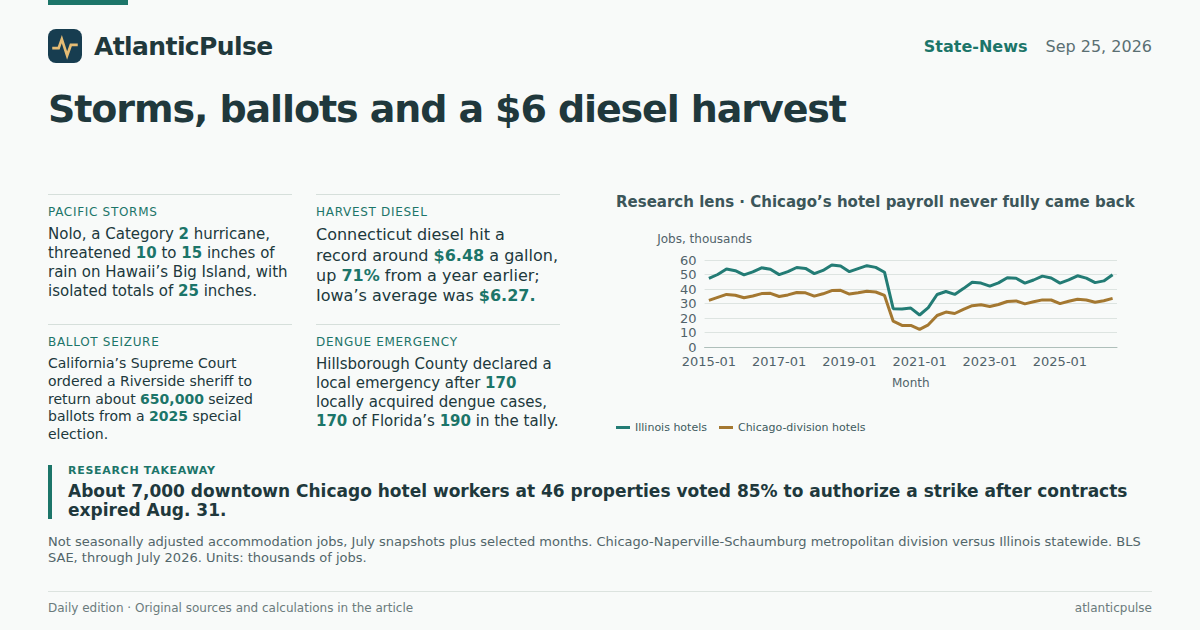
Two years after Helene, Western North Carolina is still pulling the storm out of its rivers. MountainTrue’s crews have removed more than five million pounds of debris; public cleanup spending has topped $600 million. A state-funded artifact recovery technician now catalogs what the water gives back — a silk kimono, a unicycle, love letters still legible — and tries to send them home. JoLeigh Bowden, who lost a record-label building on the Toe River, got back a muddy vinyl album. It was damaged. It still mattered. In Chicago, about 7,000 downtown hotel workers at 46 properties voted 85% to authorize a strike after contracts expired Aug. 31, the largest such threat since 2018. They could walk in waves, hotel by hotel. The city that privatized its parking meters is, at least, consistent about making hospitality a contact sport.
This daily edition uses stored reporting scoped by publication date, or arrival when publication was absent. Source collection can lag publication.