State-News
States hit pause on data centers as ICE, El Niño, and diesel keep moving
World & Security
A Venezuelan DoorDash driver is now the face of a very American argument about who gets to use force on a city street. Wilber Rafael Garces Perez, 28, was shot by an ICE officer in Austin on Sunday while making a delivery, then released from hospital into detention with the bullet still near his spine. His attorney says officers sideswiped him twice in an unmarked truck before ramming and shooting; the Department of Homeland Security has said little beyond calling him a Venezuelan in the country illegally with a final removal order. Perez, who entered through the Biden-era CBP One process and, his lawyers say, held a work permit, told reporters he got no pain medication at the South Texas ICE Processing Center in Pearsall. By Monday night he was back in hospital. Advocates want an independent review of ICE force, Austin’s mayor wants local police in the investigation, and protesters gathered at the Capitol under the unsubtle slogan “Justice 4 Wilber Perez.”
The same enforcement surge is showing up as warehouse logistics. Whistleblower photos released Monday depict ICE’s Miramar, Florida field office — rated for 56 people — holding hundreds, at one point 342 in August, with detainees sleeping shackled in an unventilated garage and using overflowing portable toilets. House Oversight Democrats say a woman seven months pregnant was held three weeks. ICE’s own standards cap holding-room stays at 12 hours, though a later waiver stretched that to 72 before a judge vacated it. Meanwhile in Colorado, foreign hackers manipulated pumps, alarms and remote access at two privately owned water utilities serving fewer than 200 people. Officials say drinking water and treatment were not compromised. The EPA has counted more than 100 drinking-water and wastewater systems targeted this year across 12 states. Small utilities, as one security executive put it, cannot fund a security engineer.
California’s other emergency is fire, not fiber. A Precision-operated Super Puma crashed during a water drop on Yosemite’s Dome Fire on Sunday, killing both pilots, including Greg King. By Monday the fire had grown to 3,222 acres and 15 percent containment, with trails closed and the park otherwise open. The deaths bring this year’s wildfire helicopter-pilot toll in Colorado, Utah and California to five. And in the Hill Country, Texas Rangers obtained 14 search warrants as they pursue manslaughter and criminally negligent homicide theories against Camp Mystic leadership over the July 2025 flood that killed 27 girls and counselors — part of 119 Kerr County deaths. A state probe already found the camp lacked required written emergency plans. Fourteen months later, the paperwork is finally catching up with the river.
Markets & Economy
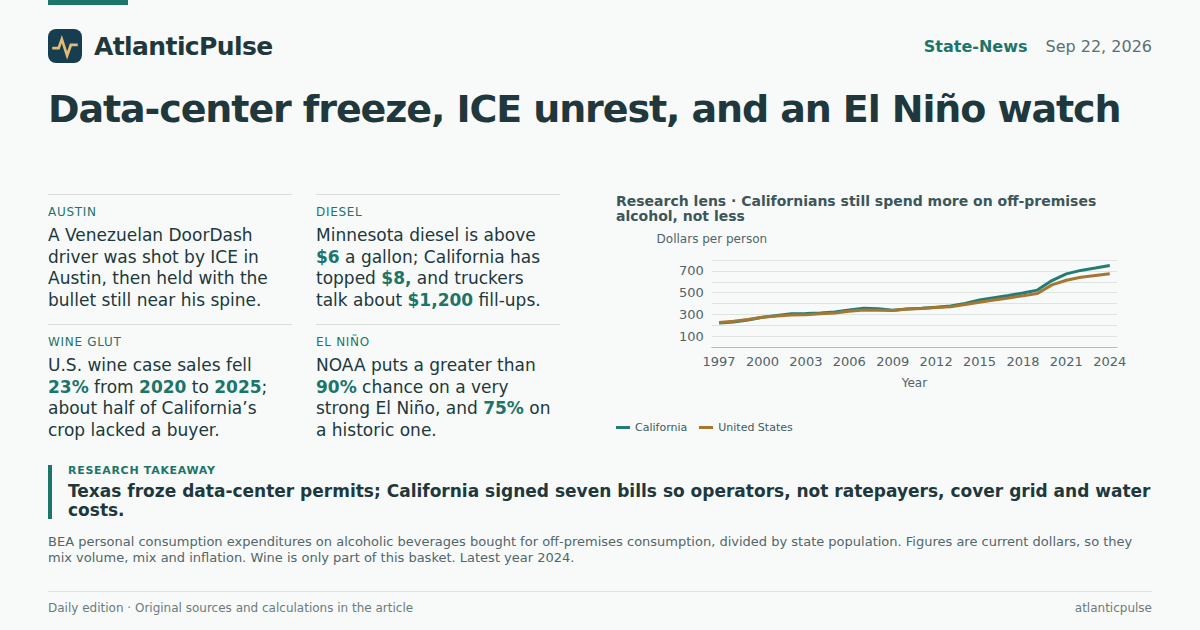
Diesel has become the unofficial cost-of-living index. In Minnesota, AAA says pump prices are at record highs above $6 a gallon — more than $2 since the U.S. war with Iran began in February and after Ukrainian strikes on Russian refineries. California diesel has topped $8. Truckers talk about $1,200 fill-ups, fleets shrinking, and companies simply shutting the garage door. “If diesel does retain the $6 per gallon or higher pricing, it is going to change the economics of trucking, and ultimately that will come downstream to the consumer,” a Mankato carrier executive warned, which is a polite way of saying your groceries already know.
Wine country, by contrast, has too much of a good thing. U.S. wine case sales fell 23 percent from 2020 to 2025, from 427 million to 329 million, and California growers have taken roughly a quarter of peak vineyard acreage out of production. About half this year’s crop went into harvest without buyer contracts. Third-generation Lodi grower Bill Berryhill cannot sell grapes from 200 of 500 acres and plans to rip out 50. “The kids just aren’t drinking as much,” he said, which is the rare harvest complaint that also sounds like a public-health win. Sacramento is trying a different fuel story: after signing SB 795, California cleared the last barrier to E15, a 15 percent ethanol blend already sold elsewhere. Officials cite a UC Berkeley and Naval Academy study estimating up to 20 cents a gallon and as much as $2.7 billion a year — if stations actually upgrade the pumps.
Elsewhere, the invoices are coming due. DoorDash will pay New York City $131.5 million to settle a probe under the 2023 delivery-worker pay law, admitting “we screwed up.” Some 264,000 Dashers get at least $10; $83 million of the pot covers a fight over on-call waiting time. South Korea named a 6.3-gigawatt gas plant in Encinal, Texas, valued at more than $20 billion, as the first project under a $350 billion U.S. investment bargain meant to feed AI data centers and chip plants. And on Sept. 30, Florida’s voter-approved minimum wage hits $15 an hour, the last scheduled $1 step before inflation adjustments — a reminder that some cost-of-living fights were won at the ballot box years ago and are only now arriving at the register.
Technology & Industry
Greg Abbott has discovered that “come to Texas” has a footnote. On Sept. 21 he ordered the Texas Commission on Environmental Quality to freeze all environmental permits for data centers until ERCOT finishes a grid interconnection audit, folding water and air approvals into a whole-of-government standstill. Projects must cover electrical infrastructure, not take community water, report consumption, and, Abbott says, he wants the Legislature to kill remaining financial incentives. TCEQ owes a progress report by Oct. 19. Developers with queue positions but no air permits now have a new hobby: waiting. The governor’s lawyers insist this is not a death knell, merely a “forceful” pause — the sort of pause that still stops a construction calendar.
California, never to be out-regulated, signed seven data-center bills Newsom called the nation’s most comprehensive. They do not ban the buildings; they make operators pay a “fair share” of grid upgrades, disclose water use, and forgo blanket environmental exemptions. Data Center Watch counts 843 opposition groups, scrutiny in 49 states, and at least 45 projects worth an estimated $68 billion blocked or delayed in the second quarter. Nevada’s Joe Lombardo, who once called the industry the state’s new gold rush, barred school-tax exemptions for new incentive deals and required applicants to eat their own power costs. Nevada has 76 centers planned or built and had awarded $461 million in forecast tax breaks over 11 years; local governments, an Independent analysis found, forwent more than $537 million in sales-tax collections, including $236 million meant for schools.
While hyperscalers wait on permits, New York is writing the software license. Kathy Hochul is rolling out the RAISE Act: frontier developers register from November, the law bites Jan. 1, serious incidents must be reported in 72 hours, and fines can hit $3 million a violation. She invited lawsuits (“Bring it on”) and mused about kill switches. A more cheerful experiment already ran: during a Sept. 9 heat wave, 140,000 home batteries dispatched 580 megawatts — Tesla Powerwalls 517 MW from 110,000 devices — enough, the companies said, to power every home in Sacramento County for three hours. Virtual power plants, it turns out, show up even when the brick-and-mortar kind is on hold.
Politics & Policy
Kamala Harris spent Tuesday in Michigan doing the unglamorous work of midterm glue. Campaigning with Senate nominee Abdul El-Sayed, she called him a future “national voice,” talked Black maternal health, and described the Trump administration as “the most callous, corrupt, and incompetent” in American history. Democrats need a net four Senate seats; Michigan’s open Gary Peters seat is supposed to be the easier pickup. It is not. El-Sayed beat Rep. Haley Stevens with progressives; Black voters largely did not, and Attorney General Dana Nessel — Jewish, previously wary — endorsed him as “no choice” versus Republican Mike Rogers. Harris, who lost the state in 2024, has not decided on 2028. “28 won’t matter if we don’t get through 26,” she said, which is either discipline or a very elegant hedge.
Texas, of all places, is not cooperating with its reputation. A Texas Southern University poll of 1,800 likely voters put Democrat James Talarico ahead of Ken Paxton 47 to 46, with both men underwater on favorability and 7 percent of Republicans crossing to Talarico. Abbott still leads Gina Hinojosa 49-45. In Missouri, the 8th Circuit reinstated a GOP-drawn congressional map but delayed implementation a week, teeing up a possible third Supreme Court trip as absentee voting begins and overseas ballots have already gone out under the old lines. And in Utah County, a former letter carrier, Damon Matai Seei, 34, was indicted for dumping some 300 primary mail ballots in a church-parking-lot dumpster. Over 95 percent of Utahns vote by mail. The ballots were not recovered.
Newsom, never one to wait for rain, declared a state of emergency for a potentially historic El Niño — NOAA puts a greater than 90 percent chance of a very strong event and 75 percent of a historic one — staging 4.4 million sandbags and 400,000 tons of rock. In New York, Donald Trump paid a rare presidential call on Democratic Socialist Mayor Zohran Mamdani at Gracie Mansion, praised him as “off to a good start,” and found common ground in a proposed 12,000-unit neighborhood over a rail yard. Mamdani still objected to the immigration crackdown. The two populists, having already met at the White House in February, appear determined to confuse their bases. It is the first time in 44 years a sitting president has visited the mayor at home. The housing shortage, at least, is bipartisan.
Human Stories / Social Trends
Not every California beach story this week involved king tides. An olive ridley turtle — perhaps two visits by the same animal — laid eggs near Seal Beach and Huntington Beach, NOAA’s first recorded natural nesting of any sea turtle species on the U.S. West Coast. Lifeguards first thought the animal was sick. Nests are fenced; incubation runs 45 to 60 days. A 9-year-old called it “so magical.” A few hundred miles inland and several thousand feet up, Colorado’s St. Mary’s Glacier — technically a perennial snowfield that usually survived summer — melted out completely for the first known time after a thin snowpack and a brutal summer. Denver day-trippers who hiked 1.5 miles for September turns found PVC pipe and bare rock. The climate, unlike the turtle, is not laying anything new.
Minnesota’s cafeteria politics are happier. Three years into universal free school meals, lunch participation is up 15 percent and breakfast 40 percent; the state is spending an estimated $306 million in 2026, and families save about $1,000 per student per year. Before the program, 34 percent of students who did not qualify for free lunch still skipped meals — 70 percent among Black, Indigenous and other students of color. Kids report less stigma and more energy; some even request brussels sprouts at home, which may be the strongest evidence yet that the program works. In Texas, U.S. District Judge Robert Pitman ordered air conditioning in every state prison by the end of 2029, calling uncooled lockups cruel and unusual. The Texas Department of Criminal Justice will appeal; it has about 143,000 people in custody and has estimated systemwide cooling at $1.5 billion. Inmates described splashing toilet water on themselves to survive 100-degree heat.
Pennsylvania, meanwhile, is living through a public-health argument with a body count. The state logged 792 measles cases as of Monday, up 25 from Friday, with 155 hospitalizations, cases in 38 of 67 counties, and four measles-associated deaths that the CDC’s dashboard still does not list. Governor Josh Shapiro accused Health Secretary Robert F. Kennedy Jr. of intervening to keep the deaths off federal stats; Kennedy said the CDC is applying a consistent national standard. Two Lancaster County infants died in August. The MMR vaccine is 97 percent effective after two doses. That is not a culture-war talking point. It is, as the turtles and the glacier both suggest, a reminder that some trends still answer to biology.
This daily edition uses stored reporting scoped by publication date, or arrival when publication was absent. Source collection can lag publication.