State-News
Diesel at Records, Measles at 700, and a Parking-Meter Peace Treaty: The States, Sept. 15, 2026
World & Security
Federal prosecutors charged a Pennsylvania man Tuesday with obtaining a semiautomatic rifle to carry out an attack for ISIS; court documents say he discussed strategies for targeting non-Muslims and had a history of plotting a mass-casualty attack as a minor (NBC News). In New York, federal officials disclosed that Operation Rotten Apple — an ICE-led sweep across the state from July 27 to August 29 — produced 2,197 arrests, though the government has published no detailed breakdown of those cases by criminal history or location, which is precisely what immigrant advocates and New York officials are asking for (Rezo Nòdwès). As that report notes, an administrative immigration arrest is not itself a criminal conviction.
Florida's immigration experiment keeps generating paper trails. A Department of Homeland Security inspector general report released September 11 — based on a January site visit — found detainees at the Everglades facility nicknamed Alligator Alcatraz were held in 18-square-foot cages for up to two hours at a time, limited to three showers a week and three one-hour recreation sessions, with violations spanning safety, medical, food-service and hygiene standards. The facility has since closed, but a state budget panel just approved $240 million more for immigration-enforcement contracts even as roughly $524 million in federal grants sits largely unspent; Governor DeSantis defended the broader effort while conceding the described conditions were something people "should not be subject to" (WENG).
And a reminder that maritime infrastructure is now a target: the Coast Guard and FBI boarded a foreign-flagged oil tanker bound for Texas after indications its network had been compromised by overseas cyber actors in an August 21 attack, according to a Coast Guard spokesperson cited by Reuters (KFGO/Reuters).
Markets & Economy
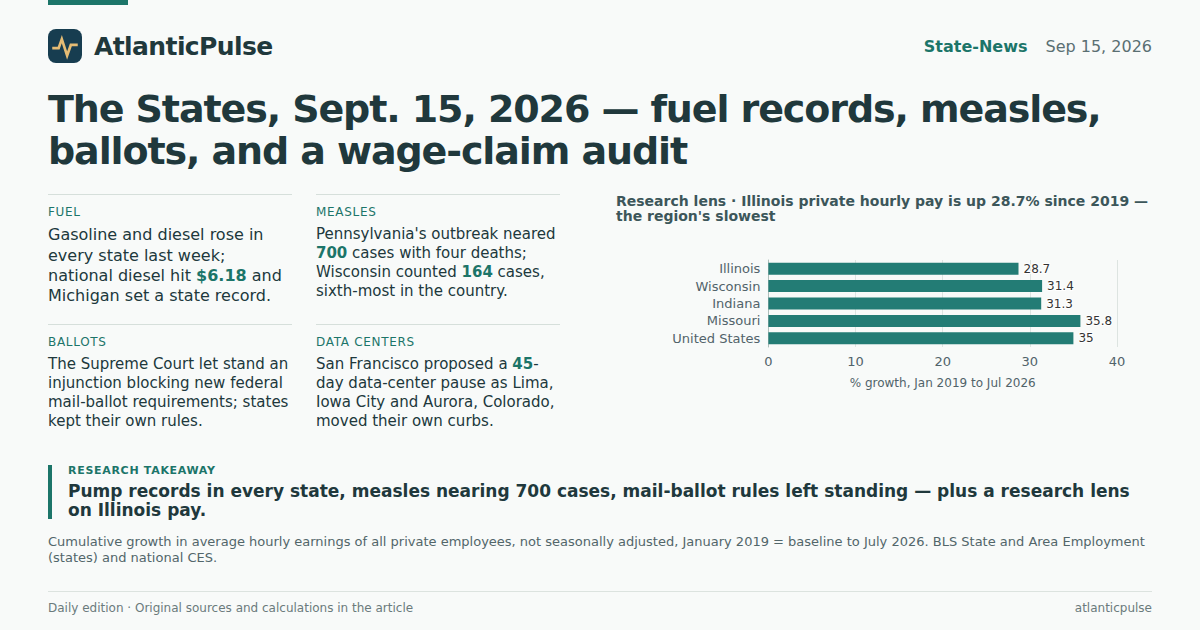
Fuel prices rose in every state last week — a neat trick for the time of year when they usually sag, as GasBuddy's Patrick De Haan ticked off US–Iran friction, Red Sea hostilities, a shut Saudi East–West pipeline and two more Russian refineries knocked offline (Whig). The national gasoline average hit $4.25, up $1.14 in a year; national diesel rose 31.6 cents in a week to $6.18. Illinois' average jumped 21.2 cents to $4.47 — more than a dollar over last September — and Virginia's rose nearly 18 cents to $4.14, with Virginia diesel at $6.16 against $3.61 a year ago (Rapp News). Michigan set a state record for diesel at $6.25 after refinery trouble in Joliet and Whiting, and Iowa's diesel hit a record $6.06, 58% above a year ago — which works out to roughly $1,200 more to fuel a 160-acre corn harvest (KSCJ). California, per AAA, is past $6 a gallon, the nation's priciest, and the ethanol lobby wants CARB to approve E15 next week, projecting 20 cents of savings (advocacy arithmetic, mind) (BioEnergy Times).
Chicago inched toward peace in its long war with its own parking meters. City Council negotiators brokered terms for New York's Stonepeak Partners to buy the meter system for $2.5 billion, extracting a 5% profit share worth an estimated $376.2 million through 2083, a $75 million transfer fee and better street-closure terms — all earmarked for pensions — while Stonepeak agreed to sell Omni Air International, whose deportation-flights contract had united the Latino Caucus against the deal (Sun-Times). For scale: the original 2008 lease of 36,000 meters ran 75 years for $1.15 billion, and Mayor Brandon Johnson had toyed with a $3.2 billion buyback before deciding some lemons aren't worth the lemonade.
Elsewhere, the mailbox is the new relief program. New York starts mailing $1 billion in energy-rebate checks on September 21 — up to $200 to about 8.2 million households, state cash rather than utility credits (TS2). State Farm is paying its largest-ever dividend — $5 billion nationally, reaching about 3.7 million insured California vehicles at roughly $70 apiece, separate from the 6.2% rate cut regulators already approved (USA Herald). And the Port of Los Angeles just logged the best three-month cargo stretch in its history, moving 955,907 TEUs in August alone (Cyprus Shipping News).
Technology & Industry
The AI data-center boom met its first coordinated neighborhood backlash tour. San Francisco supervisors proposed an urgent 45-day pause on approvals — "we cannot use 2001 rules to regulate 2026 technology," as Supervisor Shamann Walton put it, noting the city still zones data centers under a 2001 "internet service exchange" definition (Local News Matters). Lima, Ohio, passed an 18-month moratorium and Iowa City hit pause, while Aurora, Colorado, banned permits for evaporative cooling in future commercial buildings (9NEWS).
Regulators are moving from yes-or-no to how-much. Governor Hochul unveiled a Community Investment Framework under which large data centers could pay New York towns up to $1 million per megawatt (News10); Governor Abbott ordered Texas' water agency to penalize centers that don't report their water use (Newsweek); and Pennsylvania's PUC warned that data-center demand could leave the PJM grid six times less reliable by 2030 (FOX43). New Jersey supplied the cautionary visual: an Equinix data center in Secaucus spilled 5,000 gallons of diesel into a Hackensack River tributary (Bisnow).
The industrial buildout behind the boom is real, too. Hitachi Energy announced a $528 million transformer expansion in Copiah County, Mississippi — its largest US investment, adding 654 jobs with production slated for 2029 (Gov. Reeves' office). Samsung's Taylor, Texas, fab began 2-nanometer mass production on Tesla AI-chip orders (Seoul Economic Daily); Zipline asked the FAA for environmental clearance to run up to 220,000 drone deliveries a day across five Texas metros, with public comments open through October 11 (DroneXL); and Waymo opened driverless rides in Las Vegas, its fourth new US city this month (TNW).
Politics & Policy
The Supreme Court let stand an injunction blocking the Trump administration's new federal requirements for mail-in ballots — voter-list sharing, approved envelopes, barcodes — after roughly two dozen states sued. Pennsylvania's elections chief Al Schmidt called it assurance that procedures will stay identical across all 67 counties with seven weeks to the election (abc27); Minnesota's system stays unchanged, with absentee voting starting Friday (Ingstad); and Vermont, which mails ballots to all registered voters by October 1, got a straightforward "a win for all voters" from its Secretary of State (Seven Days).
Meanwhile, enforcement and access ran in parallel. Texas and federal officials charged seven people in Tarrant County with noncitizen voting offenses — out of more than 18 million registered voters — while the Secretary of State referred 117 more potential cases and confirmed citizenship for 578 of the 2,724 voters it flagged last year, 506 of them because passport records reached the federal SAVE database after the initial check (Votebeat). Texas is separately investigating why some voters' registrations displayed as "inactive" on the My Voter Portal (WFAA). Virginia, by contrast, told registrars that many people with felony records can now register, ending what advocates called a 150-year-old "Jim Crow scheme" (WRIC).
In education, New York's Board of Regents is ending the decades-old requirement that students pass Regents exams to graduate, starting with the class of 2028; this year's seniors will be the last who must (NBC New York). Minnesota advocates want a statewide bell-to-bell phone ban, noting 24 other states plus DC already have one (FOX 9); a Wisconsin lawmaker proposes screen-free classrooms through second grade (WPR); and a new Telemundo/Mason-Dixon poll puts James Talarico up three points on Ken Paxton in Texas' Senate contest (The Hill).
Human Stories / Social Trends
Measles is writing the season's saddest ledger. Pennsylvania's outbreak grew to nearly 700 cases as officials reported two more deaths — unvaccinated residents of Jefferson and Mifflin counties, one identified by a coroner as a 40-year-old woman who died September 12 — on top of two infant deaths in Lancaster County last month (WHYY). Governor Shapiro blasted HHS Secretary Robert F. Kennedy Jr., whose tenure Newsweek notes has now seen more measles-linked deaths than the prior 20 years combined (Newsweek). Wisconsin counted 164 cases statewide, sixth-most in the country, including a new travel-related case in Marathon County beyond the 155-case southwestern outbreak (FOX 9).
San Francisco's overdose crisis hit a record low — and then introduced a new word. Cychlorphine, a synthetic opioid officials say is stronger than fentanyl and not yet a controlled substance in California, was linked to the death of a 16-year-old; four arrests followed (ABC7).
Kindness and loss shared the wire. Phil and Penny Knight are giving $1.1 billion to Providence for Oregon's first women's hospital and cardiac care across eight hospitals (Quartz), and Atlanta launched a pilot offering $500 no-fee, no-interest rent microloans — repaid $20 a week for 25 weeks — to keep a late paycheck from becoming an eviction (FOX 5 Atlanta). At Michigan's special 9/11 session, a fire captain who spent a week at Ground Zero revealed his stage-four stomach cancer is confirmed linked to that service; a federal program tracking about 145,000 responders and survivors has now logged more than 9,400 deaths from 9/11-linked illness — more than the 2,977 who died in the attacks (WZMQ). And Los Angeles mourned aerial reporter Eliana Moreno and pilot George Marciniw, killed when their news helicopter crashed in Chatsworth while covering a deadly Metro bus crash (NBC Chicago).
This daily edition uses stored reporting scoped by publication date, or arrival when publication was absent. Source collection can lag publication.