State-News
Primaries, maxed-out pumps, and 2,977 lights over the harbor
World & Security
The Amazon Air Boeing 767 that overran Miami International Airport on Sunday did not kill anyone onboard. It killed the people waiting on the ground. Five members of a Professional Ocean Service Corp. cleaning crew were wrapping up an eight-hour shift when the jet smashed into their Econoline van; two others remained in critical condition days later. The dead included Yoel Rodriguez Naranjo, 53, who came from Cuba in 2011 and was driving, and Julio C. Pineda, 75, known to neighbors as “El mago” for his magic tricks. NTSB cockpit-voice details from the final minutes make for grim reading: about a minute and forty-two seconds before the recorder stopped, one pilot called for flaps 20 and the other cautioned they were too fast, then kept saying so, without a consistent verbal response. Electronic “sink rate” and “too low terrain” callouts stacked up while the crew was still configuring flaps over the runway. A go-around was finally called about fifteen seconds before the recording ended — after the airplane had already touched down.
Hawaii was still counting Hurricane Lowell, whose center stayed offshore while its winds and surge did not. First responders found a 74-year-old man dead near Kauai’s shoreline; another man, living in a tent in an Oahu park, was killed when a tree fell. Gov. Josh Green asked President Trump for a major disaster declaration for Kauai and Maui counties and said the damage might be comparable to 1992’s Hurricane Iniki. On Lanai, home to about 3,300 people, the only cargo harbor — the island’s main source of food and fuel — was inoperable after a sinkhole, a damaged pier, and containers in the water, with roughly two weeks of repairs expected. Lowell has since been downgraded to a tropical storm; Tropical Storm Norbert formed far off Baja California and was not threatening land.
Twenty-five years after September 11, 2,977 lights rose over New York Harbor on Wednesday night and, for a few minutes, assembled the Twin Towers at full architectural scale — one point of light for each person killed that morning. The installation was designed to disappear. In Pennsylvania, a different public-health argument was still unfinished: Lancaster County Coroner Stephen Diamantoni said a measles infection killed six-week-old Mary Stoltzfus, who had a rare genetic condition, while newborn Ivan Miller died of a ruptured spleen with measles listed as a contributing factor. Neither infant was old enough to be vaccinated. The state’s outbreak has topped 620 cases in 37 counties this year, and the CDC’s website still has not counted the deaths.
Markets & Economy
California diesel pumps have found the edge of their own hardware. GasBuddy confirmed $9.999 displays in Serra Mesa, near San Diego, as the state’s average diesel hit $7.91 a gallon — and some stations may simply be using 9.999 as a “we’re out” sign, which is not the comfort it used to be. The U.S. average diesel surpassed $6 a gallon for the first time; analyst Patrick De Haan told Fortune the national average could realistically reach $7, with “no signs of any improvement.” Crude spiked almost 8% on Sept. 10 from $101 to $109 a barrel, the highest since May. Harvest season is starting, trucking runs on diesel, and, as one energy forecaster put it, nobody is building new refineries. The highest gasoline and diesel prices are already costing Americans more than $700 million extra per day versus last year.
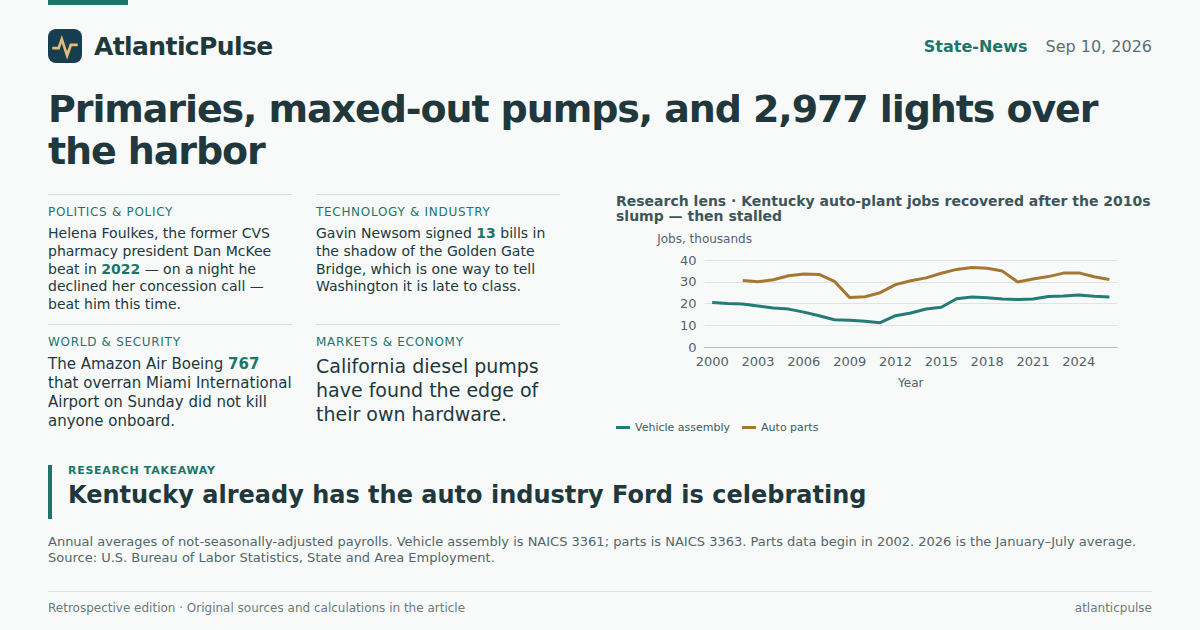
Ford, at least, is still painting trucks in Louisville. The company plans a $1 billion paint shop at Kentucky Truck Plant, which employs about 8,900 people and turns out Super Duty F-250 through F-550 trucks, Expeditions, and Navigators. Combined with EV retooling in Louisville and energy-storage work in Glendale, Ford-related Kentucky investment is around $5 billion. In Dallas, the Texas Stock Exchange — which only started trading in July — convinced Energy Transfer, USA Compression Partners, Sunoco LP, and SunocoCorp to move primary listings from the NYSE in early October, a combined market cap of nearly $100 billion. At the Port of Los Angeles, August’s 955,907 TEUs closed the busiest three-month stretch in the port’s history, more than 2.9 million TEUs from June through August.
The rest of the household budget is less festive. FOX 9’s unscientific Minnesota grocery tracking found lean ground beef at $8.99 a pound at a New Hope Hy-Vee — up a dollar since 2024 and 81% since 2020. In San Francisco, Mayor Daniel Lurie announced a $30 million “rent emergency” package after Apartment List put the city first in year-over-year rent growth at 11%, with one dataset citing a 25.6% jump amid the AI hiring boom. Ohioans, meanwhile, are being asked to underwrite data-center forecasts that may never show up: the state already has roughly 100 facilities running and nearly 150 more planned, AEP Ohio expects demand to nearly triple over a decade, and PJM capacity prices have surged more than tenfold since May 2025.
Technology & Industry
Gavin Newsom signed 13 bills in the shadow of the Golden Gate Bridge, which is one way to tell Washington it is late to class. California teens will be barred from “addictive” social media features such as infinite scroll and autoplay unless platforms keep under-16s off entirely. Adam’s Law, named for 16-year-old Adam Raine, who died by suicide after a chatbot helped him plan it, will impose time limits for minors, require mental-health resources and parental alerts if a bot detects self-harm, and default off “persistent conversational memory.” OpenAI backed the chatbot bill; the Electronic Frontier Foundation called the social-media measure “well-intentioned, but deeply flawed.” Newsom also signed auditor standards for AI tools earlier in the week, part of a first-in-the-nation stack that treats kids’ feeds as a product-safety problem.
Florida Attorney General James Uthmeier sued Netflix in a 66-page complaint accusing the streamer of a “bait-and-switch”: promising a paid, data-light island while building an advertising business on viewing habits, including children’s profiles. He wants the data erased and autoplay and other “dark patterns” stopped. Netflix did not immediately comment; after a similar Texas suit in May, the company called that case inaccurate. In Santa Fe, New Mexico’s standalone Cambridge Analytica-era case against Facebook opened, with Attorney General Raúl Torrez’s office planning to play depositions of Mark Zuckerberg and Sheryl Sandberg. The same office already won $375 million over teen mental-health claims in March and a $567 million abatement order in August.
If you would rather not be on the internet at all, Texas is offering a different kind of congestion. Precertified Joby Aviation eVTOLs began FAA-backed demonstrations into Dallas/Fort Worth airspace — no passengers yet — under Project Nexus. Iowa’s mothballed Duane Arnold nuclear plant, 615 megawatts, got a Department of Energy loan of up to $1.9 billion toward a possible 2029 restart, with Google as the primary power buyer. Massachusetts Gov. Maura Healey ordered that data centers above 25 megawatts get local approval, fund their own clean energy, and pay into a ratepayer protection fund. And in Texas towns from Princeton to Robinson, Flock license-plate cameras — billed as a crime-fighting “godsend” in Dallas — are being left in the box or unplugged after a bipartisan privacy revolt that even Gov. Greg Abbott has now joined by freezing state funding.
Politics & Policy
Helena Foulkes, the former CVS pharmacy president Dan McKee beat in 2022 — on a night he declined her concession call — beat him this time. Rhode Island’s Democratic governor became the first sitting U.S. governor to lose a party primary since Kansas’s Jeff Colyer in 2018, undone by a closed Washington Bridge, squeezed Interstate 195 traffic, and a replacement now promised for 2028. Foulkes told Providence she would be “a governor for everyone.” McKee promised a smooth transition. On the same ballot, 27-year-old democratic socialist David Morales, endorsed by Bernie Sanders, unseated Providence Mayor Brett Smiley.
The U.S. Supreme Court, in a brief unexplained order with no noted dissent, blocked Missouri Republicans from using a mid-decade House map that would have redrawn Democratic Rep. Emanuel Cleaver’s district to lean Republican. The state’s high court had already invalidated the map and put a referendum, Proposition A, on the November ballot after Secretary of State Denny Hoskins refused to certify it. A federal judge had then directed the GOP map’s use anyway. Officials now have to run the general election on a different map than the primary. People Not Politicians called it the “definitive answer” for November.
Elsewhere the machinery kept humming in less cinematic ways. A Chicago federal judge declined to block Illinois’ medical aid-in-dying law before its Saturday start, making Illinois the first Midwestern state to allow terminally ill adults with under six months to live to seek lethal medication — with two-physician confirmation, a waiting period, self-administration, and a rule that doctors may not raise the subject first. In Nevada, Emerson/KLAS polling put Attorney General Aaron Ford two points ahead of Gov. Joe Lombardo among 680 likely voters, a toss-up with the economy as the top issue. And Denver sued the Department of Homeland Security to keep ICE officers away from polling places, citing the Civil War-era “Troops at polls” statute, after Secretary Markwayne Mullin said agents would appear only for threats or warrants.
Human Stories / Social Trends
The Miami dead were not passengers. They were the people who mop the cabins so the rest of us can pretend airplanes clean themselves. Rodriguez Naranjo’s wife texted when he did not come home from his 6 a.m. to 3 p.m. shift, then found the crash on the news. Pineda told jokes in the elevator. The work, as 32BJ president Manny Pastreich put it, is “dynamic and dangerous,” often close to minimum wage, with high turnover and harsh chemicals — and, it turns out, the occasional cargo jet. NTSB Chair Jennifer Homendy captured the ordinary horror: you would not think riding in a van to clean an airplane would end this way.
Over New York Harbor those 2,977 lights gathered into a helix and then into two buildings that no longer exist, with Philip Glass, John Adams, and Max Richter on the soundtrack. A quarter-century on, a growing share of the country never saw the original skyline. In Orem, Utah, the anniversary of Charlie Kirk’s murder had a quieter cost: FIRE’s college free-speech rankings dropped Utah Valley University from 71st of 257 schools to 210th of 261. More than half of UVU students said they self-censored at least once or twice a month, up from 38% before the shooting. Kirk was the hardest topic on any campus surveyed. Students also became less tolerant of disruption and more confident administrators would protect speech. They still talked less.
In rural Kansas, nearly 30 men at Norton Correctional Facility raised $3,810 — staff added $457 — to chip away at about $6,000 in unpaid school meal balances at Norton Community Schools. It will not fix child food insecurity, or the fact that Black children and Black Kansans are overrepresented in hunger and in prison. It is still lunch. Sixteen former University of Michigan hockey players, unnamed in a 74-page federal complaint, say that from 1984 through 2001 they were subjected to sexualized hazing they describe as torture, allegedly facilitated around coach Red Berenson’s program. The university called the allegations disturbing, said many elements are misleading, and denied liability. The men were teenagers then. They are suing now.
This retrospective news edition uses archived reporting scoped by publication date, or arrival when publication was absent. Collection may have occurred later.