State-News
Runways, reactors, and rival maps: a restless Wednesday in the states
World & Security
Investigators spent another day picking through what NTSB Chair Jennifer Homendy called “utter devastation” at Miami International Airport, where an Amazon cargo Boeing 767 overshot a runway on Sunday, punched through a fence and killed five people in a plane-cleaning van. The 32-year-old jet, converted from passenger service and flown by North Carolina cargo carrier 21 Air as Prime Air Flight 7598 after a two-hour hop from Puerto Rico, barreled about 1,300 feet past the runway end in a reported tail wind of more than 25 knots, the Associated Press reported. The dead — Rolando Aleman Leon, 55; Yoel Rodriguez Naranjo, 53; Julio C. Pineda, 75; Carlos Acosta Fajardo, 53; and Javierkys Reyes Quevedo, 47 — worked for Professional Ocean Service Corp. The pilots survived. Flight-data traces now show wheel brakes were applied, but speed brakes and thrust reversers did not deploy, investigator-in-charge Chihoon Shin said, according to Fox News. Miami, unlike about 120 U.S. airports, has no engineered material arresting system at the runway end. Homendy’s warning was not subtle: implement the board’s old recommendations, “or we’re going to be here again.”
Security elsewhere was less cinematic and no more comforting. A federal grand jury in Nevada indicted Treyvon Jameel Currie, Jessica Marie Zamora and Demandre Michael Frazier after two of them allegedly entered or tried to enter a Department of Energy site in North Las Vegas on Aug. 5 with a concealed firearm, BNO News reported. The facility sits inside the Nevada National Security Sites, the Cold War test range that still handles weapons stewardship and nuclear forensics. Prosecutors have not said what the trio intended. Zamora and Frazier also face charges over false statements on federal firearms forms while buying Smith & Wesson pistols.
Hawaii was still counting downed trees after Hurricane Lowell. The Category 2 storm slammed Kauai with winds up to 80 mph, killed at least one person, tore up beachside roads and knocked out power for thousands — including about 30,000 on Oahu, Metro reported. Governor Josh Green warned of dangerous winds and flash flooding; by daylight, Kauai emergency manager Elton Ushio asked residents to stay off the roads while crews surveyed the mess. Locals said cleanup could take weeks. It is not the September anyone on the western islands ordered.
Markets & Economy
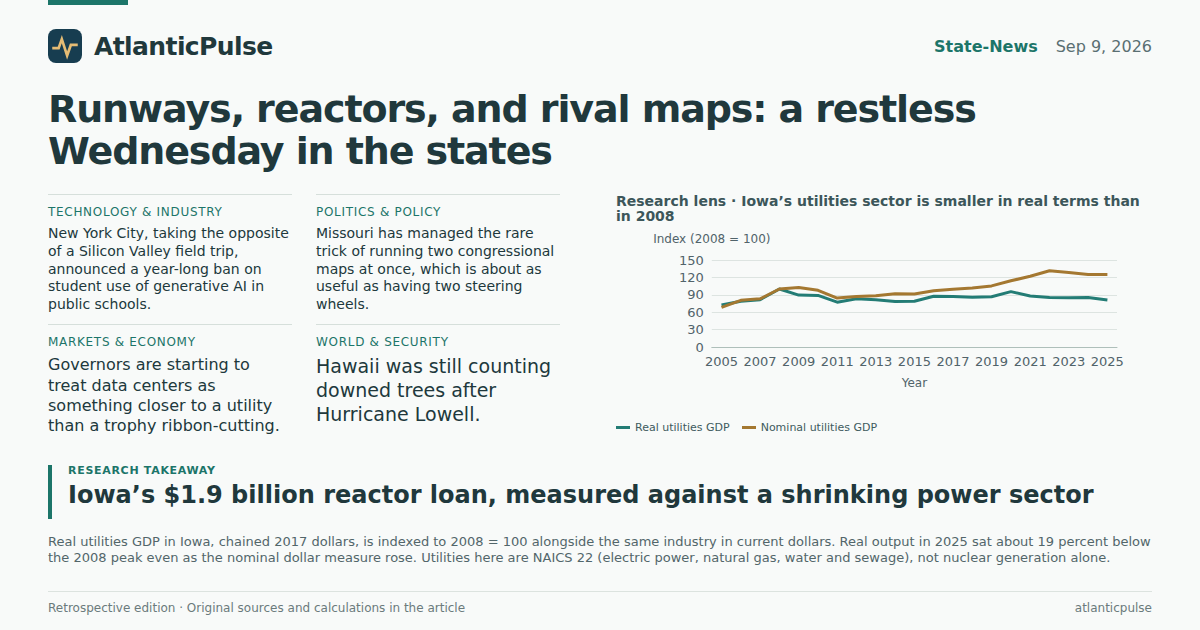
Iowa is preparing to resurrect a “zombie” reactor so a data center can have lunch. The Energy Department’s Office of Energy Dominance Financing closed a $1.9 billion loan to NextEra Energy to restart the 615-megawatt Duane Arnold Energy Center near Cedar Rapids, decommissioned in 2020 after a derecho wrecked its cooling towers, Heartlander News reported. Google has a 25-year contract, signed in October 2025, to buy 70 percent of the plant’s output; the Central Iowa Power Cooperative would take the rest. NextEra still needs a “bundle of licensing actions” from the Nuclear Regulatory Commission through at least January 2028 and hopes to be online in early 2029. Construction could mean almost 1,500 jobs, then more than 450 full-time workers. Sierra Club Iowa, unpersuaded, called it a public-money gamble “just to satisfy the electricity cravings of massive tech monopolies.” Similar restarts are in motion at Michigan’s Palisades and Pennsylvania’s Three Mile Island Unit 1.
The same appetite is colliding with household bills. Massachusetts food-truck operator Richard Cambriello told CBS Boston he will probably raise prices within a week or two as gasoline, burgers and lettuce all climb, WROR reported. AAA Northeast put the Labor Day national average near $4.15 a gallon for regular and $5.90 for diesel, with spokesperson Mark Schieldrop noting that prices usually ease as summer driving ends — except when Iran, the Strait of Hormuz and related volatility all refuse to cooperate. Amkor, unbothered by the mood at the pump, announced a second phase of its Arizona semiconductor packaging campus that would add 60,000 square metres of cleanroom to 33,000 already planned and lift the total investment to about $12 billion, The Next Web reported.
Governors are starting to treat data centers as something closer to a utility than a trophy ribbon-cutting. Massachusetts Gov. Maura Healey signed Executive Order 658 on Sept. 8, declaring that unless a community says yes to a facility above 25 megawatts, the state is saying no, Gadget Review reported. Developers would have to lock in a community-benefits agreement, bring their own clean power, pay for grid upgrades, protect water and, if they miss the clean-energy mark, pay into a Ratepayer Protection Fund. In Texas, The Texas Tribune spent Wednesday dissecting a rural conservative backlash, a shifting stance from Gov. Greg Abbott, and a moratorium pending audits by ERCOT and the Public Utility Commission — a November issue that no longer splits neatly by party.
Technology & Industry
Florida Attorney General James Uthmeier spent the day treating chatbots as if they had a rap sheet. In Tampa he called for criminal penalties on companies whose AI systems contribute to crimes, asking how aware executives were of the “behaviors of the crimes that took place,” Creative Loafing Tampa reported. The pitch follows his office’s earlier action against OpenAI after prosecutors reviewed ChatGPT logs with Phoenix Ikner, the accused gunman in the April 17, 2025, Florida State University shootings, and an expanded inquiry after a University of South Florida case. Proposed sanctions — not yet drafted — could include fines, victim payments, monitorship and a timeout from doing business in Florida. He also wants the Board of Medicine to look at chatbots practicing medicine without a license. OpenAI has said it will “continue to prioritize safety while balancing privacy.”
Uthmeier was not finished with consumer tech. A 66-page lawsuit filed Wednesday accuses Netflix of promising an ad-free, privacy-minded service while collecting years of behavioral data, including from Kids Profiles, to build the advertising business it once swore off, Fox News reported. The complaint cites former CEO Reed Hastings’s 2020 claim that Netflix did not collect user data, alleges autoplay “dark patterns” on children’s profiles, and seeks deletion of data plus civil penalties under Florida’s Deceptive and Unfair Trade Practices Act and Digital Bill of Rights. Netflix did not immediately comment.
New York City, taking the opposite of a Silicon Valley field trip, announced a year-long ban on student use of generative AI in public schools. Mayor Zohran Mamdani called the moratorium “a commitment to getting the future right,” SheKnows reported. Student-facing tools and companion chatbots are out for preschool through eighth grade; high schools may run monitored pilots, and all high-schoolers would get twice-yearly training on literacy, bias and ethics. Suggested screen-time caps: 30 minutes a day in grades 3–5, 45 minutes in grades 6–8. Out on the roads, the cameras that were supposed to be uncontroversial are suddenly very cancelable. Stevens Point, Winnebago County, Fond du Lac County and Sheboygan are among Wisconsin communities stepping back from Flock license-plate readers — Sheboygan after the company allegedly tried to sell the city traffic data it did not know had been collected, News From The States reported. In Nevada, Assemblymember Selena La Rue Hatch is preparing a statewide ban, with the ACLU of Nevada arguing the government should not know “every single road you’re on at every moment of the day,” Coyote Country reported. Las Vegas Metro, which has used readers since 2019, would beg to differ.
Politics & Policy
Missouri has managed the rare trick of running two congressional maps at once, which is about as useful as having two steering wheels. The state Supreme Court ruled on Sept. 3 that a 2025 Republican remap, HB 1, “is not the law and has never been the law” because a referendum petition suspended it, so the 2022 map must be used in November, Law Dork reported. Justice Brett Kavanaugh, sitting as circuit justice, declined Tuesday to stay that order. Minutes later, U.S. District Judge Stephen Clark issued a temporary restraining order requiring Secretary of State Denny Hoskins to use HB 1, the same map the state court forbade. By nightfall the Missouri Supreme Court had ordered Hoskins to show cause why he should not be held in contempt. Opponents of the remap — drawn to help Republicans take a seventh of the state’s eight House seats by targeting Democratic Rep. Emanuel Cleaver’s Kansas City district — were back at the U.S. Supreme Court on Wednesday after the Eighth Circuit let Clark’s order stand, WTOP reported. Voters, as one might expect, are not entirely sure which district they live in.
New Hampshire, at least, produced an actual matchup. Former Republican Sen. John E. Sununu will face Democratic Rep. Chris Pappas for the seat Jeanne Shaheen is leaving, WHDH reported. Pappas beat four Democrats; Sununu beat a field that included former Massachusetts Sen. Scott Brown. Stefany Shaheen, the outgoing senator’s daughter, was in the scrum for Pappas’s House seat. The winners have eight weeks before Nov. 3 — after which New Hampshire, in a fit of self-awareness, will move future state primaries to June.
Vote-by-mail states are discovering that a postmark is not a philosophy. Oregon Secretary of State Tobias Read said 7,314 ballots that arrived in the May primary’s grace period were rejected for late postmarks — a 13 percent rejection rate, up from 9.5 percent two years earlier, Fox 13 Seattle reported. Washington counted 20,267 late-postmarked ballots, up from 16,131 in 2024. In Stevens County, Auditor Lori Larsen received 547 late-postmarked ballots three days after the August primary and is doubling drop boxes from five to 10. The Postal Service says mail early, or walk into a post office and ask for a manual stamp. In Dallas, Republicans opened the first-ever GOP Midterm Convention with Donald Trump as keynote, even as some members facing voters stayed home, KYMA reported. Illinois, on a different calendar, will see its medical-aid-in-dying law take effect Sept. 12, with a limited restraining order covering some religious hospitals and physicians who object to participating, the Biblical Recorder reported.
Human Stories / Social Trends
The most quietly alarming number in California is not a poll. SchoolHouse Connection and the University of Michigan’s Poverty Solutions estimate that nearly 86,000 children ages 0 to 3 — more than 5 percent of the state’s infants and toddlers — experienced homelessness in 2023-24, a 15 percent jump from about 74,000 the year before, EdSource reported. Only about 12,000, or 14 percent, were enrolled in early-learning programs where housing trouble is often spotted. UCLA’s Joseph Bishop notes nearly 300,000 homeless students in California public schools in 2024-25. Pandemic-era federal money that paid for gas cards and emergency housing is gone; a one-time $116 million state grant is supposed to fill part of the gap. The youngest children, as usual, are the hardest to count and the easiest to miss.
Ohio offered a rarer kind of good news. U.S. Marshals announced that Operation Meridian, run through August, recovered 79 missing children ages 6 to 17 — described as the largest such operation in state history — working with police in Akron, Cleveland, Columbus and Toledo, plus Kentucky partners, Heartlander News reported. Cases included suspected trafficking, abuse, neglect and runaways; some children were found as far as Georgia. Amanda Berry, who escaped captivity in Cleveland in 2013, briefed the team beforehand. “Treat every missing child like they were our own,” Marshal Pete Elliott said they did.
In Pennsylvania, measles is no longer an abstraction. Lancaster County Coroner Dr. Stephen Diamantoni said two infants who died in August were measles-related: Ivan Miller, who died Aug. 14 shortly after birth of a ruptured spleen, with measles listed as a contributing condition, and Mary Stoltzfus, 6 weeks old, who died Aug. 18 of a measles infection atop Amish lethal microcephaly, the Associated Press reported. Neither was old enough to be vaccinated. Health Secretary Robert F. Kennedy Jr. had suggested the deaths “may even have been altogether fabricated”; the CDC website still was not counting them. Pennsylvania’s outbreak has topped 620 cases in 37 counties. “Eliminated” turns out to be a status, not a personality trait.
This retrospective news edition uses archived reporting scoped by publication date, or arrival when publication was absent. Collection may have occurred later.