State-News
Storms, Steel and Surveillance: A Labor Day Map of the States
World & Security
Hawaii spent the holiday weekend doing something the islands generally prefer to leave to the mainland: staring at a hurricane tracker. Category 4 Hurricane Lowell was turning north toward the western islands with 145 mph winds and a 936-millibar core, sitting about 635 miles south-southwest of Lihue, Kauaʻi, after a 70-mph jump that briefly made it the Central Pacific’s first Category 5 since Walaka in 2018. Governor Josh Green had already declared a statewide emergency, activated the disaster fund and the National Guard, and asked residents to stock 14 days of supplies while Kauaʻi closed campgrounds and staged high-water vehicles. The National Hurricane Center still expected most models to keep the center west of the chain, but it also warned of 3 to 6 inches of rain on Kauaʻi and the Big Island, with isolated totals above 10 inches, plus 14-foot surf. Green, whose state is still digging out from Hurricane Lala’s mid-August deluge, put the stakes without poetry: if Lowell does what Iniki did in 1992, “we could see tragic consequences.” Super El Niño, officials said, is stacking storms in a basin that used to take the summer off.
Michigan, meanwhile, got the storm that actually showed up. An EF-2 tornado tore through Detroit’s east side — the city’s first in 29 years — bringing down roofs, walls, power lines and more than 80 trees, including 20 old-growth specimens at Gabriel Richard Park before the funnel crossed the river onto Belle Isle. Mayor Mary Sheffield declared an east-side emergency; city officials counted at least 20 properties with significant damage and, remarkably, no serious injuries. Daquan Addison had just stepped off his porch with his infant daughter when the roof caved in. The National Weather Service later confirmed three tornadoes in Southeast Michigan, including an EF-0 in Lincoln Park. DTE Energy said about 450,000 customers lost power after the storms; by Saturday evening some 76,000 were still dark, with roughly 4,000 utility workers on the job and a goal of restoring 90 to 92 percent by nightfall. Senior vice president Brian Claka called the damage among the worst weather events of his career, which is not a phrase one wants from the people who own the poles.
The other security stories of the day were quieter and, in their way, more unsettled. In McAllen, Texas, ICE officer Christian Castro was released on a $75,000 unsecured bond and a GPS monitor after a federal indictment accused him of lying about a January Minneapolis shooting during Operation Metro Surge. Prosecutors say Castro claimed he was beaten with a broom and shovel before firing; the indictment says he shot Julio Cesar Sosa-Celis through a front door, hitting him in the leg, after a brief scuffle, and that no one struck him as described. It is the first Justice Department prosecution of a federal officer from this year’s Twin Cities surge. Castro’s lawyers say he intends to plead not guilty. Public health desks were equally unquiet. Health Secretary Robert F. Kennedy Jr. acknowledged that measles caused one Pennsylvania infant’s death after asking last month that two state-reported measles deaths be pulled from the CDC tally; Pennsylvania still says there were two, and the CDC’s 2026 national count still listed none while the agency “re-evaluates” how it classifies measles deaths. Georgia, less interested in taxonomy, confirmed three more measles cases tied to a metro Atlanta daycare, bringing that cluster to eight and the state’s year to 14 — already past 2025’s total of 10 — in children who were unvaccinated or not fully vaccinated.
Markets & Economy
On the industrial map, the groundbreaking of the week belonged to Louisiana. Hyundai Steel and POSCO, with Hyundai Motor and Kia as partners, broke ground on a $5.8 billion electric-arc furnace mill — Hyundai-POSCO Louisiana Steel — meant to pour 2.7 million metric tons of automotive steel a year for plants in the southern United States and Mexico. Hyundai Steel holds 50 percent, POSCO 20 percent, and Hyundai Motor and Kia 15 percent each. South Korea’s industry minister used the ceremony to ask Washington for tariff relief on Korean equipment and materials, which is the sort of toast one gives when the ribbon is still on the shovel. The mill is part of Hyundai Motor Group’s $26 billion U.S. expansion and is aimed at commercial production in 2029, with reporting that it would support 5,400 jobs including 1,300 direct positions. Louisiana’s economic-development secretary, Susan Bourgeois, said the project is already feeding contractors and training workers. Whether the tariff ask travels as far as the steel will is a question for a different groundbreaking.
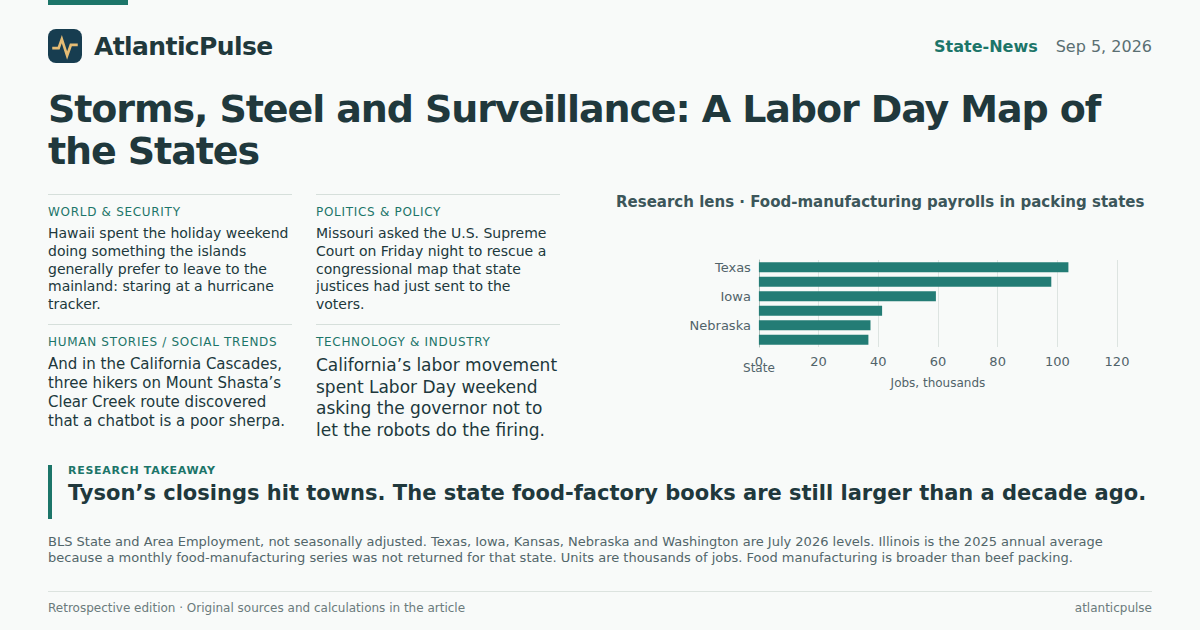
Utah’s labor market told a less ceremonial story. Tyson Foods is shutting its five-year-old Eagle Mountain case-ready beef plant, sending layoff notices to more than 700 workers, and closing a larger plant in Joslin, Illinois, while selling another in Washington — a retreat the company ties to U.S. cattle supplies at a 75-year low after years of drought and rising costs. Austin Campbell, a 27-year-old maintenance worker with a software-engineering degree and two small children, was offered a shot at other Tyson sites and declined. Starting pay at the plant ran around $30 an hour, with leads near $39; other industrial shops, he said, offer $20 to $25. Nationally, Challenger, Gray & Christmas counted just under 530,000 job cuts through August, 41 percent fewer than a year earlier and the lowest January–August total since 2022, even as hiring has slowed to a monthly average of about 61,000 new positions. Economists have named the mood “no hire, no fire,” which is a polite way of saying nobody is throwing a party. Utah’s July unemployment still sat at 3.6 percent, below the national 4.1 percent reading after August’s 162,000-job gain, so the state’s workforce agency is pointing laid-off meatpackers toward 25,000 listings and a September job fair. Networking, they note, still fills 80 percent of jobs. The other 20 percent, one suspects, involve a hard hat and a prayer.
Other statehouses tried to buy their way into better news. Burlington Stores said it would move its headquarters to Philadelphia with a $370 million investment at 3151 Market Street in Schuylkill Yards, promising at least 2,000 Pennsylvania jobs over five years against $30 million in state grants plus city incentives. Governor Josh Shapiro called it the city’s largest headquarters relocation in years; Burlington already had more than 43 stores in the Philadelphia market. Maryland, less interested in Fortune 500 trophies than in the people who answer 911, opened a $50 million First Homes program that knocks half a percentage point off mortgage rates for teachers and first responders and adds a 0 percent loan equal to 5 percent of the mortgage — $15,000 on a $300,000 loan. Chicago’s Mayor Brandon Johnson, in a less festive week-in-review, said next year’s budget hole is smaller than feared but still nearly $900 million, which is the municipal equivalent of being told the iceberg is slightly shorter. Texas, at least, could brag about electrons: ERCOT met record July demand of 91,308 megawatts without conservation appeals, with solar at times above 45 percent of generation and batteries discharging a record 11,980 megawatts. Oregon’s land-use board, for its part, overturned Marion County’s denial of a 15-acre battery storage farm, ruling that storing power for PacifiCorp counts as a utility facility even if neighbors preferred cows.
Technology & Industry
California’s labor movement spent Labor Day weekend asking the governor not to let the robots do the firing. Unions rallied in San Francisco for nine AI workplace bills on Newsom’s desk, including what labor president Lorena Gonzalez called a ban on a “non-human” boss. Nicolle Pillion, a hospital teleservice worker, said emotion-recognition software now pops up in real time to tell her she lacks empathy while she is trying to hear whether a caller is having an emergency. Former state employment chief Michael Bernick, less panicked, noted that recent labor-force data still show no significant statewide job destruction from AI, and advised workers to get the skills. The centerpiece bill, SB 947, the No Robo Bosses Act, has passed the Senate 28–10 and the Assembly 53–14. It would bar employers from relying solely on automated systems to fire or discipline staff, require written notice when such systems are used, and ban predictive behavior analysis and inference of protected characteristics. Newsom vetoed a broader predecessor last October; this version is narrower, takes effect July 1, 2027 if signed, and carries $500 civil penalties plus a private right of action. He has until September 30. Silicon Valley, one assumes, has the date circled in a shared calendar.
Minnesota, meanwhile, told Elon Musk’s image generator to keep its clothes on. Federal Judge Donovan Frank denied xAI a preliminary injunction against HF 1606, the country’s first ban on tools that generate realistic nudes of identifiable people, allowing civil penalties of up to $500,000 per image to proceed. The judge said the “balance of harms” and public interest favored the state, noted the law passed almost unanimously after reports of a man fabricating sexual images of more than 80 women, and observed that xAI waited until days before the August 1 start date to sue. A report cited in the ruling said Grok produced about 3 million sexualized images in 11 days after a new editing feature launched, including about 23,000 that appeared to depict children; xAI said it had suspended more than 52,000 accounts and filed tens of thousands of reports with the National Center for Missing and Exploited Children. The company has noticed an Eighth Circuit appeal. Attorney General Keith Ellison called the ruling a win for “the dignity of the people of Minnesota,” a phrase that does not often appear in product-launch decks.
The other machine in the dock was the license-plate camera, and it is having a worse month than any chatbot. California lawmakers, for the fifth year, killed a Flock-regulation bill when SB 1013 died in the Assembly on the session’s last day; more than 230 California agencies use the readers, a Los Angeles audit found one in three “stolen” hits inaccurate, and Secure Justice counted more than 200 U.S. cities or agencies ending contracts in August. Wisconsin’s Racine, Fond du Lac, Sheboygan and Kenosha have dropped or covered cameras even as Milwaukee launched a transparency portal after two former officers were charged with personal use and a woman was pulled over at gunpoint on a bad hit. Arizona’s Payson and Cottonwood joined Chandler, Surprise, Cave Creek and Tempe in shutting systems down. Florida’s transportation department revoked highway permits, and Jacksonville’s sheriff scrapped readers countywide. Wisconsin Senators Tammy Baldwin and Ron Johnson, not a duo famous for duets, both called for tighter limits; Johnson said that until restrictions exist he supports “limiting or banning their use.” New York City, in a smaller but telling pause, imposed a one-year moratorium on student-facing generative AI through eighth grade for 2026–27. The cameras, at least, never claimed to be tutoring anyone.
Politics & Policy
Missouri asked the U.S. Supreme Court on Friday night to rescue a congressional map that state justices had just sent to the voters. Secretary of State Denny Hoskins filed an emergency application to freeze a unanimous Missouri Supreme Court ruling that a citizen referendum on the “Missouri First” map is valid, that the 2022 lines remain in force, and that Hoskins created his own chaos by sitting on more than 300,000 signatures until the last legal day — which happened to be primary day. The 2025 map, signed by Governor Mike Kehoe after President Trump’s mid-decade redistricting push, was drawn to convert Kansas City Democrat Emanuel Cleaver’s seat and shift the delegation from 6–2 Republican to 7–1. Hoskins argues that the U.S. Constitution’s Elections Clause lets legislatures, not “3.3 percent of a state’s voters,” suspend a federal map. Justice Brett Kavanaugh gave opponents until noon on Labor Day to answer. November 3 is less than two months away. Election administrators, who already had plans, now have a Supreme Court briefing, a holiday, and a map that may or may not exist.
Florida’s university governors took a clearer, if colder, vote. The State University System Board of Governors unanimously barred undocumented students from the state’s 12 public universities starting in the 2027–28 academic year, following a June ban at 24 public colleges and GED programs and a pending career-and-technical rule. Lieutenant Governor Jay Collins called it “common sense” and said taxpayers should not “subsidize opportunities for people who broke our laws to come here.” The system does not currently track how many such students are enrolled. Legislative bills to the same effect died in committee this year; the boards simply wrote the rules themselves. Idaho’s fight was over wording, not enrollment. The state Supreme Court unanimously rejected yes/no ballot language for Proposition 1, the Reproductive Freedom and Privacy Act, finding that Secretary of State Phil McGrane and Attorney General Raúl Labrador’s statements were not “clear and concise.” Justice Gregory Moeller said a “yes” description skipped the initiative’s independent right to reproductive privacy and its shield for clinicians against felony charges, while a “no” description stretched Idaho’s life-of-the-mother exception beyond the statute’s “prevent the death” standard and enlarged rape and incest exceptions that are limited to the first trimester with documentation. Revised statements were due by 5 p.m. Saturday. In Idaho, even the glossary goes to court.
Texas education conservatives, never shy about a glossary, voted 8–4 to overhaul high-school history, government, world history and geography standards, with classroom implementation now set for 2033–34. The posted world-history text describes Muhammad’s “brutal military campaigns,” jihad and the “conquest of Christian lands,” and lists the Muslim Brotherhood, al-Qaeda, September 11 and ISIS in a modern unit; U.S. history and government sections tie the Revolution and civic virtue to the Bible, the Great Awakenings and John Adams. CAIR-Texas called the portrayal “bigoted caricatures” and pledged to seek reversal; Governor Greg Abbott designated national CAIR and the Muslim Brotherhood as foreign terrorist organizations under Texas law in 2025, a move CAIR disputes. Board member Brandon Hall refused to drop the word “brutal,” saying opponents were “whitewashing” history. Nevada’s fight was over lists, not lesson plans. Secretary of State Francisco Aguilar said the Justice Department had issued seven voter-related subpoenas via the FBI in three months, part of a wider federal push that includes a DHS “surge” in nine states. Aguilar, a Democrat, accused the administration of “inundating election offices” and “making sweeping claims of election fraud… before any investigation is done.” DHS had publicly claimed more than 250,000 registered noncitizens in four states, including 16,000 in Nevada; internal records reviewed by CNN showed the department had “confirmed” 185 in the state, with another 6,200 labeled “higher confidence” and still needing vetting. The difference between a headline and a confirmed name is, as ever, several thousand people.
Human Stories / Social Trends
Colorado students chose the most traditional form of speech still available to people without a lobbyist: they walked out. Organizers said more than 180 schools planned noon walkouts against ICE, and hundreds gathered at Denver’s La Alma Park. Jalen De La Rosa, watching peers and younger kids take the microphone, said it was “inspirational” that people his age would speak when “a lot of people won’t say anything.” Cherry Creek students walked out but stayed on campus, which is the school-district version of civil disobedience with a hall pass. The protests landed on the same weekend as the Minnesota ICE shooting case and Florida’s university ban, a reminder that immigration policy is no longer something that happens only at a border crossing. It is happening in parks at lunch.
Farther north, Michigan’s winemakers were learning a West Coast vocabulary they never wanted. When Canadian and Minnesota wildfire smoke turned the Leelanau Peninsula a “pinky, peachy haze” in July, Shady Lane Cellars winemaker Kasey Wierzba started thinking about lab tests for smoke compounds. The state’s nearly $9 billion wine industry was spared this time: the grapes were still in the “buckshot berry” stage, the smoke did not linger, and Michigan State’s Paolo Sabbatini, who fielded about 10 worried calls, said there was not enough exposure to taint the vintage. Smoke taint — flavors of barbecue and burnt bacon that only show up after fermentation — has already stalked California, Australia and, this summer, the edge of Bordeaux. Brian Hosmer of Chateau Chantal called farming “legalized gambling.” Vineyard manager Andy Fles put the new climate in one line: not warmer every year, but “climate chaos.” The lake still lengthens the season. The woods around the vines, he noted, are another matter.
And in the California Cascades, three hikers on Mount Shasta’s Clear Creek route discovered that a chatbot is a poor sherpa. The Siskiyou County Sheriff’s Office said Google’s Gemini advised them to pack far less food and water than an eight-hour climb required; the climb became a multi-day ordeal, one hiker fell, and rangers had to bring the group down the next morning. Deputies’ advice was almost quaint: call the Forest Service ranger station, and “never rely solely on AI for your trip planning.” It is a small story next to hurricanes and mill groundbreakings, which is why it sticks. The same week states argued over robot bosses, nude-image generators and license-plate networks, three people followed an autocomplete into thin air and ran out of water. The future of work can wait. Bring a map, and maybe a sandwich.
This retrospective news edition uses archived reporting scoped by publication date, or arrival when publication was absent. Collection may have occurred later.