State-News
States spend a Friday arguing over maps, measles and who gets to decide
World & Security
Minnesota spent the day naming the dead from two very different kinds of public violence, which is not the sort of civic branding any tourism board would choose. Officials identified Dale Henry Spry, 63, and Muse A. Afrah, 61, as the civilians killed when Carlton Neal Johnson II, 35, opened fire at a Minneapolis apartment complex during a child-custody exchange; Johnson was later killed in an exchange with police, and two Minneapolis officers, Joseph Michnowski and Yahye Ahmed, were wounded (Fox News). Separately, federal prosecutors charged ICE agent Christian Castro with making false statements about the January shooting of Julio Cesar Sosa-Celis, a Venezuelan man Castro claimed had attacked him with a shovel and a broom. Surveillance video and witnesses contradicted that account; Castro turned himself in Thursday after a months-long extradition tug-of-war between Minnesota and Texas Governor Greg Abbott, who had questioned whether Castro even counted as a fugitive (FOX 4). If you were hoping the federal government and a red-state governor might agree on the definition of “running away,” Friday was not your day.
Nature, meanwhile, declined to wait for anyone’s legal briefing. Hawaii Governor Josh Green declared a statewide emergency as Hurricane Lowell, briefly a Category 5 storm on Wednesday and still a major hurricane Friday, prepared to swing north toward Kauai and Niihau — the state’s third Pacific threat in a month after Hurricane Lala and Tropical Storm Moke, on a track meteorologists compared, uncomfortably, to 1992’s Hurricane Iniki (KEYT/CNN). Detroit Mayor Mary Sheffield signed a local emergency order after the city’s first tornado in nearly three decades tore through the east side and Belle Isle, collapsing buildings and uprooting trees (FOX 2 Detroit). In North Texas, the human-caused Ross Fire had burned about 90,400 acres across Palo Pinto and Jack counties, destroyed 167 structures including 18 homes, and sat at 38 percent containment after days of 109-degree heat and 16 percent humidity (KOTA). The weekend’s travel plans, in other words, come with a weather appendix.
Public health officials were fighting a different kind of outbreak, and then fighting each other about how to count it. Lancaster County’s coroner said a six-week-old Pennsylvania girl born with Amish lethal microcephaly died of measles, one of two measles-associated deaths the state health department reported last week — the first such deaths in Pennsylvania in 35 years — even as those fatalities remained off the CDC’s 2026 death tally. Pennsylvania has recorded 577 measles cases, all in people without both MMR doses; nationally the count has topped 3,100, the most since 1991. Health Secretary Robert F. Kennedy Jr. suggested the Pennsylvania deaths might have been “altogether fabricated”; Governor Josh Shapiro told him to stop playing games with people’s lives (KION/CNN). And in a quieter but no less statewide security story, Kentucky’s Administrative Office of the Courts confirmed that appellate records on Thomson Reuters’ C-Track system were swept up in a multi-state vendor breach, with trial-court files spared only because Kentucky never outsourced them (The Cyber Express). The courts kept running. The notifications, as usual, will take longer.
Markets & Economy
The One Big Beautiful Bill is starting to look, from county budget offices, like the One Big Spreadsheet Problem. Minnesota stands to lose about $37 million a year in federal SNAP administrative funding starting in October, when states’ share of those costs jumps from 50 percent to 75 percent; Olmsted County alone expects roughly $262,000 in extra costs for the last quarter of 2026, more than $1 million in 2027, and about $2.46 million by 2028 once a new share of benefit costs kicks in. Food-bank directors say they cannot backfill a SNAP hole, and county officials are already talking tax levies (KAAL). Illinois hospitals face a slower-moving but larger hit: a KFF analysis and the Illinois Health and Hospital Association warn that new federal caps on Medicaid “state directed payments,” plus cuts to provider taxes, could drain billions — IHA puts hospital losses near $3 billion over five years from 2028, while the governor’s budget office has projected a $4.5 billion Medicaid funding reduction by fiscal 2031, with critical-access and safety-net hospitals most exposed (Mahomet Daily/Capitol News Illinois). Congress, in the great American tradition, has not scheduled a reprinting press for Springfield.
New Mexico’s insurance superintendent, Alice Kane, approved carriers’ request for a 24 percent average rate increase on the individual market and said some BeWell premiums will rise as much as 30 percent, after federal subsidies ended and the state tried to paper over the gap. Starting January 1, the Health Care Authority projects 89,000 Medicaid enrollees could lose coverage under new 80-hour-a-month work rules — and people who fail the paperwork could also be locked out of state exchange subsidies (KOB). That is a neat trick of public finance: raise the price of private coverage in the same season you shrink the public alternative, then suggest everyone call their insurer with questions. Call volume, one suspects, will not be actuarially sound.
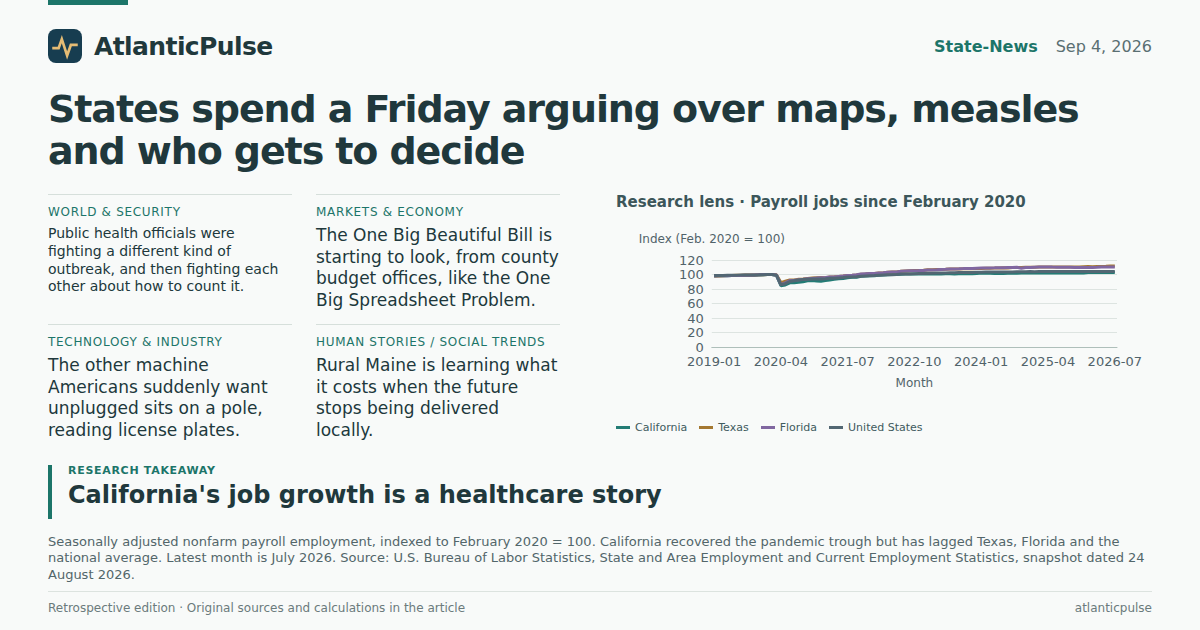
There were a few places still writing checks instead of cutting them. Burlington Stores is leaving its namesake New Jersey hometown after more than 50 years for a $370 million headquarters in Philadelphia’s Schuylkill Yards, a move Pennsylvania sweetened with $30 million in state grants and the city matched with a $7 million forgivable loan, pitching at least 2,000 jobs over five years (Daily Voice). California’s labor market, by contrast, remains the campaign issue nobody wants to campaign on: the state’s July unemployment rate was 5.1 percent, its U-6 underemployment rate 10.3 percent in June — highest in the country — and the labor force shrank by 286,300 over the year, even as healthcare did most of the hiring (The Business Journal/CalMatters). San Francisco is the glittering exception that proves the squeeze. The AI boom has turned the city into the country’s hottest housing market again, with median prices up 25 percent in a year, $25 million cash offers losing bidding wars, and average rents around $4,600; only 2.1 percent of March listings were affordable to a $75,000 household (Cryptopolitan). If your economic development strategy is “hope OpenAI goes public next door,” it is working beautifully for the people who already work there.
Technology & Industry
New York spent Friday on both ends of the AI seesaw, which is at least consistent with a state that can ban a chatbot before lunch and boot a supercomputer after it. Mayor Zohran Mamdani and Schools Chancellor Kamar Samuels announced a one-year ban on generative AI for K–8 public-school students, pulling about 40 classroom tools while leaving more flexibility in high school — though ChatGPT and Claude stay out of class — and carving exceptions for students with disabilities and English learners. Mamdani’s line was that the tech industry wants early AI to look inevitable; the city does not see it that way, joining restrictions already taking shape in Los Angeles and Texas’s Katy ISD (My Modern Met). Upstate, Empire AI Beta went fully online at the University at Buffalo: a $40 million shared academic machine, the second system in a $500 million-plus public-private effort, with four NVIDIA GB200 NVL72 racks, 288 Blackwell GPUs and more than 40 petabytes of storage. Officials say it offers 11 times the training capacity of 2024’s Alpha system, with more than 300 research projects already queued (EdTech Innovation Hub). The pedagogical moral appears to be: children should wrestle with hard problems unaided, while graduate students may have 288 GPUs.
Tesla tried to make Austin look like the future and immediately summoned a regulator. The company launched paid Cybercab rides — two-seat, gold-finished robotaxis with butterfly doors, a Grok screen, and no steering wheel or pedals — and the National Highway Traffic Safety Administration opened an audit query the same day, because federal vehicle standards still expect backup controls. Zoox got a similar exemption only after years of review; Tesla self-certified. NHTSA Administrator Jonathan Morrison said the agency supports automated vehicles but also, inconveniently, the law (Mashable). Texas Republicans, who spent last year calling the state the epicenter of AI, are now running against the warehouses that make the models run. Governor Greg Abbott wants new restrictions, a repeal of data-center tax breaks, and an August 3 grid audit that has effectively paused new connections; Attorney General Ken Paxton, in a tight Senate race, has unveiled his own “negative impact” plan. An August Texas Politics Project poll found only 30 percent of respondents would welcome a data center next door, even as OpenAI’s Stargate campus rises in Abilene and tech-linked groups pour hundreds of millions into the midterms (Communications Today/Reuters). President Trump warned that fighting the centers risks leaving Americans “backwards and poor.” Local electric bills have a dissenting opinion.
The other machine Americans suddenly want unplugged sits on a pole, reading license plates. Florida’s Department of Transportation revoked permits for automated readers on state highway rights-of-way, giving agencies 30 days to pull them, after what FDOT called an “exponential increase” plus reports of misuse; sheriffs in Volusia, Jacksonville/Duval and Bradford counties went further and shut their programs down (Carscoops). In Tennessee, Kingsport Commissioner Joe Carr told a Flock Safety representative the CEO should be hanged “publicly for treason,” then clarified he meant due process, which is the sort of clarification that does not actually clarify. Roughly 100 municipalities have canceled or deactivated Flock contracts; Sullivan County’s sheriff suspended all 10 of its cameras. Texas paused state funding, Pennsylvania’s governor is pushing a ban, and Flock cameras have been vandalized in at least 36 states (LiveNOW from FOX). Crime-fighting hardware that unites MAGA county commissioners and Democratic governors is rare. Enjoy it while the footage lasts.
Politics & Policy
Two state supreme courts spent Thursday rewriting the midterm map, in opposite directions, which is as close as American federalism gets to a split-screen sitcom. Maryland’s high court allowed Democrats’ redistricting constitutional amendment onto the November ballot, reversing a circuit-court finding that the question was fatally bundled, though lawmakers must redraft the language to make clear compactness rules apply to General Assembly districts, not congressional ones. A yes vote would also send map fights straight to the state Supreme Court; the new congressional map favoring Democrats in all eight House seats would not take effect until at least 2028 (NOTUS). Missouri’s Supreme Court, unanimously, blocked a Republican-drawn U.S. House map from November’s election, holding that a citizen referendum petition was “legal, sufficient, and timely,” so the legislature’s plan — which would have turned Emanuel Cleaver’s Kansas City district red and the delegation 7–1 GOP — “will not go into effect unless and until approved by the voters.” The 2020-era 6–2 map stays. President Trump called it a “Dark Day for ‘Justice’”; Attorney General Catherine Hanaway is heading to federal court (Streamline). Voters, for once, were invited to the cartography meeting.
Missouri’s other political story was less about lines than about alleged baggies. Thomas Ross, the Republican nominee for House District 161 after winning his August primary by 33 votes, was charged over an alleged plot to have his campaign manager plant cocaine and a prescription amphetamine pill on rival Louise Secker; he is being held without bond in Joplin, and the state GOP has asked him to withdraw (Streamline). Florida’s Board of Governors, with no debate beyond public comment, approved a rule that will, starting in 2027–28, keep students “unlawfully” in the country out of universities that do not admit every academically qualified applicant — which is most of them. About 8,000 undocumented students graduate Florida high schools each year; Governor Ron DeSantis called the policy a matter of putting Florida residents first, a decade after the state had opened in-state tuition to those same graduates (Creative Loafing Tampa). Michigan’s Supreme Court, meanwhile, declined to force a proof-of-citizenship voting amendment onto the ballot after the Board of State Canvassers tied 2–2 on signatures. Being a citizen is already required; officials have charged six of 5.7 million 2024 voters with noncitizen voting. Organizers say they will try again in 2028 (Votebeat).
Conscience and envelopes filled the rest of the docket. Cardinal Blase Cupich, the Carmelite Sisters for the Aged and Infirm, the Little Sisters of the Poor and pharmacist Luke Vander Bleek sued to block Illinois’ End-of-Life Options Act before it takes effect September 12, arguing the law would force objecting providers to discuss assisted suicide, help patients qualify for lethal drugs and make referrals (FOX 32 Chicago). North Carolina’s elections board, on a party-line vote the same day it started mailing absentee ballots, told counties to “spoil” mail ballots over unsealed inner envelopes, multiple ballots in one envelope, or signature mismatches, and to limit in-person delivery to immediate relatives or guardians. The state is among the first to send midterm mail ballots; the new processing rules echo the president’s long campaign against mail voting, even as a separate U.S. Postal Service voter-list fight heads to the U.S. Supreme Court (NOTUS). If your theory of democracy is that every technicality is a feature, Friday was a banner day.
Human Stories / Social Trends
Not every statewide story this week was a fight over a statute. In Los Angeles, Lissette and Juan Naula met Ryan Keith, a Hawaii woman who had signed up as a live organ donor and gave part of her liver to their baby, Julian, after doctors said a transplant was his only hope. They met in person at Children’s Hospital Los Angeles; Juan, already known for cleaning city streets, said he is adding donation advocacy to the list (FOX 11). In New York, 25 years after September 11, historian Asad Dandia — eight when the towers fell, 19 when an NYPD informant befriended him and slept in his family’s home — is leading walking tours of Muslim New York, a city that now has a Muslim mayor, public prayers in Times Square, and more than 100 mosques added since 2001. Islamophobia has not vanished; a far-right rally still showed up at Gracie Mansion this year. Dandia’s point was simpler: he is as much a New Yorker as anybody else, and he does not owe anyone an apology for other people’s crimes (Dawn/AFP).
Rural Maine is learning what it costs when the future stops being delivered locally. MaineHealth will deliver its last babies at Lincoln Hospital in Damariscotta on December 18, the 12th maternity unit to close in the state since 2015, leaving fewer than half of Maine’s 34 hospitals with labor wards; prenatal care stays in town, but birth means a 40-minute drive to Brunswick. Senate Republican leader Trey Stewart called it the moment a community notices it is losing more than a department (Bangor Daily News). In Minnesota, a Sahan Journal analysis of districts and charters with the most English learners found enrollment down about 1,700 students in March versus October, after Operation Metro Surge sent ICE through the Twin Cities; Minneapolis and St. Paul each lost nearly 500. Teachers described children who “literally disappeared.” One St. Paul eighth-grader, Alessandro, fled with his Honduran family to New York after agents knocked, then came back because school was the only place he felt safe (Eden Prairie Local News/Sahan Journal). Births leaving town and students leaving in the night are different crises with the same aftertaste: the census is not an abstraction.
And then there were the three Roseville men who asked Google Gemini how to climb 14,179-foot Mount Shasta, packed the food and water the chatbot recommended, missed the noon turnaround, wandered into Mud Creek Canyon after dark, and spent the night in a drainage after one hiker hurt his knee. Forest Service rangers and Siskiyou County search-and-rescue got them out. The sheriff’s office’s advice was almost tender in its exasperation: call the ranger station, do not treat a language model as a guide, and turn around while there is still daylight (KTVU). It is a very 2026 parable. The same week New York locked AI out of elementary classrooms and Buffalo switched on a supercomputer, three adults outsourced a mountain to autocomplete and had to be carried home. The machines are getting more capable. Judgment, as ever, is not included in the download.
This retrospective news edition uses archived reporting scoped by publication date, or arrival when publication was absent. Collection may have occurred later.