State-News
Maps, storms, and the midterm fight over data centers
World & Security
Gunfire tore through a downtown Minneapolis apartment tower just after 4:30 p.m. Wednesday, leaving three people dead — including the suspected shooter — and five others wounded by gunfire, two of them Minneapolis police officers. A sixth person, another officer, suffered other injuries; all three officers were described as stable and expected to recover. Interim Police Chief Bill Peterson said officers were inside the building less than two minutes after the 911 call, then followed more shots into a haze that “significantly limited their visibility.” One officer was shot in the leg and another twice in the abdomen. Neighbors told reporters they recognized a fellow tenant known for flashing a pistol. Later reporting identified the suspected gunman as Carlton Neal Johnson II, 35, a Shoreline Plaza resident facing eviction after alleged threats, with a court date set for Sept. 11. Authorities still had not said how the shooter died.
Minnesota’s other federal-enforcement story was less cinematic and more paperwork, which is how these things usually get worse. ICE officer Christian Castro was federally indicted for lying about a January shooting of Venezuelan national Julio C. Sosa-Celis during the state’s immigration crackdown — the first time, reporting said, the Justice Department has charged an officer for on-duty conduct in the second Trump administration’s immigration operations. Homeland Security first claimed a “defensive shot” after an attack with a snow shovel; video later prompted an investigation into “untruthful statements.” The quieter numbers keep climbing. Nevada logged 203 ICE arrests across a two-week late-June/early-July stretch, the state’s highest two-week total on record, with a rising share of people who have no criminal record. Maine has already recorded 488 ICE arrests through July, well above last year’s full-year 315, and a 161 percent jump in arrests of people with no criminal records — third-highest in the country.
The weather, at least, is not waiting for November. Category 4 Hurricane Lowell is passing south of Hawaii and is forecast to turn north, a track Kauai Mayor Derek Kawakami compared, with the unease of someone who remembers 1992, to Hurricane Iniki. Kauai sits inside the National Hurricane Center cone; even a miss could mean huge waves. Back on the Gulf side, former Tropical Storm Edouard dumped 18 to 20 inches of rain on Hardin County, Texas, about 85 miles northeast of Houston, forcing the evacuation of 21 people from an assisted living facility, a dozen motorist rescues, and leaving thousands without power. Jefferson County still had about 22,000 customers in the dark. Edouard was expected to dissipate Thursday, which is the sort of forecast Texans have learned not to frame and hang on the fridge.
Markets & Economy
Mayor Brandon Johnson tried to sell Chicago’s $882.4 million 2027 corporate-fund hole as good news, on the grounds that an earlier projection had topped $1.1 billion. The smaller gap, his team said, reflects departmental efficiencies and overperforming taxes on online sports gambling and cloud computing. Revenues are still projected to fall 6 percent, or $375 million, as one-time TIF surplus and a failed plan to sell city-owed debt evaporate; spending is expected to rise more than $500 million on pensions, cost-of-living raises, and about $400 million in police-misconduct settlements. Johnson pledged “progressive” revenue and did not rule out a property-tax hike heading into February elections — a sentence that will not age well in aldermanic group chats. Across the state line of fiscal reputation, Moody’s upgraded Illinois issuer and general-obligation ratings to A1 from A2, citing eight consecutive on-time balanced budgets. The agency also noted, because it is Moody’s, that Illinois remains an outlier for debt and unfunded pensions.
At the pump, Ohio just posted its most expensive August on record: regular gasoline averaged $3.988 a gallon, beating August 2012’s $3.776 and sitting about 84 cents above August 2025. Weekly averages hit $4.180 on Aug. 17. AAA had Ohio at $3.90 on Sept. 3, with diesel at $5.79. The reporting ties the surge to the U.S.-Israeli war with Iran that began Feb. 28 and disruptions around the Strait of Hormuz. Sen. Jon Husted’s votes against withdrawing U.S. forces have become a November talking point against former Sen. Sherrod Brown. Presidents promising $2 gas and senators asking “What do you want me to do?” is not a new American folk song, but it had a strong August.
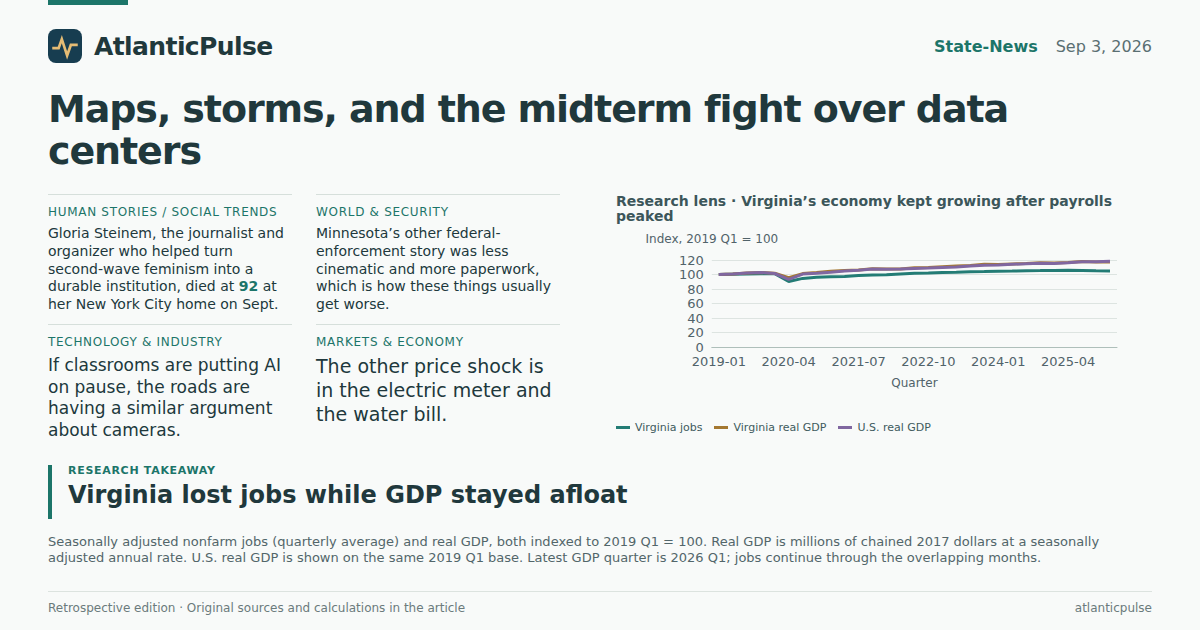
The other price shock is in the electric meter and the water bill. Texas Governor Greg Abbott, who last year called the state the “epicenter of AI development,” is now campaigning for restrictions on data centers, a pause on grid connections, and the repeal of tax incentives. An August Texas Politics Project poll found only 30 percent of respondents would support a data center in their community. Virginia’s Weldon Cooper Center, meanwhile, raised its 2026 GDP forecast from a 0.2 percent contraction to 0.5 percent growth while still projecting 18,050 job losses — and warned that much of the growth is AI- and data-center investment. Somewhere a consultant is writing “jobless expansion” on a whiteboard and calling it a strategy. Not every industrial story is a server farm: Chobani is putting $1.2 billion into an Allentown plant expected to create about 900 jobs and process more than three billion pounds of Pennsylvania milk a year. Texas hospitals, by contrast, face an estimated $27 million daily shortfall in supplemental Medicaid payments after CMS withheld about $9.8 billion amid a fight over hospital taxes.
Technology & Industry
New York City Mayor Zohran Mamdani announced a one-year moratorium on student-facing generative AI from 2-K through eighth grade, covering nearly 600,000 students — about two-thirds of public-school enrolment. High schoolers get two 45-minute literacy modules and tightly capped pilots; companion chatbots are banned in every grade. “I have yet to see a study showing that AI is beneficial for students in elementary and middle school, with the exception, of course, of research sponsored by the very corporations that stand to profit,” Mamdani said. The city will switch off AI features in more than 30 existing products and dump any curriculum tool that cannot be defanged. Teachers may still use AI for planning. Children, for one year, will have to wrestle with long division the old-fashioned way, which is to say: badly, and in public.
If classrooms are putting AI on pause, the roads are having a similar argument about cameras. At least a dozen Virginia localities have pulled away from Flock Safety devices since July; Wythe, Appomattox and Campbell counties terminated contracts this week, and Lynchburg was set to vote on doing the same. Sheriffs who still call the cameras the best investigative tool they have also said public trust now comes first. Florida’s Department of Transportation went further, banning local police from placing license-plate readers on state highways and revoking existing permits, after Governor Ron DeSantis said the deployments had “gotten out of control.” A Reuters/Ipsos poll found 47 percent of Americans oppose Flock cameras in their community and 38 percent support them — a rare midterm issue on which both parties can lose the argument at the same intersection.
Utah, never one to miss a chance to legislate the internet, saw Senate Bill 73 take effect, the first state law to treat anyone physically in Utah as a resident for adult-site age checks even if they are on a VPN. Sites face $2,500 per violation; NordVPN, AdGuard and Surfshark say they will not change how their services work, on the reasonable ground that the statute targets websites, not tunnels. Legal challenges continue, so Sept. 3 may be less a launch than an opening bid. In Austin, Tesla was set to debut its pedal-free, two-seat Cybercab against Waymo and Uber. The company had 314 robotaxis registered in Texas as of Wednesday, including 45 Cybercabs. State law still requires many autonomous vehicles to keep a human ready to grab the wheel — an arrangement that sounds, to anyone who has ridden with a teenager, like a business model.
Politics & Policy
The Missouri Supreme Court unanimously blocked Republicans’ redrawn congressional map and let a November referendum proceed, forcing the state back to the 2022 6-2 map for this year’s midterms. Judge Ginger K. Gooch wrote that House Bill 1 never took effect because the referendum petition — more than 330,000 signatures — was legal, sufficient and timely. The discarded map had been drawn to produce a 7-1 Republican edge by slicing Democratic Rep. Emanuel Cleaver’s Kansas City district into three. Attorney General Catherine Hanaway said she would appeal to the U.S. Supreme Court; President Trump called the ruling “horrible, ridiculous and unconstitutional.” Same Thursday, different coast of the Chesapeake: Maryland’s high court cleared a Democratic redistricting amendment for the November ballot, reversing two lower courts. The measure would not change 2026 districts, but could let lawmakers target the state’s only Republican House seat in 2028. Mid-decade map fights, once a curiosity, are now just Thursday.
The Justice Department sued Kansas City, Kansas, Public Schools over transgender-student policies, the administration’s first FERPA lawsuit asserting a parent’s right to know about a child’s gender transition. The district, which serves more than 20,000 students, disputed that it was out of compliance. Topeka has already agreed to rescind guidance; Olathe and Shawnee Mission have not, and could lose federal funding. In Pennsylvania, the Department of Human Services began mailing notices to more than 700,000 Medicaid expansion enrollees — including about 183,000 in Philadelphia — that after January many adults must document 80 hours a month of work or volunteering to keep coverage. City officials’ advice was admirably unglamorous: open your mail, download the app, update your address.
New Jersey Attorney General Jennifer Davenport asked the U.S. Supreme Court to decide whether Kalshi’s sports event contracts are federally regulated derivatives or just sports bets wearing a CFTC lanyard. Lower courts have split; a Ninth Circuit panel ruled 3-0 against the contracts. States that spent years building licensed sportsbooks are not eager to watch a prediction market skip the queue. The justices may decline the case, which would leave the country with a legal patchwork that looks a lot like American gambling already: legal in some ZIP codes, theoretically a crime in others, and extremely available on a phone.
Human Stories / Social Trends
Gloria Steinem, the journalist and organizer who helped turn second-wave feminism into a durable institution, died at 92 at her New York City home on Sept. 2. Born in Toledo in 1934, she co-founded Ms. magazine and, in 1971, the National Women’s Political Caucus. A New York Times obituary described her as the “personification of the women’s movement,” a writer who challenged sexist assumptions and helped women claim a measure of equality at work, at home and in public life. She outlasted several predicted endings of feminism, which is the sort of last laugh an essayist would have appreciated.
In Mason County, Kentucky, 75-year-old cattleman Tim Grosser has spent a year saying no. A Fortune 100 technology company — rumored, though not confirmed, to be tied to Meta — wants a campus worth more than $1 billion along the Ohio River. Farmland there sells for about $6,000 an acre; Grosser was offered $35,000 an acre, nearly $8 million for 250 acres, then invited to name any price at all. He declined the premise. Neighbors on 1,200 acres turned down $26 million; other neighbors signed options on 28 properties awaiting a zoning change. Local officials talk about 400 permanent jobs. Holdouts talk about pavement that does not un-pave. It is the national data-center fight reduced to one farm, one family, and a blank check that somehow still was not enough.
Farther north, 91-year-old Dale Sanders reclaimed the title of oldest hiker to finish the 2,193-mile Appalachian Trail, summitting Mount Katahdin in Maine after starting Sept. 6 in West Virginia. He fell 71 times. At the sign on Maine’s highest peak he paused to pray. It is not a policy story, which is rather the point: after a day of maps, cameras, and $882 million holes, a man older than most of the infrastructure arguments crawled the last miles anyway. The trail does not care about midterms. Neither, apparently, did he.
This retrospective news edition uses archived reporting scoped by publication date, or arrival when publication was absent. Collection may have occurred later.