State-News
Storms, Superfunds and Surveillance: A Very American Tuesday
World & Security
Labor Day week opened with two kinds of water trouble. Tropical Storm Edouard formed in the Gulf with 40 mph winds, crawling west-northwest at 6 mph toward a Tuesday landfall on the Texas–Louisiana coast. A warning covered Port Bolivar, Texas, to the Vermilion/Cameron Parish line; surge watches of two to four feet hung over southwest Louisiana and Port Arthur. Houston sat in line for three to five inches if the storm dawdled inland. Farther west, a Saturday flash flood in Grand Canyon National Park was already uglier: searchers recovered Texas chiropractor John Giusti, 53, who had set out Thursday with two Granbury friends. More than a dozen hikers remained missing, the canyon’s only water pipeline was wrecked, and emergency restrictions hit year-round residents. Monsoon rain on a 2025 burn scar is not a postcard.
In New York the danger was a shopping bag. Just before 4:30 p.m. Monday, beside an NYPD substation outside One Times Square, a 49-year-old Queens woman pulled two kitchen knives from a bag and stabbed a 68-year-old man leaving the subway with his wife, then a 32-year-old woman. Officers asked her for several minutes to drop the knives; a Taser failed, and two of them shot her as she advanced. Police cited a mental-health history from 2018 and 2019, no NYPD arrest record, and no evidence of terrorism. The younger victim died. City homicides are down 24% this year—excellent on a slide, less so next to the ball-drop building. It was the second Times Square killing of 2026.
North Carolina prosecutors used a grand-jury indictment to reopen a May horror. Seventeen-year-old Sarah Lindsay Santiago is charged as an adult with three counts of murder by aiding and abetting and one of conspiracy, accused of spreading a livestream and manifesto from the Islamic Center of San Diego attack that killed security guard Amin Abdullah and two mosque members. District Attorney Jim O’Neill said the teenage gunmen had also planned to hit Kehilat Ariel Messianic Synagogue and Black students at a local high school; Abdullah’s shot, he said, likely stopped that itinerary. The FBI’s San Diego chief noted that being 2,000 miles away in support of an attack can still draw the gravest charges. On immigration, Homeland Security Secretary Markwayne Mullin said “Operation Rotten Apple” produced about 2,100 arrests in New York and threatened more agents unless Governor Kathy Hochul and Mayor Zohran Mamdani dropped sanctuary limits. He called the city “crime-ridden” even as the NYPD, through July, was on pace for record-low murders. Syracuse University’s TRAC project finds about 70% of people in ICE detention have no criminal record. The mug-shot wall and the crime spreadsheet still live on different planets.
Markets & Economy
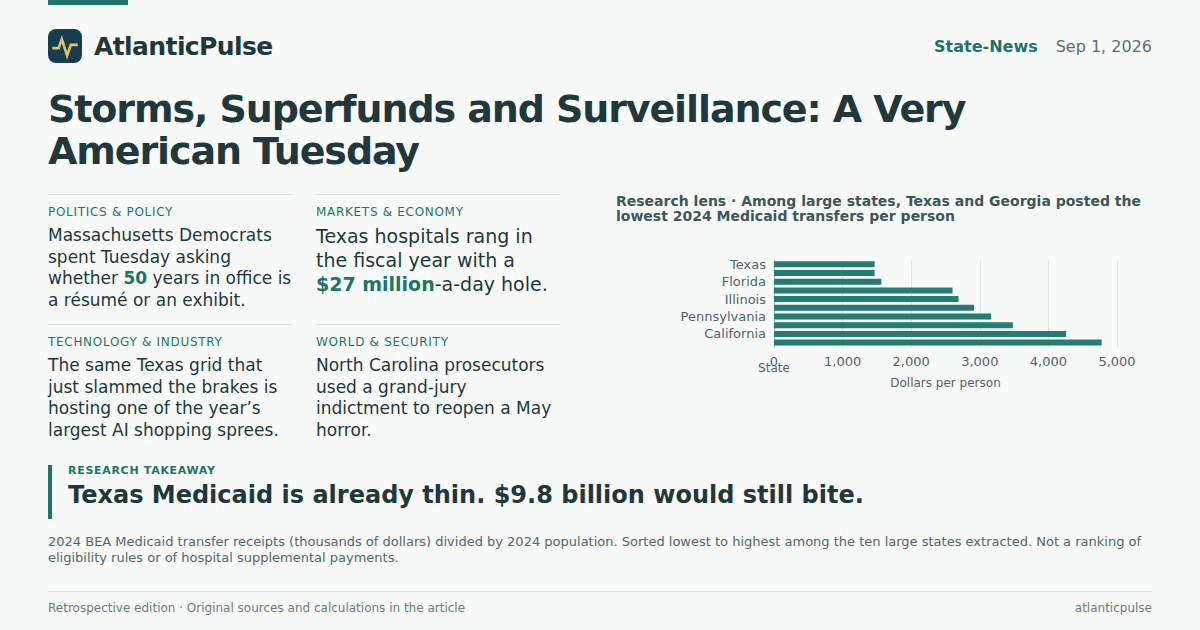
Texas hospitals rang in the fiscal year with a $27 million-a-day hole. Washington is withholding about $9.8 billion over the next year from three Medicaid programs, mostly CHIRP, which tops up the gap between outdated state rates and actual costs. Local governments collect roughly $4 billion a year in hospital taxes that the federal government usually matches; without that match, four million Medicaid enrollees—most of them children—sit inside a system that cannot lose money on one side of the ledger without cutting the rest. Harris Health’s CEO called the Houston-area hit “catastrophic.” Governor Greg Abbott has already written Health Secretary Robert F. Kennedy Jr. describing an economic “gun to the head,” and puts the 2027 risk as high as $12 billion. Even a last-minute deal, the Texas Hospital Association warns, would leave a claims backlog of at least 90 days. Texas never expanded Medicaid and still thought it was shielded. That theory is having a bad Tuesday.
Not every balance sheet was bleeding. Chobani pledged about $1.2 billion over five years for a 1.5-million-square-foot Allentown, Pennsylvania, campus—Governor Josh Shapiro’s “largest private sector investment in the history of Pennsylvania’s agriculture industry”—with more than 900 jobs and, at full capacity, more than 3 billion pounds of Pennsylvania milk a year. The deal folds in a Keurig Dr Pepper plant and a distribution network that already reaches most of the country. Down the Gulf Coast, CF Industries, Japan’s JERA and Mitsui broke ground on Blue Point One, a $3.7 billion low-carbon ammonia plant in Modeste, Louisiana, aiming for 1.4 million metric tons a year by 2029 and about 3,900 construction jobs. It is designed to capture roughly 98% of its CO₂. One region is pouring yogurt; another is pouring fertilizer. Both are betting American farms still matter if someone writes a large enough check.
The other industrial boom is harder to count. Data-center requests on the Texas grid have jumped from about 48 gigawatts in 2023 to more than 474, and Reuters tallied more than 700 gigawatts of large-user requests across the Midwest, Mid-Atlantic and South—more than ten times current U.S. data-center use. Texas froze new connections to audit ownership, subsidies and water. Exelon cut its “high-probability” tally about 40% after stricter collateral; AEP Ohio’s pipeline more than halved after study fees. Ghost demand is a wonderful business if you never have to build the ghost a substation. A federal judge in Albany, meanwhile, struck down New York’s Climate Change Superfund Act, the $75 billion bid to bill fossil-fuel producers for historical emissions. West Virginia Attorney General J.B. McCuskey, leading 22 states, called it a “money grab.” Chief Judge Brenda K. Sannes found the law “simply beyond the limits of state law.” California’s session-end wildfire package left Governor Gavin Newsom’s utility cost-shift on the floor: a fast-pay program, no end to insurer subrogation, no cap on survivors’ damages. Who pays for fire, flood and server farms remains the most expensive unanswered question in state politics.
Technology & Industry
The same Texas grid that just slammed the brakes is hosting one of the year’s largest AI shopping sprees. Anthropic signed a $35 billion cloud deal with Nvidia-backed Lambda for a Hut 8 campus in Nueces County, with Nvidia holding the lease on a 700-megawatt site already disclosed as a 15-year, $20 billion facility. The pact follows Anthropic’s $45 billion Nscale rental in West Virginia and $50 billion with Fluidstack. Lambda is talking about raising up to $3 billion at a $12 billion-plus valuation. It is an impressive way to solve a compute crunch, and an even better way to make ERCOT’s “what is real?” audit feel urgent. Tesla, for its part, said it was offering limited Cybercab rides in Austin—a two-seater with no steering wheel or pedals—ahead of a Thursday launch. The future arrives in geofenced pieces, then asks the grid for another 474 gigawatts.
If AI wants more barns, license-plate cameras are being shown the door. Florida’s transportation department revoked general-use permits for automated readers on the state highway system and gave agencies 30 days to pull hardware—roughly 700 Flock Safety cameras. County roads and private lots sit outside that reach; Jacksonville’s sheriff shut LPR use countywide. Governor Ron DeSantis, not previously famous as a civil-liberties poet, said he does not want a “surveillance state” and cited officers tracking ex-girlfriends. In Texas, Governor Greg Abbott paused state agency funding for Flock as Wylie and Pflugerville canceled contracts. Democrat Gina Hinojosa called it an election-year pump of the brakes. Flock says the gear finds stolen cars and missing people. Both can be true. A camera that never sleeps is a wonderful cop until it is your driveway.
California’s Legislature closed August 31 by sending Newsom a pile of AI and social-media bills—26 by one count—and he already signed SB 928, requiring a human instructor of record for CSU courses. Still on the desk: AB 1709, barring addictive feeds and autoplay for users under 16; SB 1119 (“Adam’s Law”), named for teenager Adam Raine, adding chatbot child-safety rules after a 39–0 Senate vote; and AB 1883, limiting workplace AI that collects neural data or reads emotional state, with penalties up to $500 per violation. OpenAI’s Sam Altman reportedly lobbied Newsom directly. Newsom’s 2025 pattern was to sign the narrow companion-chatbot law and leave the broader one unsigned. Founders waiting for one grand AI statute will wait a while. The rules are arriving by use case: children, classrooms, feeds, and the boss who wants to scan your nervous system and call it wellness.
Politics & Policy
Massachusetts Democrats spent Tuesday asking whether 50 years in office is a résumé or an exhibit. Representative Seth Moulton, 47, is challenging Senator Ed Markey, 80 in a primary that, here, is the election that matters. Moulton’s line—“what are you going to accomplish in the next six years that you haven’t been able to accomplish in the last 50?”—is the year’s generational slogan in a nicer suit. Markey answers that Moulton is the one out of step, citing a 2022 climate bill, opposition to Medicare for All, and Moulton’s 2024 comments about transgender athletes, which Moulton has since apologized for. Similar youth tickets are trying to unseat Representatives Stephen Lynch, 71, and Richard Neal, 77. Markey already beat a Kennedy in 2020. Experience is a powerful argument until the neighboring district in Connecticut proves it is not a force field.
In suburban Detroit, Vice President JD Vance used a MAGA Inc. rally in Sterling Heights to define Abdul El-Sayed as “very, very evil” and a “goldmine of content.” The attacks clustered around a Democratic Socialists endorsement El-Sayed does not have, streamer Hasan Piker, ICE, and comments El-Sayed later apologized for after an attack at Temple Israel. El-Sayed, Arab American and Muslim, called Vance a sock puppet from Ohio and defined evil as ripping away health care for billionaire tax cuts. Republican Senate hopeful Mike Rogers promised the SAVE Act and classroom flags, and skipped Canada’s trade war and a missile exchange with Iran—the two topics most likely to show up in a Michigan grocery bill. University of Michigan sentiment numbers, the reporting noted, are sour across the spectrum. Culture-war content is easier to clap for than a produce aisle.
Texas’ third-most-populous county took a clerical approach to turnout. Tarrant County’s Republican-led court voted 3–2 to cut 92 polling places, from 316 in the 2022 midterms to 224. County Judge Tim O’Hare said the plan still exceeds the statutory minimum and averages 1.56 miles between Election Day sites. Democratic commissioner Rodrick Miles Jr. noted the population has not shrunk. Senate candidate James Talarico warned of longer lines “especially in our Black and brown communities.” In Olympia, hundreds of Washington state workers walked out for an hour as the Washington Federation of State Employees, representing 52,000 people, pressed Governor Bob Ferguson for raises before an October 1 deadline. Last cycle’s contracts cost about $1.7 billion. A health-premium split of 85/15 was saved at a $348.5 million price. Ferguson’s office talked about “draconian” federal cuts. One sign suggested the governor kiss something other than a baby. Collective bargaining, like polling maps, is never only about the spreadsheet.
Human Stories / Social Trends
Wendell Berry, the Kentucky farmer-essayist who spent a lifetime telling industrial America that cheap energy and “honored greed” were mostly theater, died at 92 in Port Royal. His daughter, Mary, confirmed it Monday. Berry published more than 40 books, farmed organically without a computer for decades, sat in against strip-mining, and taught a generation of food writers that “eating is an agricultural act.” He never won a Pulitzer; he did win a National Humanities Medal and the habit of being right too early. On a day of data-center gigawatts and yogurt campuses the size of airports, his death is a reminder that someone once thought the authentic world was the one where you knew the cost of a thing because you had watched a neighbor make it.
The names attached to Tuesday’s violence were painfully ordinary. The Times Square victim was Erin Piacenti, 32, of Chester, New Jersey, a Bank of America executive, Penn undergraduate and 2021 Fordham Law graduate with her husband, Frank. The attacker, Pamela Cisneros, 49, of Queens, had no criminal history and a file of mental-health encounters. In Arizona, Giusti’s friends Brent Rosenkranz, 42, and Timothy Smith, 53, were still missing in the canyon, along with Michael Wilhoit, 53, his daughter Mystic, 30, and her boyfriend, who left Saturday and went silent. Shannon Cahill said that was “not like Mystic,” who posts constantly. Search-and-rescue is a technology story until it is a voicemail that will not pick up.
San Francisco Mayor Daniel Lurie said he will rebid every homelessness-services contract through 2029, arguing the city will not keep spending “$1 billion of taxpayer money on a failing system.” Providers said they had not been consulted and that 12,000 households are already waiting; the homelessness director replied that more money has not moved the needle. It is the rare overhaul that promises better outcomes and explicitly not more funding. Against that grind, New York offered a quieter win: overdose deaths fell 45% from 2022 to 2025, from 6,630 to 3,775, with $500 million in settlement money and more than 1.4 million naloxone kits in the field. Monroe County still counted 81 fatal overdoses this year. On the Pacific, more than 100 sea lions have been rescued for domoic acid poisoning, most since July, and the Marine Mammal Center has been taking 300 to 600 calls a day—already past a typical year’s 75 to 90 cases. Humans are not the only ones having a complicated relationship with a warming, blooming, overbuilt coast.
This retrospective news edition uses archived reporting scoped by publication date, or arrival when publication was absent. Collection may have occurred later.