State-News
From canyon floods to camera freezes, states spent Sunday arguing over land, water and who gets to watch
World & Security
A half-inch to an inch of rain in about 30 minutes on the Grand Canyon’s North Rim was enough, on Saturday, to turn Bright Angel Canyon into a debris chute. The National Park Service said more than 20 people may be unaccounted for after torrents tore through Phantom Ranch, destroyed nearly all the footbridges over Bright Angel Creek and shoved metal wreckage into the Colorado River, which is now closed to traffic. By Sunday morning, 62 people had been evacuated from Phantom Ranch and the lower North Kaibab Trail, with more lifts planned from Cottonwood Campground; no injuries had been reported in the latest update. Officials asked anyone who knows hikers from the North Kaibab, Bright Angel Campground or “the Box” to call in names and itineraries. The inner canyon does not keep a guest list.
Farther east, a federal wildlife officer paid for the same late-summer fire season with his life. David Taylor, 38, a Navy veteran from Scio, Oregon, was going door to door with local crews on Oklahoma’s Railroad South Fire when he died helping a family leave; five homes were lost, and the blaze between Cache and Indiahoma was later called under control. Washington is having the year the maps warned about: nearly 850,000 acres burned statewide by late August across 1,456 fires, with Little Giant, Sinlahekin and Kaiser Canyon alone chewing through more than 460,000 acres. Little Giant is still only about 27 percent contained after 13 injuries and at least 35 structures lost. Level 3 “go now” orders remain in parts of Chelan and Okanogan counties, and the smoke is the other casualty — unhealthy to very unhealthy far from the flames.
The weekend’s other security ledger was local and grim. In Columbia, Officer Christopher DeLong, 29, was killed and Officer David Dymock wounded in a Saturday gunfight with Adam Tyler Dowdy after a domestic-dispute call; Dowdy, who had arrests spanning several states, was also killed. In Chicago’s Washington Park, police trying to break up a late gathering found 10 people shot, one of them a 35-year-old man dead at the scene. In Trenton, gunmen fired into an unauthorized block party, killing two adults, wounding eight others and leaving more than 50 casings on Locust Street. In Asheville, Treasury denied credentials to certain reporters from The New York Times, The Wall Street Journal and Bloomberg at a G20 finance ministerial, a decision Secretary Scott Bessent said had “nothing to do with point of view.” And in Alaska, Washington’s other kind of security — the mineral kind — moved a 500-tonne antimony plant toward Port MacKenzie, with Nova Minerals targeting 2027 production of defense-grade antimony trisulfide under a $43.4 million Defense Production Act award.
Markets & Economy
The Interior Department’s new Colorado River plan is a two-speed document, which is a polite way of saying the Lower Basin got the bill. Arizona, California and Nevada must collectively cut 1.25 million acre-feet a year for the next two years to prop up Lake Powell and Lake Mead; Colorado, Utah, New Mexico and Wyoming are asked only for voluntary conservation, with Washington putting $100 million on the table and envisioning up to 200,000 acre-feet when conditions allow. Nevada sued first. Gov. Joe Lombardo said southern Nevada could lose more than 70 percent of an already meager allocation “while the Upper Basin states … are not required to contribute a drop.” Upper Basin officials reply that drought already cuts them when the snowpack fails, and Colorado negotiator Becky Mitchell put it with lawyerly courtesy: they will help “not because we have to.”
If water is the West’s oldest fight, data centers are the new one. West Virginia Gov. Patrick Morrisey rolled out a seven-point plan to dedicate 50 percent of hyperscale data-center revenue to shrinking, then killing, the state income tax — already cut to a 4.58 percent top rate — with 30 percent for host counties, 10 percent for all 55 counties and 10 percent for water and other infrastructure. “No Data Centers” signs are already a roadside crop in Jefferson and Berkeley counties, which have seen what Loudoun County, Virginia, looks like when the server halls arrive. Across the state line in Pennsylvania, 86-year-old Mervin Raudabaugh made the opposite bet: he turned down a reported $60,000-an-acre data-center offer on 261 Cumberland County acres, about $15.7 million, and instead took just under $1.9 million for a conservation easement that keeps the farms in farming.
Indiana, less interested in easements, is cashing the industrial checks. SK hynix broke ground on a more than $4 billion high-bandwidth memory packaging plant in West Lafayette, its first U.S. production hub for the chips that feed AI servers, with a cleanroom targeted for October 2028 and mass production in the second half of 2029, plus a Purdue pipeline for the humans who will staff it. Governor Mike Braun separately announced that RayzeBio, a Bristol Myers Squibb company, will put more than $173 million into a 450,000-square-foot radiopharmaceutical plant in Whitestown, with up to 100 jobs paying more than $130,000 a year. PG&E, by contrast, had a worse Friday: shares fell 7.5 percent, wiping out about $3 billion, after California lawmakers declined to give utilities the wildfire-liability shield they wanted. Markets, unlike milkvetch, do not thrive in the shade of a delayed bailout.
Technology & Industry
Lithium-ion batteries run the modern world and, occasionally, set parts of it on fire. California startup Unigrid says its sodium-ion cells, using sodium chromium oxide chemistry, have now passed Hyundai’s technical evaluation with no fire and no thermal propagation, holding up from -20C to 60C with “minimal capacity degradation” after cycling. Sodium is cheaper and more abundant than lithium; energy density is still the unsolved homework, which is why researchers keep steering the chemistry toward grid storage rather than the phone in your pocket. CATL, the world’s largest battery maker, has said it will start mass-producing a different sodium-ion recipe before the end of 2026. Unigrid’s test is one factory’s gold star, not a changing of the guard — but it is a gold star Hyundai was willing to stamp.
Elon Musk is treating another bottleneck as a foundry problem. SpaceX is building an in-house turbine-blade and vane plant in Bastrop, Texas, on 830 acres acquired this spring next to the Starlink factory, aiming to shave as much as 18 months off natural-gas turbine delivery for AI power and for SpaceX’s own shops. Only four foundries worldwide can cast the single-crystal hot-section parts that run at 3,000 to 3,600 degrees Fahrenheit; backlogs at firms such as GE Vernova stretch toward 2030. Musk has warned that without more power, up to 15 gigawatts of new AI chips could sit unplugged next year. The same Texas industrial cluster is tied to a planned $16.8 billion “Terafab” in Grimes County with Tesla and Intel. Metallurgists note that a new foundry usually needs years, not months, to yield blades that do not shatter. SpaceX is betting Starbase-style automation can argue with the calendar.
Not every industrial footprint is a scar. At Nevada’s Gemini solar farm — 1.8 million panels on 20 square kilometers of Mojave northeast of Las Vegas — a rare threecorner milkvetch that numbered 12 plants before construction had grown to 93 inside the fence by 2024. Plants among the rows produced about eight times more flowers and ten times more fruit than neighbors on open ground, because shade and driplines kept rain in the sand. Ninety-four percent grew in the sunny gaps between panels, not in the dark underneath. Developers had left soil and seed banks largely intact instead of blading the site. Call it ecovoltaics, or call it an accidental greenhouse. Either way, the rare plant voted with its pods.
Politics & Policy
California’s wildfire fight moved from the hills to the Governor’s Mansion, where Eaton Fire survivors waved “No Utility Bailout” signs while Gov. Gavin Newsom bargained with his own party. He wanted to cut what utilities pay after their equipment sparks fires; lawmakers, insurers and Altadena survivors of the January 2025 Eaton Fire — 19 dead, blamed on Southern California Edison gear — said that would dump the bill on households. The Saturday deal, Senate Bill 492, does none of the big cost-shifting. It creates a “fast-pay” track for property loss and pain-and-suffering, bans private equity from investing in wildfire claims, and denies utility CEO bonuses in years their companies cause fatal fires. Nine of California’s 20 most destructive wildfires were started by electrical equipment. Newsom called it “partial” reform and asked for the rest next year. PG&E’s stock had already voted.
Elsewhere, two campaigns spent the weekend eating their own words, or trying not to. Minnesota’s Supreme Court rejected MyPillow founder Mike Lindell’s bid for a full recount of his 45,000-vote loss to House Speaker Lisa Demuth in the GOP gubernatorial primary; Chief Justice Natalie Hudson said the canvassing board’s plan follows the law, and that Lindell had confused a recount with an election contest. He says he will go to the U.S. Supreme Court. In Lansing, Democratic Senate nominee Abdul El-Sayed told the party’s Jewish caucus he “made a mistake” after a March attack on Temple Israel’s preschool, when he followed a condemnation with “Hurt people hurt people” and a reference to the attacker’s family losses in Lebanon. Some in the room, including a delegate whose daughter and grandson had been inside the synagogue, were still measuring the apology against the rest of his Israel answers.
South Carolina’s Fourth Circuit problem is age discrimination with a stamp. The appeals court said a law letting voters 65 and older mail ballots with no excuse, while younger voters must qualify, violates the 26th Amendment; Chief Judge Roger Gregory wrote that the state must either open absentee voting to everyone or to no one. Columbia plans to appeal. Illinois, meanwhile, is counting a different settlement: up to $768 million of Meta’s $17.1 billion teen-addiction deal, plus tighter age gates, with Meta dangling $5.3 billion more if TikTok and YouTube match the restrictions. California Democrats raced a last-minute bill to ban electric-shock gloves after ICE awarded a $16.7 million contract for 6,000 pairs, even as a UC Davis professor noted that states generally cannot tell federal officers how to dress. And in Texas, Gov. Greg Abbott froze state spending on Flock Safety’s AI cameras after more than $30 million in grants, and after Pflugerville and Hood County had already unplugged theirs. Privacy, it turns out, can make a bipartisan caucus when the cameras are in the driveway.
Human Stories / Social Trends
The best science story of the day is 14 years old and still refuses to get boring. In a Kansas City Montessori classroom, ten-year-old Clara Lazen clicked together carbon, oxygen and nitrogen from a ball-and-stick kit, carried the cluster to teacher Kenneth Boehr, and asked if it was a real molecule. He photographed it and sent it to computational chemist Robert Zoellner, who found a structure no database had described: tetranitratoxycarbon, a hypothetical cage with nitroglycerin-like ratios. The 2012 paper in Computational and Theoretical Chemistry lists three authors, the youngest of them still in fifth grade. The molecule exists in silicon, not in a flask, and later modeling has been less starry-eyed about its manners. The citation, however, is permanent. The discovery required no genius at any single step — only the absence of dismissal at every step.
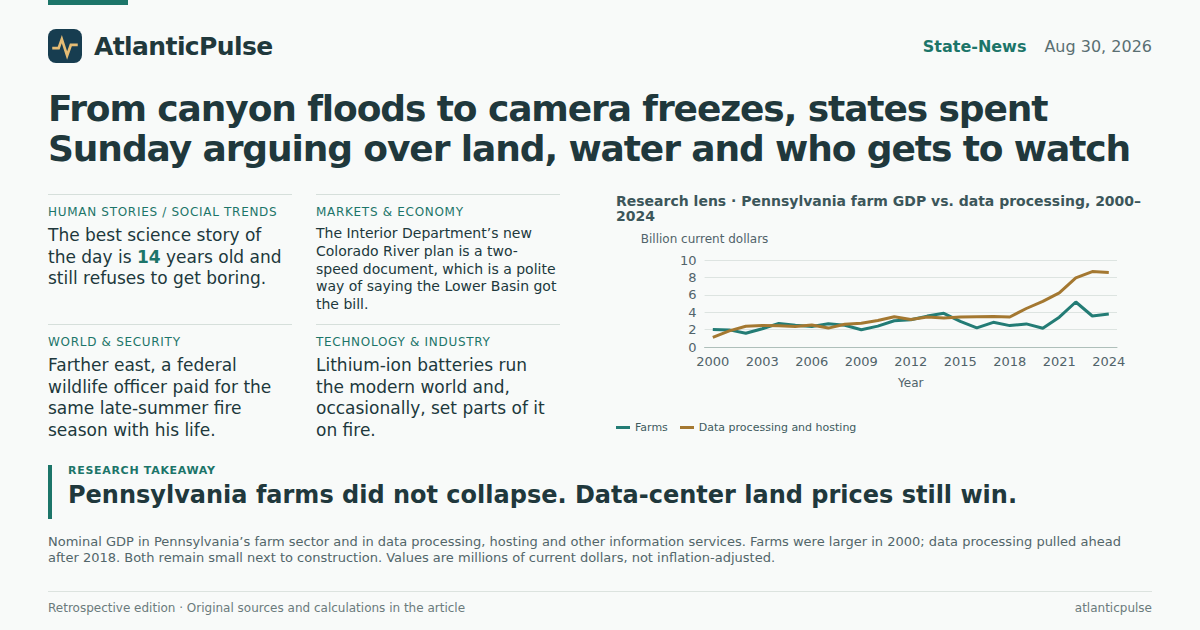
Mervin Raudabaugh’s choice is the adult version of the same stubbornness. At 86, after 51 years of milking cows and a later run of beef, corn and soybeans, he kept 261 acres in Silver Spring Township instead of selling them for a data-center campus. The $1.9 million was not a fire-sale of the land; it was payment for development rights, funded by a local earned-income tax that costs households about $120 a year, and it binds later owners too. The farms now sit in a block with three other preserved properties, a park and Appalachian Trail ground. Data-center money capitalizes a highway corridor in a single check. Corn does not. Voters decided which ledger they preferred.
Kentucky’s elk herd is what happens when an industrial accident meets a grazer. Between 1997 and 2002 the state released 1,541 western elk onto strip-mined coalfields that reclamation had turned into grassland; the herd now runs about 13,000, the largest east of the Rockies, and the permit lottery draws on the order of 90,000 applications. Reclaimed mines are not restored forests, and nobody should give mountaintop removal a conservation medal. But 16 coalfield counties now sell hunts and watch 600-pound animals fatten on the leveled remainder. In Fort Kent, Maine, the restoration project is smaller and indoor: Rivertown Arts Center was about $10,000 short, so the St. John Valley answered with cash, a dunk tank, a raffled sled-ride painting and a “Dance Like Hamilton” workshop from a local who spent five years in the Broadway ensemble. Pottery wheels, unlike watercolor sets, do not fit in a kitchen. That, founder Jenna Jandreau notes, is why the kiln still pays the rent.
This retrospective news edition uses archived reporting scoped by publication date, or arrival when publication was absent. Collection may have occurred later.