State-News
Shock gloves, empty lakes, and a Dolly welcome
World & Security
Southwest Wisconsin has a measles problem that is no longer a rumor at the county fair. The outbreak in Grant, Lafayette, and Iowa counties has reached 92 confirmed and six probable cases, part of 100 reported statewide this year, most of them in children and almost all in people who were not vaccinated. Health officials say the cluster is local and that new infections keep linking back to earlier ones, which is the epidemiologist’s way of saying the virus is still finding the unvaccinated next door. The MMR shot is 97 percent effective, they note, and about one in four U.S. measles patients ends up in a hospital — a ratio that makes “it’s just a childhood illness” sound like copy written by someone who has never sat in a pediatric ICU.
Pennsylvania has turned two measles-linked deaths into a political food fight. Gov. Josh Shapiro said vaccinations could have averted the fatalities; Health Secretary Robert F. Kennedy Jr. suggested on social media that the deaths might even have been fabricated. Independent experts call the squabble a symptom of the worst national measles surge in more than three decades, with kindergarten immunization slipping below the 95 percent coverage that keeps outbreaks from taking off. What is not disputed: both people who died were unvaccinated and had measles. What is disputed is whether measles caused the deaths. Lancaster County’s coroner says a newborn boy who died August 14 had measles in lung tissue but died of a torn spleen, not the virus. The state health department’s working definition is blunter: Did the person have measles, and did they die? Dr. Paul Offit of Children’s Hospital of Philadelphia warned that two measles-related deaths against about 400 reported county cases looks high for a disease that usually kills about 1 in 1,000 — a hint, he said, of many unreported infections just as school starts.
Elsewhere, Immigration and Customs Enforcement awarded a $16.7 million contract for 6,000 pairs of electric “de-escalation” gloves even as California Democrats raced to ban the devices. Assemblymember LaShae Sharp-Collins rewrote a late-session bill into a statewide prohibition, later steered toward a three-year pause while the state studies safety; Homeland Security called any attempt to strip federal officers of equipment “despicable.” Civil rights groups cited a Kentucky jail death after alleged repeated shocks; sheriffs called the gloves lifesaving. Legal scholars, less impressed by the theater, noted that states generally cannot dictate how federal officers do their jobs. Thousands of miles from Sacramento, families in Northern Virginia waited for word of ten local men, including Ashburn’s Anil Goel, unaccounted for after a Himalayan glacial collapse sent flash floods across the Nepal-Tibet border. More than 2,000 people were missing. Rep. Suhas Subramanyam said Nepal had asked the Pentagon for specialized gear. Closer to the Pacific, California’s Plaskett fire in Big Sur doubled overnight to more than 5,900 acres and remained uncontained, forcing evacuations in Monterey County.
Markets & Economy
The Colorado River is running a deficit that no spreadsheet can charm away. Lake Mead and Lake Powell hit record lows this month; eight other Reclamation reservoirs posted 30-year lows. The Bureau of Reclamation wants California, Nevada, and Arizona to cut 1.25 million acre-feet a year for the next two years — enough, the reporting notes, to fill more than 600,000 Olympic pools. Cave Creek, Arizona, a town of about 5,000 that draws nearly all its water from the river, has already capped growth and revived old wells. Mayor Robert Morris compared the federal plan to watching a meteor you cannot dodge. Nevada sued Interior and Reclamation, arguing Las Vegas-area basic needs would go unmet if the region absorbed cuts of up to 70 percent of its Colorado River water over the next decade. Yuma farmers, who grow most of North America’s winter leafy greens, have senior rights that may spare them short-term cuts but not the longer-term reluctance to plant orchards that take years to pay off.
Nevada is also arguing with itself about who pays for digital thirst. Gov. Joe Lombardo’s office has been reviewing the state’s data-center tax breaks — $461 million in incentives for 14 centers promising 313 permanent jobs — but twelve counties told The Nevada Independent they were not in the room. Local governments in Clark, Washoe, and Storey counties have missed more than $537 million in sales-and-use tax over eight fiscal years because of a 75 percent personal-property abatement and a 2 percent sales-tax rate for qualifying centers. Attorney General Aaron Ford, running for governor, wants the program paused pending audits. Sheldon Mudd, who leads northeastern Nevada’s development agency, told the state it is time to dissolve the abatement: smaller operators are already knocking, which he reads as a sign they were “booted from other locations.”
Illinois, by contrast, finally got the check it had been waiting almost a year for. The state was approved for $1.04 billion in Broadband Equity, Access, and Deployment money to connect about 350,000 residents by 2031, part of more than $2 billion in combined public and private broadband investment. Gov. JB Pritzker accused the Trump administration of holding the application “hostage.” Connect Illinois has already linked more than 20,610 households. And Florida, never one to join a national chorus if a solo will do, became the only state to reject its share of a nearly $18 billion Meta youth-safety settlement, with Attorney General James Uthmeier calling the payouts “peanuts.” New Mexico sat out for a different reason: it already won a $942 million judgment at trial. The multi-state deal spreads payments over ten years, with a two-hour daily time limit for teens, a midnight-to-6 a.m. blackout, and muted school-hour notifications — 70 percent paid up front, 30 percent hanging on YouTube and TikTok matching the restrictions. Florida says it will keep suing.
Technology & Industry
The Army picked Fort Hood as one of five bases where contractors will develop nuclear microreactors, with General Atomics Electromagnetic Systems as the vendor under the Janus Program. Up to $2.2 billion is on the table for fiscal years 2027 through 2031 across five companies, and the service ultimately wants more than 20 microreactors at Defense Department sites. The pitch is off-grid baseload so a base does not go dark if the civilian grid does. First operations are targeted for September 2028. Sister sites include Fort Bragg, Fort Campbell, Fort Benning, and Fort Drum. Army Secretary Dan Driscoll talked about projecting combat power without “potentially vulnerable external grids,” which is a polite way of saying the lights should stay on even if the neighborhood’s do not.
California, which banned new nuclear plants in 1976, is being courted by a stranger idea: small reactors on barges. The Port of Long Beach signed an agreement with the Trump administration to develop SMRs, and local startup Bluecore Energy, founded in January with a $10 million pre-seed round, wants to float 10-megawatt units that could be stacked and connected by subsea cable. Port CEO Noel Hacegaba stressed the project is years away and cannot proceed without state and federal approvals. Meanwhile Amazon is bringing Prime Air back to California, launching MK30 drones from a Tracy distribution center within a month — packages up to five pounds, 7.5 miles out, the first California flights since Lockeford closed in April 2024. The aircraft are not remotely piloted; on-site monitors watch the airspace. Critics remember a Texas pool drop and an Arizona crane crash. Amazon’s answer, more or less, is that practice makes fewer splashes.
Texas Gov. Greg Abbott ordered state agencies to stop funding AI-powered Flock license-plate cameras, a network that photographs vehicles and uses AI to flag make, model, color, even bumper stickers. Pflugerville voted to kill all 28 of its readers; Hood County ordered its three cameras covered until removal. Flock says the cameras help find missing people and stolen cars. Sen. Josh Hawley has been asking who can search a network that, he said, boasts more than 120,000 cameras across 49 states and more than 20 billion vehicle scans a month. And in Indiana, SK Hynix said it will start volume production of next-generation HBM4E AI memory at Purdue Research Park in West Lafayette in the third quarter of 2029, a more-than-$4 billion project with about 7,000 direct and indirect jobs, $458 million in CHIPS Act grants, and up to $500 million in loans. Cleanrooms are due in the second half of 2028. Wafers will still be made in Korea; Indiana will package and test them for Nvidia, Microsoft, and Google. The AI boom, in other words, is still being assembled.
Politics & Policy
Nevada’s casinos got a federal appellate valentine. A Ninth Circuit panel held that Kalshi’s sports event contracts are likely not “swaps” under the Commodity Exchange Act, so federal law does not preempt the state’s sports-betting rules. Judge Ryan Nelson warned that the broadest reading of “swap” would raise major-questions problems. The Third Circuit had gone the other way for New Jersey in April, which is how circuit splits become Supreme Court invitations. Gaming Control Board Chairman Mike Dreitzer said the ruling “completely vindicates” the state’s view that this is sports betting and should be regulated as such.
California’s other Saturday deal was smaller than Gov. Gavin Newsom wanted. After homeowners, insurers, and Eaton Fire survivors argued that easing utility liability would dump costs onto them, Newsom and legislative leaders agreed on a narrower wildfire package: a “fast-pay” claims program with 60- and 30-day clocks, a ban on private-equity investment in wildfire claims, and no CEO bonuses in years when a utility causes a fatal fire. SB 492 does not substantially change how much utilities pay. Nine of the state’s 20 most destructive wildfires were caused by electrical equipment. Newsom said the system still needs “full structural reform”; senators said they ran out of time. In Colorado, a coding update to the Secretary of State’s “Find my voter registration” tool left 133,000 confidential voter profiles exposed for 11 days. Fifty-nine profiles were accessed; officials believe those voters looked themselves up. Secretary Jena Griswold apologized and promised automated quality assurance, which is the sort of promise one makes after the last three layers of quality assurance have already failed. Two years earlier the office had released a spreadsheet with partial election-system passwords. Some lessons, like measles, appear to be making a comeback.
Texas Gov. Greg Abbott directed the Higher Education Coordinating Board to design a statewide three-year bachelor’s framework, with recommendations due December 31, 2026. Texas would be the largest state to push 90-credit degrees, joining Massachusetts, Virginia, and Ohio. The in-state cost of attendance at a Texas public four-year campus runs about $26,100 a year, so dropping a year is real money — if students actually finish in three. Faculty groups have called compressed degrees a “stripped-down curriculum.” Applied fields such as nursing, IT, and business are the likely first wave. Abbott will need the Legislature in 2027 to write it into statute. Until then, it is a working group with a calendar and a very Texas theory of efficiency.
Human Stories / Social Trends
Tennessee wants travelers to land in Dolly. After Dolly Parton died Tuesday at 80 following a brief battle with cancer, Gov. Bill Lee and Nashville International Airport announced they intend to rename the airport in her honor. The Metro Nashville Airport Authority takes it up September 17. A petition started more than a year before her death had more than 160,000 signatures. Lee said her life is “forever woven into the fabric of our state,” which, for once, is not campaign poetry so much as a statement of the obvious. Imagination Library still mails free books to children; the hair and the jokes were the branding, the books were the point.
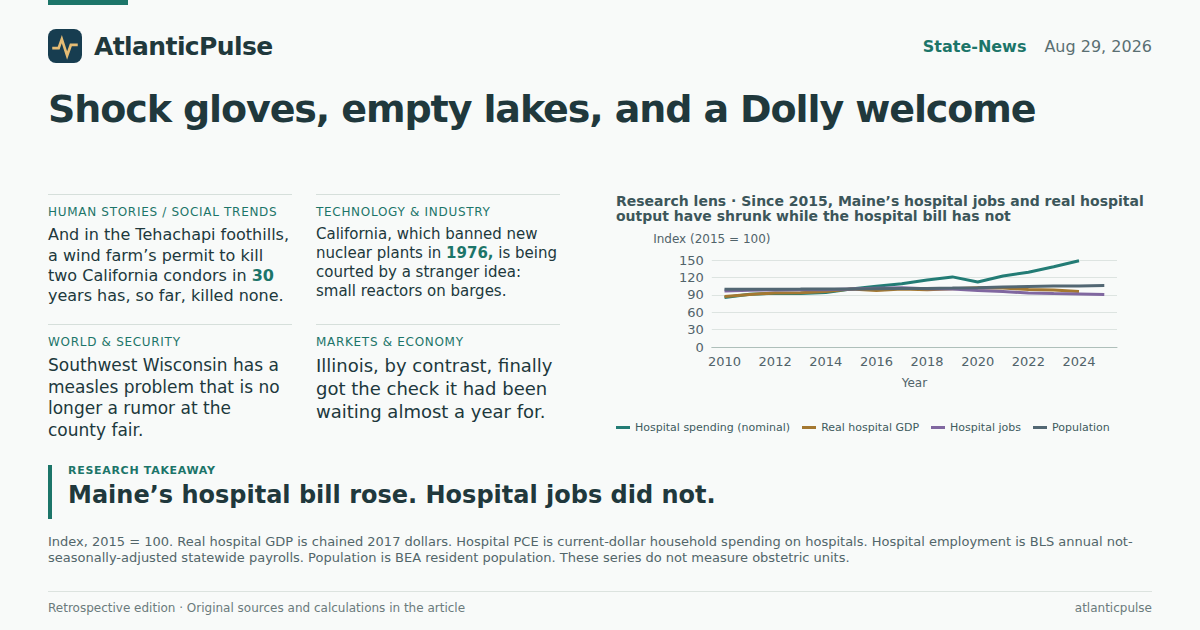
In Maine, lawmakers spent a hearing trying to keep babies from being born an hour down the road. MaineHealth will end labor and delivery at Lincoln Hospital in Damariscotta by year’s end. CEO Andy Mueller said 130 births a year is too few for obstetricians to keep their skills — “bakers don’t want to work in a bakery where there’s no flour.” Maine has lost 11 hospital-based birthing centers since 2015, and more than 40 percent of women in Washington and Aroostook counties already drive at least an hour. Family physician Stephanie McCullough called the closure “shortsighted.” The committee will send MaineHealth a letter asking it to reconsider, which is the legislative equivalent of a strongly worded sticky note. New Orleans, marking Katrina’s 21st anniversary, learned that Charity Hospital — shuttered since 2005 after doctors kept patients alive in the dark — is slated for a $500 million Tulane-led conversion into a biomedical research hub, with construction this fall and a 2029 finish. Mayor Helena Moreno called it a chance to put a historic property back to work.
And in the Tehachapi foothills, a wind farm’s permit to kill two California condors in 30 years has, so far, killed none. Avangrid’s Manzana project paid to rear condor chicks at the Oregon Zoo — twelve, double the obligation — while GPS tags and a geofence stop turbines when a bird approaches. Nationally, no condor has been recorded killed by a turbine. Lead poisoning remains the actual killer. The permit that sounded like a scandal has become a scheduling problem: the bird radios ahead, the blades pause, and the ledger reads twelve condors to the good.
This retrospective news edition uses archived reporting scoped by publication date, or arrival when publication was absent. Collection may have occurred later.