State-News
Rockets, runoffs, and a Sunday dinner that did not end
World & Security
North Texas spent the midweek learning how fast grass can run. The Ross Fire, sparked Monday afternoon near Palo Pinto, about 60 miles west of Fort Worth, grew from pocket change to at least 80,000 acres with containment stuck around 12 percent. Dry fuels, gusty southwest winds, and more than a month without measurable rain did the rest. Evacuations, highway closures, and school cancellations followed in Palo Pinto and Jack counties; at least five structures were damaged or destroyed, and Worth Ranch, empty of scouts, took catastrophic damage. FEMA approved a Fire Management Assistance Grant. The same heat that cooked Texas also fed Nevada’s Hawk Fire, which had destroyed at least 47 homes near Reno, injured seven people including three first responders, and at one point pushed 42,000 residents out. Washington was fighting 15 large uncontained fires across 800,000 acres—its third-worst acreage season since 2015.
In Montana the threat was inside the house. Relatives identified 44-year-old Alan Smith as the man who killed eight family members, including four children, at a Sunday dinner outside Billings, then set the place alight. Twelve-year-old Charlotte Ghekiere called 911 from inside. Nine people died, including the suspect of a self-inflicted gunshot; investigators were still picking through a house burned to its foundation. It was the 22nd U.S. mass killing of the year and the deadliest since April. A different standoff played out in Brownsville, where a federal judge refused to force Texas to extradite ICE officer Christian Castro, charged in Minnesota with shooting Julio Cesar Sosa-Celis through a Minneapolis door in January and lying about it. Under Texas law he was due for release after 90 days. Minnesota called him a flight risk. Abbott’s office called it the governor’s call.
Pennsylvania added a quieter casualty list. Health officials announced the first two U.S. measles deaths of 2026, both unvaccinated residents of Lancaster County, as national cases reached 2,777—already worse than all of 2025 and the worst year since 1991. Gov. Josh Shapiro told Health Secretary Robert F. Kennedy Jr. that federal rhetoric was hurting more than it helped, and declined extra federal staff. The virus, unimpressed by the briefing, continues.
Markets & Economy
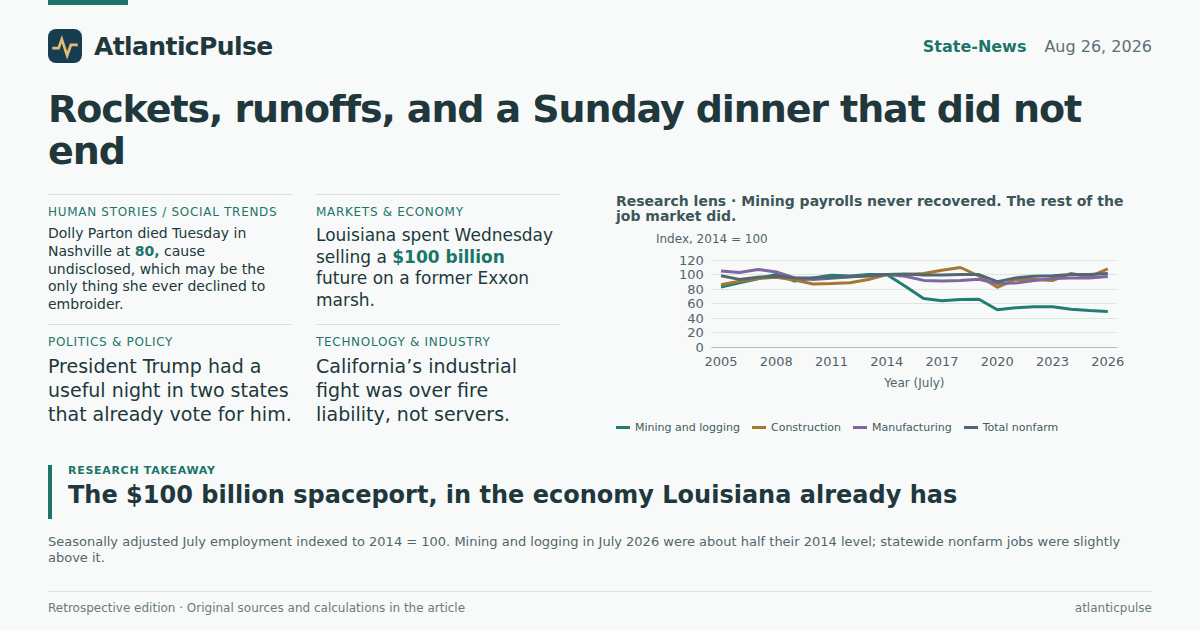
Louisiana spent Wednesday selling a $100 billion future on a former Exxon marsh. Gov. Jeff Landry and SpaceX unveiled Starbase Louisiana in Vermilion Parish: 125,000 acres, construction aimed at 2027, a first Starship flight “as soon as” 2029, and a full-buildout pitch of thousands of launches a year. The state projects 3,000 direct jobs over a decade at an average $92,600, plus more than 8,100 indirect jobs. Vermilion Parish gets $20 million up front and about $25 million a year for 25 years. Read the $100 billion as a completed-campus ambition, not a wire transfer. As one accounting of the deal noted, a 2029 target is a construction schedule; “thousands a year” is a rocket that does not yet turn around like a bus.
Attorneys general cashed a different kind of launch. California’s Rob Bonta said Meta and 51 state claimants had agreed to a proposed $17 billion settlement over ten years, plus default two-hour daily limits for users under 18, a midnight-to-6 a.m. block parents must lift, hidden like-counts for minors, and an independent auditor. The Oakland trial was supposed to last into October. It folded in week two, which is what happens when the alternative is months of whistleblowers on the stand.
Trade policy found the salad bowl and the lobster dock. Yuma growers, who supply more than 90 percent of U.S. leafy greens from November to April—and Canada’s too—now face 50 percent tariffs with harvest approaching and talks suspended. Maine’s lobster association warned that Canada’s 25 percent tariff on American lobster, effective Sept. 8, could hammer dock prices in the season when Canada buys roughly half the catch. Texas, thinking bigger than crustaceans, announced a $138 billion ten-year transportation plan. Illinois collected more than $1 billion in federal broadband money to reach about 350,000 residents by 2031. And the Bureau of Reclamation told California, Nevada, and Arizona to cut 1.25 million acre-feet a year from the Colorado River for two years after the worst basin snowpack on record, with Arizona taking the largest share. Upstream states are spared, for now.
Technology & Industry
The spaceport is also a statute. Months before the countdown video, Louisiana passed laws that hide most aerospace records, make unauthorized entry a felony, and immunize large operators against nuisance, trespass, noise, sonic-boom, and light claims—the sort of claims families near SpaceX’s Texas site have already filed. Company president Gwynne Shotwell said birds “come back” after launches and that SpaceX would develop “just enough” of the acreage. Pecan Island, which hunts and fishes that marsh, was offered a website and a jobs portal. FAA licenses, wetlands permits, and a reusable Starship still sit between the animation and an orbital flight. Louisiana has welded Saturn V stages and shuttle tanks for sixty years without sending anything into orbit. That trivia is about to become a coastal hearing.
Delaware took the opposite bet on a different industrial neighbor. Gov. Matt Meyer signed what he called the nation’s most comprehensive ratepayer protections on data centers: developers pay their own infrastructure, customers are shielded from the power tab, tax incentives come off, and facilities must bring their own clean energy or stay home. Other states have tried one or two of those ideas. Delaware served the whole platter.
California’s industrial fight was over fire liability, not servers. With six days left in the session, lawmakers rejected central pieces of Gov. Gavin Newsom’s wildfire package—caps on survivors’ pain-and-suffering awards, limits on insurers recouping payouts from utilities, and a push to pay local governments only depreciated value for burned infrastructure. Utilities have told Wall Street they will protect shareholders if Sacramento does not help. Eaton Fire survivors showed up at the Governor’s Mansion with a simpler ask. Miss Friday’s bill-print deadline, and the next governor inherits the wreckage.
Politics & Policy
President Trump had a useful night in two states that already vote for him. In South Carolina, Sen. Darline Graham, appointed after her brother Lindsey died six weeks ago, beat Rep. Ralph Norman about 52 percent to 48 in a runoff Trump recruited, rallied, and late-moneyed. She had never run for office, told a debate audience that “national security is not my thing,” and now enters November as the heavy favorite against Democrat Annie Andrews. In Oklahoma, Tulsa businessman Mike Mazzei narrowly won the GOP nomination for governor after Trump branded Attorney General Gentner Drummond a “FAKE Republican.” The runoff alone chewed through more than $14 million in ads, on top of nearly $40 million spent before it. Mazzei is favored against Democrat Cyndi Munson; a Democrat has not won the job since 2006.
Democrats had a worse afternoon in Annapolis. A Maryland judge blocked a redistricting amendment from the November ballot, finding lawmakers missed their own July deadline, used “intentionally misleading” wording, and stuffed two subjects into one question. The measure was meant to let Democrats draw across the Chesapeake and contest the state’s last Republican House seat. The ruling is paused for an appeal to the state Supreme Court. On voting mechanics, Illinois and two dozen other Democratic-led states sued the Postal Service over a Trump order that would restrict mail ballots, hours after a Boston judge lifted an injunction she still called “likely unconstitutional.” First ballots go out next week, which is an inelegant moment to restart a constitutional argument.
New York’s “Local Cops, Local Crimes” Act took effect Tuesday, ending local ICE agreements; some sheriffs pronounced it useless, which is rural New York for we preferred the old paperwork. In Wisconsin, a special prosecutor declined to charge Elon Musk over a 2025 post offering million-dollar checks tied to voting, calling it a poorly worded statement that was corrected and never paid anyone for a ballot. Alaska, never knowingly under-complicated, will put two Dan Sullivans on the Senate ballot under ranked choice, alongside Democrat Mary Peltola. The incumbent is Dan S.; the retired teacher is Daniel J. A former Anchorage mayor—yes, another Dan Sullivan—endorsed the senator. Good luck in the booth.
Human Stories / Social Trends
Dolly Parton died Tuesday in Nashville at 80, cause undisclosed, which may be the only thing she ever declined to embroider. The voice behind “Jolene,” “Coat of Many Colors,” and “I Will Always Love You” also built a reading program because her father struggled to read. Imagination Library now has affiliates in 16 Pennsylvania counties among more than 2,700 worldwide and has mailed more than 330 million books. Texas remembered the movies, the Cowboys cheerleader uniform at halftime, and Willie. A Reagan-appointed judge, striking down Texas’s drag-show law for a second time, quoted her example and told the offended: “just don’t go.” A plaintiff who impersonates Parton booked Saturday. That is more usable civic advice than most of what statehouses produced.
The other figures were less sequined. UCLA researchers found nearly 300,000 California K-12 students were homeless in 2024-25, a record and 10 percent above the prior peak, even as overall enrollment fell. Southern California counties account for half; about 5 percent of Los Angeles County students lacked stable housing. They miss more school and trail housed peers by roughly 20 points on state tests. Sacramento put $116 million toward finding and helping them; the researchers want money that does not vanish next year. In Billings, a neighbor described four generations at one table, from a great-grandmother in her nineties to a seven-year-old. Charlotte still called 911. In Lancaster County, two people died of a disease their grandparents were told was finished.
Parton spent a career making hard luck look like a coat you could wear proudly. A lot of the map spent Wednesday on the other version.
This retrospective news edition uses archived reporting scoped by publication date, or arrival when publication was absent. Collection may have occurred later.