State-News
Fire Lines and Ballot Lines: A Sunday Across the States
World & Security
The Hawk Fire did not wait for anyone to finish the weekend. Reported about 11:15 a.m. Saturday near Hawk Meadow Trail northwest of Reno, the human-caused blaze ran south toward Somersett, then northeast across Peavine Peak toward U.S. 395. By Sunday it had burned about 13,000 acres, injured three civilians and three first responders, and put more than 42,000 people under evacuation orders, with another 45,000 told to get ready (BNO News). Governor Joe Lombardo declared a state of emergency and sent National Guard helicopters; the Reno Convention Center opened shelter space with 950 beds expected. Sheriff Darin Balaam's advice to the yellow pre-evacuation zone was not subtle: if you can leave, leave. Earlier reports had him urging as many as 90,000 people to flee an uncontained fire already past 10,500 acres, with nearly 14,000 homes ordered out and a hospital emptying patients as a precaution (Local News 8). Mayor Hillary Schieve ranked the assets correctly: a life is worth more than a building.
Hawaii is still wringing out Hurricane Lala while Tropical Storm Moke comes in for seconds. Lala never officially made landfall, but as a Category 1 it dumped about 1.3 trillion gallons—nearly two million Olympic-sized pools—onto the islands from Aug. 14 to 16, with Hawaiʻi County taking roughly two-thirds of the volume. Peak winds hit 80 mph; more than 200,000 customers lost power at the height of the storm, and Governor Josh Green has asked for a presidential emergency declaration (FOX Weather). Moke, packing about 50 mph winds some 425 miles southeast of Hilo on Saturday, is expected to stay south of the Big Island, which is still looking at five to ten inches of rain and locally up to 15. About 8,000 customers remained without power as officials told people to restock food and medicine (LiveNOW from FOX). Inland, Colorado Governor Jared Polis asked President Trump for a major disaster declaration after the Aspen Acres and Gold Mountain fires burned more than 140,000 acres, destroyed 324 homes, and forced about 11,600 people out. Rain on the burn scars then produced debris flows, including a deadly Aug. 16 flood in Pueblo County. Custer County's sheriff put losses above $500 million; Washington has denied Colorado disaster money before (Denver7).
The slower emergency is water. Interior Secretary Doug Burgum signed operating rules on Aug. 21 that require Arizona, California, and Nevada to cut Colorado River use by a combined 1.25 million acre-feet over the next two years—about 760,000 for Arizona, 440,000 for California, and 50,000 for Nevada—plus 700,000 acre-feet of extra conservation. California negotiator JB Hamby called the Bureau of Reclamation's two-year plan "a bridge, not a permanent solution," while Upper Basin states face only a voluntary target. Lake Powell sat at 3,519 feet on Aug. 20, nine feet above a hydropower-critical mark, and the two big reservoirs together have not been this low since Powell started filling in 1963 (Kiowa County Press). On the Southern Plains the heat is doing its own rationing: Dallas has hit 105 degrees for five straight days, 77 percent of Texas is in some level of drought, and Dallas, San Antonio, and Waco have recorded a rainless start to August (FOX Weather). The West is running out of water, the Plains are running out of rain, and Reno is running out of time.
Markets & Economy
Dallas has a new nickname, and Wall Street is paying the signage bill. Morgan Stanley plans a 708,000-square-foot hub by 2031, a $587 million bet expected to house about 3,800 employees by 2035. Goldman Sachs is spending $500 million on a campus opening in 2028 for more than 5,000 people, its largest U.S. workforce outside New York. JPMorgan already has more than 12,500 people on its Plano campus and more than 32,000 across Texas, the most of any state. The Texas Stock Exchange began trading in July; Nasdaq Texas launched in March. The pitch is familiar—low taxes, lighter rules, cheaper living—and New York Mayor Zohran Mamdani's election has only sharpened the sales literature (Business Insider). Call it Y'all Street if you must. The buildings will have rooftop gardens either way.
California is asking its billionaires to underwrite health care, and some of them have already packed. Proposition 40, on the November ballot, would levy a one-time 5 percent tax on the assets of nearly 250 California billionaires, with 90 percent of the money earmarked for health care. Union leader Dave Regan framed it as a five-year patch for federal cuts in President Trump's 2025 spending law. Governor Gavin Newsom opposes it, as does Google co-founder Sergey Brin, who has poured $102 million into a campaign against the measure and recently moved to the Nevada side of Lake Tahoe. The tax is written to apply to people who lived in California in January, so a late change of address is not a get-out-of-levy card (LAist). Fortune's tax-escape map puts Larry Page and Brin in Florida property anyway, alongside Jeff Bezos, Peter Thiel, and Larry Ellison, and estimates that Page, Brin, Travis Kalanick, and Thiel together could take about $29 billion of the hoped-for haul off the table if they are no longer in scope (Fortune). Florida has no income tax. It also has Indian Creek Island, which has 41 residents and 24-hour security. Voters are, helpfully, split.
Hollywood's $110 billion merger is still in a California conference room. Representatives for Paramount Skydance and Attorney General Rob Bonta's office are expected to meet Monday over a 12-state antitrust suit that has frozen Paramount's acquisition of Warner Bros. Discovery. The states say the combination would merge two of five major film distributors and give the company roughly 27 percent of the wide-release theatrical market. Bonta told CNBC he prefers the boardroom to the courtroom, but only with "robust structural remedies." A trial is set for March 2, 2027; Warner shareholders start accruing extra consideration if the deal is still open after Sept. 30 (FOX Business). Down on the ground, Texas has found a cheaper way to keep solar farms from disappearing under grass: sheep. They now graze roughly 68,000 acres of Texas arrays—more than half the American solar-grazing map—because goats climb the panels and chew the wires, and cattle are simply too tall for the rows (ScienceBlog). Maintenance, it turns out, has a wool grade.
Technology & Industry
Tesla is trying to launch a car without a steering wheel in a state that still loves trucks, and a city that still loves taxis. Teslarati says it has an invitation to a Sept. 3 Cybercab event in Austin; Tesla has not publicly confirmed the date. The purpose-built robotaxi is designed without wheel or pedals, with Elon Musk previously putting a private-sale price under $30,000, and an initial plan to offer employee rides before commercial service (MCI Group). Las Vegas was less romantic. Tesla asked the Nevada Transportation Authority for about 5,000 robotaxi permits; the NTA answered with a maximum fleet of ten, confined to an approved Strip corridor at no more than 45 mph, with no pickups within a quarter-mile of the airport and "appropriate human supervision." In Austin, Tesla has operated without a safety monitor since January (Supercar Blondie). Ten cars on the Strip is not a fleet. It is a chaperoned field trip.
Data centers, once the uncontroversial cousins of the server room, have become the thing politicians now run against. Texas Governor Greg Abbott, who earlier cheered the buildout, told ABC's "This Week" that the industry "basically dug their own grave" and "got the backlash they deserve." A Gallup survey this year found seven in ten Americans oppose constructing AI data centers in their local area. Abbott has instructed the utility commission and grid operator to shield residents from infrastructure costs, floated a rural ban, and said his administration had halted some 1,800 projects. Texas already has more than 300 data centers, second in the country, with at least 200 more planned (Business Insider). President Trump called the pause a "mistake." Abbott noted that Texas has its own grid, which is either a boast or a warning, depending on the last freeze you remember. In Nevada, an opinion column argued that Governor Lombardo is still selling tax abatements while a leaked National Republican Senatorial Committee memo warned that unpopular data-center fights are already putting GOP candidates at risk, starting in Ohio (The Nevada Independent).
OpenAI, which helped California pass SB 53 last September, now wants the law tougher: monitoring frontier models during training for signs they could bypass someone else's security, plus stronger cybersecurity through the development stack. The company calls the strategy "reverse federalism"—states write the rules while Congress does not (Mashable). The more terrestrial surveillance fight is over Flock's automated license-plate readers. In Highland Heights, Ohio, a part-time dispatcher allegedly ran 20,292 Flock searches in 13 months, including 5,369 on a single plate; she resigned, and the chief has ordered monthly audits. Flock says its Audit Assistance tool is becoming mandatory (MotorBiscuit). According to CBRE, New York City had 394,300 tech workers in 2025, up 8.4 percent over three years, edging the San Francisco Bay Area's 375,730, which fell 6 percent amid Silicon Valley layoffs (NewsBytes). The talent map moved east. The cameras, unfortunately, did not.
Politics & Policy
Seventy-two days from the midterms, Texas Governor Greg Abbott sat in the governor's mansion and declined to panic. A late-July Texas Pulse poll had Democrat James Talarico leading Attorney General Ken Paxton 47 to 43 in the Senate race, and Abbott himself up one point on Gina Hinojosa, 46 to 45, in a state Donald Trump carried by nearly 14 points in 2024. Abbott's theory of the case is contrast: "common sense" versus "the crazy," and a belief that once voters inspect Talarico's record they will be "rushing to vote for Ken Paxton." Gas in Texas is averaging over $3.60 a gallon, not the sub-$2 Abbott predicted by summer's end; he still expects the drop, citing a Strait of Hormuz that remains mostly closed (KVNU). Former Harris communications director Ashley Etienne, back from Houston, warned that Talarico's promised $25 million Black-voter turnout push had yet to flow. Jasmine Crockett, whom Talarico beat 52.4 to 46.2 in the primary, said she does not feel excitement in the Black community. Decision Desk HQ rates the Senate race a toss-up (Daily Signal). Abbott says November is what matters. Pollsters, inconveniently, work in August.
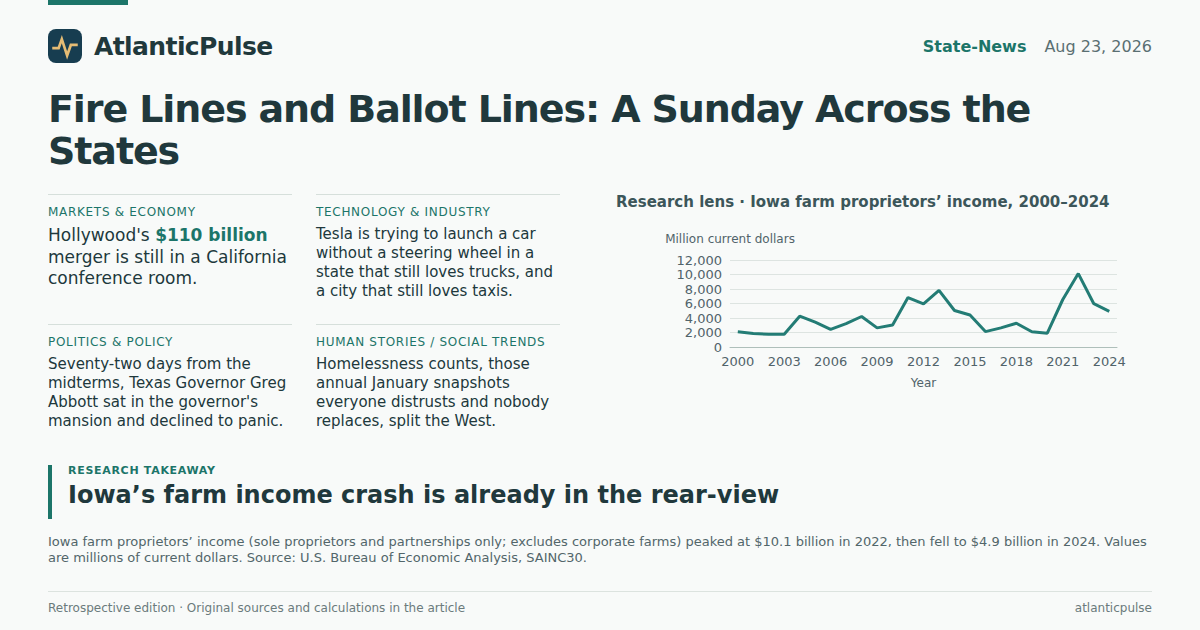
Iowa's farm economy is doing its own polling. Diesel is $5.37 a gallon, up from $3.50 a year ago; Iowa Corn Growers Association President Mark Mueller estimated an extra $12,000 to fill an 8,000-gallon harvest barrel. Farmers at the State Fair talked about delayed repairs, tariffs, a new plan that paused tariffs on imported ground beef, and a farm bill they say is three years overdue. The Cook Political Report moved Iowa's open Senate race from lean Republican to toss-up and the governor's race from toss-up to lean Democrat. Democratic nominee Josh Turek, a Paralympian facing GOP Rep. Ashley Hinson, said the word he hears in rural communities is "betrayal" (MS NOW). Trump won Iowa by 13.2 points in 2024. That is a lot of ground to give back in two growing seasons.
Alaska, never content with a simple ballot, has two Dan Sullivans and a ranked-choice hangover. Independent Dan J. Sullivan Jr., a logger, took 2.3 percent in the primary—not enough to catch incumbent Republican Sen. Dan Sullivan, but enough that former GOP chair Randy Ruedrich sees "obvious crossover" and a rerun of the 2022 Kelly/Tshibaka name muddle. Democrat Mary Peltola led the field Tuesday by 5.4 percent. November adds ranked-choice voting, which some Republicans refuse to use on principle (Fox News). Educating voters about which Sullivan is which is now a campaign workstream. Democracy, in the Last Frontier, comes with a name tag.
Human Stories / Social Trends
In northwest Indiana, the lights are still out. More than 20,000 people remained without power Sunday, nearly two weeks after Aug. 11 storms with gusts up to 100 mph. Gary Mayor Eddie Melton said at least 17,000 residents were still dark Saturday; NIPSCO hoped to finish Gary by Tuesday, Aug. 25. Governor Mike Braun activated the National Guard, President Trump approved an emergency declaration, and Braun publicly told the utility to bring in more crews. The outage overlapped with parent NiSource's announcement of about $140 million in shareholder dividends. Gary is nearly 80 percent Black; Bernice King called the wait "part of a pattern," and the ACLU of Indiana asked that relief reach every community "quickly and equitably" (KPBS). Rebuilding lines that usually take weeks, a NiSource executive said, is being attempted in days. The people in the dark have been counting those days without a spreadsheet.
Homelessness counts, those annual January snapshots everyone distrusts and nobody replaces, split the West. California's 2025 statewide tally fell nearly 3 percent to 181,934. Among 28 continuums that have released 2026 numbers, more than half reported declines: San Francisco down 4 percent, Alameda County down 13 percent, San Joaquin nearly a third. Officials credit state shelter and housing money. Activists credit encampment sweeps that scatter people out of the count. Los Angeles County ticked up 1 percent after two years of drops (KQED). Nevada went the other way. Clark County counted nearly 9,000 people, up 12 percent from 2024 and the highest raw number since the Great Recession, with nearly three in five unsheltered. Black residents are 14 percent of Clark's population and 43 percent of those counted. Washoe County rose just 2 percent and keeps about four in five people in shelter, but its homeless population has nearly doubled in two decades. Campus for Hope, a 900-bed Las Vegas facility, is due in 2028 (The Nevada Independent). Affordable housing remains, as Washoe's homelessness director put it, the elephant in the room.
Schools, at least, are trying bribes, pouches, and free preschool. Detroit Public Schools will keep paying high-schoolers $100 in Visa gift cards for every five consecutive days of perfect attendance, up to $1,000, and will extend a $50 parent gift card to grades 6–8 in 2026-27. Chronic absenteeism was 60.9 percent in 2024-25; the district says the high-school rate fell nine points over two years of the program (Voz US). Vermont's statewide classroom phone ban takes effect this year. Districts may use lockers, magnetically sealed pouches, or the honor system of a backpack; staff who tried early versions report more attention and less cyberbullying. Advocates who wanted phones in a central office all day say a backpack is not a ban, it is a temptation with a zipper (VTDigger). Michigan's free Pre-K for All program has nearly 53,000 applications since June, up 16 percent from last year, with families saving an estimated $14,000 a year on child care (The 74). Pay kids to show up, lock the phones, and start school at four. It is not a theory of everything. On a Sunday of fire, flood, and outages, it is at least a theory of Monday morning.
This retrospective news edition uses archived reporting scoped by publication date, or arrival when publication was absent. Collection may have occurred later.