State-News
Water cuts, robotaxis, and a ninth night without power
World & Security
Federal prosecutors say they stopped an ISIS-inspired plot against the New York State Capitol before anyone lit a fuse. Jessica Bowie, 35, of Albany was charged with providing material support to the Islamic State after allegedly pledging loyalty and trying to obtain explosives and firearms, according to a Justice Department case described in reporting. An FBI complaint describes undercover chats on encrypted apps, Home Depot shopping, and photos outside the Capitol that investigators treat as reconnaissance. Gov. Kathy Hochul said there is no specific, credible threat against the building now, credited the FBI and State Police, and noted New York had already tightened Capitol security this year. Bowie remains in custody at the Schenectady County Jail. Informant-heavy terrorism stings still make civil-liberties lawyers twitch; the marble pile remains, inconveniently, both a workplace and a place where tourists buy souvenir seals.
A civilian-contracted Cessna 441 crashed Thursday near the Cape Newenham Long Range Radar Site, about 450 miles west of Anchorage, killing all eight people aboard. The National Transportation Safety Board said the flight carried two pilots and six passengers; the FAA said it left Ted Stevens Anchorage International Airport and went down about 12:15 p.m. Sen. Lisa Murkowski identified the operator as Anchorage-based Security Aviation. Air Force Lt. Gen. Robert Davis called it a devastating loss for a chain of remote radar sites that watch Alaska’s airspace. Hawaii is still clearing Hurricane Lala — two deaths, wrecked roads, lingering outages — as Tropical Depression Two-C approaches. Forecasts keep the center south of the state, which is meteorologist for “you will still get soaked”: the Big Island could see 15 inches of rain, locally near 20.
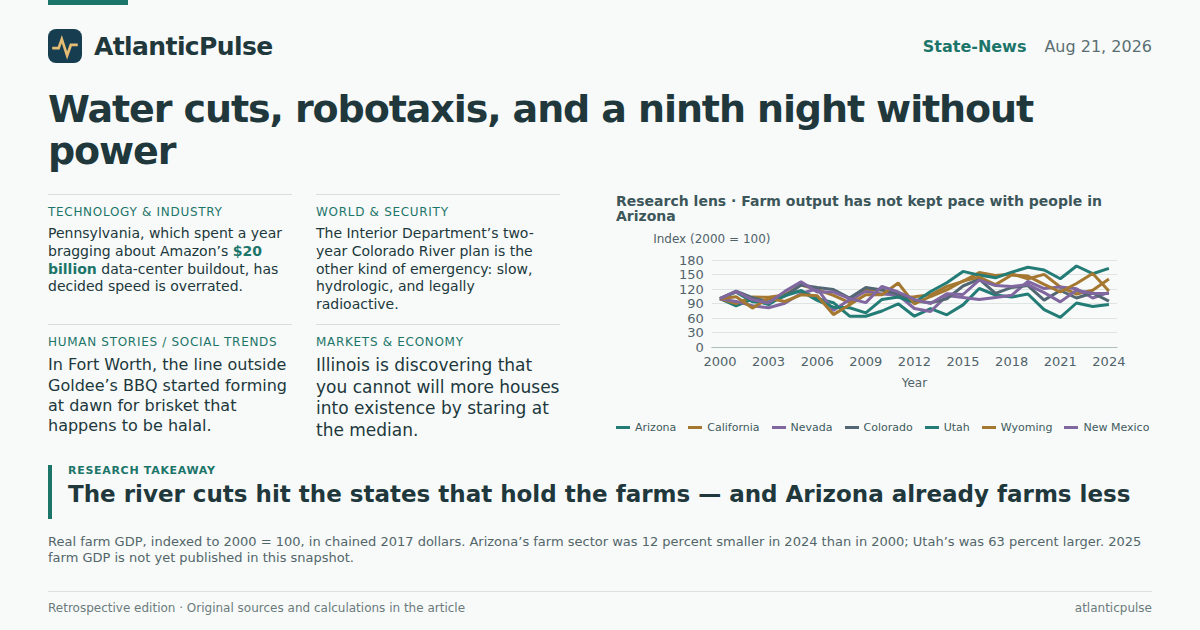
The Interior Department’s two-year Colorado River plan is the other kind of emergency: slow, hydrologic, and legally radioactive. Arizona, California, and Nevada will cut 760,000, 440,000, and 50,000 acre-feet through 2028 — roughly 27 percent, 10 percent, and 16 percent of their supplies — with no mandatory cuts for the upper basin, after Lake Mead hit a record low and Lake Powell followed on August 15. The river still waters about 40 million people and more than 5 million acres of farmland under a 1922 compact written for a wetter West. In South Texas, scarcity is measured in days. A Texas Tribune analysis found children at the Dilley family detention center often stay far past the Flores settlement’s 20-day limit: at least 60 for 100 days or more, an average of 25 days that peaked at 47, and about 3,000 children in the first year after the March 2025 reopening, more than half beyond 20 days. Washington calls Flores outdated. Lawyers call the stays illegal. Children experience both as the same fluorescent hallway.
Markets & Economy
Illinois is discovering that you cannot will more houses into existence by staring at the median. Chicago’s median sale price hit $425,000 in July, up 13.3 percent from a year earlier; statewide the median was $338,000, up 6 percent, even as listings thinned and homes moved faster, Illinois Realtors data show. CEO Jeff Baker said meeting today’s shortage would require tripling new construction every year for five years — a sentence that sounds like a threat and a business plan. After Gov. JB Pritzker’s BUILD plan stalled in Springfield, the group published a municipal playbook for code and permitting reform. Chloe Groome of Strong Towns Chicago noted the city’s architectural joke on itself: classic three-flats and four-flats are barred on more than 60 percent of residential land.
Households that already have roofs are discovering other bills. Oregon regulators approved roughly 22 percent premium hikes for individual marketplace plans and 15.5 percent for small groups, framing the pain as the price of keeping statewide coverage. A 40-year-old in Portland looking at a middle-tier plan would pay $599 to $734, up from about $567, state estimates show. Officials blamed expired enhanced ACA subsidies, medical costs, and tariffs, and said they would add $15 million to a reinsurance program while considering enrollment caps — a phrase that sounds tidy until you are the enrollee. In Seattle, Starbucks filed notice of more than 200 headquarters layoffs in SoDo, including about 120 IT workers who declined a move to Nashville plus store-design staff, another high-wage hole in a city already watching tech jobs leave. The company still says Seattle is home. The neighboring art gallery would prefer the foot traffic.
New Jersey, not to be outdone in household strain, posted the nation’s steepest average credit-card balance in a LendingTree review of first-quarter 2026 reports: $9,733, even as WalletHub, TransUnion, and Experian put the figure lower with different methods. Americans’ total card balances hit $1.263 trillion in the second quarter, the New York Fed found. Analysts note that high-income states often carry bigger balances because issuers hand out bigger lines — prosperity with a revolving APR. A quieter Illinois ledger: residential customers have lost more than $2.3 billion since 2015 by switching to alternative electricity suppliers, the Citizens Utility Board analysis found. That is the sort of market “choice” that looks like a menu until you add up the check.
Technology & Industry
Las Vegas is about to find out whether robotaxis and human cabbies can share the Golden Triangle without a fistfight. The Nevada Transportation Authority unanimously approved commercial robotaxi permits for Tesla, Uber, and Waymo in Clark County, authorizing up to 8,000 autonomous vehicles over 12 months — Tesla as many as 5,000, Waymo and Uber 1,000 each, with Uber working through Motional and Zoox. Tesla’s Cybercab chief engineer Eric Early told the hearing the 5,000 figure is a ceiling; he would be “extremely happy” with 2,500. Livery operators warned of oversaturation between the airport and the Strip. Uber, ever the diplomat with a robot in the passenger seat, pitched a hybrid fleet. Even half the permitted total would make Clark County one of the most competitive robotaxi markets on Earth.
Pennsylvania, which spent a year bragging about Amazon’s $20 billion data-center buildout, has decided speed is overrated. Gov. Josh Shapiro’s executive order, effective August 18, yanks data centers out of the PA Permit Fast Track Program and makes local land-use approval a gate for state permits on projects above 25 megawatts. Developers who sign onto GRID requirements still get rolling review; everyone else waits at the back. Existing Amazon campuses were directed off the fast-track rolls. A second fight — making large loads pay their own grid costs and face first-in-line curtailment in emergencies — still sits with regulators. PJM’s independent monitor has attributed 38.2 percent of 2028–29 capacity charges, $6.3 billion, to data-center load. The permits moved this week. The electric bill has not.
The talent map shifted too. CBRE says New York’s office market now hosts 394,300 tech jobs versus 375,730 in the Bay Area, the first New York lead in 13 years of the firm’s analysis, powered by AI hiring in finance while Bay Area layoffs bite. AI-specific roles in the United States and Canada jumped 45 percent in a year; those jobs, unlike the Zoom era, tend to want people in the office four to six days a week. Micron, thinking in decades rather than quarters, pledged $10 billion over ten years for Research Labs near its Boise campus, aimed at memory and packaging beyond today’s DRAM and NAND roadmaps, with groundbreaking expected in 2027. It is the rare Idaho announcement that is not about potatoes or ski days.
Politics & Policy
California’s 14th District spent two extra days counting before the Associated Press called a special runoff for state Sen. Aisha Wahab, who will finish the term of former Rep. Eric Swalwell. With 95 percent of ballots in, Wahab had 53.1 percent to Melissa Hernandez’s 46.9 percent — tighter than her double-digit primary lead, after AIPAC’s United Democracy Project and affiliates spent more than $2.5 million in August on ads that, a local strategist said, targeted public safety rather than Israel. Wahab, who would be the first Afghan American in Congress, said the district “cannot be bought.” The two Democrats meet again in November, with redistricting adding about 26,000 Dublin voters from Hernandez’s old mayoral turf. Incumbency is a heck of a head start.
Florida Democrats got a sharper surprise. Jacksonville state Rep. Angie Nixon, a democratic socialist who joined DSA only in June, beat well-funded centrist Alex Vindman by 12 points in a Senate primary despite being outraised 19-to-1 — Vindman’s war chest north of $16 million against Nixon’s less than a million. She campaigned on Medicare for All, universal child care, and a national rent freeze in a state the Miami Herald described as deep in an affordability crunch. Vindman, who moved to Florida three years ago, declined to debate. Whether that coalition travels in November is another matter; Florida has a habit of nominating interesting Democrats and then electing Republicans. Still, the math on the left just got less theoretical.
Pennsylvania is watching the same midterm calendar for a rarer prize: a Democratic trifecta. Gov. Josh Shapiro leads Republican Stacy Garrity by more than 20 points in recent polls, but Democrats would need to hold the House and flip a 27–23 GOP Senate. If they do, the party’s election bill — true early voting, drop boxes, electronic poll books, pre-canvassing — would no longer die in the other chamber. They would also face pressure for mid-decade congressional redistricting of the sort Shapiro called “shameful” when Texas did it. Senate Republicans call themselves the last line of defense; Democrats have not held the whole building since 1993, and then for a year. Harrisburg does not do landslides. It does stalemates with better catering.
Human Stories / Social Trends
Nine days is a long time to wait for a light switch. After an August 11 storm, Northern Indiana Public Service Co. still had 68,000 customers dark as of Thursday morning, most in Lake County; Gary schools stayed closed and full restoration in some places was not expected until Tuesday. Shatiya Hardin, a Gary stylist of 25 years, said the city is used to survival mode, “but this is the second week now.” Neighbors threw out groceries, slept on cooler floors, and hunted for working laundromats while community hubs handed out boxed lunches. NIPSCO called the damage unprecedented and noted Illinois recovered faster from the same storm, with fewer trees and some buried lines. No storm is created equal, which is cold comfort when the freezer is.
In Fort Worth, the line outside Goldee’s BBQ started forming at dawn for brisket that happens to be halal. Texas Monthly once ranked the shack No. 1 in the state; Michelin gave it a Bib Gourmand. Pitmasters across Dallas–Fort Worth are folding Pakistani spices, Iraqi sausage, and Laotian sai oua into the salt-and-pepper canon, even as some Republican leaders talk about targeting Muslim communities and even halal food. Diners who do not keep halal still show up because the meat is good. That is integration you can smell from the parking lot.
In Chicago’s Humboldt Park, 19-year-old Nooran Amin opens Best Sub #2 the way his father taught him — grill first, then the fryers — after Asif Amin Cheema was detained last September over a missed court date the family says a former lawyer never mentioned, then deported to Pakistan on New Year’s Day after more than 30 years away. Cheema told them to sell the shop. They refused. “If we lose this restaurant, we’ll lose anything of my dad in the U.S.,” Nooran said. A Tuscaloosa jury, meanwhile, awarded former Alabama basketball player Kai Spears about $9.25 million after finding The New York Times liable for a 2023 story that wrongly placed him in a car at a fatal shooting — the paper’s first U.S. defamation loss over an article in more than 50 years. The Times called it an honest mistake. Spears’s father said they had asked for a retraction. Sometimes the country argues over who belongs in the picture. Sometimes it just misspells the caption and pays for it.
This retrospective news edition uses archived reporting scoped by publication date, or arrival when publication was absent. Collection may have occurred later.