State-News
From an Albany sting to a ninth night in the dark
World & Security
The FBI says it interrupted an ISIS-inspired plot against the New York State Capitol before anyone got near a live bomb. TIME reports that Jessica Bowie, 35, of Albany, was arrested Wednesday and charged with attempting to provide material support to a designated foreign terrorist organization after a sting that began with social-media posts and ended, in the government’s telling, with an inert device, a gun, a magazine and ammunition. A confidential source posing as an ISIS facilitator messaged her in July; the complaint says she did reconnaissance at the Capitol on July 21, later told two undercover sources she wanted an explosive timed for a day when “the most amount of senators” would be inside, bought components at a Home Depot with $200 the informants supplied, and was arrested as she left a car with the purported bomb and firearm. Governor Kathy Hochul thanked the FBI and state police, noting earlier security upgrades after a rise in threats against public officials, and said there was no immediate remaining threat. It is the kind of case that looks airtight in a press release and still has to survive a courtroom, where sting operations tend to look less cinematic.
Far from Albany, a different kind of strain was showing on the USS Abraham Lincoln. Colorado Rep. Jason Crow, a veteran Army Ranger on the House Armed Services Committee, joined a letter to the acting Navy secretary after more than 200 family members described food shortages, scarce hygiene supplies, broken toilets, mental-health trouble and reports of sailors trying to jump overboard during a record deployment of more than 260 days in the Middle East. Crow said the administration had not answered, called the situation a message of “weakness,” and noted Iran’s public line that it can simply wait the United States out. President Trump, for his part, dismissed the complaints and said the deployment had not nearly been long enough. By Thursday, the USS George Washington had reached the Arabian Sea to relieve the Lincoln, which the New York Post described as the longest American naval deployment since the Cold War — a handover that arrived after the political argument, not before it.
At home, invited guests discovered that “please come to the base” is not always a complete security brief. Five reporters and two service members headed to a groundbreaking at Vandenberg Space Force Base were stopped at gunpoint by officers who apparently mistook an escorted convoy for gate crashers; sirens, barricades, two military members in handcuffs, civilians on a curb, more than 30 minutes, and a missed event later. The installation commander ordered a review. In Pennsylvania, the stakes were higher: a Cessna 150 struck a State Police Bell 407 from behind during training near Carlisle, killing the plane’s pilot and injuring two troopers who were trapped, then got out, and are expected to recover. Acting Commissioner George Bivens said the Cessna veered right at the last moment. The NTSB will lead; the FAA will assist; the rest of us will keep noticing that “routine training” is a phrase that only sounds routine until it isn’t.
Markets & Economy
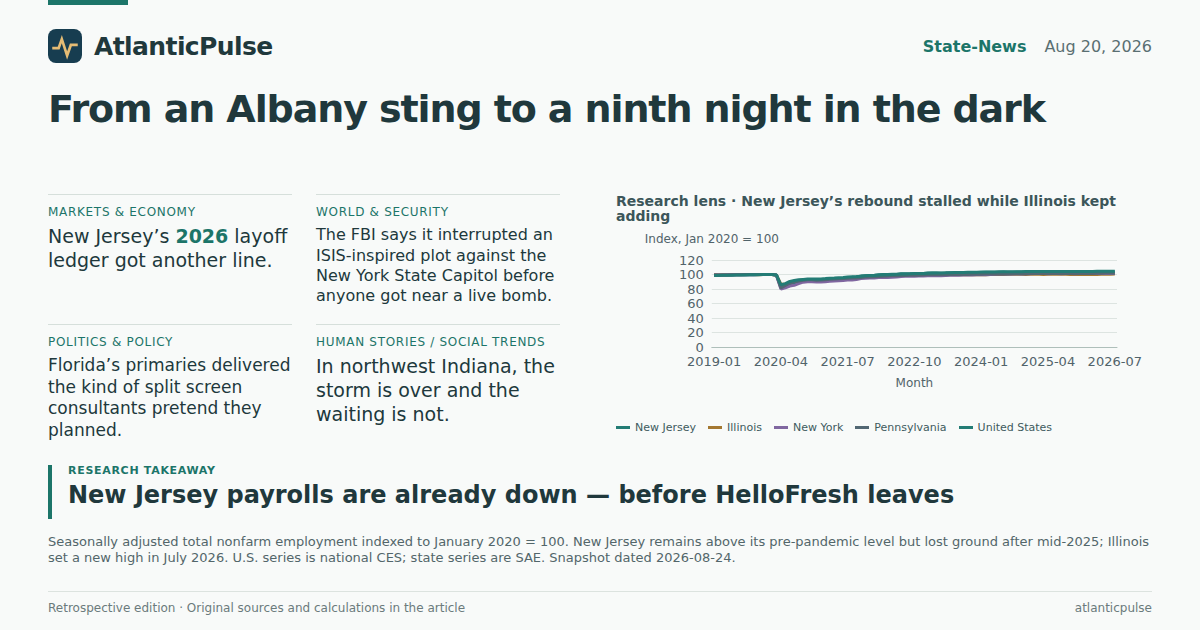
New Jersey’s 2026 layoff ledger got another line. HelloFresh told the state it will close its Swedesboro distribution center by November 17 and cut 374 jobs, folding the 170,000-square-foot site into the rest of its network in the name of “operational efficiency.” The company, which rode pandemic meal-kit demand to $8 billion in 2022 revenue, is offering severance, extended health coverage, career help and internal transfers. The closure sits on top of more than 11,500 announced cuts statewide this year: Samsung moving its U.S. headquarters to Texas (739), Amazon shutting Fresh stores (871), plus Novartis, Mars Wrigley, Blue Cross, Gerresheimer, Verizon, JPMorgan Chase and Spirit Airlines. July was the worst month, with 2,440 cuts from 13 employers. If you still associate HelloFresh with a box of tidy vegetables on the stoop, the Swedesboro notice is a reminder that even the pandemic’s favorite kitchen shortcut eventually meets a spreadsheet.
Households that kept their jobs still got a rate-case education. Colorado regulators approved an Xcel Energy increase of $5 a month for residential customers and $7 for commercial accounts — smaller than the utility asked for, and still the eighth hike since September 2023, according to critics who note that shopping for another wires company is not a real hobby. Xcel said the money covers poles, transformers and grid work, protested that the commission did not fully back a settlement, and pointed out that 2025 residential bills were 39 percent below the national average. The new rates start at the end of December. In Illinois, the Tollway board voted 8-0 for a $26.5 billion, 15-year rebuild that includes the first passenger-vehicle increase since 2012, averaging about 45 cents a plaza for cars, with I-PASS still the cheap seat. O’Hare-area plazas that now cost I-PASS users 75 cents go to $1.20 on January 1; inflation adjustments arrive in 2029. Nearly 1.7 million drivers a day will notice. The Tollway, which gets no tax dollars for operations, has discovered that “we don’t take taxes” is not the same as “we don’t take more of yours.”
California, never shy about a ballot fight, is teeing up a one-off 5 percent tax on billionaire wealth in November, with backers claiming about $100 billion for health care, food assistance and schools after federal Medicaid cuts. Sergey Brin has already spent $100 million against a measure that, if it passed, could cost him on the order of $13 billion — a return-on-political-investment story that writes itself. Governor Gavin Newsom is among the critics who warn that billionaires and their tax base will simply leave. Polling cited by supporters still shows majority backing after 1.6 million petition signatures. Similar “tax the rich” fights are bubbling in New York, Washington, Maine and Minnesota. Whether California actually collects, or merely conducts a very expensive seminar in capital mobility, is the question the rest of the country will grade in November.
Technology & Industry
The server-farm boom has become a ballot-box problem. Pennsylvania Gov. Josh Shapiro signed an executive order that forces data-center developers to get local approval and make binding GRID commitments on energy costs, environment, workforce, transparency and community engagement before the state even looks at permits. Data centers are off the Fast Track list; nondisclosure agreements are out. Maryland’s Utility RELIEF Act takes a different cut — lowering the “large load” threshold to 25 megawatts and making the Public Service Commission weigh system costs — without tying state review to local yes-or-no. Ohio is the warning poster. A National Republican Senatorial Committee memo obtained by ABC News says Sen. John Husted and Democrat Sherrod Brown are in a dead heat, and that “more than any other thing in this race, data centers are the anchor hanging around Husted’s neck.” Ohio has more than 200 of them, fifth in the country. Gov. Mike DeWine paused new tax exemptions; Husted has a Senate bill to keep power costs off household bills. President Trump told local leaders to take the plants, then allowed they could use “a little public relations help.” A spring Gallup poll found 71 percent of Americans oppose an AI data center in their own backyard. That is a lot of not-in-my-substation.
The cameras watching those roads are a second argument. Minnesota departments using Flock automatic license-plate readers share the pictures with anywhere from nobody to hundreds of outside agencies. Faribault keeps access inside the county 911 center; St. Paul lists more than 60 Minnesota partners; Stillwater and New Brighton open the door to out-of-state shops as far as the East Coast. The ACLU of Minnesota’s John Boehler argues that once another state has the data, tracing the next hop is “functionally impossible,” and that local agencies do not get a veto on each search even if they later see a log. Police chiefs counter with stolen cars, missing people and audit trails. New Brighton’s portal showed 11 searches in 30 days despite hundreds of agencies on the access list, which is either reassuring or a reminder that permission and use are not the same spreadsheet. Flock says it captures vehicles, not people. Boehler’s retort is that computing power is not standing still.
Idaho, meanwhile, is living the other side of the AI boom. Micron is putting $50 billion into two leading-edge memory fabs around Boise, with first wafers targeted for mid-2027 and late 2028, about 3,500 new direct jobs on top of roughly 7,000 already there, and up to $6.2 billion in CHIPS Act money. The company is the only U.S.-based maker of the high-bandwidth memory that Nvidia and AMD processors need, and there is not enough of it. Shares have had the kind of year that turns employee stock into a second career; a Boise wealth manager told CNBC of a client who was “$1 million richer in eight trading days.” Housing is less amused: more homes selling above list, 10.4 percent population growth from 2020 to 2025, and a CEO who admits construction is constrained by skilled trades, permitting and energy infrastructure. Fortune in the 208 is arriving faster than substations.
Politics & Policy
Florida’s primaries delivered the kind of split screen consultants pretend they planned. State Rep. Angie Nixon, a Democratic Socialist, upset retired Lt. Col. Alex Vindman — the Ukraine-aid whistleblower recruited by party leaders, who raised more than $16 million to her less than $1 million — with more than 56 percent of the vote. She now faces a Republican in a Senate map that has not lately been kind to Florida Democrats. On the other side, Rep. Byron Donalds, Jamaican-American, Brooklyn-raised and Trump-endorsed, won a crowded Republican primary to succeed term-limited Gov. Ron DeSantis and will meet former Republican-turned-Democrat David Jolly, with Gwen Graham as Jolly’s running mate, on November 3. A Donalds win would make him Florida’s first Black governor and first of Caribbean descent; a Jolly win would be the first Democratic governor since Lawton Chiles left in 1999. The state that spent a decade as a Republican showroom is suddenly a laboratory for two different theories of 2026.
Wyoming Republicans held a family meeting and fired the hardliners. After taking the House in 2024, the Freedom Caucus spent a budget session watching its biggest bills fail, then asked voters for “reinforcements.” Voters sent the opposite. WyoFile’s tally has the group losing 13 House incumbents — including former chair John Bear and majority floor leader Scott Heiner — plus nine other seats it tried to hold, winning no new House districts, and dropping six caucus-aligned lawmakers in Senate races, among them former Speaker Chip Neiman. Reliable House votes shrink to about 10; the Senate looks likely to keep five hard-core members. The caucus can no longer block two-thirds introductory votes in budget sessions. Chair Rachel Williams lost a secretary of state primary. Gov. Mark Gordon said people were thinking about Wyoming, not national talking points. The caucus posted that it is “not going anywhere.” Legislatures have heard that before.
National Democrats, looking past the midterms toward a wide-open 2028 primary, narrowed their convention list to Boston, Denver and Philadelphia — three liberal cities with suburban money and, in Philadelphia’s case, a genuine battleground around them. Atlanta and Chicago are out for 2028; Republicans already picked Houston. Atlanta Mayor Andre Dickens accused DNC Chair Ken Martin of “abandoning Black voters” and the South, saying the party was told after the fact and that “the road to the White House runs through the South.” Chicago’s host committee, which ran a 2024 convention it says generated $371 million in economic impact and left no debt, is already talking about 2032. Party officials did not explain the cuts. They will pick a city later this year, which is plenty of time for everyone to stay annoyed.
Human Stories / Social Trends
In northwest Indiana, the storm is over and the waiting is not. Nine days after the deadly August 11 weather, Northern Indiana Public Service Co. still counted 68,000 customers without power Thursday morning, most in Lake County; 306,500 had been restored, and some neighborhoods, including Gary, may wait until Tuesday. Schools stayed closed. Hair stylist Shatiya Hardin, unable to open her salon, said Gary is used to survival mode — “but this is the second week now.” Neighbors threw out groceries, slept on cooler floors, hunted open laundromats on Facebook, and lined up for boxed lunches. A resilience researcher warned about generators, carbon monoxide, uncharged medical devices and spoiled food. NIPSCO called the damage unprecedented and said out-of-state crews were in; a parent-company executive noted that neighboring Illinois recovered faster with fewer trees and some buried lines. “No storm is created equal,” she said, which is true and not much comfort if your freezer is a science experiment.
Hawaii is doing the same dance with worse scenery. Communities are still digging out from Hurricane Lala — roofs gone, roads under mud and rock, nearly 15,000 homes and businesses dark Thursday, about 13,200 of them on the Big Island, with some repairs estimated at two weeks. The storm, later a Category 3 with 115 mph winds, dropped 43.54 inches of rain at Laupahoehoe, washed houses off foundations, and cut off Pahala. Two people died, including May Doi, 93, a former kindergarten teacher who taught generations in a small Big Island town and was found after trying to reach a shelter. Forecasters then warned that a depression southeast of the islands could become a tropical storm and dump up to 15 inches more on the Big Island this weekend. Governor Josh Green scheduled a briefing. A 16-person marine-debris crew near the Northwestern Hawaiian Islands had already fled Lala’s path. Hurricane season, as one skipper put it, is when you keep on your toes. Hawaii has not been given a chance to put them down.
The quieter emergency is measles. Southwestern Wisconsin added two Grant County cases tied to Lafayette and Iowa counties, bringing a regional outbreak to 36 confirmed and three probable; statewide, 41 cases this year, almost all in the southwest, after 36 in all of 2025 and none in 2016. More than half of this year’s patients are ages 5 to 17; 40 of 41 were unvaccinated; two have been hospitalized. Officials have named no public exposure sites. In Minnesota, kindergartners sit at 86 percent coverage for both DTaP and MMR — second- and third-lowest in the country — with a 6.9 percent exemption rate, below the 90 percent often cited for measles herd immunity. A pediatrician described more parents questioning shots, and a long shadow from older, unfounded MMR-autism claims in immigrant communities. President Trump this month ordered a revamp of the childhood vaccine schedule. The diseases, inconveniently, did not wait for the new calendar.
This retrospective news edition uses archived reporting scoped by publication date, or arrival when publication was absent. Collection may have occurred later.