State-News
States Test Their Limits: ICE, Data Centers and a Florida Upset
World & Security
Minnesota Attorney General Keith Ellison sued Texas Governor Greg Abbott on Tuesday to force the extradition of ICE agent Christian Castro, who faces state charges of assault and falsely reporting a crime after a 14 January shooting in Minneapolis. Prosecutors say Castro fired through the front door of a home, striking Julio Cesar Sosa-Celis in the leg with a round that lodged in a child’s bedroom wall, then falsely claimed Sosa-Celis and another man attacked an officer with a broom handle and a snow shovel. Ellison wants a federal judge to keep Castro in Cameron County jail and compel Abbott to sign the warrant before Texas’s 90-day detention clock expires around 26 August — after which, Ellison warned, Castro could slip into Mexico from a border town. Jail calls about marrying a woman there and buying a house have not soothed anyone in St. Paul. Abbott said he has no immediate intention of answering Minnesota until the state “acknowledge[s] their fault in the fraud that took place” in social-service programs, a political condition a local law professor called a straightforward loser under the Constitution’s extradition clause. Homeland Security still brands the prosecution a “political stunt.” Interstate courtesy, it turns out, now comes with a news conference.
On the Arizona line, bulldozers are writing a different custody dispute: habitat leaving the premises. Photographs released by the Center for Biological Diversity show desert inside Organ Pipe Cactus National Monument cleared for a second border wall running about 100 feet north of the existing 30-foot barrier near Quitobaquito Springs. Advocates say the work could squeeze three endangered species tied to those springs, while road closures since 31 July have made it harder for the public to see what contractors are doing. The Tohono O’odham Nation has already sued over other wall segments on reservation land, and a roughly 1,000-year-old fish-shaped geoglyph at nearby Cabeza Prieta was scraped earlier this year — not the cultural-resource outcome anyone puts on a visitor-centre plaque.
Farther west, Hurricane Lala has moved off as a Category 3 with 125 mph winds, but Hawaii is still counting: two dead, 43.54 inches of rain at Laupahoehoe, a collapsed road cutting off Pahala, and about 19,000 customers still without power on Wednesday after a peak near 104,000. Forecasters warned another tropical depression could form southeast of the islands. In northwest Indiana, a week after severe storms, a Gary school pantry ran out of food, Hobart Township served more than 700 meals in two days, and one resident compared strawberries at a distribution line to winning the lottery. Meanwhile the Colorado River’s two great reservoirs set new lows — Lake Mead around 27 percent full at 1,040 feet, Lake Powell around 22 percent and only about 30 feet above the hydropower minimum — while basin states still cannot agree on post-2026 operating rules. Forty million people drink from a system that is, at the moment, managing the edge.
Markets & Economy
The Port of Los Angeles processed 960,464 TEUs in July, the second-busiest July on record — 6 percent below last year’s rush-ahead-of-policy peak, but 7.5 percent above the five-year average. Year-to-date volume is 6.08 million TEUs, a modest 1.8 percent ahead of 2025. Executive director Gene Seroka credited “windows of opportunity” and stubborn consumer demand, which is a polite way of saying American shopping habits have not yet received the memo. In Orlando, Disney now has legal room in the Central Florida Tourism Oversight District’s 2045 plan for one major and two minor additional parks, about 850 acres, though the district notes there are no applications under review. Universal’s Epic Universe opened in 2025; Disney, characteristically, is still stuffing new lands into parks it already owns. Permission to build a fifth gate is not a groundbreaking. The Mouse has been practising that distinction since Animal Kingdom opened in 1998.
Illinois drivers, meanwhile, will pay for someone else’s transit arithmetic. The Tollway board unanimously approved the first rate hike since 2012: 45 cents more at a typical plaza, turning 75 cents into $1.20 — a 60 percent jump — with commercial tolls up about 30 percent on average. The extra billion dollars a year is meant to fund a $26.5 billion, 15-year construction list, and starting in 2029 the board will index tolls to inflation every other year, capped at 8 percent. Officials insist the money will not leak into CTA, Metra or Pace, a rumour that apparently needed killing at 13 public hearings. After the hike, I-Pass cars will still average 11 cents a mile against a national 16, which is the consolation prize you offer people who just watched a 60 percent increase sail through on a Wednesday.
Data centres have become the other bill households fear. Pennsylvania Governor Josh Shapiro’s executive order requires developers who want permits to sign legally enforceable GRID commitments: pay for the generation and wires they need, hold public meetings, skip nondisclosure agreements, and lose the sales-tax exemption if they refuse. DEP already knows of more than 100 proposed projects; only five have all first-phase permits. In Austin, a Texas House hearing heard ERCOT’s Pablo Vegas report nearly 500 gigawatts of large-load interconnection requests, with Abbott’s audit likely delaying “Batch Zero” until year’s end. Industry voices said they will pay their way; neighbours in Glen Rose and East Williamson County were less convinced that paper guardrails equal water in the aquifer. One developer guessed 50 to 60 percent of the queue is speculative. If so, Texas is holding a very expensive RSVP list.
Technology & Industry
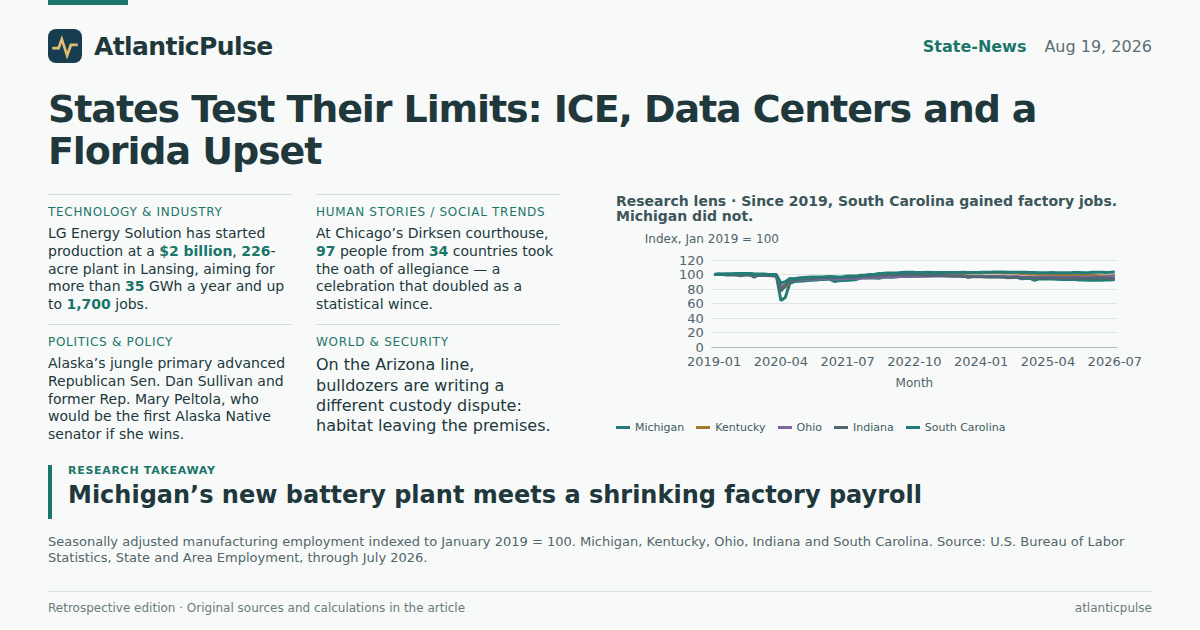
LG Energy Solution has started production at a $2 billion, 226-acre plant in Lansing, aiming for more than 35 GWh a year and up to 1,700 jobs. Lithium-iron-phosphate cells will feed grid storage; nickel-manganese-cobalt cells will go into Toyota’s 2027 Highlander EV, assembled in Kentucky. The company has poured more than $5 billion into Michigan since 2010 and expects more than 50 GWh of North American LFP capacity by year-end, with about 80 percent of its global storage manufacturing on this continent. It is the rare factory story that tries to charge both the car and the grid — elegant industrial policy, or a reminder that every electron now has a lobbyist.
California, never one to leave a household object unregulated, has now come for the squish of your tyres. The Energy Commission’s replacement-tyre rules target rolling resistance: a 9.1 rating by 2029 and 7.2 by 2033, thresholds dealers say could knock out about 70 percent of current replacement rubber. A set of low-resistance tyres can run $480 to $1,000 against $280 to $600 for the ordinary sort; officials say 1 to 3 percent better efficiency pays back in three to four years. Dealers warn people will drive on bald rubber or shop in Nevada. Commissioner Nancy Skinner says the state has done this with appliances and will revise if it gets impractical. Somewhere, a spare doughnut is sweating.
Amazon wants to drop five-pound parcels by drone in suburban pockets of nearly 500 U.S. cities, including Chicago, Atlanta, Cleveland and Boise, in as little as 30 minutes. Prime members get it free above $50; curiosity orders will be the first wave. Analysts note drones still move a rounding error of Amazon’s volume, and inflatable pools remain an unsolved last-inch problem. In St. Paul, Elon Musk’s xAI spent Wednesday asking a federal judge to freeze Minnesota’s first-in-the-nation ban on AI “nudification”, a law with penalties up to $500,000 and, the company says, no carve-outs for consent, art or parody. The Justice Department filed in support of xAI. The judge took it under advisement. The machines, it turns out, need a lawyer.
Politics & Policy
Florida’s primary night did what Florida does: it made the rest of the country look on and reach for a snack. Trump-backed Rep. Byron Donalds won the Republican nomination to succeed term-limited Ron DeSantis and, if he beats former Republican-turned-Democrat David Jolly in November, would be the state’s first Black governor. The shocker was on the Democratic Senate side, where state lawmaker Angie Nixon, a democratic socialist who raised less than $1 million, easily beat retired Lt. Col. Alex Vindman, who had outraised her more than 16-to-1. She now faces appointed Sen. Ashley Moody for the stub of Marco Rubio’s term. Progressives will toast the upset; Republicans will quietly note that Florida is still Florida. Scandal-plagued Rep. Cory Mills lost to former television reporter Ryan Elijah. Debbie Wasserman Schultz held a redrawn, plurality-Black South Florida seat against a field that included a colleague who had resigned under indictment and wanted the chair back. Trump’s pick to replace Donalds in Congress, Catalina Lauf, lost a race that featured more transplants, ex-cons and reality-show energy than a Fort Lauderdale timeshare pitch.
Alaska’s jungle primary advanced Republican Sen. Dan Sullivan and former Rep. Mary Peltola, who would be the first Alaska Native senator if she wins. Voters also had to distinguish him from another Dan Sullivan, a retired teacher Republicans called a sham candidate — a charge he denies. In Wyoming, Trump-endorsed superintendent Megan Degenfelder lost the governor’s primary to state Sen. Eric Barlow, a Marine veteran and livestock veterinarian; Harriet Hageman, Trump’s Senate pick, had no such trouble. California’s special to replace Eric Swalwell was still being counted, with state Sen. Aisha Wahab and BART board president Melissa Hernandez in the mix after heavy AIPAC spending. Trump’s gubernatorial batting average this year remains, as the kids say, a vibe.
Abbott, on the campaign trail in Austin, proposed banning public schools from sponsoring H-1B visas, aiming for “exactly zero” such employees, plus a foreign-gift ban modelled on university rules. Dallas ISD already employs 171 H-1B holders, more than any Texas district or public university, often in bilingual classrooms. The Legislature would have to pass it. Minnesota’s GOP gubernatorial picture is already set in the other direction: House Speaker Lisa Demuth beat MyPillow founder Mike Lindell, one of several Trump-backed governor candidates to stumble this cycle. The midterms are still a map. Tuesday just redrew a few of the crayons.
Human Stories / Social Trends
At Chicago’s Dirksen courthouse, 97 people from 34 countries took the oath of allegiance — a celebration that doubled as a statistical wince. The Northern District of Illinois administered fewer than 4,500 naturalisations in the first seven months of 2026, about a quarter of the 16,580 average for that stretch over the prior four years. USCIS says it will not take shortcuts; the ACLU of Illinois calls the drop by design. Josue Carranza, 26, a FedEx driver from Honduras, talked about masonry exams and brick buildings. Maria de Los Angeles Marrufo, 49, wanted the vote after three decades and a career at Popeyes. Father and daughter Sandeep and Anshyka Dutta described the ceremony as loss and gain in the same breath. More than 300 additional citizens were due at the State Fair in Springfield the next day. The room was smaller than last year’s Wrigley Field spectacle. The flags were not.
Oregon’s legal psilocybin experiment, the first of its kind, got a real-world report card in JAMA Network Open: among nearly 350 people at licensed centres, most called the trip beneficial, more than half ranked it among life’s most meaningful experiences, and serious adverse reactions were rare — though four first-timers had them, and suicidal thoughts ticked up for a handful at one week and three months. More than 20,000 people have gone through the programme; the study sample skewed white, college-educated and, in about a third of cases, household income over $200,000. The lead researcher, once a sceptic of nonmedical dosing, said the data swayed him. Other scientists urged not to over-generalise from a “rarified sample.” It is promising and unfinished, like most Oregon policy.
And then the quieter emergencies. More than 100 Eaton Fire survivors rode a bus to Sacramento to ask for a $25 million CARE Fund so Altadena families can rebuild 19 months on; the governor’s office listed mortgage help and insurance payouts and pointed to unpaid federal disaster money. In Florida, a Flock Safety camera hit helped send 23-year-old Lindsey Brooke Isaacs to jail for 13 days on a triple-fatal hit-and-run her black Durango apparently could not have committed; charges were dropped when a maroon Durango and its driver turned up. Houston’s City Council closed a rental-housing loophole that let landlords offer window screens instead of air conditioning, giving owners 120 days to meet a standard of 80 degrees or 20 below outdoor temperature. In a summer of empty refrigerators, low reservoirs and licence-plate algorithms, a working window unit is not a luxury so much as a minimum.
This retrospective news edition uses archived reporting scoped by publication date, or arrival when publication was absent. Collection may have occurred later.