State-News
From Hawaii mud to Florida ballots, states take the week's punches
World & Security
Tropical Storm Lala, already demoted from a hurricane, left Hawaii with a muddy cleanup rather than a cinematic landfall. Officials blamed the storm for one death, a 90-year-old woman reported missing in Naalehu and found Monday. Hawaiian Electric counted nearly 104,000 customers without power after winds took down trees, poles and transmission towers; the Big Island's grid suffered "extensive damage." About 100 homes had been swept from their foundations. Laupahoehoe recorded 43.54 inches of rain, and gusts hit 140 mph atop Mauna Kea. Southern communities were cut off by debris-blocked roads, and two cemeteries in Naalehu washed out, scattering iwi kupuna. Gov. Josh Green, after flying over the wreckage, said flood, mud and rock did more harm than wind, and recovery should be "somewhat brisk" — a phrase that will be tested in Punaluu, where even 911 service briefly failed.
A different federal project paused in West Texas. Customs and Border Protection Commissioner Rodney Scott halted construction on a $1.7 billion border package at Big Bend National Park pending a personal look and talks with locals. The plan calls for vehicle barriers, patrol roads, lighting and sensors across desert, river and mountain country, including a "technology and patrol road" that critics say would require blasting Mariscal Mountain. All 14 Texas border county judges signed an open letter supporting security but wanting more "practical solutions." CBP's own numbers undercut the urgency: 9,624 migrant apprehensions in the Big Bend Sector from January 2024 through July 2026, versus 23,080 in the Swanton Sector on the Canadian border. The Center for Biological Diversity sued anyway, treating the pause as a coffee break, not a victory.
Industrial risk was closer to home in Toledo, where an early-morning blast at Brent Industries killed two workers — an adult man and an adult woman — during a shift change. Firefighters found part of the building already collapsed; chemicals turned the response into a hazmat job. Two or three other employees had minor injuries. ATF joined local investigators. Immigration enforcement kept generating its own aftershocks. In Biddeford, Maine, Rep. Chellie Pingree said the ICE operation that killed 25-year-old Johan Sebastián Durán Guerrero on July 13 had been aimed at a roommate who was not under a final removal order; Durán Guerrero had a pending asylum case and a valid work permit. DHS said it stood by its account and would not disclose "law enforcement sensitive" methods.
Markets & Economy
California's billionaires are spending as if Proposition 40 were a house fire. The November measure would levy a one-time 5% tax on residents with more than $1 billion in assets to fund health care. Building a Better California, the PAC fighting it, already boasted about $110 million by late June; newer filings show venture capitalist John Doerr putting in $7.5 million and Ripple executive chair Chris Larsen adding $10 million. Google cofounder Sergey Brin has put $102 million toward the fight after moving many assets out of the state. A UC Berkeley Institute of Governmental Studies poll of more than 4,000 registered voters found likely voters split 48% to 41%. Opponents also qualified Propositions 41 and 42, which would cancel Prop 40 if either gets more votes — a legislative Swiss Army knife if you happen to own a Swiss canton. Gov. Gavin Newsom and gubernatorial candidate Xavier Becerra oppose the tax; the California Democratic Party endorsed it anyway.
Maryland's experiment in taxing the internet's billboard went the other way. A state tax court struck down the first-in-the-nation digital advertising levy and ordered refunds to Apple, Google and Peacock TV, finding violations of the Internet Tax Freedom Act, the First Amendment, and the commerce and due process clauses. The 2021 law, which Maryland estimated could raise about $250 million a year for K-12 education, taxed digital-ad revenue of large firms at 2.5% to 10% based on global gross receipts. Senate President Bill Ferguson and House Speaker Joseline Pena-Melnyk "respectfully disagree" and expect appeals. Other states watching the case now have a cautionary memo: Congress, the court said, still gets to regulate interstate commerce.
Elsewhere, money was flowing into server farms and, less happily, into water bills. Amazon added $6 billion to its northwest Louisiana data-center project, bringing the planned investment to $18 billion with a third campus in Shreveport; the company expects up to 750 direct jobs across three sites. In Arizona, Apache Junction officials who depend entirely on the Colorado River are expanding a treatment plant from 4 million to 10 million gallons a day and piloting wastewater-to-drinking-water purification, because cuts on the river will raise prices even if taps stay on. And in New Jersey, Feeding America found food insecurity hit about 13% of residents in 2024 — a 75% jump since 2020 — with more than half of those households earning too much for SNAP. Camden's Salvation Army pantry was already booked through September.
Technology & Industry
Nvidia agreed to back OpenAI's Ohio data-center lease with a guarantee of up to $105 billion, plus a $1.5 billion investment in SoftBank-owned SB Energy, which is developing the Pike County site. OpenAI is taking a 20-year lease on a campus that could reach 8 gigawatts, with the first 800 megawatts due in 2028; Nvidia will be the exclusive chip supplier. Jensen Huang insisted this is not circular financing, merely "long-lived infrastructure" that might contribute as much as $200 billion to Nvidia revenue from an initial 4.25-gigawatt slice. SoftBank and SB Energy plan at least 10 gigawatts of new generation and $4.2 billion in regional grid work with AEP Ohio. The ChatGPT maker projects about 35,000 construction jobs through 2032 and 2,500 operating jobs, plus $80 million in community projects — the sort of local-politics insurance policy that, the sources said, should keep the bulldozers from becoming a campaign issue.
Governors, meanwhile, have noticed that voters can see a hyperscale warehouse from the highway. Pennsylvania Gov. Josh Shapiro said his administration will stop putting data centers at the head of the permitting line or granting a lucrative tax exemption unless projects pay the full cost of their electricity, limit water use and run a local outreach campaign. He complained of an "unacceptable number of speculative proposals" scaring communities. Texas Gov. Greg Abbott, once a recruiter, has told regulators to keep data centers from raising household bills and promised to revisit a billion-dollar-plus annual tax break. Arizona's Katie Hobbs won a three-year moratorium on the state's sales-tax exemption; New York's Kathy Hochul ordered a one-year ban on large centers; Illinois's JB Pritzker halted new exemptions. In Ohio, both gubernatorial nominees unveiled tougher standards. The servers, it turns out, vote in neither party.
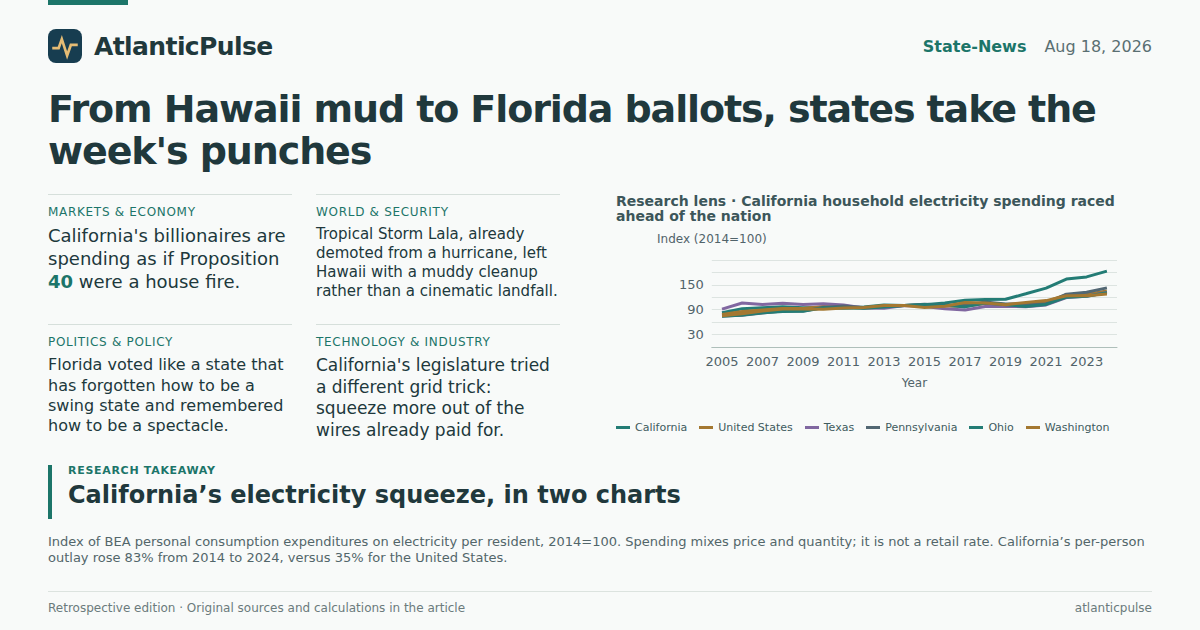
California's legislature tried a different grid trick: squeeze more out of the wires already paid for. Committees advanced bills for plug-in balcony solar up to 1,200 watts (SB 868), community solar valued with the Avoided Cost Calculator (AB 1813), and virtual power plants that would let behind-the-meter batteries count for resource adequacy (SB 913 and SB 905). Electricity rates have doubled over the past decade, which concentrates the mind. A smart-meter data-access bill, AB 1787, died in Senate Appropriations, leaving consumers in the dark about the one thing they actually own. In Houston, Apple opened a 20,000-square-foot Advanced Manufacturing Center at its 500,000-square-foot northwest Harris County campus, where AI servers are already shipping and Mac mini production is due this year — part of a $600 billion U.S. commitment. And in Hood County, Texas, Constable John D. Shirley unplugged and covered the county's Flock license-plate cameras, on the theory that warrantless tracking of "regular folks just going about their day" does not belong in a free society, even if Dallas still has nearly 700 of the things.
Politics & Policy
Florida voted like a state that has forgotten how to be a swing state and remembered how to be a spectacle. With more than 95% of the vote counted, Rep. Byron Donalds, endorsed by President Donald Trump, led the Republican gubernatorial primary with 48% to Lt. Gov. Jay Collins's 25%; he would be the state's first Black governor if he wins in November against former Republican congressman David Jolly, now a Democrat. Appointed Sen. Ashley Moody cruised on the GOP side, but Democrats nominated state Rep. Angie Nixon, a democratic socialist, over Army veteran Alexander Vindman, who had raised $16.3 million to her $975,000. Embattled Rep. Cory Mills lost to former TV anchor Ryan Elijah, 47% to 34%. Debbie Wasserman Schultz and Jared Moskowitz held their Democratic seats; Moskowitz's 25th District is rated a toss-up after redistricting. Inside Elections still rates the governorship and Senate Solid Republican, which is another way of saying the fireworks were mostly intramural.
Two Midwestern executives used state power as a blunt instrument. Minnesota Attorney General Keith Ellison sued Texas Gov. Greg Abbott to force extradition of ICE agent Christian Castro, charged with four counts of aggravated assault after allegedly shooting through a Minneapolis homeowner's door in January, plus a count of falsely reporting a crime. Castro was arrested in Cameron County on May 29; Minnesota says Abbott has sat on the rendition warrant since June 3 even while signing two unrelated warrants to Minnesota the same week, and Texas law would discharge Castro after 90 days. Abbott's office declined to comment on pending litigation. In St. Paul, Gov. Tim Walz ordered the DNR and Pollution Control Agency not to review or permit nonferrous mining in the Rainy River Headwaters until related litigation is resolved, blocking Twin Metals' copper-nickel plan near the Boundary Waters after Congress rolled back federal protections in April. A 2020 poll found 60% of Minnesota voters opposed new mines near the wilderness.
Courts absorbed the rest of the argument. Opening statements began in Oakland in the multistate child-safety trial against Meta, with California, Colorado, Kentucky and New Jersey going first among 29 state plaintiffs. California deputy attorney general Megan O'Neill told jurors Meta studied how children's brains chase rewards and titled one study "The young ones are the best ones"; theoretical damages could reach $1.4 trillion, though legal experts doubt anything near that. Meta said it is proud of its teen protections and looks forward to showing the jury. Families represented by the ACLU asked the Supreme Court to review Texas's law requiring Ten Commandments posters in public classrooms after the Fifth Circuit upheld it 9-8, overturning the spirit of a 1980 high-court ruling against a similar Kentucky statute. San Diego County supervisors, for their part, moved to end ICE and Border Patrol access to county firing ranges — about 3,350 hours since 2024 on contracts worth some $127,000 — on the theory that the federal government should not "terrorize our families all week and rent our firing range on the weekend."
Human Stories / Social Trends
In Maysville, Kentucky, Delsia Bare, 54, and Ida Huddleston, 83, turned down $26.48 million for their 216-hectare family farm rather than host a 2.2-gigawatt hyperscale data center. The land has been in the family for almost 200 years, used for cattle, tobacco and other crops. Neighbors had already signed purchase agreements totaling $110 million; legal challenges from Bare and others have delayed those deals. Local officials dangle 400 permanent jobs and a fatter tax base in a town where about one in four residents live below the poverty line, which is a polite way of saying some neighbors now regard two women as the obstacle to a payday. A Gallup poll earlier this year found seven in ten Americans oppose AI data centers in their own communities. Seattle and Nashville have paused permits; several Michigan townships have done the same. The servers can wait. The farm, they decided, cannot.
Wisconsin's measles count more than doubled in a week, from 15 confirmed cases last Thursday to 36 by Tuesday, plus probable cases, clustered in Iowa, Lafayette and now Grant counties. Most of those infected are children; of 23 earlier state cases, all but one person were unvaccinated. Two MMR doses are 97% effective, yet only about 85% of Wisconsin kindergartners were vaccinated in 2024-25, and 8.2% of parents claimed exemptions for 2025-26, nearly all non-medical. National kindergarten coverage has slipped to 92.5%, below the 95% herd-immunity line. The outbreak's local spread, with no identified public exposure sites yet, suggests more cases are already in the community as school starts — a grim companion to a presidential order last week seeking to break the combination MMR shot into separate injections, a change Wisconsin's health secretary said no new science justifies.
Immigration enforcement kept rearranging ordinary lives. San Diego Padres catching coordinator Oswaldo José Pirela, a Venezuelan former minor-leaguer who sought asylum in 2014, was detained at El Paso International Airport around 5 a.m. Sunday while traveling for work. Family members say he is in the country legally, has two U.S.-born daughters outside Phoenix, and still has not been told why he was taken. In Maine, Durán Guerrero's relatives joined Democratic House members at a Biddeford forum still waiting for basic answers a month after the shooting. And in Camden, Cathedral Kitchen is plating more than 500 meals as working people show up because wages no longer cover groceries. The week's through-line is not subtle: storms, servers, ballots and badges all land on the same kitchen table, and the table does not get a press secretary.
This retrospective news edition uses archived reporting scoped by publication date, or arrival when publication was absent. Collection may have occurred later.