National / Federal News
Midterm Eve: Diplomacy on Hormuz, a Court That Said No, and a Receipt That Already Voted
World & Security
The United States spent Monday doing two things that do not usually happen together: bargaining with Iran and threatening to hit it again. Iranian Foreign Minister Abbas Araghchi said “intensive” indirect talks were underway through Qatar and Pakistan, and Tehran offered to reopen the Strait of Hormuz within two days if Washington met a familiar list—end the war, unfreeze assets, lift oil sanctions, and drop the counter-blockade of Iranian ports, Iran’s foreign ministry said. Oil, which has yo-yoed between roughly $70 and $120 a barrel since the conflict began, dropped more than 6% on the optimism. That is the kind of move that makes a midterm look briefly cheaper. It is also the kind that reverses if someone decides diplomacy is taking too long.
Someone is already making that case. Israeli Prime Minister Benjamin Netanyahu is pressing President Donald Trump for another wave of strikes after Tuesday’s vote, according to regional officials who spoke to the Associated Press—a return to full-scale war that could help him form an emergency government after he and his far-right allies lost their parliamentary majority last week. Trump called the weekend conversation “very good”; at a rally he still promised that “at some point we’re going to have to give them the hammer.” Secretary of State Marco Rubio said the president has not decided and prefers a deal. Gulf partners, who have spent billions on air defenses since February, are less enthusiastic about the hardware. UAE adviser Anwar Gargash warned that if the gap is not closed, “we have to worry about the worst.”
Ukraine got a date, if not a peace. A senior U.S. official said Washington will bring Ukrainian and Russian delegations to Abu Dhabi on November 10–11, with Steve Witkoff and Jared Kushner expected to represent the United States—the first such talks since February, when the Iran war began. In Kherson, a localized ceasefire that first lady Melania Trump helped broker, and that let civilians leave Oleshky, was already ending; the regional theater planned to keep performing in a basement. The FBI blamed North Korea’s TraderTraitor operators for stealing more than $6 billion in crypto from Binance around October 29; the exchange said it had covered about 95% of the hit and would eat the rest. Closer to home, a Learjet 60 plunged into a Palm Beach County neighborhood less than seven miles from Mar-a-Lago, killing all nine aboard. The FAA and NTSB will investigate. For one afternoon, that was the only sentence in Washington without a foreign policy in it.
Markets & Economy
Wall Street treated cheaper crude as a campaign contribution. By mid-morning the S&P 500 was up 0.8%, the Dow 547 points, and the Nasdaq 1%, recovering some of a three-week, tech-led slide that had left the S&P within 2.3% of its record. Brent fell 6.7% to $105.87. Airlines and cruise lines jumped. Marvell fell 6% after announcing a roughly $115 billion all-stock purchase of Lumentum. Alphabet rose 2.4% after Thursday’s historic drop of more than 12%. Nvidia gained 1.9% a day after ceding the “most valuable stock” crown to Apple. The AI complex is living a split-screen October: 47 AI and chip names lost about $5 trillion in market value from October 6 even as 625 other large U.S. stocks added $1.3 trillion. It is a reminder that a data-center boom can impersonate a national economy until it doesn’t.
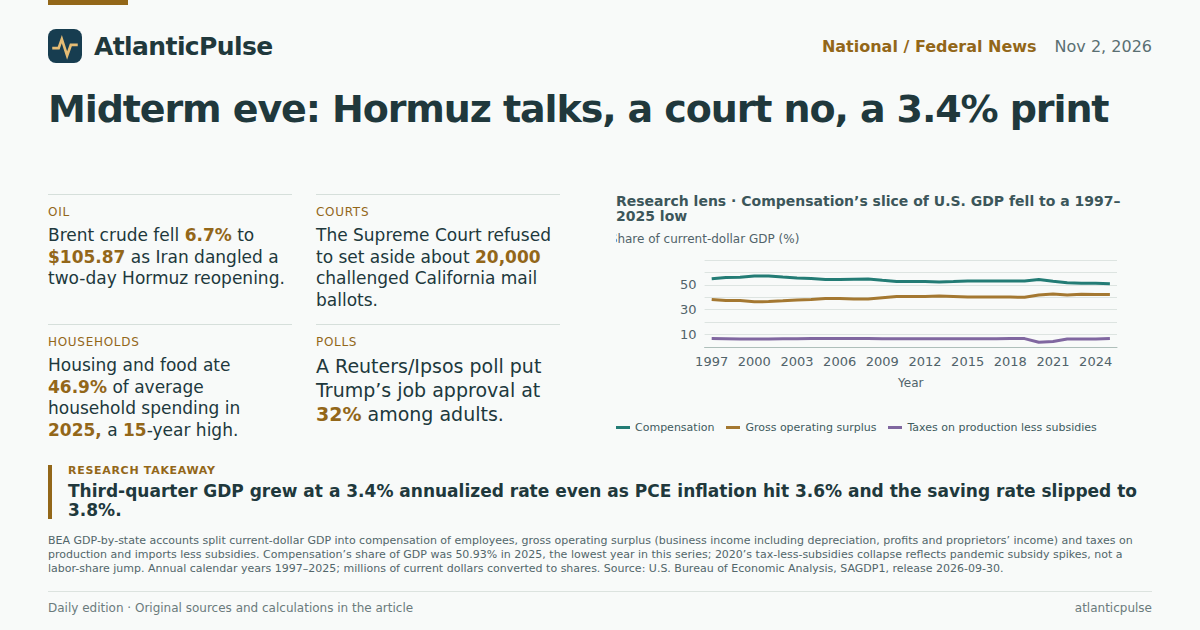
The official economy still looks muscular on paper and stingy at the till. Third-quarter GDP grew at a 3.4% annualized rate, consumer spending rose 3.8%, and business equipment investment surged 20.9%. The ISM manufacturing PMI climbed to 55.5 in October, a tenth straight month of expansion, though the prices-paid gauge stayed a blistering 75.2. PCE inflation, the Federal Reserve’s preferred measure, accelerated to 3.6% year-on-year in September. The Fed left rates at 3.75%–4.00% last week and admitted inflation “remains elevated.” The personal saving rate slipped to 3.8% in September. That is the statistical version of households eating next month’s groceries.
Rural America got an envelope with a midterm stamp. The USDA has pledged about $15 billion in recent weeks—more than half of it an $8 billion one-time diesel payment—on top of $13.8 billion in 2025 crop-year safety-net checks, meant to offset fuel and fertilizer costs that farmers tie to tariffs and the Iran war. Diesel averaged $6.32 a gallon Friday, about 70% above a year earlier. Farm economists say the money may cover this year’s fuel shock without solving next spring’s loan meeting. The Bureau of Labor Statistics, less interested in rallies, found housing and food ate 46.9% of average household spending in 2025, the biggest share in 15 years. The University of Michigan’s sentiment index sat at 48.0 in October, the second-lowest reading in the survey’s history. Voters do not need a briefing for that number.
Technology & Industry
Anthropic walked into IPO week looking like a growth story that is also a construction site. An amended S-1 showed $17 billion in third-quarter revenue, up from $11.6 billion in the second quarter and $1.4 billion a year earlier—still more than 1,000% year over year, though sequential growth slowed to about 47% from 144%. Operating expenses jumped to $17.5 billion, swinging the lab to a $567 million operating loss after a $974 million operating profit the quarter before, a reversal it blamed on pricey short-term compute and $2 billion in non-cash charges tied to employee donation matching. Adjusted operating margin shrank to 15% from 19%. Then there is the figure that will haunt the roadshow: about $895.4 billion in spending commitments, mostly for compute. Price cuts offset roughly $600 million of usage growth. Liquidity still stood at $146.6 billion. That is a lot of cash with which to discover that chips are not getting cheaper.
Apple, in John Ternus’s first quarter as chief executive, posted a September-quarter record: $114.5 billion in revenue and $30.7 billion in profit, with Services at an all-time high and a fiscal year of $478.8 billion in sales. Ternus plugged the iPhone Duo as “the most transformational iPhone since the original.” Tesla and Samsung, less lyrical, asked the U.S. Trade Representative not to pile new tariffs on Vietnam as a November 29 deadline approaches on an intellectual-property probe. Vietnam already faces a 12.5% general tariff and is now America’s largest goods-surplus partner; steel, solar, and plywood groups want penalties, while footwear and console makers do not. Four analog astronauts, meanwhile, walked out of a 1,700-square-foot 3D-printed habitat at Johnson Space Center after 378 days of simulated Mars, growing crops in fake soil and waiting through fake interplanetary lag. Medical officer Ellen Ellis called it “captivity of our own free will.” After a week of compute bills and tariff comments, a year in a box almost sounds restful.
Politics & Policy
Tuesday is Election Day, and the president spent Monday afternoon at the Lincoln Memorial Reflecting Pool calling this “the most important midterm, I believe, in our lifetime,” and insisting that if 2024 voters show up, Republicans “will win in a landslide.” He also admitted the historical joke on himself: sitting presidents usually lose midterms, “good or bad,” he told the crowd. A Reuters/Ipsos poll completed Monday put his job approval at 32% among adults, a tick above a record-low 31% two weeks earlier. Democrats led the generic congressional ballot 46% to 38% among registered voters, a narrower gap than the prior week’s 11 points. Half of independent registered voters called their ballot a vote against Trump. More than 57.5 million people had already voted early.
The courts spent the day swatting last-minute election theory. The Supreme Court, with no public dissent, refused the administration’s request to set aside about 20,000 California mail ballots from people the Justice Department flags as likely noncitizens. California officials said the list was riddled with errors and that segregating ballots now was logistically impossible; a DOJ lawyer conceded in a hearing that a “high error rate” was “a fair statement.” Chief Judge James Boasberg separately found last-minute demands on California officials likely violated the Elections Clause. If the White House wanted a closing visual of competence, this was not it.
Plan B is already in the counsel’s office. Trump has said that if Democrats take Congress he will become “Mr Veto” for “a month or two” and then “probably make deals.” Aides have been inventorying unilateral moves on tariffs, visas, and housing since April. He also said he would preemptively pardon staff and, if needed, Elon Musk, pointing to his January 6 clemency. In Michigan, outgoing Democratic Rep. Haley Stevens endorsed Republican Senate nominee Mike Rogers two days before the vote after a feud with nominee Abdul El-Sayed over Israel and antisemitism. Chuck Schumer called it a “despicable betrayal”; Trump invited her to join the GOP. El-Sayed said he does not think about Haley Stevens. Quieter still, the U.S. trade representative notified Congress of Trump’s intent to drop South Africa and Rwanda from AGOA as of January 1, 2027.
Human Stories / Social Trends
Halloween weekend was not cute. CNN, drawing on Gun Violence Archive tallies, counted at least 13 dead and 92 injured in shootings that interrupted costume shopping, football, and college parties. Constance Hages, 31 and pregnant, was killed at a Spirit Halloween in Fairfield, California. Delaware had two mass shootings in an hour; Gov. Matt Meyer said, “This is not normal.” Birmingham’s Magic City Classic, Dallas’s Deep Ellum, two towns named Bloomington, Jacksonville house parties: the map looked like a weather system. There have been nearly 400 mass shootings in the United States this year, more than one a day by the Archive’s definition. The country will vote tomorrow as if that were a separate file.
The household file is the one that actually decides midterms. Housing and food took 46.9% of average spending in 2025; the Urban Institute says renters pay about $710 more per month than in 2017. Forty-four percent of adults told Pew they had faced at least one hardship involving medical bills, transport, housing, or a food pantry. Affordable Care Act open enrollment started Sunday with KFF projecting a 13% average premium increase for 2027 marketplace plans, fewer subsidies, and new immigrant restrictions. CMS counted 19.2 million people enrolled as of February; 1.2 million already dropped off after COVID-era credits expired. The bottom income quintile spent more than it earned before taxes. That is not a metaphor. Four people who volunteered to disappear for a year stepped back into Houston sunlight. They had practiced patience and delayed messages. On Earth, everyone else practiced waiting in line, watching oil, and hoping the next 24 hours produce a Congress that can still pass a bill. The reflecting pool will still be there Wednesday. So will the grocery receipt.
This daily edition uses stored reporting scoped by publication date, or arrival when publication was absent. Source collection can lag publication.