National / Federal News
Two days out: Iran on a timer, a $6.3 billion heist, and a midterm already in court
World & Security
President Donald Trump spent Saturday at Mar-a-Lago sounding like a man who has already won a war and is now deciding whether to finish the paperwork. The United States, he told reporters, had “knocked out” much of Iran’s military and nuclear programme but still had to “take care of” one or two remaining sites — including the underground complex known as Pickaxe Mountain — and could do so “in 10 minutes”. Tehran denies nuclear work there. Iran’s supreme leader, Mojtaba Khamenei, in his first reported meeting with commanders since taking over after his father’s death in US-Israeli strikes, ordered an “immediate, impactful and geographically unrestricted” response to any new attack. At the same time, Iranian officials described a letter from Vice President JD Vance as a complete shift in tone. Foreign Minister Abbas Araghchi said Qatari mediators had helped shrink a Hormuz reopening timetable from five days to two — if Washington lifts post-Islamabad sanctions, restores oil waivers, releases frozen funds and thins its regional force. Asked whether he would strike again, Trump called the question “stupid”: “Let’s say I did, would I tell you?” Diplomacy is on a two-day clock, with a ten-minute backup plan.
The FBI put a name to the largest crypto theft on record, attributing more than $6 billion stolen from Binance on or around 29 October to North Korea’s TraderTraitor operation — the same cluster tied to the $1.5 billion Bybit breach — and asking exchanges and DeFi platforms to block laundering addresses. Binance said it had replenished about 90 percent of customer losses and planned to reopen withdrawals on 1 November. Washington also played helpful neighbour: after the US Embassy warned of a mass-casualty threat at Moscow’s Tsaritsyno Museum Reserve, Russia’s FSB said a US tip led to the arrest of a Russian minor who had posted tactical-gear videos and searched past attacks. The agency even said it was “grateful.” Farther west, the State Department approved a potential $2.1 billion sale of 500 Patriot PAC-3 MSE interceptors to Ukraine, financed by Canada, Germany, Norway and an EU-backed loan — with no US money in the package. Sources told Reuters the missiles have not been built and may not arrive until a couple of years into the 2030s. Approval without a delivery date is the defence-industry equivalent of a gift card that expires in the next decade.
Markets & Economy
US debt held by the public closed fiscal 2026 at $32.2 trillion, or 100.03 percent of GDP — the first fiscal year-end above 100 percent since 1946, when wartime borrowing peaked at 106 percent, according to figures reported from The Wall Street Journal. That tally excludes intragovernmental IOUs such as Social Security; gross federal debt is described as exceeding $40 trillion. Net interest hit $1.05 trillion, more than the defence budget. The economy, unhelpfully for anyone hoping the ratio would shrink on its own, still expanded at a 3.4 percent annualised clip in the third quarter. Growth is doing its job. The Treasury’s coupon is doing overtime.
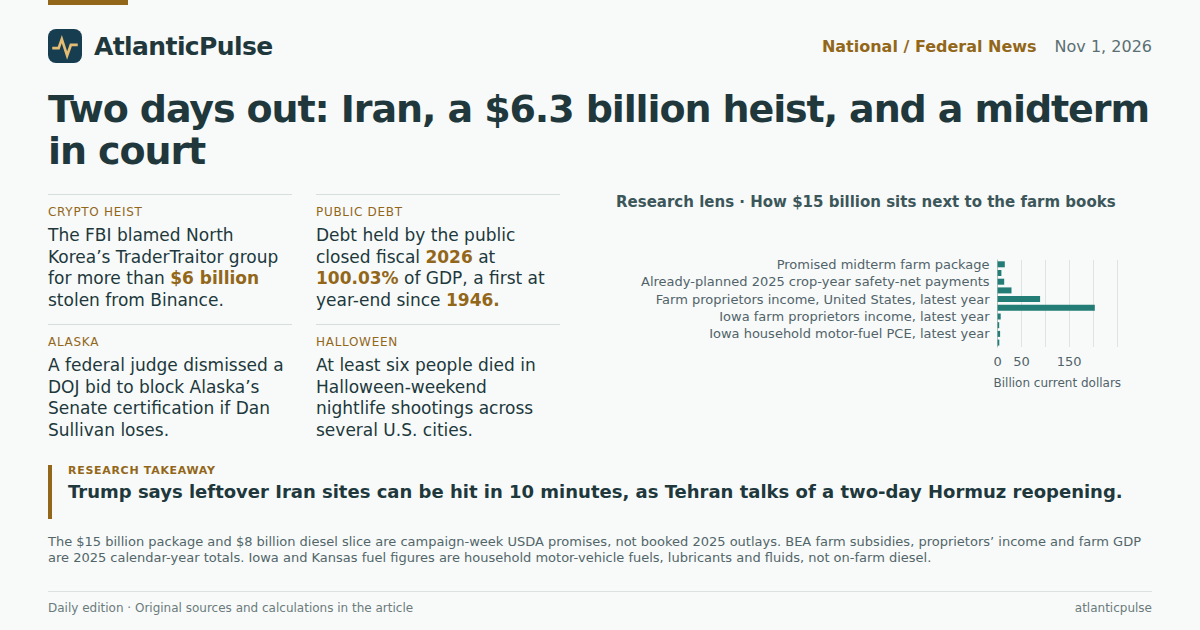
In farm country the administration tried a more tangible fiscal instrument: $15 billion in late-campaign promises meant to offset diesel and fertiliser costs that farmers have blamed on tariffs and the Iran war, on top of $13.8 billion in already-planned 2025 crop-year safety-net payments. More than half of the new package is an $8 billion one-time diesel payment whose details arrive later this month; AAA had diesel averaging $6.32 a gallon on Friday, 70 percent above a year earlier. Kansas State’s Gregg Ibendahl estimated the cash would more than cover the fuel spike, then asked the awkward lender question: how do you finance next year’s crop on a one-time cheque? Sunday, Trump told Iowa reporters the United States and Canada had the “concept of a very good deal”, with Keystone XL in the mix and Canada paying “all of it.” Prime Minister Mark Carney called Saturday’s conversation “good” and said teams would work in the coming weeks. After a year of 50 percent tariffs and a presidential order renaming Lake Ontario, “concept of a deal” is the sort of phrase that keeps trade lawyers employed.
Households look richer on paper and later at the mailbox. The Federal Reserve’s Survey of Consumer Finances found 19.6 percent of families reported being late on a loan in the 2025 survey, up from 12.2 percent in 2022 and the highest since 2010. Families two months behind rose to 8.2 percent. Median debt-to-assets kept falling; debt-to-income did not. Intel offered the listed-company version of the same mood: it beat quarterly estimates and posted 78 percent growth in data-centre and AI revenue, then guided fourth-quarter sales to $15–16 billion against a $17.1 billion Wall Street guess. The stock dropped nearly 29 percent on Friday, erasing about $140 billion, and sits 54 percent below June’s record. Beating estimates and still losing a fifth of the company is a very 2026 way to have a good quarter.
Technology & Industry
The Justice Department is asking whether Nvidia should own the internet’s favourite shelf of open AI models. Reuters and CNBC confirmed a probe of the chipmaker’s planned $12.93 billion purchase of Hugging Face, announced 3 September and aimed at a first-half 2027 close. The hub hosts more than three million models, about 500,000 datasets and 18 million-plus developers — on roughly $150 million of annualised revenue, or about 86 times sales. Investigators are examining whether the platform would become a chokepoint that tilts defaults toward Nvidia silicon; a separate line of inquiry looks at alleged tied selling of chips, networking gear and Groq processors. Nvidia says Hugging Face will stay open to rival processors and clouds. Pledges, as every merger lawyer knows, are not structural remedies.
Anthropic’s S-1, filed 26 October with Goldman Sachs, JPMorgan and Morgan Stanley leading, put the other end of the boom in print: $19.7 billion in revenue and a $109.74 billion net loss for the year ended 30 June 2026, including a vast accounting charge on financing instruments. Reports of a raise as large as $100 billion at up to $2 trillion would make ticker ANT larger than SpaceX’s $1.77 trillion June debut. OpenAI, not to be left with a single landlord, plans to buy Google tensor processing units — quantities undisclosed — on top of Nvidia GPUs and a Broadcom-designed custom chip slated before 2027. Alphabet, Amazon and Microsoft are expected to spend as much as $600 billion on AI infrastructure this year. Binance’s $6.3 billion weekend is the ugly twin of that spending boom: the same rails that move model weights also move stolen tokens.
Politics & Policy
Tuesday’s midterms are being treated in the West Wing as both a referendum and a contingency plan. Reuters reported that since April, Stephen Miller, OMB director Russell Vought and White House counsel Will Scharf have been inventorying executive actions on immigration, tariffs, housing and spending that could proceed without Congress if Democrats take the House — they need a net four from a 218–214 majority — and perhaps the Senate (53–47). Polls favour a Democratic House; the Senate is too close to call. Ideas include new tariffs on critical minerals and wind turbines, tighter student and guest-worker visas, and grant rules that give political appointees more say over already appropriated money. Trump has already governed that way on tariffs, immigration, the federal workforce and the Iran war. A Democratic Senate could still freeze nominees. Asked how comfortable Trump would be governing by decree, one person familiar with the plans said: “very comfortable.”
The administration’s pre-election litigation had a worse weekend than its speechwriters. In Alaska, Judge Sharon Gleason dismissed a Justice Department suit that sought to block certification of the Senate race if GOP Sen. Dan Sullivan lost to Democrat Mary Peltola, on the theory that a same-name candidate, Daniel J. Sullivan, would taint the result. Gleason noted ballots already cast and “no workable plan” to segregate votes without violating secrecy. Sen. Sullivan said on CNN he would accept the result even if he lost. In California, UCLA analysts told a court that 8,880 of 20,930 names on a DOJ list of alleged noncitizen voters — 42 percent — do not match the current voter file, with at least 22 confirmed citizens. Judge Trina Thompson ordered the government to stop threatening election officials with criminal charges for processing those ballots, writing the campaign was “likely to have the effect of interfering with election administration and disenfranchising lawful voters.” Trump’s response: “Why would they reject fixing Election Fraud?”
Michigan supplied the week’s intra-party grenade. Democratic Rep. Haley Stevens, two days from Election Day, endorsed Republican Mike Rogers over Democrat Abdul El-Sayed after a fight over an anti-Israel PAC ad. State party chair Curtis Hertel said she is “not a current member of the Michigan Democratic Party, nor will she be.” Her chief of staff resigned. Trump praised her “bravery.” In Florida, Judge Darrin Gayles dismissed with prejudice Trump’s $10 billion defamation suit against the Wall Street Journal over an alleged 2003 Epstein birthday-book letter, calling the case “grasping at straws” and holding that a public figure’s denial does not create actual malice. The First Amendment, it turns out, does not require newspapers to spike a story because the subject says so.
Human Stories / Social Trends
Halloween weekend was supposed to be costumes. Instead it was trauma maps. At least six people died and dozens were injured in nightlife-district shootings across Dallas — four dead and 15 hurt in Deep Ellum — Birmingham after the Magic City Classic, Newark, Delaware, Bloomington, Illinois, Fayetteville and Little Rock. Separate Friday attacks at Spirit Halloween stores in Fairfield, California, where family members said a 31-year-old woman who died was pregnant, and Madison Heights, Michigan, added to the toll. Dallas’s chief still did not know whether three shootings in 75 minutes were related. Increased police presence had not been enough.
A different kind of official mercy arrived in the Bronx. After 15-year-old Javits Frimpong, a Ghanaian 10th-grader, was shot on his way to school on 29 October, Mayor Zohran Mamdani said he had spoken with Trump, who agreed to grant the boy’s mother an immediate visa so she could say goodbye in person. The White House did not immediately comment. Police were still looking for three teenage suspects. Meanwhile the twice-yearly clock ritual returned because the Senate has parked the Sunshine Protection Act even after the House passed it 307–117. Trump posted Sen. Tom Cotton’s cellphone number; Cotton replied that Arkansans do not want children walking to school in pitch dark. And from Tuesday 3 November at 11:59 p.m. ET, every international passenger to the United States must attest they have not been in the Democratic Republic of the Congo in the prior 21 days, under a CDC Ebola rule. The overall risk to the American public, the CDC says, remains low. The paperwork risk is not.
NASA offered the one story in which isolation was voluntary. Four analog astronauts — Ellen Ellis, Ross Elder, Matthew Montgomery and James Spicer — walked out of a 1,700-square-foot 3D-printed habitat at Johnson Space Center after 378 days, NASA’s second CHAPEA Mars simulation. Ellis called it “captivity of our own free will.” On Earth, some parents are refusing a different sealed box: Trump Accounts, automatically created for nearly 70 million children, with more than $8 billion already deposited. Nashville father Israel Anthem told Fortune he would rather put $1,000 of his own money aside for his 14-month-old than claim the federal contribution. “When money is psychologically tainted, we often avoid it,” a Michigan professor explained. After a weekend of shootings, visas, clock changes and health attestations, that is as close as the country came to a unifying theory of 2026: people will endure a lot, but they still want to choose the name on the form.
This daily edition uses stored reporting scoped by publication date, or arrival when publication was absent. Source collection can lag publication.