National / Federal News
Ballots, bases and a $2 trillion AI hangover
World & Security
The Iran war is in its eighth month, and much of the Gulf is treating Tuesday’s midterms less as an American civic ritual than as a military weather report. The conflict began in February when the United States and Israel struck Iran and killed Supreme Leader Ali Khamenei; neither side has broken the stalemate, and President Donald Trump has said Washington “will not be attacking Iran at any time prior to the midterm elections” without saying what happens after. Residents are scanning social media for troop movements, US diplomat families have quietly left posts they had only just returned to, and Iran’s new supreme leader, Mojtaba Khamenei, ordered a response “without geographical limitations” to any new threat. Qatar is mediating. Secretary of State Marco Rubio, asked in Atlanta whether the last 48 hours had produced progress, would not characterise it and declined to put a clock on diplomacy. “I don’t know if there’s a time frame,” he told CNN, which is one way of leaving Tuesday on everyone’s calendar except, officially, his.
An Associated Press analysis of satellite imagery found that through August more than 115 drone or missile strikes claimed by Iran or Iranian-backed militias had damaged or destroyed structures on 26 military bases and other sites with US equipment, often hitting early-warning radars first and hangars later. Kuwait absorbed the heaviest blows; six soldiers were killed in a 1 March drone attack at Port Shuaiba. A radar destroyed in Jordan was one of only 13 the Army possessed worldwide, each costing about half a billion dollars, and a Congressional Research Service update in October said 15 US aircraft had been damaged on regional bases. CENTCOM commander Adm. Brad Cooper, flying over the Strait of Hormuz, said the primary shipping lanes had been cleared of Iranian mines, that more than 1.5 billion barrels of Gulf crude had been exported since summer, and that Iran’s navy was “at the bottom of the sea” — a claim the IRGC promptly asked him to prove with something other than a press statement. Closer to home, the Secret Service asked NORAD to park Avenger short-range air-defence systems, Stinger missiles included, at Mar-a-Lago and Trump International Airport.
Washington still found time to approve a $2.1 billion sale of 500 Patriot PAC-3 MSE interceptors to Ukraine, paid for by Canada, Germany, Norway and an EU-backed Ukrainian loan rather than US taxpayers. The catch, according to people briefed on the decision, is that the missiles have not been built and may not arrive until the early 2030s — a long wait if you are trying to keep the lights on in Kyiv this winter. In Atlanta, Rubio cancelled the G20 foreign ministers’ family photo after European counterparts refused to stand next to Russia’s Sergey Lavrov; South Africa, a G20 founder, was not invited at all. And the FBI attributed the theft of more than $6 billion from Binance — about $6.3 billion stolen on 29 October — to North Korea’s TraderTraitor group, a reminder that not every American security headache is currently in the Gulf.
Markets & Economy
Wall Street closed October the way a student closes a group project: by discovering, rather late, that the invoice is real. On Friday the Nasdaq Composite fell 2.84 per cent, or 747.73 points, to 25,440.68, its steepest one-day percentage drop since 5 June; the S&P 500 lost 1.80 per cent to 7,580.21 and the Dow 571.98 points to 51,770.58, according to market tallies. Roughly $2 trillion was wiped from the Nasdaq-100 over the sell-off as investors asked whether the artificial-intelligence boom could justify its costs. Intel was the day’s cautionary tale, collapsing nearly 29 per cent to $65.76 and erasing more than $146 billion in market value — its steepest session in more than 50 years — after a fourth-quarter outlook that landed well short of Wall Street.
The chipmaker’s quarter was, in the abstract, fine. Total revenue rose 21 per cent to $16.5 billion, and Data Center and AI revenue jumped 78 per cent to $7.3 billion. Then came the guidance: $15 billion to $16 billion for the fourth quarter against a $17.07 billion consensus, adjusted earnings of $0.25 a share versus $0.43 expected, and a 38 per cent gross margin after 44.1 per cent in the third quarter. An explosion at an Israeli plant, an estimated $600 million revenue hit, and a PC slump did not help; the chief financial officer also warned investors not to expect positive free cash flow next year. Alphabet shares lost nearly 13 per cent on the week after $9.1 billion in negative free cash flow; Amazon is looking at about $220 billion in capital expenditure this year. The pattern is not subtle: customers want the chips, the factories are expensive, and the market has started to bill for enthusiasm.
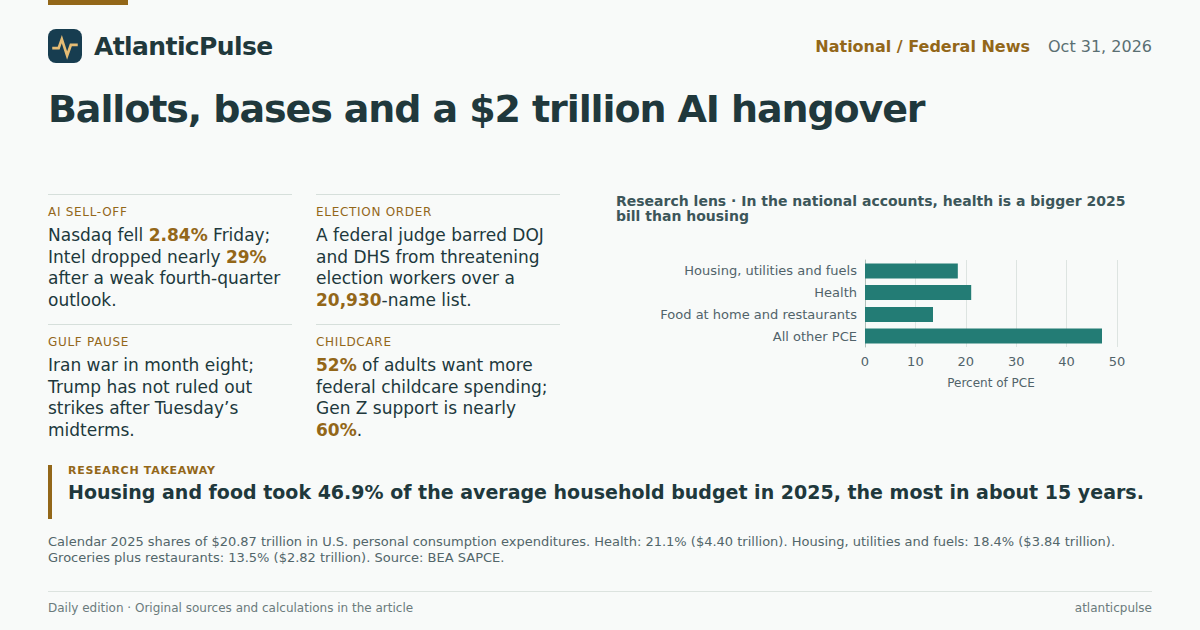
The rest of the economy is having a less abstract argument with prices. US oil companies have earned almost $130 billion in profits since the Iran war began, against less than $47 billion over the same span of 2025, the New York Times calculated; ExxonMobil’s profits doubled and Chevron’s grew 180 per cent in quarterly reports out Friday. The national average price of gasoline in the third quarter was $4.12 a gallon, up 96 cents from a year earlier, and the median household has spent about $856 extra at the pump. The Consumer Expenditure Survey, released 29 October, found that in 2025 housing and food together took 46.9 per cent of household spending — $27,790 and $10,633 of an $81,905 budget — the largest combined share in about 15 years. A brief Bureau of Economic Analysis item put third-quarter growth at a 3.4 per cent annual rate, an advance estimate, with housing a weak spot. Growth on paper, a grocery bill that feels like rent: the midterm mood in one sentence.
Technology & Industry
Intel’s crash was not a story about vanishing demand so much as a company that finally has orders it cannot fill at a price investors will tolerate. Buyers building AI infrastructure are queuing for its processors, yet manufacturing constraints, a weaker PC market and that Israeli accident squeezed the outlook. The foundry dream — catching TSMC, hosting Nvidia’s $5 billion 2025 bet, perhaps making some of Apple’s chips — had carried the stock past $130 in May. At $65.76 it has surrendered roughly half that high. The irony, as one trader put it, is brutal: data-center revenue just grew about 80 per cent, and the share price still had its worst day since the 1970s.
Anthropic’s IPO paperwork offered a companion exhibit in how large “the future” can look on a spreadsheet. The filing disclosed nearly $900 billion in future commitments tied to servers, buildings and electricity, including $321 billion in leases that have not yet started and $265.6 billion in purchase agreements that quadrupled between December and June. Reported liabilities were $117.5 billion against $112 billion in cash — figures that describe the present, not the invoice still in the post. Coin Bureau noted that the commitment total exceeds the annual nominal GDP of more than 160 countries individually, which is a colourful comparison and also a reminder that leases do not become cheaper if the revenue to pay them fails to arrive. The company plans to finance the build-out with growth and new capital, which is another way of saying the market must keep believing.
Not every lab is having a bad week in orbit. Google said a prototype satellite launched on 1 October had booted a Tensor Processing Unit, run Gemma 4 and sent back its first complete reply — a haiku — as the craft passed over Svalbard. Project Suncatcher is a long bet that low-Earth-orbit arrays might one day tap near-constant sunlight; the next tests are thermal stress and radiation, with two interconnected satellites eyed for 2027. Back on Earth, Binance said it had replenished about 90 per cent of the stolen assets from treasury and protection funds, allocating some $6.34 billion so customers would not eat the loss, while the FBI named North Korea. The CFTC chair, not coincidentally, used the heist to argue that offshore exchanges need US oversight. Between a poem from space and a $6 billion hole in an exchange, the industry’s range of product remains, if nothing else, wide.
Politics & Policy
Five days before Election Day, a federal judge in California told the Justice Department to stop threatening the people who count the votes. US District Judge Trina Thompson, ruling on a union lawsuit, described an “unprecedented and unlawful” campaign of intimidation against state and local election workers and barred the DOJ and Homeland Security from further threats or demands to segregate suspected noncitizen ballots. The fight centres on a list of some 20,930 California names the department labelled “likely noncitizens”; letters warning of prosecution went to officials in California, Washington state and, plaintiffs say, all 50 states. Thompson found the conduct likely violated the Voting Rights Act, the Elections Clause and the Fifth and Tenth Amendments. A UCLA analysis filed Saturday found that 8,880 of those names — 42 per cent — do not appear on California’s current voter file, and that at least 22 are US citizens. The US attorney in Los Angeles called the analysis “bogus.” President Trump, on social media, spoke of “20,000, but potentially Hundreds of Thousands, and maybe even Millions.” Courts, as a rule, prefer the smaller number they can see.
Alaska offered a second federal experiment in last-minute election law. The Justice Department asked a judge to halt certification of a possible Democratic Senate win by Mary Peltola and to isolate ballots for a second candidate named Daniel J. Sullivan Jr., a retired teacher whose presence, The New York Times reported, was tied to recruiting by people around Peltola’s campaign. Alaska’s Republican-run government called the demand “meritless” and “not even possible” without violating voter privacy; the two Sullivans are distinguished on the ballot, and the state Supreme Court had already kept the second name on. Peltola denies involvement. Meanwhile a Miami judge dismissed with prejudice Trump’s defamation suit against The Wall Street Journal over a lewd birthday letter to Jeffrey Epstein bearing his name, holding that he had not plausibly alleged actual malice and that a public figure’s denial does not entitle him to spike a story. Dow Jones was pleased. The White House pointed reporters to personal lawyers.
The rest of the ballot is already moving. An Associated Press tally five days out found more than 43 million Americans had voted early, nearly 10 million more than at the same point in 2022, with especially sharp jumps in Senate battlegrounds; Texas alone was at 6.3 million early votes, up 50 per cent. About 36 million Latino adults are eligible this cycle. Support for Trump among Latinos has fallen from 45 to 48 per cent at the 2024 ballot box to 27 per cent approval in September polling, with only 26 per cent of Hispanic respondents telling Reuters/Ipsos in October they planned to vote Republican — a swing pollsters call unusually fast, driven by prices and the spectacle of immigration enforcement. In Washington, D.C. and Virginia sued to block a 250-foot triumphal arch the administration says could start construction as early as next week, complete with a late-breaking national-security rationale involving drones and snipers. Judge Tanya Chutkan asked the obvious question: what, exactly, is the rush?
Human Stories / Social Trends
Affordability is not a slogan so much as a line item. A 19th/YouGov poll of 2,357 adults, conducted 18–24 September, found that 52 per cent of US adults want the federal government to spend more on childcare, including nearly 60 per cent of Gen Z voters. The United States currently spends about $12.4 billion a year on care, mostly for the poorest families, leaving an average price tag around $13,000 and, by Child Care Aware’s count, centre-based care for two children more expensive than median rent in 47 states and the median mortgage in 39. Only 21 per cent favoured fully government-paid care for children under two; the most popular answer was to split the bill. Selasi Tagbor Morales of the Alliance for Youth Action put the generational version cleanly: the question is not only “Can I afford childcare?” but “Can I afford to have kids at all, and when?”
That household arithmetic collides this week with a harder kind of displacement. Court filings obtained by the Associated Press show the administration planning to deport detained Afghans via Pakistan, with further transport onward to Afghanistan, on flights that could begin as early as Monday from Louisiana. Advocacy groups say some of those people, or their relatives, helped US forces; Human Rights First said it had confirmed a Tuesday charter. ICE declined to discuss future operations. Shawn VanDiver, a Navy veteran who leads #AfghanEvac, called the plan “absolutely unconscionable.” Senators Jeanne Shaheen and Richard Blumenthal said it broke a wartime promise. The administration has already paused the prior Afghan resettlement programme. For families who spent years in vetting queues, Pakistan is not a layover. It is the long way home to the Taliban.
A different kind of homecoming played out on the Ukraine–Belarus border, where hundreds of civilians — and many pets — arrived from occupied Oleshky under a local ceasefire that Pope Leo XIV called for and first lady Melania Trump helped negotiate. Dmytro had not seen his wife Larisa for 1,711 days. Medics warned that people who had been starving would have to be fed carefully. Zelensky thanked the mediation; the ombudsman rode with the convoy. It is a small, specific mercy in a war that otherwise produces Patriots on a 2030s timetable. Between Gulf residents bunkering for November, California election workers reading prosecution letters, and American parents running the childcare spreadsheet, the through-line is not ideology so much as waiting — for Tuesday, for a flight, for a bill that finally looks like a wage.
This daily edition uses stored reporting scoped by publication date, or arrival when publication was absent. Source collection can lag publication.