National / Federal News
Four days out: two wars, an AI invoice, and a ballot fight
World & Security
Admiral Brad Cooper of U.S. Central Command briefed President Donald Trump on Thursday on options for renewed strikes on Iran, with War Secretary Pete Hegseth and Joint Chiefs Chairman Gen. Dan Caine in the room. That is a briefing, not an order — the sort of distinction Washington likes to keep until it isn't. Iranian Parliament Speaker Mohammad Bagher Ghalibaf said a “carrot-and-stick approach” would not move Tehran off seven stated conditions. Iranian agencies reported a letter from Vice President JD Vance to security chief Mohsen Rezaei; Trump publicly described the outreach as help obtaining medical supplies, a friendlier gloss than the one in the Wall Street Journal. The IRGC claimed oil tankers had struck mines in the Strait of Hormuz a day after the U.S. military said it had cleared the main routes. The supplied reports did not independently identify the vessels.
Closer to Kyiv's war, The Wall Street Journal reported that Ukraine had unofficially paused strikes on Russian refineries after weeks of pressure from Trump, who has blamed those attacks for American fuel prices ahead of the Nov. 3 midterms. Kyiv did not announce a formal halt. Hours after that account, Ukrainian drone maker Fire Point said its FP-1 drones hit Rosneft's Novokuibyshevsk plant, including a diesel hydrotreating unit — the first reported fire at a Russian refinery since mid-October. Ukraine's General Staff did not comment; President Volodymyr Zelenskyy had told reporters his forces were being “a little more careful” but had no order to stand down. In a related transaction that still costs money, the State Department approved a possible $2.1 billion sale of 500 Patriot PAC-3 missiles, financed largely by Canada, Germany, Norway and an EU loan. At the same time, Pentagon officials have privately asked Baltic allies to tone down public warnings about Russia while Washington courts a deal. In Atlanta, Secretary of State Marco Rubio scrapped the traditional G20 family photo after European diplomats objected to standing next to Sergey Lavrov. South Africa, a G20 founder, was not invited.
At home, Hegseth fired Lt. Gen. Brett Sylvia, the Joint Staff's J5 strategy chief, over alleged leaks about the Iran and Ukraine wars. A War Department official said Sylvia failed three polygraphs and met journalists outside the building after reporters were required to be escorted; two other Pentagon sources disputed the accusations. The case was referred to the Justice Department. Investigators are also treating freezer malfunctions at at least six commissaries as suspected cyberattacks, after units flipped into defrost and spoiled food, with U.S. Army CID coordinating with French police after a similar grocery-store incident. And in crypto, Binance said hackers stole about $6 billion through an engineer's laptop; TRM Labs, Pangolin and Chainalysis attributed the heist to North Korea with high confidence. The FBI and Secret Service said they were working with partners including Circle to freeze funds. Binance pledged to cover losses from company coffers. Pyongyang has previously denied hacking allegations.
Markets & Economy
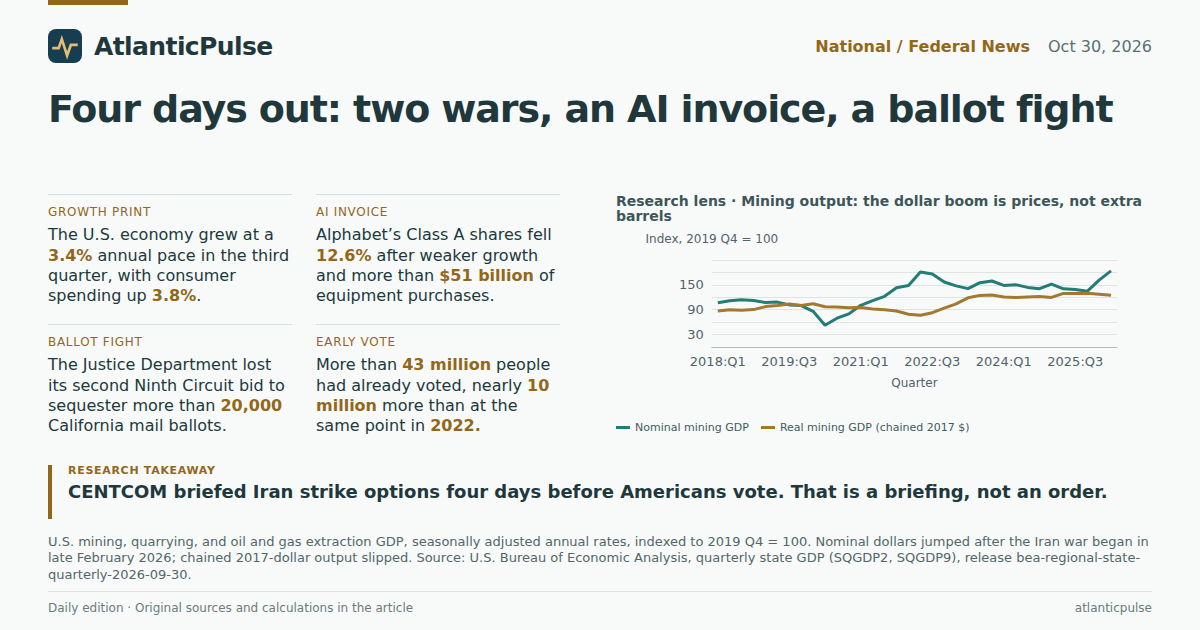
The Commerce Department said the U.S. economy grew at a 3.4% annual pace in the third quarter, beating a FactSet consensus of 3% and accelerating from 2.2% in the spring. Consumer spending rose 3.8%. Business investment excluding housing jumped 12.7%, with information-processing equipment up 37.4%, software 9.6% and research and development 7.5% — the AI boom showing up in the national accounts even as housing investment fell 3.3% for the sixth decline in seven quarters. It is the first of three GDP estimates, and the kind of report that lets politicians claim victory while voters still argue with the grocery receipt. The American economy, the department's statisticians noted, has so far proved resilient in the face of higher energy prices from the fighting with Iran.
The Federal Reserve, in its last meeting before the midterms, held its benchmark rate in a 3.75%–4% range on a 10–2 vote. Chair Kevin Warsh said the economy was expanding at a “strong pace” but was not overheating, and that productivity — including gains that predate the AI boom — could allow faster growth without matching inflation. Governor Lisa Cook, whom Trump is targeting for removal, cast her first monetary-policy dissent in favor of a quarter-point hike; Cleveland Fed President Beth Hammack joined her. Markets still priced roughly an 80% chance of a December increase. Inflation remains about a percentage point above the 2% target. Energy, especially diesel, is the headache that refuses to leave the room.
Wall Street, meanwhile, discovered that “AI investment” looks less glamorous on a cash-flow statement. Alphabet's Class A shares fell 12.6% after weaker-than-expected summer growth and more than $51 billion of equipment purchases that pushed free cash flow negative — the stock's worst day since it began trading more than two decades ago. The S&P 500 still only slipped 0.3% because four in five stocks rose; the Nasdaq fell 1.4%. After the close, Amazon dropped about 7% on a soft holiday-quarter outlook and Intel around 18% after weak PC guidance and a $600 million revenue hit from an Israel factory explosion. Microsoft launched a $25 billion debt sale. Over in the part of the economy that sells things people can put in a tank, Exxon posted a $15.4 billion third-quarter profit and Chevron $9.9 billion, more than double year-ago levels, as oil stayed above $100 and refining margins soared with roughly 10% of global capacity offline. Trump, campaigning, said U.S. energy companies were “making a freaking fortune.” Voters paying autumn-record gasoline and all-time-high diesel prices may have preferred a different slogan.
Technology & Industry
Anthropic, the developer of Claude, filed an S-1 for a Nasdaq listing under the ticker ANT. First-half 2026 revenue was $16.3 billion, up 1,300% from $1.2 billion a year earlier; full-year 2025 revenue was $4.6 billion versus $386 million in 2024. The operating loss narrowed to $693 million in the first half from $2.1 billion. Then the accountants arrived: a net loss of $80.7 billion, largely from $72.4 billion of fair-value adjustments on convertible notes and other financing instruments, with $8.9 billion of compute and infrastructure costs. A founder-controlled entity would keep 50.1% of voting power. The filing spends 94 pages on risks, including patient harm if healthcare models err. OpenAI has delayed its own listing. It is an IPO prospectus that reads, in places, like a waiver.
That filing lands in a market suddenly allergic to the very spending that made Anthropic look inevitable. Amazon's cloud business is still growing, Intel's data-center unit beat forecasts, and yet investors punished anyone whose next quarter required more chips, more buildings or more borrowed money. Microsoft can sell $25 billion of bonds before lunch; smaller AI cloud names cannot. The semiconductor index, still up more than 60% this year on shortages of AI-related chips, sat 21% below its June record. Amazon's below-forecast holiday outlook and Intel's PC warning spilled into CoreWeave, Nebius, HP and Dell. The boom is not over. The invoice, however, has arrived.
The FCC, for its part, is treating Chinese carriers as a phone-book problem. Chair Brendan Carr said the commission will vote Nov. 19 on barring China Mobile, China Telecom and China Unicom from direct access to U.S. phone numbers — a cheaper Voice-over-IP pathway the agency links to scam robocalls — and on barring IP providers that use Huawei or ZTE kit. The agency also said it would ban all Chinese labs from testing U.S. electronics by December 2028. The FCC has already barred those firms from providing international telecom services to the United States. Concerns about Chinese access to U.S. networks have grown since the Salt Typhoon espionage campaign; the FBI has said the threat is “still very much ongoing.” China has denied wrongdoing. The embassy did not immediately comment.
Politics & Policy
Four days from Election Day, the Justice Department lost its second Ninth Circuit bid to sequester more than 20,000 California mail ballots that federal prosecutors say may belong to non-citizens. A 2–1 panel held that Congress had not overridden California's challenge rules. District Judge David O. Carter had already refused a temporary restraining order, warning the request “would wreak havoc” and calling it part of “a broad, ongoing pattern of attempted election interference.” He set a Nov. 13 hearing and noted results must be certified by Dec. 3. The department sued on Oct. 15, after ballots were already in the mail, and followed with grand-jury subpoenas to state and local officials. Attorney General Rob Bonta called three legal wins in a week proof that Washington has “zero authority” to run California's election. The administration has sued 30 states that refused to turn over voter data and lost most of those cases. Separately, it issued new grand-jury subpoenas in Alaska after reporting that Democrat Mary Peltola's campaign may have helped recruit a candidate sharing Republican Sen. Dan Sullivan's name. Trump called it a “conspiracy” and questioned whether Peltola would be seated even if she won.
Trump, who had pledged a closing rally blitz, canceled weekend stops in Kansas and Iowa in favor of telerallies in nearly 20 states, then put both in-person events back on the calendar for Sunday. He told a reporter he felt “perfect” and did not need Kansas because Sen. Roger Marshall was “doing very well.” He had already done 25 October rallies, short of a goal north of 30, and his voice has grown raspy enough that he recently told a Mississippi crowd God did not design vocal cords for daily rallies. In South Carolina he stumped for appointed Sen. Darline Graham against Democrat Annie Andrews, a pediatrician, in a state that has not sent a Democrat to the Senate in nearly three decades. Tight races in Texas, Ohio, Iowa, Kansas, Alaska and Mississippi explain the schedule gymnastics. Republicans hold both chambers. Democrats smell an opening in gas prices and the Iran war.
A Boston judge handed states a partial win on health policy. U.S. District Judge Richard Stearns blocked CMS from requiring people already in Congress's “medically frail” categories to prove those conditions also “significantly impair” work, citing “potential for great hardship.” He left in place a one-year limit on medical evidence and a cap of one self-attestation. The underlying work rules — 80 hours a month for most expansion adults ages 19 to 64, starting Jan. 1, 2027 — still stand. Meanwhile, more than 43 million people had already voted, nearly 10 million more than at the same point in 2022, with especially sharp jumps in Texas (up 50%) and South Carolina (up 83%). In states that report party, about 6.8 million Democrats and 5.2 million Republicans had voted early. Those figures do not say whom they picked. They do say nobody is waiting for Tuesday to get this over with.
Human Stories / Social Trends
The Vatican confirmed that Pope Leo XIV, the Chicago-born former Robert Prevost, submitted a mail-in ballot from a New Lenox, Illinois, address — the first sitting pope to vote in a U.S. general election. He requested the ballot on Oct. 3, ten days before surgery to remove a cancerous lung tumor, and has been easing back into public duties since leaving hospital on Oct. 17. Illinois records show he voted in every general election since 2000 except 2020 and 2022, and requested Democratic primary ballots twice and Republican ones three times; general elections do not require a party. Since becoming pope he has clashed with Trump over the Iran war and the treatment of migrants. Trump called him “weak”; Leo said he was “not afraid of the Trump administration.” Civic duty, in this case, arrived by mail.
The FDA proposed the first major update to infant-formula nutrient standards in nearly 30 years, adjusting vitamin A, vitamin D, iodine and manganese and seeking comment on optional ingredients such as DHA and ARA. HHS Secretary Robert F. Kennedy Jr. said parents “deserve confidence in every bottle.” Most tested samples showed low or non-detectable chemical contaminants. In another public-health file that is less easily bottled, an analysis of National Cancer Institute data found colorectal cancer incidence, after falling from 55.2 per 100,000 in 2000 to 36.7 in 2022, rose to 38.3 in 2023 — the first overall increase in more than 20 years, not just among younger adults. Rates among 20- to 49-year-olds had already been climbing 3% a year; by 2026 the disease was the leading cause of cancer deaths in that age group, the American Cancer Society said. Screening starting at 45 explains a spike among 45- to 49-year-olds. It does not explain the rest.
And then there is the leak that turned a workforce directory into a national-security argument. Transparency group DDoSecrets published information identifying more than 40,000 DHS employees and contractors, including some in undercover roles. ICE contractor ZeroFox asked Icelandic host FlokiNET to take the data down, saying it put people at risk of harassment and harm. CEO Kolja Weber refused, noting the files listed work addresses and work phones, not home ones. The administration has spent months trying to keep immigration agents anonymous. The internet, as usual, had other plans.
This daily edition uses stored reporting scoped by publication date, or arrival when publication was absent. Source collection can lag publication.