National / Federal News
Five days out: growth, inflation, and a war that will not sit still
World & Security
With five days until the midterms, Washington is doing that very American trick of talking peace while stacking the runway. U.S. officials have told several West Asian governments to prepare for possible renewed strikes on Iran after November 3 — and for Iranian retaliation against energy facilities and other infrastructure — according to diplomats briefed on the warnings. President Donald Trump has not made a final call, they stressed, even as he keeps telling campaign crowds the eight-month war can end “whenever I want it to.” Iranian Foreign Minister Abbas Araghchi, for his part, says Tehran is still “giving diplomacy a chance” and shopping a seven-day plan through mediators. The Pentagon’s last strike was in early September; the Navy has since sent the USS Theodore Roosevelt and amphibious ships carrying roughly 9,000 Marines from San Diego toward the Gulf, a deployment that could swell the regional presence above 20,000 sailors and Marines.
The dual-track is even messier than it looks. Vice President JD Vance sent a letter, via Qatari mediators, to Mohsen Rezaei — secretary of Iran’s Supreme National Security Council and a former Revolutionary Guard commander — to test whether talks, including on the nuclear file, might restart. Trump later told reporters the missive was about medical supplies, not a peace bid he had ordered. A June memorandum of understanding collapsed within a fortnight over the Strait of Hormuz; subsequent Qatar- and Pakistan-brokered talks have gone nowhere, with Washington wanting nuclear concessions first and Tehran wanting economic relief. Meanwhile the official tab keeps climbing: the Pentagon has told Congress the war has cost American taxpayers $47.1 billion, with a Central Command estimate putting munition replacement alone at $29 billion — and that figure still excludes damage to U.S. bases.
At the same moment Defense Secretary Pete Hegseth, in Cebu for an ASEAN gathering, fired Army Lt. Gen. Brett Sylvia, the Joint Staff’s director of strategy, plans and policy — the J5, in Pentagon-speak, and the office that actually writes the war plans. Sylvia is the second general removed from that post under Hegseth; there is no named replacement and no public explanation. He is among nearly two dozen generals, admirals and service secretaries ousted, retired or otherwise shown the door, as Hegseth pushes a 20 percent cut in flag and general officer slots by January 2027. Sen. Mark Kelly called it a “purge” that will take a generation to rebuild. The same Cebu sidelines produced a quieter piece of hardware diplomacy: Japan and the United States agreed to a Japanese plant for joint production of advanced medium-range air-to-air missiles under “Operation Supercharge,” aircraft-killer insurance for F-35s as both capitals talk, carefully and without naming Beijing, about “coercion.” Closer to the commercial front, Homeland Security said it will block imports from BGI Group, BGI Genomics and MGI Tech over alleged Xinjiang forced-labor ties; China called the listing “political manipulation,” which is the diplomatic equivalent of hanging up and then calling back to hang up again.
Markets & Economy
The Federal Reserve, six days from an election obsessed with grocery receipts, did the one thing guaranteed to annoy everyone: nothing. Chair Kevin Warsh’s committee left its key rate unchanged at about 3.9 percent after last month’s first hike in three years, saying inflation “remains elevated” and that waiting would allow “the accumulation of more information.” Warsh insisted politics played no role — “I didn’t hear an utterance about politics,” he told reporters, which is either admirable or a superpower — even as two colleagues, Governor Lisa Cook and Cleveland Fed President Beth Hammack, dissented in favor of another quarter-point increase. Cook’s dissent is her first since a 2022 appointment; Trump has tried to fire her, a campaign the Supreme Court paused while litigation continues. Markets now treat a December hike as the base case. Warsh’s wrinkle is that the usual rate medicine may not reach the two things actually juicing prices: an AI construction binge and a war-driven energy shock. He still thinks rates “matter,” especially as tech firms borrow to build data centers. Try telling that to anyone shopping for a house: the 30-year mortgage recently touched a three-year high of 7.4 percent.
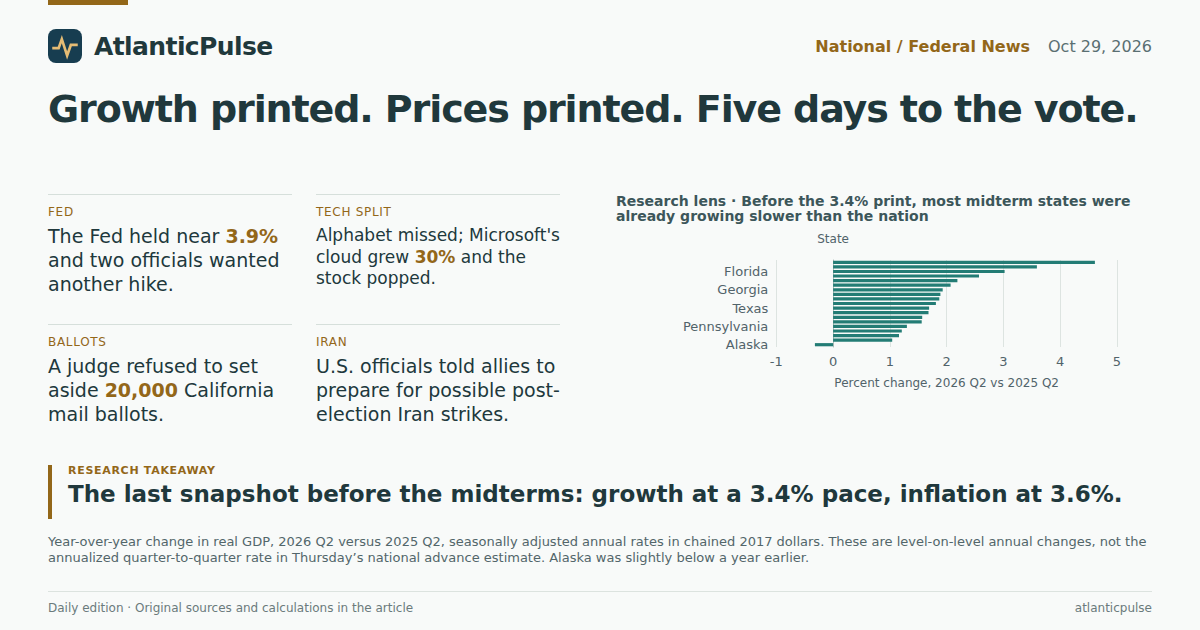
Thursday’s last official snapshot before the vote did not make the Fed’s job prettier. Gross domestic product grew at a 3.4 percent annualized pace in the third quarter, the fastest in a year and ahead of a 3.0 percent forecast, powered by 3.8 percent consumer spending and a 12.7 percent surge in business investment. The same morning, the Fed’s preferred inflation gauge — the personal consumption expenditures price index — rose 0.5 percent in September, lifting the annual rate to 3.6 percent from 3.4 percent. Core PCE, stripping food and energy, ticked up to 3.1 percent. Real consumer spending was flat on the month; inflation-adjusted after-tax income fell 0.3 percent; the personal saving rate slipped to 3.8 percent, the lowest in nearly four years. Exports dropped 5.7 percent while imports ran at a nearly 20 percent annualized clip, a mix of AI hardware and tariff-front-running that subtracted from headline GDP even as domestic demand roared. Fitch’s Olu Sonola put it without mercy: the AI boom and “the irrepressible American consumer” have not got the memo that policy is tightening.
That is the peculiar pre-election economy: the national accounts look hearty, the household ledger looks tired, and gasoline still sits above $4 a gallon because a war that was supposed to be brief has become a line item. Households, as Santander’s Stephen Stanley observed in a pre-release note, appear to have bet that the energy spike would prove temporary. If that bet is wrong, belt-tightening arrives after the ballots, not before. For a White House that would like voters to celebrate 3.4 percent growth, it is the statistical equivalent of baking a beautiful cake and serving it with a gas-pump receipt.
Technology & Industry
Big Tech’s earnings week split like a poorly planned group project. Alphabet posted $127.58 billion in third-quarter revenue, up 25 percent, and still missed Wall Street; net income fell to $26.17 billion, or $2.12 a share, from $34.98 billion a year earlier. Shares slid about 9 percent after hours. The number that rattled investors was free cash flow: negative $9.07 billion, after $51.36 billion in capital spending and an $8.7 billion net loss on equity securities. Google Cloud more than doubled, to $30.7 billion, and the Gemini app hit a billion users — Sundar Pichai called it the fastest-growing product in Google’s history and boasted of a half-trillion-dollar revenue run rate — but search ads, still the family business, grew 12 percent to $63.35 billion and missed estimates. Advertising overall came in $1.41 billion light. Alphabet left 2026 capital-expenditure guidance at $195 billion to $205 billion, which is a polite way of saying the binge continues. Microsoft, reporting the same cycle, took the other fork: $92.3 billion in revenue, up 19 percent; $36.6 billion in GAAP net income; Microsoft Cloud at $63.9 billion, up 30 percent. The stock popped about 3 percent after hours. One campus is being paid for growing the cloud. The other is being billed for building it.
Regulators, perhaps sensing that voters can smell a personalized price from across the parking lot, joined the queue. The Federal Trade Commission ordered Delta, Walmart, United, JetBlue, Uber, Lyft, DoorDash, Instacart and Target to explain how they use personal data to set prices — and, for the gig platforms, how they set driver pay. Chair Andrew Ferguson promised to scrutinize “opaque methodology.” Delta said it has “zero tolerance for discriminatory or predatory pricing”; JetBlue said fares follow demand and seat availability, not browsing history. The commission has a related disclosure proposal out for comment through November 21. DoorDash, undeterred, agreed to buy Instacart for about $17 billion — $65 a share, a 26 percent premium, at least 75 percent cash — in its biggest deal yet, with closing not expected until late 2027 or the first half of 2028, a timeline that fairly screams antitrust review. Restaurant delivery is maturing; grocery is where the weekly ticket lives. New York City’s consumer agency called the merger a “troubling trend.” Shoppers, staring at surge-priced everything, may have stronger language.
Then there was the hack that treated Homeland Security like a poorly locked filing cabinet. A group styling itself the Department of Peace said it subverted DHS single sign-on and passed personnel files to Distributed Denial of Secrets, which posted a database branded Icepick: names, phone numbers and addresses for more than 40,000 employees and contractors, including people tied to undercover work. About 21,000 records were Customs and Border Protection; another 10,000 were ICE and Homeland Security Investigations — roughly a fifth of a 220,000-person department. DHS said it was “aware of a potential breach” and working to protect those affected. The leakers’ moral theory, reduced to a slogan, was that a masked deportation state should not expect privacy. Operational security officers will have a longer, less tweetable reply.
Politics & Policy
If the administration wanted a last-minute lever on California’s count, a federal judge snapped it off. U.S. District Judge David O. Carter refused to order state officials to set aside some 20,000 mail ballots the Justice Department says may belong to noncitizens, calling the request part of “a broad, ongoing pattern of attempted election interference.” “Never before in American history,” the Clinton appointee wrote, has the federal government, on the eve of an election, tried to coerce a state to abandon its own procedures. Granting the motion, he warned, would let either party “create chaos for their own political purposes,” and “eroded trust in our democracy is irreparable.” Prosecutors concede some names on the list are likely citizens; state officials and civil rights groups say the file often lacks Social Security and driver’s-license numbers needed to match voters. Attorney General Rob Bonta called it “amateur hour.” First Assistant U.S. Attorney Bill Essayli said the government would appeal — after a Ninth Circuit panel had already, 2–1, refused to leapfrog Carter’s courtroom.
On the trail, the closing argument is less a policy debate than a celebrity roast with Super PACs. Trump packed a gym in Chillicothe, Ohio, urging a “tremendous victory” while mostly touring states he already won, a defensive itinerary dressed up as a victory lap. A heckler shouted about Jeffrey Epstein; the president said he had thrown Epstein out of Mar-a-Lago, then pivoted to Sen. Jon Husted’s physique, because of course he did. The same evening, Barack Obama was in suburban Atlanta with Keisha Lance Bottoms and Sen. Jon Ossoff, declaring that “change is in the air” and that Trump is “spending time supergluing gold medallions to the mantel in the Oval Office.” Obama, still living rent-free in the Cheesecake Factory discourse, said “these are not serious people.” Ossoff accused the White House of “a spectacle of grift unprecedented in American history.” Voters, polls and early-vote lines suggest they are less interested in interior design than in the price of diesel.
Trump also demanded that Alaska Democrat Mary Peltola leave the Senate ballot and face prosecution over a second candidate named Dan Sullivan — the same name as the Republican incumbent — which he called “voter fraud at the highest level.” Peltola’s campaign said it has “no involvement with either Sullivan campaign.” The Justice Department has already sued to contest a Peltola win in advance, which is a novel approach to sportsmanship. Michigan’s Senate race, meanwhile, is being fought as much over Abdul El-Sayed’s name and a year-old synagogue-attack comment as over auto plants. The through-line is not subtle: with the House and Senate both in play, the incumbent party is litigating, subpoenaing and heckling its way to Tuesday, and the courts, so far, are not playing along.
Human Stories / Social Trends
Dolores Huerta died Wednesday at 96, of cancer, at home in Bakersfield, with family beside her — a sentence that feels too small for a woman who spent six decades making farm labor a national argument. Born April 10, 1930, in Dawson, New Mexico, she taught children who arrived hungry, then decided organizing their parents would do more than another lesson plan. With César Chávez she helped found what became the United Farm Workers, ran the grape boycott, and pushed toward California’s 1975 farm-labor law. “Sí, se puede” left the fields and entered presidential English. Barack Obama gave her the Medal of Freedom in 2012; Joe Biden, Kamala Harris, Martin Luther King III and a generation of Latino organizers spent Thursday remembering a woman who, well into her nineties, was still marching. She asked crowds who had the power. They were supposed to answer: the people. On a week when ballots, boycotts and labor still collide, the chant does not sound archival.
A less uplifting ledger arrived from Rutgers. In the first national gambling-prevalence study of U.S. adolescents and young adults in nearly twenty years, researchers surveyed about 1,700 people aged 13 to 27. More than half said they had gambled; among 13- to 17-year-olds, for whom it is illegal, the share was nearly 43 percent. Lia Nower, who leads Rutgers’ Center for Gambling Studies, put the cultural diagnosis in one line: “anyone can have a casino or sports book in their pocket.” Among those who gambled, nearly 40 percent showed problem-gambling symptoms and 10 percent were high-risk; among teen gamblers, about 11 percent were high-risk. Scratch-offs led, then bingo and lottery tickets; about 20 percent of gamblers had bet on sports. The Supreme Court opened the sports-betting floodgates eight years ago; 39 states and D.C. now allow some form of it, and World Series broadcasts are a prediction-market infomercial. Nower’s warning was unfashionably adult: prevention has to start before the apps finish the job.
Work, meanwhile, has the emotional temperature of a fluorescent-lit waiting room. Gallup’s engagement measure — whether people feel focused, motivated and enthusiastic — fell to 29 percent in the third quarter, matching its 2011 low and down from a 36 percent peak in 2020. The drop was steepest among fully remote workers (five points) and hybrid staff (two), especially in firms rolling out AI, while on-site employees slipped about a point. Fewer workers say expectations are clear or that someone at work cares. Gallup’s suspicion is that AI adoption is outrunning the managers meant to explain it, and that physical distance is becoming psychological distance. Pair that with a 3.4 percent economy that still feels expensive, a war that prices the commute, and a midterm that both parties are treating as existential, and you get a country that is, statistically, busy — and, in the Gallup sense, not particularly present. Huerta’s generation organized for dignity in the fields. This one is being asked to stay engaged on Slack.
This daily edition uses stored reporting scoped by publication date, or arrival when publication was absent. Source collection can lag publication.