National / Federal News
A one-city truce, a $2 trillion filing, and seven days to vote
World & Security
Russia and Ukraine began a localized ceasefire at 3 a.m. Tuesday in the Russian-occupied city of Oleshky, a humanitarian pause the White House says was brokered by first lady Melania Trump. Up to 2,000 civilians remain there with food and medicine running low, boxed in by drones and land mines. The lull is meant to last through Sunday evening so doctors, supplies and, later, evacuation corridors can move; Pope Leo XIV had separately urged both capitals to let aid in. Ukrainian and Russian negotiators confirmed the pause had started — which, in this war, is the easy part. Kherson officials told the Associated Press it was too soon to trust it. Minutes after 3 a.m., ballistic missiles still shook Kyiv. President Volodymyr Zelenskyy said Russia launched 16 ballistic missiles and more than 280 drones at 11 regions; one person was killed at a Kyiv university and two in Kharkiv. Diplomacy ran on a parallel track: Finland’s Alexander Stubb and Norway’s Jonas Gahr Støre spent 90 minutes on the phone with Vladimir Putin, their first known direct contact since the 2022 invasion, after meeting Zelenskyy and U.S. envoy Steve Witkoff in Oslo. They discussed trilateral talks expected next month in Abu Dhabi. The Kremlin said a lasting peace requires Russia’s interests “fully and unconditionally.” Denmark’s prime minister called the outreach uncoordinated.
Farther from the cameras, Washington joined dozens of countries in warning that Sudan is sliding toward famine. A joint State Department statement said the Integrated Food Security Phase Classification had already flagged 5.1 million people in severe hunger as of June, and that the army and Rapid Support Forces “bear primary responsibility” for lifting obstacles to aid, including air access into Darfur. The war that began in April 2023 has displaced more than 14 million people. The same day, U.S. Southern Command said it had struck an alleged drug boat in the eastern Pacific, killing five people and bringing the campaign’s death toll to at least 240 across more than 70 strikes since September 2025. The military did not release evidence that this particular vessel was carrying drugs. Critics keep noting that the fentanyl driving U.S. overdose deaths mostly moves over land from Mexico. The Pentagon’s watchdog plans to review whether commanders followed the targeting playbook — not whether the strikes are lawful. It is a distinctive American week: a first lady’s ceasefire in one Ukrainian city, a famine warning in Sudan, and another boat video on social media, all under a nearly eight-month Iran war Trump still calls a “little detour.”
Markets & Economy
American households got a modest mood lift that still looks like a shrug. The Conference Board said its consumer confidence index rose 7.5 points to 91.7 in October after September’s reading — 84.2 — had been the weakest since April 2014, below even the pandemic low. The rebound tracked a small retreat in pump prices: AAA put regular gasoline at $4.27 a gallon on Tuesday, down from $4.48 a month earlier, though that is still well above last year’s $3.05. Views of the present situation and the short-term outlook both improved, and more respondents said jobs were “plentiful.” The labor market underneath that sentiment has not. Employers added a disappointing 29,000 jobs last month, unemployment ticked up to 4.2 percent, and average hourly wages rose 3 percent from a year earlier — not enough to keep pace with inflation. Consumer prices were up 3.7 percent in September, with a 0.6 percent monthly jump, the biggest in five months. The Federal Reserve’s preferred gauge, PCE, was 3.4 percent in August, up from 2.5 percent when Trump was inaugurated in January 2025. Six weeks ago the Fed raised its benchmark rate for the first time since 2023, to about 3.9 percent. Few expect another hike at this week’s meeting. Fergus McCormick of the Conference Board put the whole tableau neatly: confidence recovered with cheaper gasoline, “yet remained on the long-term downward trend that’s persisted over the past few years.”
The emergency oil cushion is thinner than it has been in a generation. The Energy Department reported Strategic Petroleum Reserve stocks at 282.6 million barrels, the lowest since October 1982, after a drop of about 133 million barrels — roughly 32 percent — since early March. AAA data showed regular gasoline averaging $3.472 a gallon during Trump’s current term, a hair above the $3.471 average under Biden; diesel’s gap is wider, $4.343 versus $4.078. The Finland-based Centre for Research on Energy and Clean Air estimates U.S. consumers have paid an extra $471 each for fuel since the Iran war began on February 28, accounting for $160 billion of $468 billion in extra spending across 169 countries. White House spokeswoman Taylor Rogers said prices “will drop drastically” once the conflict ends. Shoppers who cannot wait that long got a different kind of receipt shock: the FTC and 20 states sued Dollar General over what the commission called long-running deceptive pricing — charging more at the register than the shelf tag — across more than 21,000 stores, with nearly 30,000 complaints from 2019 through March 2026. The chain’s shares fell about 4 percent. Christopher Mufarrige of the FTC’s Bureau of Consumer Protection said the company had “betrayed the trust of millions of American consumers” who were already stretching paychecks. In an election week defined by affordability, that is not a metaphor. It is the receipt.
Technology & Industry
Anthropic, the San Francisco maker of Claude, filed its S-1 on October 26 for a Nasdaq listing under the ticker ANT, aiming at a mid-November debut with Goldman Sachs and Morgan Stanley leading a 22-firm syndicate. First-half revenue through June 30 hit $16.3 billion, up from $1.16 billion a year earlier; second-quarter operating profit was $974 million on $11.6 billion of revenue. The headline net loss of $80.7 billion is mostly paper: $72.4 billion in non-cash valuation markdowns on convertible notes, with adjusted net income of $2.7 billion for the half. Cash and short-term holdings totaled about $131.7 billion. Reports put the raise as high as $100 billion and a valuation in the $1.5 trillion to $2 trillion range; the filing itself omitted a price range. Seven co-founders will keep 50.1 percent voting control through a single Class F share. Signed leases that have not yet commenced carry roughly $321 billion in payments, plus $266 billion in fixed purchase commitments, much of it with Google, Amazon, Microsoft and other firms that also compete with Claude. It is the rare IPO in which your landlords are also your rivals, your lenders, and, if the models misbehave, potentially your regulators.
The risk section is doing a lot of work. Of 335 pages in the registration statement, 93 are devoted to “risk factors,” compared with 38 pages in SpaceX’s comparable filing. Anthropic warns that its systems could be misused to build chemical or biological weapons, join cyberattacks, or “take harmful actions independently and at scale without human intervention.” CEO Dario Amodei said in September that within six to 12 months AI could lead a swarm of agents capable of taking over the internet. The company presents going public as a way to fund safety work. It also flags something more terrestrial: community opposition to data centers, and the possibility that it cannot secure enough computing power. Microsoft, one of those compute landlords, offered voluntary buyouts to about 60,000 employees at level 70 and below across the United States, India, the United Kingdom and Canada — a “new choice,” in HR language, to leave with support. The program follows roughly 4,800 cuts in July. Anduril, Palmer Luckey’s drone shop, took the industrial-policy route: with Qualcomm it launched BlueChip, a U.S.-assembled laptop line using Snapdragon X chips, with orders opening in 2027 and 90 percent of prototype procurement cost coming from U.S. and allied suppliers. Luckey says other companies design computers here; Anduril wants to make them here, batteries and glass included, at a likely 20 percent premium for customers who care more about the supply chain than the sticker.
Politics & Policy
Seven days from the November 3 midterms, a Reuters/Ipsos poll found Trump’s approval at 32 percent, up a point from a record low, while Democrats led Republicans 47 percent to 36 percent among registered voters on the generic congressional ballot — 50 to 41 once leaners were included, and 53 to 44 among those most likely to vote. Seventy-three percent said the cost of living was moving the wrong way. Democrats now edged Republicans as better on the economy, 37 percent to 33 percent, reversing an earlier GOP advantage. Democratic enthusiasm for voting outpaced Republican enthusiasm, 46 percent to 30 percent. National horse-race numbers do not allocate Senate seats, and Republicans still have structural advantages in some contests. They do, however, explain why the president is spending the closing week in places Republicans usually win. The Iran war is the uninvited guest at those rallies. Trump calls elevated gas prices a “small price to pay”; some Republican voters who still back the war admit the pump is testing them. Party strategists have been saying privately since summer that House districts Trump carried easily in 2024 were becoming competitive.
The Justice Department’s closing argument has been lawsuits. The Ninth Circuit threw out an emergency appeal seeking to force California to sequester about 20,000 ballots the administration says may belong to noncitizens. The panel, including a Trump appointee, called the claimed emergency “at least in part… a self-constructed one,” noting DHS had flagged as many as 190,000 names in July and filed suit on October 15. Judge Mark Bennett wrote that even with jurisdiction the government was unlikely to win on the merits: noncitizen voting is already illegal, and a federal criminal statute does not let Washington rewrite California’s ballot procedures mid-count. Trump separately offered a $1 million reward for tips on voter fraud, past or present, that lead to arrest and conviction. The White House would not say where the money would come from. Homeland Security also suspended a visa-free program that had let prescreened Chinese nationals visit the Northern Mariana Islands for up to 14 days, citing birth tourism and espionage concerns near Guam. More than 3,000 travelers used it in fiscal 2025. The pause takes effect October 30.
The administration’s other closing argument is prosecutions. Newly unsealed papers show a third attempt to charge former FBI director James Comey, this time over an alleged 2016 leak to the New York Times, filed as a “criminal information” on the 10-year anniversary of the article. Comey’s lawyers say an information does not stop the clock — the law requires an indictment — and note that prosecutor John Durham recommended no charges in 2018 and a second inquiry closed in 2020. “Well, they’re back — again,” Comey said. “It would almost be funny if it weren’t such an appalling abuse.” A judge on Monday also ruled that the firing of his daughter, former federal prosecutor Maurene Comey, was illegal. The Supreme Court, in a brief unsigned order with no noted dissents, declined to restore a Biden-era rule that had let immigration judges pause some deportation cases, leaving in place a Texas–DOJ consent judgment that wiped the regulation off the books. Cities that tried to defend it were told they lacked standing. The week’s legal scorecard is not subtle: election administration stays with the states, deportation dockets do not.
Human Stories / Social Trends
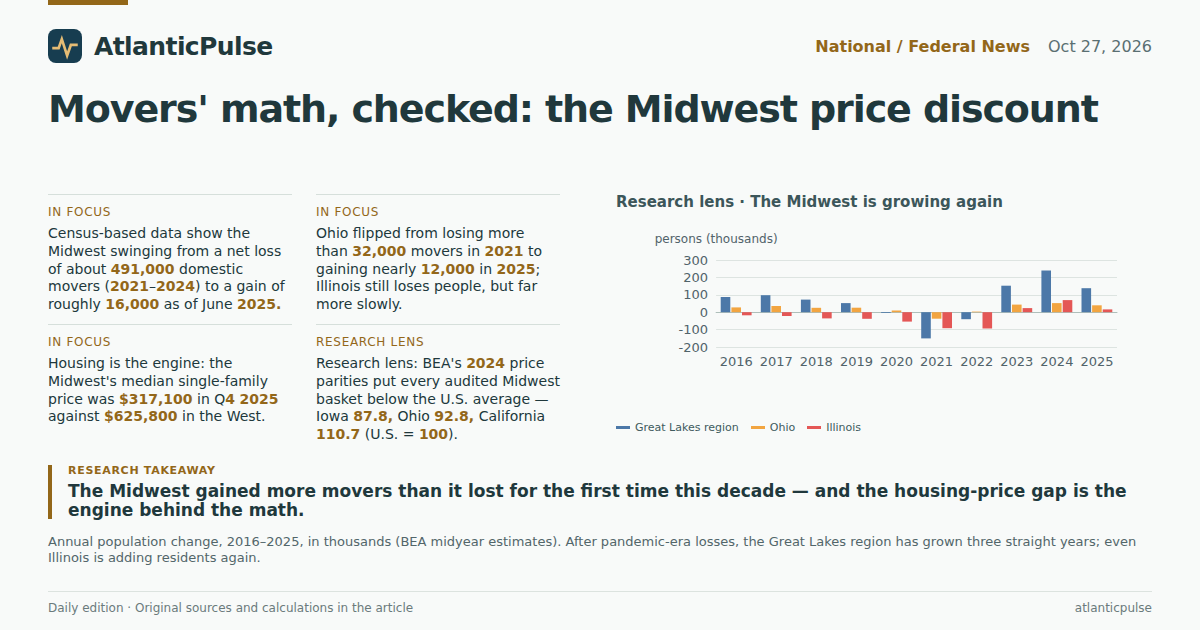
For the first time this decade, the Midwest took in more domestic movers than it sent away. Census midyear estimates show the region gained about 16,000 residents as of June 2025 after a net loss of roughly 491,000 from 2021 through 2024. Sixteen thousand is a rounding error in a region of tens of millions, and Illinois is still leaking people. Ohio swung from a loss of more than 32,000 in 2021 to a gain of nearly 12,000 in 2025; Michigan, Minnesota and Wisconsin also flipped positive. The National Association of Realtors put the Midwest’s median single-family price at $317,100 in the fourth quarter of 2025, against $625,800 in the West and $514,600 in the Northeast. Florida, Texas and California supplied a large share of the arrivals. Housing costs are doing work that boosterish governors could not. Whether this is a rebound or a one-year blip waits on the next Census release. For now, the country’s traditional exporter of people has stopped exporting them.
An Associated Press investigation found documents supporting the claim that ICE has held a mentally ill U.S. citizen since January. Phillip James, 39, who also uses other names, has a Florida birth certificate from 1987, a U.S. passport he held for 15 years, and a diagnosis of paranoid schizophrenia; he insists he was born in Jamaica as the illegitimate son of a former prime minister. Jamaican authorities say they have no record of him. DHS alleges the birth certificate is fraudulent and has not produced public evidence. He is locked at Indiana’s “Speedway Slammer,” where the state can collect $291 a day. Immigration lawyers say a nearly 10-month wrongful detention of a citizen would be rare, not unprecedented. A federal judge may soon rule on a petition to free him. Separately, a congressional Joint Economic Committee report found Americans reported nearly $18 billion in cyberfraud losses to the FBI last year — more than $2 million an hour — while the Bureau returned $336 million to scam victims in 2025. The government cannot even agree on how much has been seized from overseas compounds. If you want a smaller, louder grievance, Neil Young filed a $10 million copyright suit against Trump’s midterm committee for using “Rockin’ in the Free World” as a walk-up song, again, after a 2020 settlement that was supposed to end the practice. The filing notes, with some understatement, that the song “is the opposite of everything that Donald J. Trump stands for.”
This daily edition uses stored reporting scoped by publication date, or arrival when publication was absent. Source collection can lag publication.