National / Federal News
Maybe tomorrow: Iran on a hair-trigger, voters on the clock
World & Security
President Donald Trump, after casting an early midterm ballot in Palm Beach, declined to say whether another strike on Iran was coming. “Maybe tomorrow…There’s a possibility I will. There’s also a possibility we’ll have a nice, big, beautiful agreement,” he told reporters, according to Open. That is not a timetable so much as a weather report. Gulf News laid out the hardware behind it: sailors loading munitions on the USS George Washington strike group; an October 23 intelligence memo to Secretary of State Marco Rubio warning that Iranian plots against Americans had reached “advanced stages”; and reported targeting options that include buried nuclear sites, Kharg Island’s oil hub and Qeshm in the Strait of Hormuz. Washington has ordered non-emergency staff and families out of Saudi Arabia after Houthi attacks and trimmed embassy staffing in the UAE, Qatar, Jordan and Lebanon. Iran still talks about a Pakistan-brokered path to reopen Hormuz if the U.S. naval blockade is lifted—then Iranian outlets denied that a new Hormuz offer had been sent. Diplomacy is happening. So are the munitions carts.
The other war in America’s inbox flickered back to life on a commercial satellite. After more than a week of Starlink throttling that Ukrainian forces said they discovered only when connections failed, Elon Musk accused Kyiv of using a civilian service “for offensive drone strikes to kill people” and said the “loophole was closed.” Ukraine’s defence ministry later reported broader access, with connections stable at 250 mph. President Volodymyr Zelenskiy told TSN that U.S. warnings on Russian ballistic strikes had been “fully restored” and that Starshield was working at speeds up to 420 kilometres per hour after a meeting with envoy Steve Witkoff in Oslo, Reuters reported. November technical talks with Moscow and Washington, he added, would not include limits on Ukraine’s armed forces or enforced neutrality. Allies who treated a private constellation as public infrastructure now have a live demo of what “terms of service” can do to a front line.
Farther from the Gulf, Brazil’s electoral court said Luiz Inácio Lula da Silva held an unassailable lead for a fourth, non-consecutive term, the Associated Press reported, keeping Latin America’s largest economy at a distance from Washington even as Trump-aligned candidates have won elsewhere in the region. Closer to the shooting, the State Department issued coordinated travel warnings covering 13 Middle Eastern countries, citing Houthi drones, Iran-linked threats and the risk of sudden airspace closures. For American travellers, the region is now something you monitor on an embassy app rather than book on a whim.
Markets & Economy
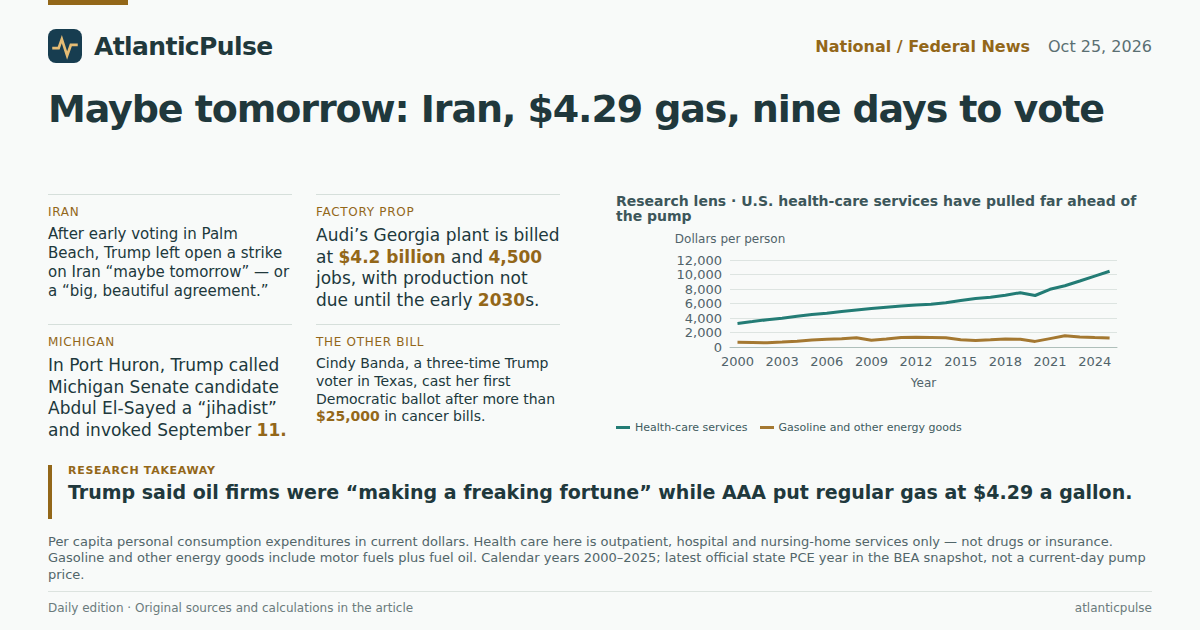
Brent crude climbed above $117 a barrel, its highest since April, after reports that Washington was weighing fresh strikes on Iran after the November 3 midterms, ThisDay reported. That is a long way from about $72 before the war began in February. At a Georgia rally, Trump put the quiet part on a microphone: American oil and gas firms were “making hundreds of billions of dollars,” adding, “we’re making a freaking fortune,” even as AAA put regular gasoline at $4.29 a gallon and diesel at $6.35, versus $2.98 and $3.75 just before the February attacks. He predicted “fake headlines” about people suffering at the pump. The headlines, in this case, did not have to invent much.
The Federal Reserve is still expected to hold its target range at 3.75 to 4.0 percent when the FOMC announces on Wednesday, days before the midterms, AFP reported, even though PCE inflation hit a three-year high of 3.9 percent in May and former Cleveland Fed president Loretta Mester argued the economics still point to further hikes. Officials, she and Brookings’ Wendy Edelberg suggested, may simply prefer not to walk into an election week carrying a rate increase. Factories are not waiting. S&P Global’s flash U.S. manufacturing PMI rose to 56.0 in October, a 53-month high, with factory hiring at its fastest since March 2012, even as composite selling prices hit 59.8, their highest since August 2022, Blockonomi noted. Investors, for one day at least, preferred the relative boredom of Treasurys: the 10-year yield fell 19 basis points to 4.953 percent, its biggest one-day drop in three years and seven months, Seoul Economic Daily reported, as money left tech stocks.
Trump’s preferred visual was a factory. At a Perry, Georgia, rally he announced that Audi would commit $4.2 billion to a plant producing 200,000 cars a year and about 4,500 jobs, with CEO Gernot Döllner on stage calling it a “long-term investment,” Fortune reported. Local officials say grading at the Middle Georgia Megasite would begin in 2027 and construction in 2028, with production in the early 2030s—so the ribbon-cutting is not a midterm event so much as a campaign prop with a very long fuse. Trump credited tariffs. Drivers staring at $4.29 gasoline may credit the calendar.
Technology & Industry
While Washington argues about Iran, it is also trying to fence off the next industrial era. The United States and China have assembled rival AI clubs—Washington’s Pax Silica and Beijing’s World AI Cooperation Organization, with 29 founding members including Pakistan and Russia—and “swing countries” are hedging, Fortune and the AP reported. Kazakhstan’s AI minister visited Washington in June, then signed in Shanghai three weeks later. The State Department’s line is unsubtle: partners cannot be “trusted” in Pax Silica while “substantively engaging” a competing vision. Beijing’s embassy replies that AI “should not be owned by major countries.” Indonesia’s Mari Pangestu put the smaller-power view more plainly: “We should be able to be part of both… And choose the best system.” Experts warn that window is closing.
Treasury is trying to close it from the capital-flow side. On Thursday it proposed expanding the Outbound Investment Security Program—already covering hypersonics, quantum, high-performance computing, supercomputing and AI in China, Russia and North Korea—to add biotechnology, an expansion Treasury Secretary Scott Bessent had sought, investingLive reported. China’s commerce ministry called the move a discriminatory stretch of national security and reserved the right to “corresponding measures,” unspecified. The proposal faces a public comment period, which is another way of saying the argument will run for months. At home, the physical footprint of that argument is a warehouse full of GPUs. Before the Georgia rally, Trump told Atlanta television he agreed locals should approve data centres and “should be paid a lot of money,” arguing that once communities get tax revenue “the same people love what they’re doing,” SocialNews.XYZ reported. He did not specify who would be paid, how much, or by what statute. Neighbours watching electricity bills and water tables will be fascinated to learn the objection was merely a pricing problem.
Politics & Policy
Nine days from November 3, the midterms have the texture of a family argument conducted with microphones. In Ohio, Barack Obama attacked Republican gubernatorial candidate Vivek Ramaswamy for an ad featuring Democratic rival Amy Acton’s estranged mother; Acton, who has spoken publicly about childhood abuse and homelessness, told the crowd there was “no low” Ramaswamy would not stoop to, the AP reported. In Detroit, Obama defended Senate candidate Abdul El-Sayed against attacks on his name and faith: “We have seen this movie before. I starred in it… I’ve got a long-form birth certificate to prove it.” He also compared Trump’s gilded White House renovations to “Saddam Hussein opened a Cheesecake Factory,” a line that will outlive whatever happens to the ballroom.
Trump answered in Port Huron by leaning into the movie Obama named. He called El-Sayed a “jihadist” and “Muslim Brotherhood member,” said he should pass a metal detector to enter the Senate, and invoked September 11, NBC News reported. David Beamer, whose son died on Flight 93, told the crowd “the enemy is right here among us.” Both El-Sayed and Republican Mike Rogers were born in Michigan; El-Sayed has denied Brotherhood ties. Rogers, on Meet the Press, said he had “never called him a terrorist.” The president, who is not on the ballot, still treated the race as if it were.
The Justice Department is treating vote-counting as a federal project. Attorney General Todd Blanche defended a suit asking Alaska not to certify its Senate race if incumbent Republican Dan Sullivan loses, citing possible confusion with another candidate named Daniel J. Sullivan, KPBS/NPR reported. Trump said he ordered the case. In California, DOJ letters demanded that counties sequester ballots tied to some 20,000 alleged noncitizen voters; a Los Angeles County sample of 200 names found more than 40 percent had canceled registrations and nearly four in ten were U.S.-born, LAist reported. A 9th Circuit panel on Sunday sounded skeptical that federal criminal law lets Washington rewrite a state’s counting process mid-election, CNN reported. Blanche insisted Trump was “not trying to take over a state election in any way, shape, or form.” The lawsuits, inconveniently, keep arriving.
Human Stories / Social Trends
In McAllen, Texas, Cindy Banda parked her Ford Expedition at a Houston cancer centre and repeated the household plan: keep the house, keep the cars, keep the kids stable. A year after surgeons removed her right breast, the 46-year-old single mother—three children of her own, three more after her sister’s murder—is more than $25,000 in medical debt even with job-based insurance, plus a $7,500 deductible that resets in January, the AP reported. She voted for Trump three times, largely over abortion. After the bills, she cast her first Democratic ballot, for Senate candidate James Talarico. A Fox News poll in September found about half of registered voters now call healthcare costs a major problem, up from a little more than a third four years ago; an AP-NORC poll found voters nearly twice as likely to trust Democrats over Republicans on the issue. Banda will learn on Election Day whether the cancer has spread. The country will learn who runs Congress. The two calendars, for once, are the same.
The other public-health story is older, and it is spreading. CDC data through October 22 show more than 4,580 measles cases nationwide this year, more than double all of 2025, with 96 percent of 2026 patients unvaccinated or of unknown status, NPR reported. Pennsylvania alone has confirmed at least 1,338 cases in 44 counties, more than 250 hospitalizations and five deaths, concentrated in Amish communities with low vaccination rates. New York has declared a disaster emergency; Utah has logged more than 700 cases. Two MMR doses remain nearly 97 percent effective, the CDC says, and Pennsylvania administered more than 39,000 measles vaccines in the first three weeks of October—higher than a typical month. It is a reminder that some of the most expensive problems in American life are still the ones a shot can prevent, and that the cost of skipping them does not wait for a midterm.
This daily edition uses stored reporting scoped by publication date, or arrival when publication was absent. Source collection can lag publication.