National / Federal News
Eleven Days Out: Warships, Ballots, and a Winter of $6 Heat
World & Security
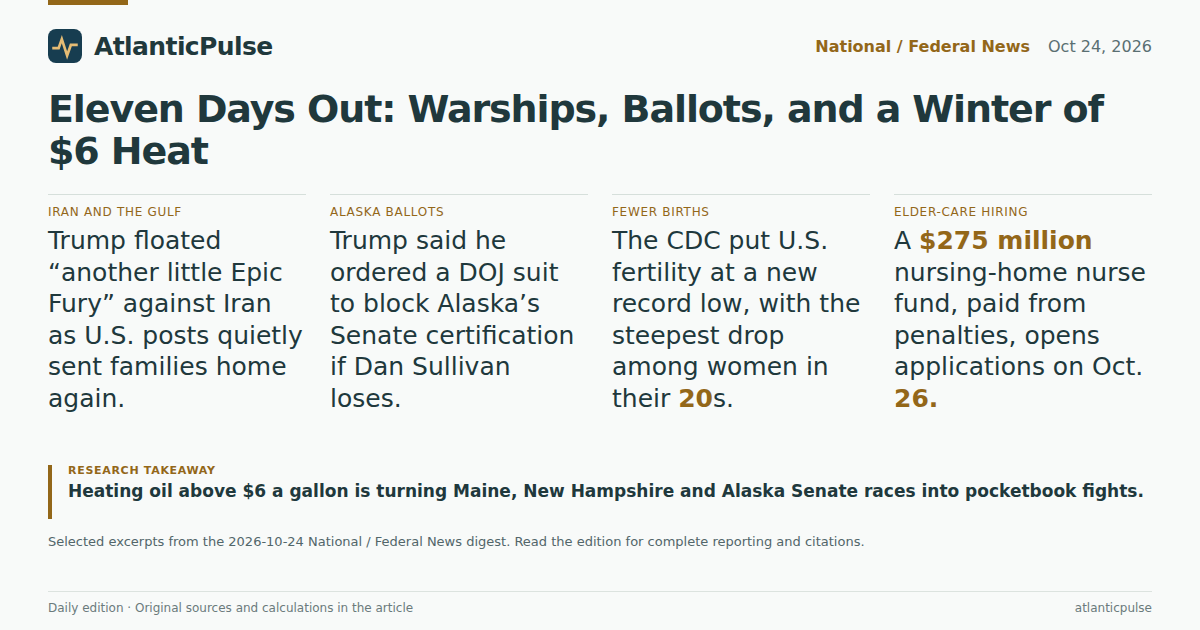
President Donald Trump told a Fort Myers rally that Washington “may do another little Epic Fury” against Iran if Tehran does not “get down to business,” a flourish delivered as the war nears eight months and after he had already said he would not strike before the Nov. 3 midterms. An unclassified Oct. 23 memo to Secretary of State Marco Rubio found that Iran has “substantially increased efforts to target US personnel” and that plotting has “reached advanced stages in both the Middle East and certain other countries.” The State Department ordered non-emergency staff and families out of Saudi Arabia after Houthi attacks, and quietly trimmed posts in Jordan, Lebanon, Qatar and the United Arab Emirates — Groundhog Day for families who had barely re-enrolled children after last winter’s evacuations.
The same Florida crowd got a Cuba encore. Trump revived the idea that U.S. warships coming home from the Middle East might “do a little stopover,” parking one “about 50 yards off the coast” before sending Rubio “to finish up the deal.” Rubio, minutes later, posted that “now is the time” for Cubans seeking change and invited them into “a discrete partnership with the CIA” — the sort of recruitment pitch that reads less like quiet diplomacy and more like a classified flyer left on a windshield. Havana is already buckling under blackouts and shortages; whether a 50-yard naval photo-op changes that is another question. Defense Secretary Pete Hegseth, working a different adversary, designated China-funded Confucius Institutes a national-security threat and said 80 “propaganda cells” at 30 universities had been dismantled after reappearing under new names.
In Ukraine, first lady Melania Trump brokered a localized ceasefire around Russian-occupied Oleshky, a Dnipro-side city without power, heat or water, so aid can enter and civilians can leave starting Tuesday. Kyiv also said Starlink and Starshield speeds were restored after more than a week of throttling that had hindered drone defense. Reuters reported that both the Biden and Trump administrations had, for years, asked Elon Musk’s SpaceX to switch Starlink on or off from Yemen and Lebanon to Iran and Ukraine — a reminder that America’s most important battlefield network is still a private company with a very online CEO. Meanwhile the Kremlin said the first tanker of Russian diesel under Trump’s import deal had sailed, bound for New York around Nov. 7: 40,000 tons, or about 7 percent of one day’s U.S. diesel use.
Markets & Economy
Foreign policy is doing something rude to household budgets. A Reuters/Ipsos poll this month found some 78 percent of Americans blame Trump’s policies for prices outrunning paychecks, and the Iran war plus tariffs have turned gas, groceries and heating oil into midterm weapons. Heating oil has climbed above $6 a gallon nationally, from about $3.50 a year ago — a brutal number in Maine, New Hampshire and Alaska, where large shares of homes still burn it. In Kingston, N.H., 80-year-old lifelong Republican Rick Russman is firing up a wood stove and voting Democrat. “Fuel that costs more than $6 a gallon is a huge expense,” he said, which is the kind of sentence that does more work than a super PAC.
The White House is improvising. It is lifting some 50 percent tariffs on Canadian goods from Oct. 30 — plywood, paper, machinery, refrigeration equipment — after Sen. Susan Collins, in a tight Maine race, lobbied for relief for blueberry, potato, apple and seaweed producers. The same week, that first Russian diesel cargo set sail under a deal meant to soothe pump prices; energy specialists note that 300,000 barrels will not dent a market that burns about 4 million barrels of diesel a day. Canada’s Mark Carney, unhurried, said Ottawa could sign a proper deal “this afternoon” if Washington were ready, or wait for another administration. Midterms, it turns out, are a heck of a trade policy.
Technology & Industry
NASA Administrator Jared Isaacman, channeling Apollo’s nine-month sprint from Apollo 7 to 11, said Artemis III remains on for next summer: a two-week Earth-orbit docking drill with SpaceX and Blue Origin landers, no moon this time. Artemis IV, the first crewed landing since Apollo, is still penciled for 2028, with NASA delaying the lander choice as long as possible. Associate administrator Amit Kshatriya, bless him, called the three-launch Cape Canaveral ballet “pretty awesome” for rocket nerds. China is the new Soviet Union in this telling, and Isaacman warned the race will be “much closer than it ever needed to be.”
On the ground, the Energy Department named helium a critical material — the 20th on its list — because chip plants cannot live without it and Qatar’s exports have been hammered by the Hormuz crisis. One-fifth of global helium goes into semiconductors; suppliers have already put some fabs and labs on allocation, and spot prices have reportedly tripled since the war began. The United States still produces about 81 million cubic meters a year, 43 percent of world supply, mostly from a Wyoming plant that cannot simply be photocopied. Energy Secretary Chris Wright framed the designation as cutting reliance on foreign sources; helium, as an assistant secretary put it, could be “a single point of failure.”
Magnificent Seven CEOs spent the week insisting AI demand is real and the bottlenecks are everything else. Musk said a SpaceX-Tesla merger would be “a good idea” but that calling it certain would be “overstating it”; he also said power and cooling, not chips, constrain superintelligence, and SpaceX’s SI compute-rental unit booked $7.6 billion, overtaking Starlink. Jensen Huang wants lenders to treat Nvidia GPUs as “financeable” collateral and put a one-gigawatt AI factory at about $50 billion. Mark Zuckerberg said Meta’s Muse assistant cannot go global because “there is just nowhere near enough compute.” The Nasdaq, unimpressed, had its worst session since June.
Politics & Policy
Eleven days before Election Day, Trump told reporters he personally ordered a Justice Department lawsuit to block certification of Alaska’s Senate race if Republican Sen. Dan Sullivan loses to Democrat Mary Peltola. The complaint turns on a second candidate also named Dan Sullivan — Daniel J. from Petersburg — whom Republicans call a spoiler and Alaska courts have already kept on the ballot. Lisa Murkowski, the state’s other Republican senator, said the department “should never have filed this lawsuit.” Notre Dame’s Derek Muller expects a court to dismiss it if it even gets that far. Peltola called it “flagrant, flagrant corruption.”
In California, DOJ letters delivered Friday demanded that county clerks sequester ballots the government says went to about 20,000 alleged noncitizens, produce Social Security numbers, and do it in 48 hours — with a warning that knowingly counting a noncitizen vote could mean prosecution. Uniformed DHS officers dropped a list of 42 names on Napa’s registrar; Los Angeles had already counted more than 331,000 mail ballots. A preliminary LA County sample of 200 names found more than 40 percent with canceled registrations and nearly four in ten born in the United States. A Ninth Circuit panel was set to hear Sunday whether California must comply. Attorney General Todd Blanche had just insisted it was not DOJ’s intention to interfere with certification — and then Alaska happened.
Courts also closed older fights. The Ninth Circuit handed Gov. Gavin Newsom what California calls a final win against Trump’s 2025 federalization of the state National Guard. The full Fifth Circuit, splitting bitterly, held that people who entered unlawfully have no constitutional right to a bond hearing, even after a decade in the country — a ruling that conflicts with nine other circuits and now sits in the Supreme Court’s in-box. In Cleveland, Barack Obama opened his midterm tour by calling Trump an agent of “chaos and cruelty,” comparing White House décor to “Saddam Hussein opened a Cheesecake Factory,” and blasting Vivek Ramaswamy’s ad featuring Amy Acton’s estranged mother. Ohio, once written off, is a toss-up again.
Human Stories / Social Trends
Oleshky once held about 24,000 people. Russian forces took it on day one of the 2022 invasion; the Kakhovka Dam collapse in 2023 drowned hundreds more. Roads out are mined, drones buzz, and winter is coming for residents with no electricity, heat or running water. Ukraine’s ombudsman Dmytro Lubinets said the pause starts Tuesday, mines get cleared, then food and medicine, then whoever wants to leave. Moscow will not say whether evacuees go west or east. It is a few days of mercy in a 4½-year war, brokered by a first lady after a U.N. hallway conversation — which is either touching or a comment on how official diplomacy is going.
At home, the CDC reported the U.S. general fertility rate fell another 1 percent in 2025, a new record low, with births down 6 percent among women 20 to 24 and 7 percent among late teens. Women 30 to 45 are having more babies; everyone else is doing the math on housing, daycare and whether they can afford a child at all. Vermont mother Sarah Harris, who had her daughter at 37, put it plainly: one is enough. The under-18 population has been shrinking for years, the median age hit 39.4 in 2025, and some states are already watching elementary-school doors.
Trump, at that same Fort Myers rally, announced a $275 million Nurses for Nursing Homes program — up to $40,000 in loan repayment and a $10,000 stipend for a three-year, 30-hour-a-week commitment, funded from civil penalties rather than new taxes, aimed at rural homes in all 50 states. Applications open Oct. 26. It is a serious staffing problem meeting a campaign backdrop. Combine it with $6 heating oil, delayed parenthood, and a ceasefire measured in days, and the week’s human through-line is unglamorous: keeping people warm, cared for, and, where possible, alive.
This daily edition uses stored reporting scoped by publication date, or arrival when publication was absent. Source collection can lag publication.