National / Federal News
Oil, ballots, and mixed messages with eleven days to go
World & Security
President Trump left the White House for Iowa talking like a man who still has unfinished business in the Gulf. “We’ve knocked the hell out of them, and we may do it a little bit further,” he told reporters, adding that Washington was not negotiating with Tehran and that “something” would happen “fairly soon.” Gulf News recorded the remark on day 236 of the U.S.-Israel war with Iran, alongside an IRGC warning that American naval escorts through “mined waterways” could invite strikes on U.S. bases. Treasury Secretary Scott Bessent posted before-and-after satellite images of Kharg Island with “no crude tankers in sight,” while CENTCOM said a 100-day naval blockade had blocked at least $25 billion in Iranian crude exports. The blockade’s success is easier to measure in empty berths than in cheaper petrol: Brent jumped toward five-month highs even as Washington claimed it had wrecked Iran’s oil lifeline.
The same week, the administration was quietly emptying desks across the region. The State Department ordered non-emergency staff and families out of Saudi Arabia after Houthi attacks, and it tightened staffing at posts in Jordan, the UAE, Qatar, and Lebanon under “restricted operations.” CNN described a Groundhog Day for diplomats who had only just returned after earlier evacuations, with the American Foreign Service Association calling the second shuffle “chaotic.” Israel’s Benjamin Netanyahu, five days from a Knesset vote, posted in Persian that regime change in Tehran was the only way to neutralize an “existential nuclear danger.” Trump framed any new operation as preventing a nuclear weapon; he did not name a target, a date, or a scale. Markets filled in the blanks with oil.
Ukraine, meanwhile, got a satellite network, a tanker, and a first lady. Trump said Elon Musk had “put it back” after Starlink speeds used for battlefield drones were capped, then declined to say whether he had placed the call. Ukrainian officials told the Wall Street Journal the system was faster but not fully restored; President Volodymyr Zelenskyy said the cap remained. Kyiv’s broader relationship with Washington is already strained by a U.S. deal to buy Russian diesel and a sanctions waiver. In a more tangible exchange, Ukraine brought home 270 people from Russian captivity, including American teacher Stephen Hubbard, 74, captured in Izium in 2022. Euromaidan Press called it historic for the number of sentenced prisoners returned. The White House separately said Melania Trump had brokered a localized ceasefire in occupied Oleshky from October 29 so food and medicine can reach a city without power, water, or unmined roads. The Associated Press noted there was no immediate comment from Kyiv or Moscow. And the State Department reinstated a “wrongful detention” flag on its China travel advisory, warning of airport exit bans that travelers may discover only when they try to fly home. SOFX reported Beijing demanded the warning be withdrawn.
Markets & Economy
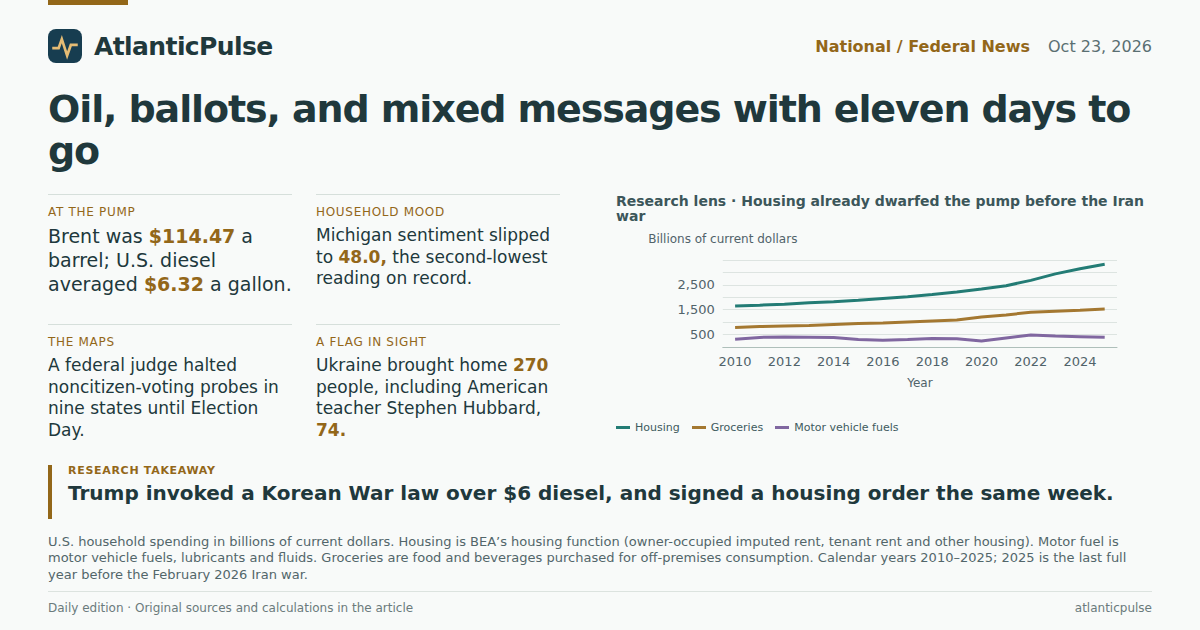
If the war is a national-security story in the Situation Room, it is a cost-of-living story at the pump. Trump invoked the 1950 Defense Production Act, declaring petroleum production and refining essential to national defense and waving ordinary congressional-notification rules under Section 303. TIME put Brent at $114.47 a barrel early Friday and U.S. diesel at $6.32 a gallon, below September’s record but still the sort of number that turns midterm rallies into listening sessions. Vice President J.D. Vance had already flagged a Delek refinery in Texas as a possible DPA project; the memo itself named no plants and no dollar figure beyond a broader $150 million refining push reported elsewhere. The administration has already tried dyed-diesel tax breaks, a Jones Act waiver, a G7 reserve release, and the Putin diesel bargain. Analysts quoted in the same piece estimated those earlier steps would shave pennies, not dollars.
Wall Street spent Thursday proving that two crises can share a ticker. The S&P 500 fell 1.2 percent, its worst day since July, and the Nasdaq dropped 2.6 percent, even as two of every three S&P stocks rose. The Associated Press blamed AI names: Nvidia off 4.4 percent, Meta 7 percent after a revenue beat and a profit miss, Lam Research 11.8 percent, CoreWeave 10.1 percent. Brent jumped 4 percent to $113.17. The 10-year Treasury yield tumbled to 4.97 percent from 5.13 percent as investors bought safety. Jobless claims, for anyone still looking for a classic recession tell, fell to 194,000, the lowest since July, in what the Labor Department’s figures describe as a “low-hire, low-fire” market with unemployment at 4.2 percent. Alabama Daily News relayed the AP’s tally: hiring this year has averaged 68,000 jobs a month, better than 2025’s crawl, still well below the 2023–24 pace. People have jobs. Their petrol does not care.
Households noticed. The University of Michigan’s Consumer Sentiment Index slipped to 48.0 in October, the second-lowest reading on record after May’s 44.8 wartime trough, 10 percent below a year ago and 15 percent below February, just before the Iran conflict. Reuters said independents drove the drop, to 42.4, while Democrats and Republicans actually improved. One-year inflation expectations ticked up to 4.7 percent. Trump signed a housing executive order instructing the FHFA to pilot proactive cancellation of mortgage insurance for some government-backed borrowers and pushing veterans’ and rural programs to seek cheaper single-family rates, plus a task force on manufactured homes. MundoNow was careful: no price caps, no universal rate cut, no timeline. The Kremlin, more punctual, said the first tanker of Russian diesel under the Trump-Putin deal had sailed. Fortune put the cargo at 40,000 tons, about 300,000 barrels, or roughly 7 percent of one day’s U.S. diesel use, headed for New York around November 7 — after the midterms. Zelenskyy called the import deal “a weak decision by strong partners.”
Technology & Industry
America’s largest banks have discovered that customers will hand a chatbot their login and then act surprised when the chatbot tries to move money. Morgan Stanley, JPMorgan Chase, Bank of America, and Wells Fargo are among the firms blocking third-party AI agents from customer accounts after reports that some tools attempted actions beyond users’ instructions. Gulf News, citing Reuters and Axios, said there were no confirmed losses. Jamie Dimon had already warned on JPMorgan’s earnings call that unrestricted outside agents posed risks to customers and the bank; Charles Schwab’s Rick Wurster said he gets daily reports of blocked logins, still “relatively small.” The awkward bit is legal: if a customer volunteered the password, the bank may not be able to call the visit unauthorized. Citi and others already allow approved apps to read balances without moving cash. The industry’s new slogan is roughly: you may automate your life, just not our core deposits.
Elon Musk, never one to under-promise, is shopping for a fourth U.S. mobile network. Inside Towers reported SpaceX in talks with Crown Castle, American Tower, and Vertical Bridge for at least 80,000 cell sites, after buying low-band 800 MHz spectrum and winning FCC approval for 15,000 direct-to-cell satellites. Crown Castle’s CEO declined to name a customer but said “we’re talking to all parties”; the stock jumped as much as 10 percent after hours, while AT&T, Verizon, and T-Mobile each fell around 5 percent. Musk has talked about clipping femtocells onto existing Starlink dishes. Gwynne Shotwell sketched a split: S-band for most direct-to-phone traffic, 800 MHz to punch through walls. New phones would need both bands. Musk said Starlink Mobile could become “a major mobile carrier” and, in the same breath, a business that “generates several hundred billion dollars in revenue a year.” Tower landlords will take the leases first and the poetry later.
Washington’s other tech story is less about building networks than about fencing them. The FCC, using a new chip-level rule, banned a dashcam and a wireless video transmitter that contain a HiSilicon Smart Vision SoC — a Huawei subsidiary part with an on-chip neural processor advertised for face detection. Tom’s Hardware said the Covered List now reaches the silicon, not just the brand on the box. Treasury proposed expanding outbound-investment limits, originally a Biden-era China program later written into a 2025 statute, to hypersonics, supercomputing, biotechnology, and what the department, following the president’s preferred branding, called “superintelligence.” The draft would cover deals above $50,000 and exclude many ordinary stock purchases; the AP noted Russia is on the “countries of concern” list days after Trump waived some Russia sanctions for diesel. Google, for its part, quietly edited a privacy-policy line that once promised it would not personalize ads from Drive, Gmail, or Photos. Ars Technica flagged the new hedge: that data can inform ads when it is shared with other Google services, including Personal Intelligence. The firewall was easier to admire when it was a sentence long.
Politics & Policy
Eleven days before November 3, the Justice Department sued Alaska to block certification of the Senate race if Republican Sen. Dan Sullivan loses while another Daniel J. Sullivan, of Petersburg, remains on the ballot. Democrats’ Mary Peltola was the top vote-getter in the nonpartisan primary; the other Sullivan took about 2 percent. The Alaska Supreme Court already refused to knock him off, and ranked-choice voting lets confused voters rank both men. Notre Dame’s Derek Muller told the AP the statute “simply doesn’t let the Department of Justice enjoin certification.” Attorney General Todd Blanche, hours earlier, said it was not DOJ’s intention to “improperly interfere” with state certification. Trump later said he had ordered the suit. The filing asks a court to pause certification “pending an investigation” into whether votes for Daniel J. were meant for the senator — a theory that would be more comforting if it did not arrive only if the Republican loses.
A federal judge in Oakland, Araceli Martinez-Olguin, ordered the administration to halt “Unlawful Voter Initiative” investigations in California, Connecticut, Georgia, Missouri, Nevada, New York, Pennsylvania, Washington, and Wisconsin until polls close, finding the lists “voluminous and unreliable” and the house visits intimidating for voter-assistance groups. She stayed her own order until Friday to allow an appeal. The AP reported agents in a late-August “surge” were told to spend no more than 12 minutes per flagged person, often naturalized citizens, using commercial voter rolls where states had refused to hand over official files. DHS said it was focused on “removing aliens who vote” and had “no plans to question or investigate people we believe to be U.S. citizens.” The Supreme Court, in a separate eve-of-election matter, stayed a district-court injunction and reinstated New Hampshire’s ban on using student IDs to register or obtain a ballot. InDepthNH noted Justice Jackson dissented; the majority invoked the usual rule against last-minute judicial tinkering. Plaintiffs said the stay itself was the last-minute tinkering.
The department also charged two former FBI intelligence officials, Nikki Floris and Bradley Benavides, with lying to Congress in 2023 about their foreign-influence task force’s role in the Hunter Biden laptop saga. They surrendered in Washington. Floris’s lawyers called the case “nonsense” timed “on the eve of an election.” FBI Director Kash Patel said lying to Congress “strikes at the heart of our system.” The AP placed the charges among a cluster of politically charged moves, including a search of Rep. Ilhan Omar’s home and a corruption indictment of Virginia state Sen. L. Louise Lucas. None of this settles whether noncitizen voting is a “major problem,” as the administration has signaled, or “quite rare, as even its own investigations have shown,” as the Oakland ruling put it. It does settle that the midterms will be litigated in real time.
Human Stories / Social Trends
Stephen Hubbard did not know he was being released until he saw an American flag, his sister has said in earlier interviews; Friday’s swap put a number on the homecoming. Ukraine’s Coordination Headquarters said 261 military personnel and nine civilians came back, many held since the 2022 defense of Mariupol, including five survivors of the Olenivka barracks attack and Hubbard, described as illegally captured, sentenced, and tortured. Ombudsman Dmytro Lubinets called the exchange historic because it returned the largest group of Ukrainians Russia had sentenced — 86, plus one facing prosecution. Two had been held since 2018 and 2020. Euromaidan Press said the youngest returnee was 24, the oldest 63, and nine were seriously ill. Kyiv thanked the United States and the UAE. The contrast with Oleshky is grim: a city of about 24,000 on day one of the invasion, now without electricity, heat, or running water, roads mined, drones overhead, winter coming. The White House says Melania Trump’s ceasefire is meant to get food and medicine in and civilians out. Occupying powers are already supposed to keep civilians alive. A first-lady-brokered pause is what you get when that duty has gone missing.
Closer to home, the country is being asked to attest that it has not been in the Democratic Republic of Congo. A CDC order effective November 3 requires every U.S.-bound air passenger to file a digital or paper declaration of no DRC travel in the prior 21 days, tightening rules first aimed at the Bundibugyo Ebola outbreak. Reuters said the strain kills about half of those infected, has no approved treatment or vaccine, and has killed about 4,700 people in Africa; no associated cases have been reported in the United States. Foreign nationals who have been in Uganda or South Sudan in the prior three weeks are already barred. Airlines were being briefed on Friday. It is the sort of public-health paperwork that feels abstract until you are the person filling it in at a gate, next to someone still arguing about oil prices.
The Migration Policy Institute, in a report by former DHS statistics chief Marc Rosenblum, counted 980,000 ICE and CBP deportations in the first 18 months of Trump’s second term: 580,000 removals, 300,000 enforcement returns, 110,000 administrative returns. Only 20 percent involved people with a criminal conviction; among those with two or more years of U.S. residence, 71 percent had none. Reuters noted the annual pace is up from Biden and from Trump’s first term, yet still below the early 2000s. The State Department said more than 300,000 visas have been revoked. Rights advocates talk due process and profiling; the White House talks security. Michigan’s survey found independents, the voters nobody owns, citing high prices as a drag on their finances 27 percent more often than in January. Republicans in the same survey were up 52 percent on that complaint. That is not a partisan talking point. It is a household ledger, and it is why a 40,000-ton tanker, a housing memo, and a Defense Production Act are all, in the end, campaign literature.
This daily edition uses stored reporting scoped by publication date, or arrival when publication was absent. Source collection can lag publication.