National / Federal News
Ten days out: strike plans, a privacy bill and a $277 million sprint
World & Security
The United States and Israel have drawn up plans for a short, intensive round of strikes on Iran after the 3 November midterms, according to officials speaking anonymously to the International New York Times. Likely targets include energy infrastructure, nuclear facilities and missile and drone stocks; some planners talk up a three-day campaign that might shove Tehran toward concessions. Sceptics will recall that Washington has predicted Iran’s collapse before, and that the first intense US-Israeli phase between February and April drove up energy prices, strained interceptor stocks and produced no diplomatic breakthrough. President Donald Trump has already vetoed a return to major combat more than once this year, including this month when both air forces were on high alert. Iranian officials promise the next round will be neither “quick nor limited,” and talk of hitting data centres and undersea cables rather than just tankers. The White House, asked about plans “that may or may not exist,” said Trump was keeping options open to stop Iran getting a nuclear weapon.
While the Pentagon waits for three carriers and the longer nights of early November, the State Department has ordered non-emergency employees and their families out of Saudi Arabia after Iran-aligned Houthi attacks on airports and other infrastructure. Attacks this week killed at least three people; a later strike at King Fahd International Airport in Dammam killed one person and injured eight. Oil markets noticed: Brent rose to $110.11 a barrel and West Texas Intermediate to $98.12, with analysts counting at least 18 attacks on shipping in two weeks. Further north, the diplomacy is equally theatrical. Trump says he asked Vladimir Putin to free Stephen Hubbard, a 74-year-old retired Michigan teacher imprisoned in Russia for more than four years, and that Washington “gave nothing in exchange.” Putin then agreed “in principle” to resume three-way talks with Washington and Kyiv after 10 November — the first such round since February, if it happens. Ukrainian President Volodymyr Zelenskyy said he supported a swift restart; shortly after his message, a missile alert sounded over Kyiv. Overlaying all of this is Ukraine’s dependence on Elon Musk’s satellites. Secretary of State Marco Rubio said Starlink access is a commercial matter for SpaceX, not the White House; Trump later said Musk had “put it back,” even as Zelenskyy said speeds had not been fully restored. If your air defence depends on a private network, you are not running a textbook alliance.
Markets & Economy
The same Gulf violence that emptied parts of the Riyadh embassy is doing the usual thing to the pump. Besides the jump in crude, US crude stocks fell 3.06 million barrels last week — a much larger draw than analysts expected — while distillate inventories, which include diesel and heating oil, actually rose. The Energy Department is offering to loan nearly a third of the one-million-barrel Northeast heating-oil reserve, a pre-election gesture toward households that have watched diesel shortages from two wars land in their utility bills. Layoffs, at least, remain scarce: initial jobless claims dropped to 194,000 last week, the lowest since July, with the four-week average at 197,750. The labour market is the now-familiar “low-hire, low-fire” shuffle. Unemployment ticked up to a still-low 4.2 per cent, and employers have added about 68,000 jobs a month this year — better than 2025’s crawl, nowhere near the post-pandemic boom.
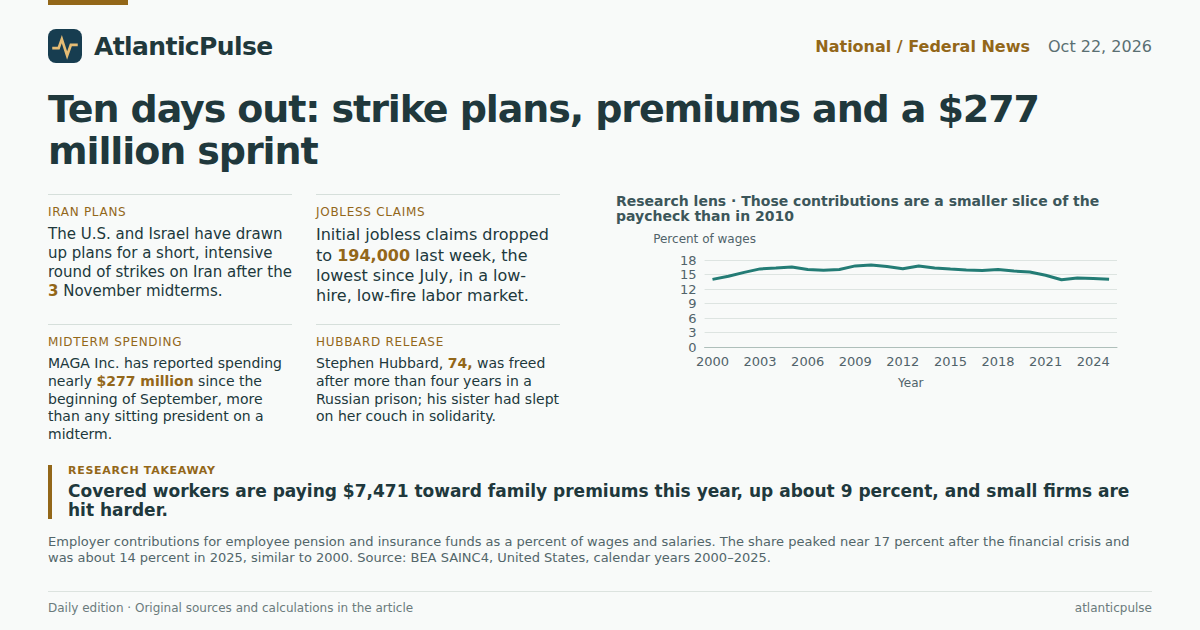
If your job is safe, your health plan is not. KFF’s 2026 Employer Health Benefits Survey found that workers on employer coverage are paying, on average, $7,471 toward family premiums this year, up about 9 per cent, or $621, from last year. At small firms of 10 to 99 workers, the employee share averages $9,687, versus $6,840 at companies with 200 or more staff; a third of covered workers at small firms pay more than half the family premium. Almost 157 million Americans under retirement age rely on this coverage, which is a polite way of saying the midterm “affordability” argument is not an abstraction. An AP-NORC poll in October found about seven in ten registered voters calling health care one of the most important issues in this election. Jenna Caligaris, who manages a 25-person contractor in upstate New York, told the AP that her firm is eating a 25 per cent premium increase this year by stretching the life of trucks, shrinking bonuses and cancelling the company picnic. That is not a metaphor. They actually cancelled the picnic.
Technology & Industry
Elon Musk would like to merge Tesla and SpaceX while the White House is still friendly, which is the sort of timetable that makes antitrust lawyers reach for a larger coffee. Bloomberg, citing people familiar with the matter, says backers are pushing to announce a combination in the first half of 2027 so it can close during the Trump administration. The combined market value would be around $3.7 trillion — the largest corporate transaction ever attempted, if it happens. Musk called the idea a “good idea,” said he would recuse himself, and left special committees to argue over terms that do not yet exist. He controls more than 80 per cent of SpaceX’s voting power but only about 20 per cent of Tesla, which is the harder shareholder vote. JPMorgan has already flagged the obvious collision: SpaceX’s defence contracts and Tesla’s large China manufacturing footprint. Tesla’s own quarter did not exactly scream spare cash. Profit attributable to common shareholders was $787 million, down 29 per cent from a year earlier, even as adjusted earnings beat estimates; automotive revenue fell 3 per cent and capital expenditure nearly doubled to $3.73 billion as the company pours money into AI, robotaxis and the Optimus robot.
Meta, meanwhile, managed to beat Wall Street and get fined in the same news cycle. Third-quarter revenue came in at $64.60 billion, up 26 per cent and above forecasts, with fourth-quarter guidance of $73 billion to $76 billion and annual investment now pegged at $135 billion to $145 billion, mostly for the data centres that train Muse, the company’s personal AI assistant. Hours from that victory lap, a Santa Fe district judge ordered Meta to pay $25 billion — the largest fine ever against the company — after a September jury found it had deceived Facebook users about privacy. Judge Francis J. Mathew wrote that “Facebook promised users that they (the users) controlled their data. This was false.” Meta’s chief legal officer called the case an attempt to “impose a tax on speech” and promised an appeal. The AI buildout is also colliding with the banking system. Major lenders including JPMorgan Chase, Bank of America and Citi are blocking external AI agents from customer accounts, citing fraud, KYC rules and the unnerving possibility that a bot might sweep low-yield deposits into higher-yielding funds. Jamie Dimon has said JPMorgan will not let outside agents operate on customers’ behalf. It is a rare case of Wall Street telling Silicon Valley to keep its hands in its pockets.
Politics & Policy
With ten days to the midterms, MAGA Inc. has reported spending nearly $277 million since the beginning of September, including $200 million transferred to No Going Back PAC and $25 million to Safety & Affordability PAC. Strategist Corry Bliss called it more than any sitting president has ever spent on a midterm, “by far.” The groups still had more than $164 million in the bank as of 14 October, and Trump has said he plans to spend “over 400 Million Dollars by Election Day.” One catch: they waited so late that ad rates are sometimes more than five times what earlier bookings would have cost. Voters, inconveniently, do not appear to want a referendum on the spender. An AP-NORC poll of 1,119 adults, conducted 8–12 October, found about eight in ten registered voters saying the next Congress should make lowering the cost of living one of its highest priorities, and roughly seven in ten saying the same about ending the war with Iran. Only about four in ten prioritise investigating Trump; only about two in ten want Congress to prioritise supporting his agenda. Even among Republican voters, only about four in ten put the president’s agenda at the top.
The legal fight over who counts as a voter is running in parallel. Democratic leaders including Chuck Schumer and Hakeem Jeffries sued the administration and the Justice Department, accusing them of unlawfully pressing states to purge suspected noncitizens from the rolls and threatening election officials with prosecution. The complaint cites a 13 October DOJ demand that California withhold or set aside ballots from more than 20,000 registered voters. A federal judge, Araceli Martínez-Olguín, separately ordered Homeland Security to stop certain field investigations in nine states, finding that the department’s lists “inadvertently include U.S. citizens.” The order does not take effect until Friday afternoon, giving the administration time to appeal, and is set to last until after the election. Elsewhere, AIPAC said it will no longer endorse candidates or make direct PAC contributions, citing “challenges” that “will continue to grow,” while still mobilising individual donors. And in a quieter win for public servants, the Justice Department dropped two appeals defending a rewrite of Public Service Loan Forgiveness that would have let Education Secretary Linda McMahon eject employers for a “substantial illegal purpose.” Judges had already blocked the rule. The administration offered no explanation, which is one way to concede.
Human Stories / Social Trends
Stephen Hubbard’s younger sister, Patricia Hubbard Fox, was driving to Denver’s airport when she told the Associated Press that her brother had been laughing on the phone. “He said, ‘I can’t believe this is happening.’” Hubbard, 74, a retired teacher and Air Force veteran, had been held in Russia for more than four years after being accused of fighting as a mercenary in Ukraine — a charge his family and lawyers dispute. She said he suffered beatings and starvation, now has an enlarged heart, and “really thought he was going to die in prison.” For four years she slept on her couch in solidarity, “because I figured he didn’t have a bed.” He is expected to live with her in Colorado. Trump presents the release as a favour extracted with no swap. Hubbard Fox still called Putin “as evil as they come.” Both things can be in the same family conversation.
The affordability argument that dominates the polls has a more ordinary face in Caligaris’s shop: 25 workers, a 25 per cent insurance hike, and no picnic. Covered workers at smaller firms contribute an average of 37 per cent of the family premium, versus 25 per cent at larger companies. That is the sort of number that does not trend on social media and still decides whether a contractor keeps a welder. And then there is the elk. The USDA confirmed the first detection of New World screwworm in US wildlife, in a Texas elk harvested by a hunter on a game ranch. The parasitic fly enters open wounds and feeds on living tissue; officials are expanding surveillance and asking hunters to report suspicious cases. After months of wars, mergers and voter-roll lawsuits, the federal government is, quite literally, worried about flesh-eating flies in Texas. Midterms are like that: the ballot is national, the infestations are local, and everyone is being asked to watch for signs.
This daily edition uses stored reporting scoped by publication date, or arrival when publication was absent. Source collection can lag publication.