National / Federal News
A Shut Strait, a Midterm Sprint, and a Very Dear Autumn
World & Security
Steve Witkoff landed in St. Petersburg on Wednesday with a peace brief, a diesel thank-you, and the sort of itinerary that makes European allies check the calendar twice. A day after Oslo talks that a U.S. official called constructive, President Donald Trump’s envoy sat down with Vladimir Putin at the Constantine Palace as Trump told reporters it was time for Ukraine to settle because “Russia is a big machine.” Kyiv’s immediate consolation prize was practical rather than poetic: Volodymyr Zelenskyy said early-warning intelligence on incoming Russian missiles was working again after a week without it, following a call with Secretary of State Marco Rubio. Rubio denied any deliberate pause. Pentagon officials, for their part, insisted they had not throttled Starlink and had not changed Ukraine policy, even as Patriot interceptors sat unapproved and Elon Musk’s satellite service became a blame-shifting exercise worthy of a custody hearing.
The Kremlin later said Putin had agreed “in principle” to resume three-way talks with Washington and Kyiv after November 10, while dismissing Oslo’s paper as containing “little of real value.” Russia also freed Stephen Hubbard, a 74-year-old American teacher imprisoned on mercenary charges, which Witkoff treated as a goodwill gesture and Trump treated as proof that talking to Moscow beats swapping. Overnight, Russian strikes still killed civilians in Kyiv and Kharkiv. Diplomacy, in other words, has rediscovered its old hobby: announcing momentum while the air-raid sirens keep their own schedule.
South of that file, the other war is still priced into every gallon. Iranian Foreign Minister Abbas Araghchi said the Strait of Hormuz stays closed unless Washington accepts Tehran’s seven-day reopening plan, while security chief Mohsen Rezaei vowed that “not a single gram” of enriched uranium would leave the country. Brent traded around $109.64 a barrel as Iran’s Revolutionary Guards claimed a mined supertanker, and the United States prepared a third carrier strike group and about 10,000 additional personnel for the region. A Financial Times account said Israel had readied a multi-day air campaign for October 10–11 until Trump blocked it until after the November 3 midterms. Non-emergency U.S. diplomats and families were ordered out of Saudi Arabia as Houthi strikes intensified. The White House would like voters to notice the prisoner and not the strait. Markets, inconveniently, can see both.
Markets & Economy
The Bureau of Labor Statistics has a way of ruining a campaign slogan. U.S. import prices jumped 8.1% in the year to September, the largest annual rise since July 2022, and 1.1% on the month against a 0.8% forecast. Imported fuel rebounded 4.8%; prices excluding food and fuel were still up 6.2% over twelve months. The index does not include tariffs, which is the statistical equivalent of weighing yourself without the overcoat and then wondering why the hallway feels drafty. The Federal Reserve’s last move was a quarter-point increase, to a 3.75%–4.00% target range, and markets were still betting on a hold in October even as core PCE looked set to print near 3.1%. Christopher Rupkey of FWDBONDS put it without much poetry: Americans, he said, “have to reach in their pocketbooks and pay a little bit more for the same goods.”
Fiscal arithmetic is not being any kinder. Treasury data put total public debt at about $40.42 trillion at the end of September, nearly $400 billion above the $40 trillion mark crossed in late August. Interest is now a line item that crowds the rest of the budget like an uninvited relative at Thanksgiving. In New England the political weather is measured in heating oil: Maine’s average sat at $5.97 a gallon, still about 80% above a year earlier, and the Energy Department agreed to release roughly 315,000 barrels — a third of the Northeast stockpile, and only the second tap in 26 years. USDA, two weeks before the vote, rolled out an $8 billion Harvest Fuel Relief program as national diesel topped $6 a gallon. Farm groups said thanks, then asked, not unreasonably, for a farm bill that lasts longer than a rally.
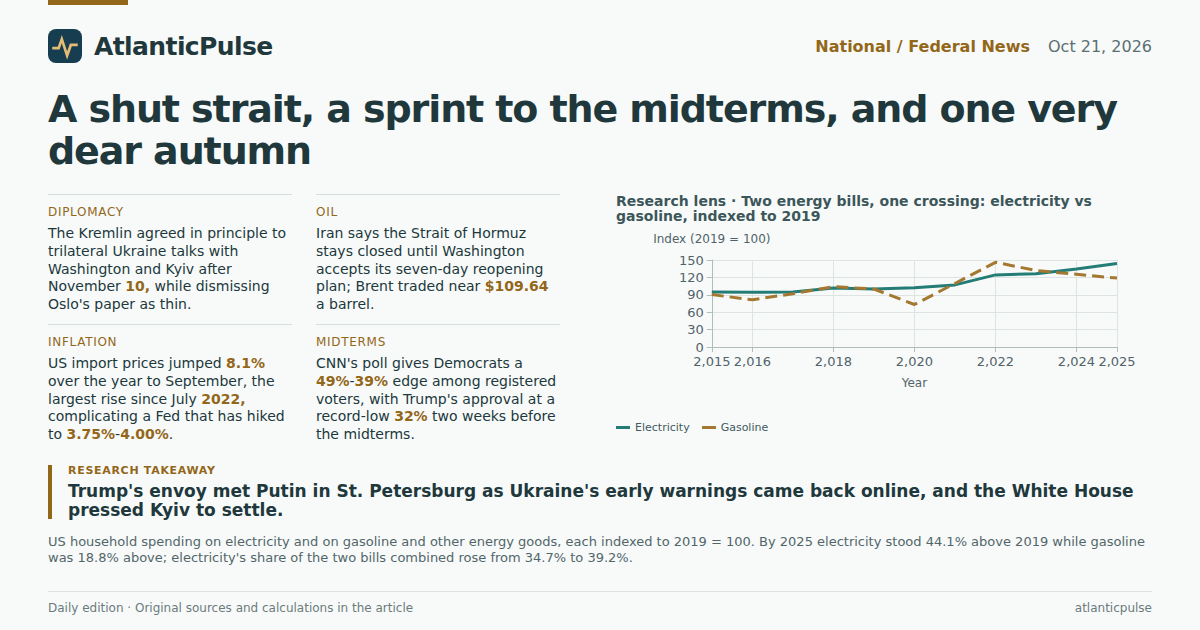
Elsewhere, Marco Rubio told Mumbai he was “as close as you can be” to an India trade deal without actually having one, and invited Indian refiners to process more Venezuelan crude while Hormuz stays jammed. Households, meanwhile, are doing the unglamorous version of energy policy. A Consumer Reports survey of more than 2,000 adults found about one in five had cut groceries to pay the power bill, and about 80% said electricity costs had risen over three years in the same home. Schneider Electric’s forecast of 16% demand growth by 2029, driven largely by data centers, is the sort of chart that makes a thermostat feel like a ballot. The administration is shopping for diesel from Russia, heating oil from the reserve, and patience from voters. Only one of those is in surplus.
Technology & Industry
Elon Musk’s public company that is not Tesla had a quarter that would make a rocketry brochure blush. SpaceX reported $14.58 billion in third-quarter revenue, up 161% from a year earlier, with net income of $4.4 billion after a $1.05 billion loss. Starlink, not the rockets, still pays the bills: 13.6 million subscribers and $5.25 billion in connectivity sales, $2.37 billion of that as operating profit. The AI unit chipped in $431 million of operating profit and, because this is 2026, a $60 billion acquisition of the coding startup Cursor. Musk said combining SpaceX and Tesla was “a good idea,” independent committees will study it, and Tesla would need 50% of all outstanding shares, not merely of those who bother to vote — a hurdle designed, apparently, to keep lawyers in ski chalets. He also sketched annual recurring revenue of $500 billion to $1 trillion by late 2027. Wall Street’s more earthbound crowd is closer to $110 billion. Both numbers are large. Only one has to survive contact with a 10-K.
Washington’s other AI story is less about launch cadence than about who is allowed to run the models. Homeland Security ordered civilian federal agencies to purge DeepSeek products within 60 days, citing Chinese data access, possible fingerprinting, and a 2025 leak of more than a million log entries. The ban reaches third-party tools built on DeepSeek, which is how supply-chain rules sneak into procurement memos. Anthropic, racing toward a possible IPO, showed in a draft filing first-half revenue of $16.3 billion and an $80.7 billion net loss driven largely by accounting adjustments, with nearly $9 billion in computing costs and potential future compute commitments that could reach $750 billion. That is not a business so much as a utility bill with a research department.
The political class has noticed that the buildings drawing that power are not universally beloved. Trump argued on Truth Social that data-center developers should pay communities a “dividend” and generate their own electricity, a conversion from boosterism to revenue-sharing that arrives just as local fights over water, watts, and property values go national. Anthropic has floated putting 5% of equity into a public-benefit fund; Musk countered with a SpaceX share for every American child. It is almost touching, this sudden interest in spreading the gains, arriving at the precise moment the neighbors started bringing pitchforks to zoning hearings.
Politics & Policy
A CNN poll conducted by SSRS from October 15–18 gives Democrats a 49% to 39% edge among registered voters in their own districts, the firm’s widest such gap since just before the 2020 election. Trump’s approval is 32%, a record low in that series and seven points weaker than on the eve of 2018; only 13% strongly approve. About six in ten voters say their midterm ballot is a message about him, and that message runs two-to-one against. The economy is the millstone: 27% approve of his handling of it, 23% of inflation, and two-thirds — including roughly a third of Republicans — say his policies have made conditions worse. Among White adults without college degrees, a group that used to be the load-bearing wall of his coalition, approval is 45%. The catch, because there is always a catch, is that 41% think the country would be better off if Democrats won Congress and 22% think it would not matter. Redistricting and a map full of Trump-friendly districts may yet turn a wave into weather.
The State Department, unburdened by such ambiguity, said the administration had revoked more than 300,000 visas since January 2025, up from more than 175,000 as of August 10. Spokesman Tommy Pigott called it the fastest clip in history and promised “zero tolerance” for visa holders who break the law, commit fraud, or undermine national security. Rights groups point to revocations over Gaza protests and social-media posts. Justice Elena Kagan, speaking at Catholic University, offered a different diagnosis of the season: the Court’s recent work on gerrymandering, campaign finance, and the Voting Rights Act had, she said, “created a democracy that does not work as well as it should.” She did grant that the justices had pushed back on National Guard deployments and mail-in voting limits — proof, perhaps, that a conservative Court can still disappoint a conservative president, which is not the same as reassuring anyone else.
The Court also declined, in a brief unsigned order, to let the Bureau of Prisons enforce a new rule that would have ended hormone therapy and related accommodations for transgender inmates. Justices Samuel Alito and Clarence Thomas would have granted the stay. It is a rare on-the-record loss for the administration in a term that has otherwise been generous, and it lands two weeks before an election in which the justices are, depending on the voter, either a last firewall or the problem Kagan described. Campaigns will spend the remaining days arguing about ballots, borders, and whether a 10-point generic ballot is a forecast or a dare.
Human Stories / Social Trends
Ask Americans how the year feels and they will not quote the import-price index. They will tell you they postponed the car, the move, or the holiday. A SoFi survey of 523 adults in June found 85% saying daily life is more expensive than five years ago and 77% reporting that money had delayed a specific life event; among postponers, 41% delayed a car and 40% a vacation. Housing-related costs were the single biggest recent burden for 38%. The Consumer Reports electricity findings sit beside that ledger: when the lights are non-negotiable, dinner becomes the shock absorber. It is a grimly efficient form of budgeting, and it does not show up neatly in a presidential podium graphic.
Childcare is the line item that turns a household spreadsheet into a voting booth. Child Care Aware of America puts the U.S. average for full-time care above $13,000 in 2025, with costs outrunning inflation from 2020 to 2024. About three-quarters of adults in a June 2025 AP-NORC poll called the expense a “major problem.” In Pennsylvania’s Seventh District, Jenny Escolastico, an Air Force veteran who backed Trump in 2024, said she stays home because “childcare is another rent, another car note.” Both parties are talking about the issue; Trump, who once promised tariff revenue would solve it, more recently told an Easter luncheon, “We’re fighting wars. We can’t take care of daycare.” A political action committee backing bigger care investments says it has spent $60 million this cycle. That is a lot of mailers. It is still less than a year of daycare in too many ZIP codes.
Public health is having its own expensive autumn. Pennsylvania’s measles outbreak, under way since April, is the largest and deadliest in more than 30 years: about 1,300 reported cases, five measles-associated deaths, and a sixth under review. Two of the dead were infants too young for the MMR vaccine. Roughly two-thirds of cases are in adults, many unvaccinated, including in Amish and other Plain communities that had gone decades without exposure. The state health secretary has publicly pressed the CDC to count all five deaths on its dashboard. A CDC disease detective is now in Pennsylvania to measure an outbreak that official tallies almost certainly understate. It is a reminder, in a campaign season obsessed with prices, that some costs still arrive as fevers rather than invoices.
This daily edition uses stored reporting scoped by publication date, or arrival when publication was absent. Source collection can lag publication.