National / Federal News
Diesel Cheques, Delayed Patriots and a 31 Percent Problem
World & Security
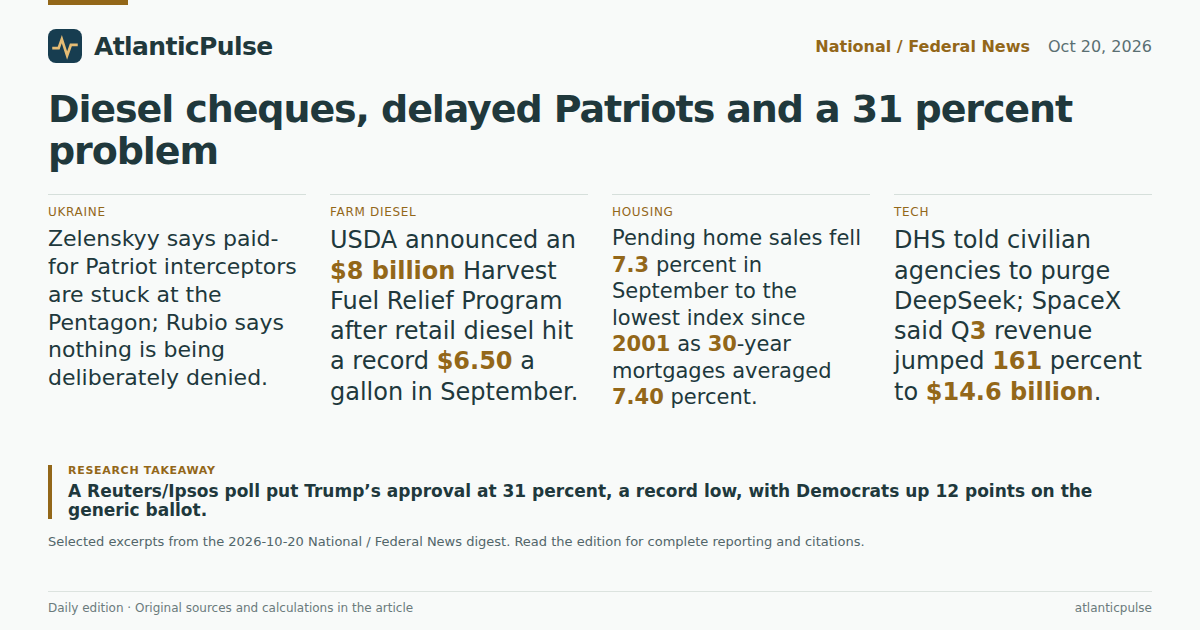
The U.S.-Ukraine alliance is, as a former ambassador put it, looking “blacker than they ever had.” President Donald Trump spent the week insulting Volodymyr Zelenskyy, waiving new Russia sanctions Congress had just passed, and telling reporters it might be “time for somebody else to negotiate on behalf of Ukraine”—including, apparently, at a proposed sit-down with Vladimir Putin and Xi Jinping that would not include Kyiv. Zelenskyy, briefing U.S. senators, said the Pentagon is sitting on Patriot interceptors European partners have already paid for, that Starlink and Starshield speeds are throttled, and that Ukraine again got no early warning before a Russian ballistic strike. A drone attack on a Kharkiv-region park killed six people, including a mother and her one-year-old.
Secretary of State Marco Rubio, speaking from India, called reports of a cutoff “outrageous” and insisted there is “nothing being deliberately denied.” The catch, he added, is that Saudi Arabia, Israel and the United States also want interceptors after months of war with Iran. Trump’s envoy Steve Witkoff was headed to Oslo and then, tentatively, to see Putin. Trump recast Putin’s three-way idea as a “denuclearization” chat—a worthy topic, perhaps, given that New START expired in February—though Ukrainian officials noted that leaving them out of talks about their own country is not how wars usually end.
Defense Secretary Pete Hegseth, meanwhile, made an unannounced stop in Israel to discuss Iran with Benjamin Netanyahu, a day after Trump offered the Israeli prime minister his “complete and total” support ahead of next week’s election. Vice President JD Vance, asked whether he would pile on, declined with the care of a man who has seen a poll. Rubio, in Mumbai, said an India trade deal is “very, very close”—as close as you can be without actually signing it, which is the diplomatic equivalent of standing in the doorway with the car running.
Markets & Economy
If you cannot lower the price of diesel, you can always write a cheque for it. At a Kansas rally, Trump announced an $8 billion USDA “Harvest Fuel Relief Program” to offset farm diesel costs, funded through the Commodity Credit Corporation and modelled on an earlier $12 billion Farmer Bridge Assistance payout. Retail diesel hit a record $6.50 a gallon in September after the U.S.-Iran conflict squeezed the Strait of Hormuz; more than 64 percent of the soybean crop was already in. Commodity-specific rates come next month. Specialty-crop growers and fishermen were invited to email their pain to [email protected], which is at least more honest than pretending the Strait will reopen because of a press release.
The housing market is not waiting for November. Single-family starts fell 4.6 percent in September to an 859,000 annual rate and permits dropped 4.0 percent to 845,000, as the 30-year mortgage averaged 7.40 percent—the highest in nearly three years. Pending sales of existing homes plunged 7.3 percent to an index of 66.0, the lowest since the series began in 2001 and 11.3 percent below a year earlier. Homebuilder sentiment hit its worst reading since June 2012. Trump called a bipartisan housing bill “a big yawn.” The market, unimpressed, yawned back.
Importers are heading to court. The Liberty Justice Center filed the first lawsuit against Trump’s Section 338 tariffs on Canadian goods, on behalf of a cheese importer, arguing that a dusty Smoot-Hawley provision has been superseded, does not apply, and would in any case be an unconstitutional blank cheque. Section 338 had never been used. Cheese, it turns out, is how constitutional law happens.
Technology & Industry
The Department of Homeland Security told federal civilian agencies to purge DeepSeek and anything “developed using” it—a phrase so broad that security researchers noted it could theoretically cover software whose authors once asked a Chinese chatbot to debug a loop. Pentagon networks already blocked the models. Beijing called the move an “overstretching of the concept of national security.” The order dates to late July and was published this week, which is either bureaucratic lag or a gift to American model-makers hoping to go public without cheap open-weight competition in government contracts.
SpaceX, reporting as a public company, said third-quarter revenue jumped 161 percent to $14.6 billion. Its “Super Intelligence” computing-lease business brought in $7.56 billion, more than Starlink’s $5.25 billion of connectivity revenue; operating income rebounded to $2.79 billion. Musk, never one to leave a news cycle unmolested, pledged to give one of his SpaceX shares to “every kid in America” next year through Trump Accounts, a programme the White House says has already taken in more than $4.5 billion since July 4. Census-based estimates put the gift around $10.5 billion, assuming a lock-up that runs until 2027 actually allows it.
OpenAI is racing to close a roughly $30 billion round that could value it above $1.4 trillion before Anthropic’s expected mid-November IPO, according to people familiar with the talks. SoftBank and Abu Dhabi’s MGX are among existing backers in discussions. Both labs are chasing overlapping investors while bond yields rise and AI infrastructure debt makes even friendly funds nervous. Completing the MAX family, the FAA certified Boeing’s 737-10, a jet that can seat up to 230 passengers, with more than 1,550 orders—the first commercial aircraft fully certified under the 2020 safety law. Not every American industrial story this week required a chatbot.
Politics & Policy
A Reuters/Ipsos poll that closed Monday put Trump’s approval at 31 percent, a record low in either term, with Democrats leading the generic congressional ballot 47 percent to 35 percent—a 12-point gap, the widest this cycle. Some 68 percent disapprove of his handling of the economy, including 37 percent of self-identified Republicans. The survey of 1,679 adults, including 1,279 registered voters, has a margin of error of two to three points. Democrats need a net gain of four seats in each chamber to flip the House’s 218-214 and the Senate’s 53-47 Republican majorities. Structural advantages still matter. Gasoline prices also still matter.
Trump campaigned in Kansas for Senator Roger Marshall, warning that if Democrats win the country will “burn” like France, a claim for which he offered no evidence. France has seen cost-of-living protests turn into riots; Kansas has seen diesel at $5.78 a gallon on the way into the arena. Marshall, in a state that last sent a Democrat to the Senate 94 years ago, is in a surprisingly tight race with Methodist pastor Adam Hamilton. Trump is in a 32-day blitz through places he already won, which is one way to spend October when internal polling on rural men under 55 is not cooperating.
At the White House, Trump and Vance unveiled a $25 million Fraud Whistleblower Incentive Program, with tips to fraud.gov theoretically worth up to $30,000—though Trump said he personally would “be the arbitrator of all of these decisions.” He presented a $10,000 cheque to right-wing influencer Nick Shirley. The State Department said it has revoked more than 300,000 visas this term, up from 175,000 in August. The Justice Department charged 28 California green-card holders with illegal registration and voting under “Operation Protect the Vote,” 15 days before Election Day. Vance, keeping his powder dry, would not endorse Netanyahu.
Human Stories / Social Trends
American scientists are packing. Marine researcher Halley Froehlich left UC Santa Barbara for five years of guaranteed funding in Helsinki. A NOAA scientist who was asked to strip climate language from websites left for Birmingham. Immigrant biologists at UC Davis decamped to Australia. The Association of American Universities says vice presidents for research can name “one or two top faculty” already gone. Trackers put frozen or cut federal grants at up to $174 billion this term; major research institutions accepted 15 percent fewer fall 2026 doctoral applicants. The White House says it is “ending waste” and “funding real science.” Finland, at least, is funding Froehlich.
Emiliano Andrade-Covarrubias, 56, a lawful permanent resident who painted apartments in Dallas, died in ICE custody at the Rio Grande Processing Center after four months detained over an alleged 2004 theft he did not disclose—his daughter says he did disclose it, and still got the green card. He is the seventh person to die in ICE detention in Texas this year. In Long Beach, videos showed U.S. citizen Ricardo Gonzalez pinned in the street during an ICE operation; his family said his arm was broken, and neighbours blocked vehicles with rubbish bins. The Supreme Court in June made it easier to stop green-card holders at the border over old arrests. “Immigration limbo,” Justice Ketanji Brown Jackson warned, is now easier to impose.
Melania Trump stood beside an executive order creating a Women’s Health Division at NIH and a White House task force—no specific funding attached, and it rescinds a Biden initiative the outgoing administration said had attracted nearly $1 billion. “Who the hell wouldn’t have a women’s health division?” the president asked, a fair question given that NIH has had an Office of Research on Women’s Health since 1990. Combined with Musk’s promised SpaceX shares for children, the week’s official human-interest offerings were science talent leaving, detainees dying, and equity in a rocket company for kids who cannot vote. The midterms, inconveniently, are for people who can.
This daily edition uses stored reporting scoped by publication date, or arrival when publication was absent. Source collection can lag publication.