National / Federal News
Peace without Kyiv, prices without pity
World & Security
The Wall Street Journal’s exclusive has the geometry of a peace conference and the guest list of a heist: Vladimir Putin has proposed a November summit with Donald Trump and Xi Jinping to talk Ukraine, preferably on the sidelines of APEC in Shenzhen, and preferably without Volodymyr Zelensky. The pitch, the paper reported, arrived on the same 9 October call that produced a diesel-export understanding. Trump spent Sunday defending his hold on new Russia sanctions so as not to “foolishly drive Russia away from the negotiating table,” while accusing Zelensky of hitting Russian refineries that, in the president’s telling, are making American farmers miserable. Kyiv’s version is less cinematic. Zelensky told NBC that intelligence-sharing had been interrupted and then “de-blocked,” but that a diesel import deal and a sanctions waiver due this week would hurt Ukraine. Asked whether Washington views Kyiv as an ally, Treasury Secretary Scott Bessent talked about negotiated settlement instead.
The hardware of that partnership is having a similarly bad week. Ukrainian forces say Starshield terminals drop their link above about 100 mph—awkward, given that Russia’s jet-powered Shaheds can fly more than twice as fast. Elon Musk says the U.S. government owns the knobs; Marco Rubio says nobody in the White House ordered a slowdown; Trump says it wasn’t him and he doesn’t think it was Elon. Somewhere a Pentagon lawyer is updating the definition of “not me.” The shooting war with Iran, meanwhile, continues to snarl the world’s oil tap. The UN’s maritime chief says about 6,000 seafarers remain trapped near the Strait of Hormuz, with 100 confirmed maritime incidents and 24 seafarers killed since late February. Iran still offers a seven-day reopening; Washington is still enforcing a naval blockade.
Trump found time, eight days before Israel’s 27 October election, to offer Benjamin Netanyahu a “Complete and Total Endorsement” as a “Great Warrior Prime Minister” against Iran—an alliance that has lately included public scolding, a reported “f-cking crazy” phone call, and a TIME interview in which Trump declined to say Israelis should give Bibi another term. Rubio is working a different map: close to a trade deal with India ahead of talks in Mumbai, and C5+1 pomp in Samarkand. If the great powers are carving the world into zones, at least the itinerary is keeping the State Department busy.
Markets & Economy
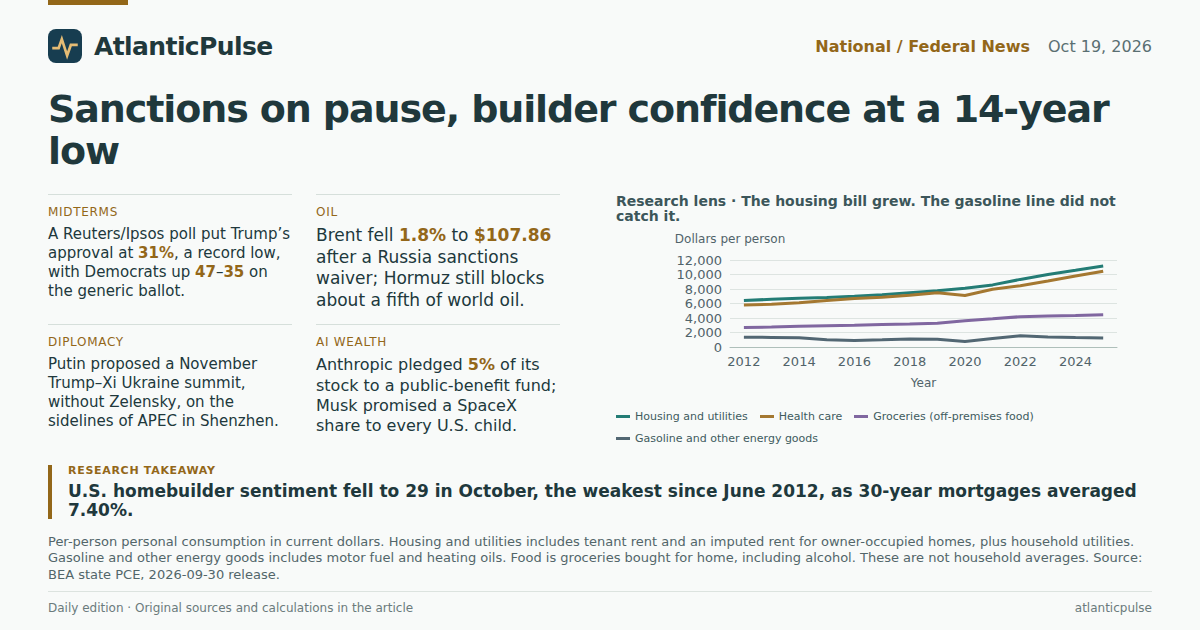
Oil traders did what they do when Washington waves a white flag at Moscow and the Gulf is still on fire: they sold a little and kept the price ugly. December Brent fell 1.8% to $107.86 and WTI 1.7% to $97.37 on Monday after Trump waived new Russia sanctions and tariffs that were about to bite, plus proposed tariffs on countries that buy Russian oil. Earlier sanctions remain. Morgan Stanley still sees Gulf-plus-Russia supplies 5.5 million barrels a day below last year and has lifted its fourth-quarter Dated Brent forecast to $105. Iran says its Hormuz offer is still on the table; the strait’s closure has blocked roughly a fifth of world oil. A “correction” after last week’s nearly 5% jump is a polite word for still-painful petrol.
Housing is not offering a discount either, unless you count the ones builders are already eating. The NAHB/Wells Fargo Housing Market Index dropped to 29 in October, the weakest since June 2012, as 30-year mortgages averaged 7.40%—highest in nearly three years—and tariffs, diesel, and immigration enforcement squeezed crews. More than a third of builders reported ICE activity in their markets last month. Forty-three percent are cutting prices, the highest share of the 2020–2026 stretch, and buyer traffic is the worst since April 2012 outside the pandemic. Trump earlier this year called a bipartisan housing bill “a big yawn.” Builders staring at unsold inventory may have a different word.
The bond market is developing its own vocabulary. Moody’s chief economist Mark Zandi says the national debt, now more than $40 trillion, is flashing early signs of a “vicious cycle”: a $2 trillion deficit for the fiscal year ending in October, more than half of it interest, a 126% debt-to-GDP ratio, and a 10-year yield up about a percentage point this year. Bessent argues U.S. yields are not “idiosyncratic.” Zandi’s reply, roughly: Treasuries are the global benchmark, so idiosyncrasy is a luxury. Rubio’s almost-done India deal is the one cheerful commercial note, assuming anyone can still hear it over the mortgage rate.
Technology & Industry
Silicon Valley spent Monday competing to look generous. Anthropic committed 5% of its stock to a new Public Benefit Fund ahead of a possible November IPO, saying combined pledges now put roughly 20% of shares toward the “public good,” with labour-market shocks among the uses contemplated. Elon Musk, never one to let a rival’s press release go unanswered, promised one of his SpaceX shares to every American child next year—“the first of many”—a giveaway that, at Friday’s close of about $146 and some 73 million people under 18, could notionally run to $10.7 billion. He has not said how the shares would be delivered, who qualifies, or whether parents get the sell button. Direct-to-kid capitalism versus a foundation with a mission statement: choose your utopia.
Washington chose a colder posture toward Chinese AI. A Homeland Security exclusion order, signed in July and only now public, bars DeepSeek from civilian federal systems and government contracts under a 2018 supply-chain law. NASA, the Pentagon, Commerce, the Navy and the House had already blocked the app on devices; this one reaches procurement itself, without putting DeepSeek on the Entity List that would pinch private-sector chips and cloud. The commercial product keeps getting cheaper. The security verdict keeps getting colder.
Politics & Policy
The polls are doing what polls do when petrol is a “very serious problem” and midterms are two weeks out: they are unkind. A Reuters/Ipsos survey closing Monday put Trump’s approval at 31%, a record low for either term, with registered voters preferring Democrats 47% to 35% on the generic congressional ballot. An NBC News poll of more than 19,000 adults had him at 34% approve and 66% disapprove, 71% saying the country is on the wrong track, and only 27% approving of his handling of the cost of living. Neither party is beloved; both are simply less radioactive than the man on the ticket.
The Justice Department, undeterred, is campaigning in its own way. Prosecutors charged 28 foreign nationals in California—green-card holders, not citizens—with election-related offences, with 11 in custody, and asked a court to set aside more than 20,000 flagged mail ballots. The state attorney general’s office noted that 28 people are about 0.0001% of California’s 23 million registered voters. Barack Obama called the search of Rep. Ilhan Omar’s home “appalling,” a hunt for a “nonexistent smoking gun from 20 years ago.” Omar has not been charged; Trump said the search had “nothing to do with me.”
In the Rose Garden, the administration tried a softer register. Trump signed an order, pushed by Melania Trump, creating an NIH women’s health division and a White House task force led by Susie Wiles and Robert F. Kennedy Jr., with no specific funding attached. “Who the hell wouldn’t have a women’s health division?” he asked, after checking that they didn’t. Meanwhile ProPublica reports that DHS political appointees asked CISA to secretly acquire and hack a voting machine and not tell the vendor—career staff said they couldn’t, in part because the relevant agents had been laid off—and that the agency has been largely absent from midterm prep. Arizona’s secretary of state put it without the footnotes: they cut the states off and left them on their own.
Human Stories / Social Trends
The streets had a simpler message than the Rose Garden. A fourth round of No Kings demonstrations filled some 3,000 locations over the weekend, this time as get-out-the-vote drives, complete with marches to drop boxes. Organisers cited a Brennan Centre tally of restrictive voting laws in at least 29 states since Trump returned. Meta briefly suspended the movement’s Instagram account mid-protest, then blamed a bot-like spike in “reading” behaviour. If democracy is a group project, the algorithm remains an unreliable lab partner.
Laboratories are emptying in a quieter way. Scientists are leaving U.S. posts for Finland, Britain, Australia and China after grant delays, political tests on research, and recruitment offers with multi-year funding. Halley Froehlich packed a climate-and-seafood lab for Helsinki; physics Ph.D. graduates in 2025 left at the highest rate in 30 years. The White House says it is “funding real science.” University research vice-presidents, according to the Association of American Universities, can already name the faculty they have lost.
Then the ordinary hazards of an American Monday: Kayem Foods is recalling about 1.58 million pounds of hot dogs, bacon, deli meats and bratwursts after a warehouse cooler ran warm—no illnesses confirmed, the USDA says throw it out anyway. In North Long Beach, the family of Ricardo Gonzalez, a 40-year-old U.S. citizen and former city worker, says ICE struck him with an unmarked vehicle and tased him twice, leaving a broken arm. City police removed the cuffs at a fire station. The mayor wondered about voter intimidation; ICE did not comment. Midterms, it turns out, are also a neighbourhood event.
This daily edition uses stored reporting scoped by publication date, or arrival when publication was absent. Source collection can lag publication.