National / Federal News
A 60-day waiver, two wars, and sixteen days to vote
World & Security
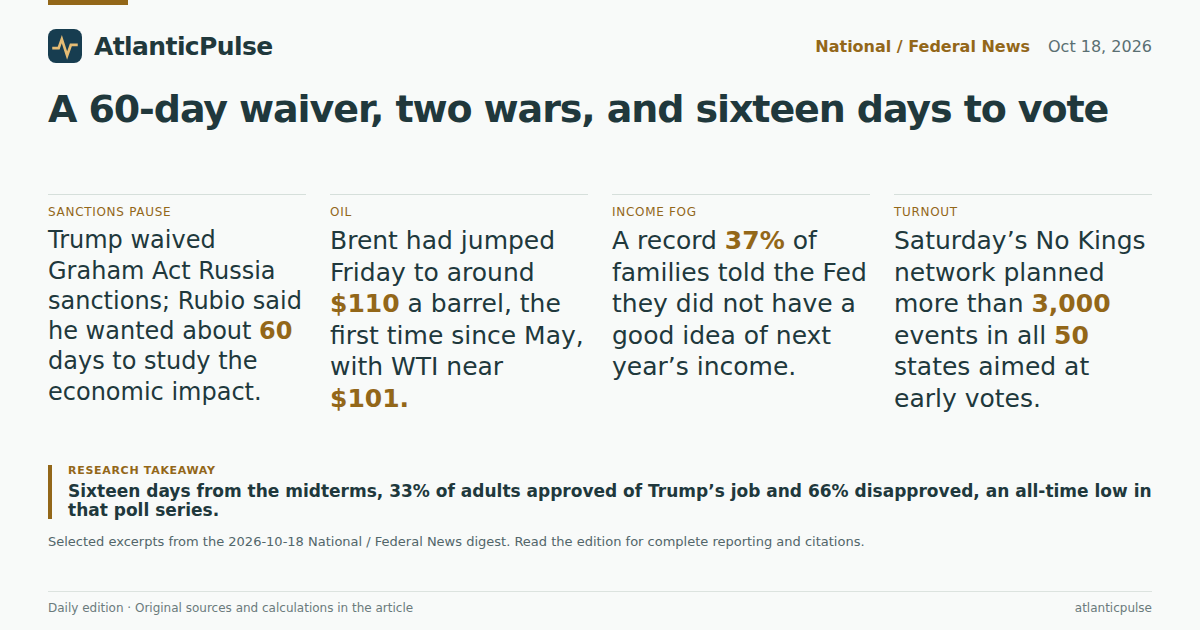
President Donald Trump signed an executive order Friday waiving key Russia-related sanctions and tariffs under the Lindsey Graham Russian Sanctions Act, days before they were due to take effect. The Senate had passed the package 86-11; it authorized tariffs of up to 100% on major buyers of Russian oil. Sen. Thom Tillis, R-N.C., called the pause “beyond irresponsible.” Sen. Ted Cruz said he wished Trump had not done it. Former U.N. Ambassador Nikki Haley called it a “terrible misjudgment of Putin.” Trump’s decision to waive Russian sanctions outrages Congress Secretary of State Marco Rubio, leaving for Central Asia and India, said the president wanted about 60 days to study the economic impact, citing high energy prices and the Iran war. President wants 60 days to analyse impact of Russia sanctions law Trump, asked about an order he had already signed, told reporters they “don’t know what my decision is yet.” Congress is in recess until after Nov. 3, a convenient time to postpone a fight over a law named for a dead colleague.
Ukrainian President Volodymyr Zelenskyy urged supporters to keep the Graham Act alive, writing that undoing it “definitely helps only the Russians.” Trump faces bipartisan backlash over Russia sanctions waiver Kyiv then answered with one of its largest aerial attacks of the war: more than 1,000 drones. Strikes set St. Petersburg’s oil terminal and Ruchi depot ablaze; the city’s governor said one person was killed and five wounded. On NBC’s “Meet the Press,” Zelenskyy said U.S. intelligence sharing had resumed after a pause, and that Russia had attacked Ukraine’s energy sector 76 times in the week after Trump announced an “energy ceasefire.” St Petersburg oil facilities ablaze as Ukraine launches more than 1,000 drones A quieter row continues over satellite internet. Zelenskyy said speed caps that cut connections when a terminal moves faster than 160 kph applied only to Ukraine. Rubio insisted nobody in the White House ordered a Starlink slowdown — “it sort of happened” — and that Ukraine does not have Pentagon-owned Starshield. Rubio: US did not order Starlink slowdown
The other war is still sitting on the world’s oil tap. Iran’s Revolutionary Guard claimed two tankers carrying about four million barrels of crude struck naval mines in the Strait of Hormuz; the claims were not independently verified. Before the conflict, the strait handled about a fifth of global oil consumption. Iran claims two oil tankers hit naval mines Foreign Minister Abbas Araqchi said a seven-day proposal to reopen the waterway remains on the table if Washington lifts its blockade and oil sanctions. Iran urges US to accept proposal to reopen Strait of Hormuz Trump told a Kentucky rally the Iran war would end “very quickly”; U.S. Central Command said American forces had redirected 138 commercial vessels under a blockade of Iranian ports. Trump says Iran war will end ‘very quickly’ He also endorsed Benjamin Netanyahu for Israel’s Oct. 27 election, warning he might not “finish the job” against Iran if Israel chose “anyone other than Bibi.” Trump endorses Netanyahu Closer to the ground, Washington Post photographer Heidi Levine said masked attackers kicked her for at least ten minutes during a West Bank olive harvest. Ambassador Mike Huckabee called it a “despicable act of terror.” US condemns attack on photojournalist Heidi Levine
Markets & Economy
Oil spent the weekend arguing with itself. Brent had jumped Friday to around $110 a barrel for the first time since May, with West Texas Intermediate near $101. Brent has surged about 80% this year; European diesel futures have more than doubled. Rystad Energy’s Jorge Leon said attacks on infrastructure and vessels were “eroding hopes of a sustained recovery in oil flows.” The U.S. said its forces had escorted more than 100 million barrels through Hormuz over the prior week. Brent crude holds near US$110 Then the Russia waiver landed as a competing headline. As futures reopened, prices edged slightly lower on the prospect of more Russian fuel reaching world markets, even as Iranian media reported a tanker explosion after a mine strike. Diesel is the product to watch: attacks on Russian refining have tightened middle distillates. Oil dips as Trump waives Russia energy sanctions Lawmakers introduced a bill to block Trump’s diesel deal with Moscow. They will have to come back from recess to do much about it.
The federal books look less like a household budget and more like a dare. Figures attributed to Treasury data put the fiscal 2026 deficit at $1.99 trillion — about 6.2% of GDP and the largest since 2021 — despite a record $5.4 trillion in revenue. Spending reached $7.4 trillion. Interest on the debt hit a record $1.36 trillion, more than $3.7 billion a day. National debt has now topped $40 trillion. US Posts Record $1.99 Trillion Fiscal 2026 Deficit Against that backdrop, the National Retail Federation still expects November-December holiday sales to rise 4.2% to $1.01 trillion, clearing $1 trillion for the first time, and for retailers to hire 325,000 to 375,000 seasonal workers. The same forecast warns that inflation and gas prices will hit income groups differently. NRF: US Holiday Sales to Pass $1T Mark for First Time It is a very American pairing: a record interest bill upstairs, and a trillion-dollar shopping list downstairs.
Households sound less certain than the holiday models. A record 37% of families told the Federal Reserve they did not have a good idea of next year’s income, a new high in the Survey of Consumer Finances, even as fewer families described recent income as unusually high or low. Between the 2022 and 2025 surveys, unemployment rose from 3.7% to 4.2%, prices rose at an average 3.6% a year, and the share of families behind on loan payments climbed from about 12% to almost 20%. A Record 37% of Americans Say They Have No Idea What Next Year’s Income Will Be More than 10 million Americans used earned-wage or on-demand pay tools as of 2024. An analysis of bank transactions found 96% of direct-to-consumer payday-style advances carried fees or “tips” averaging nearly $208 a year, with an implied APR around 232% for an average loan. The CFPB withdrew a proposal that would have treated those charges as finance charges. 10 million Americans are using advance loan apps Affordability is the midterm’s drumbeat. The apps that paper over it are not free.
Technology & Industry
Local governments have been busy pausing data centers. The buildout has been busier ignoring them. SemiAnalysis mapped more than 300 local moratoriums against the U.S. pipeline and found only about 2.3 gigawatts of roughly 21 GW in moratorium areas likely delayed — three projects, give or take — while 38 GW of U.S. data-center IT capacity is projected for 2027, more than double 2026. Existing permits, short freezes, and land yanked outside city limits keep doing the work protest signs cannot. Texas’s TCEQ pause, ordered by Gov. Greg Abbott, is the exception worth watching. The firm’s line, echoing The Economist, is that moratoriums are “much more bark than bite.” 300-plus local data center bans have only delayed just three US projects Voters have shown up anyway. In Santa Teresa, New Mexico, residents held handmade signs: “Water is for humans, not data centers.” A Memphis county meeting about slowing construction ended in a fistfight. ‘Water is for people!’
Washington’s other AI argument is about who, if anyone, gets to press stop. Anthropic has been lobbying for a safety bill that would let the government block a model only if it posed a risk of $1 billion in damages or of killing or injuring more than 50 people, with a D.C. federal judge making the call. Anthropic’s proposed AI safety bill At least eight states are suing OpenAI under consumer-protection laws, alleging ChatGPT gave dangerous medical advice and harmed children. OpenAI said it has teen safeguards and that teens spend under 15 minutes a day on the product, on average. Eight American States sue OpenAI China’s commerce and science ministries proposed outbound export controls on 23 AI technologies, including models with two trillion or more parameters. An interim registration requirement took effect Oct. 16; open-source and API access are carved out. China Proposes Export Controls on 23 AI Technologies Filings tied to Oracle Health’s legacy Cerner systems put about 19.9 million people’s records in a 2025 cyberattack; Oracle has not separately confirmed the nationwide total. Oracle Health data breach exposes nearly 20 million patients
In grocery aisles, digital price tags and AI-assisted pricing are spreading faster than public trust. Walmart’s CEO wrote that the company prices “the product, not the person.” Lawmakers in at least 30 states have considered bills on algorithmic and personalized pricing, and the FTC has proposed warning firms that hiding the use of personal data to set individualized prices could violate consumer law. Shoppers already accept surge pricing for a car ride. They are less relaxed when the cereal box starts looking back. Consumer apprehension grows as U.S. retailers adopt AI-assisted pricing tools
Politics & Policy
Sixteen days from the Nov. 3 midterms, a Washington Post-ABC News-Ipsos poll conducted Oct. 9-13 found 33% of adults approved of Trump’s job and 66% disapproved, including 52% who strongly disapproved — an all-time low in that series. Economic approval was 28%. Among likely voters, 52% said they would back a Democrat in their House district and 44% a Republican. Trump approval hits record low as midterms near An NBC News Decision Desk poll put Democrats at 55% among registered voters to Republicans’ 44%, with 71% of adults saying the country is on the “wrong track” and 67% calling gas prices a serious problem. Trump’s approval rating hits record low For the first time in more than a decade, the Post-ABC-Ipsos survey found Americans trusted Democrats more than Republicans on the economy. Speaker Mike Johnson said the ground “feels like 2024.” Rep. Jeff Van Drew was blunter: “These are really tough times.”
House Republicans are hearing it in rooms they used to own. GOP voters in a traditionally red Midwestern state blamed “corrupt politicians” and “billionaires” for gas prices. Operatives told CNN that working-class parents are furious about groceries and fuel, and that corruption has become a “two or three issue” even in red seats. Democrats feel good about several GOP incumbents; party super PACs have already cut off two. House Republicans confront voter fury Saturday’s “No Kings” network tried to turn that anger into early votes, with more than 3,000 planned events in all 50 states. Signs at the Lincoln Memorial read “VOTE EARLY.” ‘No Kings’ floods all 50 states The Justice Department sued California over mail ballots from people the federal government labeled “likely” noncitizens and warned local officials that processing suspected noncitizen ballots could mean a criminal investigation. No Kings rallies draw crowds
Former President Barack Obama accused the administration of targeting Rep. Ilhan Omar after federal agents searched her Washington home in a probe of her decades-old naturalization. Obama called it “appalling.” Trump said he had “always found her to be totally crooked, personally,” but that the matter was up to the Justice Department. Obama backs Ilhan Omar Environmental lawyers are staring at last month’s reinterpretation of the Endangered Species Act: destroying habitat would no longer count as “harm,” and “take” would be limited to intentional killing. Nearly two dozen attorneys general have sued. Trump Is Gutting the Endangered Species Act Katie Zacharia, the surprise press secretary, lasted less than a week after a 14-minute briefing and questions about calling herself a lawyer without passing the bar. Trump told her that if he were her, he would reconsider. She did. Embattled White House press secretary Katie Zacharia is leaving
Human Stories / Social Trends
The Fed’s family-finance numbers read like a mood ring stuck on “uneasy.” Recent income has settled back toward what households call normal, yet a record share cannot say what next year will pay. About 70% of families aged 45 to 64 participated in a retirement plan in 2025; among those 55 to 64 with an IRA or defined-contribution plan, mean retirement savings reached $670,200. The personal saving rate was 4.4% in the second quarter of 2026, down from 6.9% in early 2024. A Record 37% of Americans Say They Have No Idea What Next Year’s Income Will Be When the buffer shrinks, the apps fill in. Earned-wage advances and buy-now-pay-later for groceries have become a parallel payday. A 2025 CFPB finding that more than 60% of buy-now-pay-later users held simultaneous loans sits uncomfortably beside products that skip old-fashioned credit checks. 10 million Americans are using advance loan apps The fees look small until they do not.
That same squeeze is showing up in rooms that used to argue about zoning, not server farms. Santa Teresa, Harrisburg, and Memphis are not think-tank slides; they are places where water, power, and noise have become midterm issues that do not fit neatly on a party line. SemiAnalysis can show that local pauses have barely moved the national gigawatt forecast. A family watching a well does not live in that forecast. Digital shelf labels are spreading through grocery aisles for the same reason: they make frequent price changes easy. One web-data firm found about half the U.S. price changes it recorded in 2025 were decreases. Shoppers staring at electronic tags are not required to find that comforting. Consumer apprehension grows as U.S. retailers adopt AI-assisted pricing tools
There were, for once, some smaller mercies on the shelf. The first new chemical sunscreen type in more than 25 years, bemotrizinol or BEMT, is arriving in U.S. stores after FDA approval in June. Dermatologists say it offers broad UVA and UVB protection without the white streaking of many mineral lotions, and that it is a large molecule with minimal skin absorption — unlike oxybenzone, whose approval the FDA recently revoked. It is not a miracle. It is a molecule that does not immediately betray you in a mirror, which in 2026 counts as progress. The first new sunscreen type in 25 years has arrived on US store shelves At the Lincoln Memorial, No Kings crowds still danced in the cold under “VOTE EARLY” signs. The through-line is not subtle. People want a paycheck they can forecast, water that is not spoken for, a price that does not change while they walk the aisle, and a ballot that stays counted. They are being offered algorithms, waivers, and a sixteen-day clock.
This daily edition uses stored reporting scoped by publication date, or arrival when publication was absent. Source collection can lag publication.